The Domestic Divide and the Birth Rate Question

Every few years, the same anxiety resurfaces. Fertility rates are falling. People are marrying later. Women are having fewer children, or none at all. Governments commission reports. Economists debate incentives. Newspapers run op-eds heavy with concern and light on imagination. And then, almost as an aside, a finding appears that feels too small to carry such weight. When men do more unpaid work at home, fertility rates tend to rise. Not intentions. Not aspirations. Actual births.

This is often framed as an interesting correlation, a sociological curiosity. But it should unsettle us far more than it does. Because if this link holds, even partially, it suggests that declining fertility is not simply about money, housing, or childcare costs. It is about how life feels inside a home. Who is stretched thin. Who carries the invisible load? Who gets to remain a person once parenting enters the picture? And perhaps most confronting of all, it suggests that fertility is not falling because people dislike children, but because they dislike the conditions under which children are raised.

The quiet dishonesty of the word “help”
Language matters here because it exposes the problem before the data ever does. We often say men “help” around the house. They help with the cooking. Help with the kids. Help when asked. Help when reminded. Help when it fits around their real responsibilities. But help implies that the work belongs to someone else. You help a neighbour move house. You help a friend during a rough patch. You help with something that is not fundamentally yours.

A home, however, is not a favour. It is a shared responsibility. Or at least, it should be. In many patriarchal societies, including the ones I grew up observing closely in India, the contradiction is sharper still. The house is culturally and often legally the man’s. His name is on the deed. His family name defines the household. And yet the labour of maintaining that house, physically and emotionally, is treated as women’s work. Expected. Endless. Largely unacknowledged. So when a man washes dishes or manages bedtime, it is applauded as a sign of progress. When a woman does the same, it disappears into the background noise of daily life.

This imbalance persists even with education or professional success. I have seen highly qualified women, including doctors, come home from demanding jobs and immediately step into a second shift that includes cooking, caregiving, emotional management, and the care of ageing in-laws. Their husbands, meanwhile, move through domestic life with remarkable lightness, as if the household runs on autopilot. The assumption that education alone dismantles patriarchy collapses very quickly at the kitchen sink.

Why does housework have anything to do with fertility
At first glance, the link between housework and fertility sounds almost absurd. Surely people do not decide to have children based on who loads the washing machine. But that is not the decision being made. The real question couples are asking, often without articulating it, is this: What will my life look like if we have another child?

Not the milestone photos. Not the well-meaning congratulations. The daily reality. Who will wake up at night? Who will remember school forms and vaccination schedules? Who will coordinate childcare? Who will absorb the stress when work deadlines collide with sick days and family obligations?

In households where domestic and caregiving labour is shared more equally, the answer to that question looks difficult but manageable. In households where one partner, usually the woman, is already operating at capacity, another child feels less like joy and more like self-erasure.

This is where the uncomfortable truth needs to be stated plainly. Women will not have more children if having children means losing themselves. Loss of self is not always dramatic. It is cumulative. The steady disappearance of rest. The constant mental scanning of needs. The knowledge that someone else’s comfort depends on your vigilance. If men’s fuller participation at home changes fertility outcomes, it is not because housework is romantic. It is because shared responsibility makes life feel survivable.

The invisible work that shapes everything
One of the most misleading moves in conversations about domestic labour is focusing only on visible chores. Who cooks. Who cleans. Who does school drop-offs. These matter, but they are only the surface.

The heavier burden is cognitive. Knowing what needs to be done before it becomes urgent. Remembering preferences, schedules, social obligations, and emotional fault lines. Anticipating problems before they become crises. Holding the household together not through action, but through attention. Many men participate in chores and still leave this mental load untouched. They wait to be told. They complete tasks without owning outcomes. They perform competence without carrying responsibility.

From the outside, the household looks balanced. From the inside, one person is still running the system. This distinction matters deeply for fertility. Because you can outsource cleaning. You can hire help. You cannot outsource the constant low-level vigilance that drains people over time. When that vigilance rests primarily on women, the prospect of another child feels less like expansion and more like collapse.

Desire, resentment, and the parts we rarely say out loud
There is another layer people are often reluctant to acknowledge. Unequal domestic labour reshapes attraction. Resentment does not create intimacy. Exhaustion does not invite closeness. Feeling like someone’s caretaker does not nourish desire.

When men step fully into domestic responsibility, not as a performance but as ownership, it shifts how women experience the relationship. Not as a manager supervising tasks, but as a partner sharing the weight. This is not about rewarding men with affection for doing basic adult work. That framing trivialises the issue and misses the point. The shift is psychological. It is about no longer being alone inside a shared life. Fertility does not increase because chores are seductive. It increases because equality stabilises relationships.

Where the argument needs discipline
It is important not to overclaim. Some of the most gender-equal societies in the world still have low fertility rates. This tells us immediately that domestic equality alone does not raise fertility. It is one part of a larger system. Time matters. Money matters. Housing matters. Work culture matters.

In Singapore, long working hours collide brutally with family life. The expectation of constant availability leaves little room for caregiving, especially for men. In India, childcare is often informal and heavily reliant on women’s unpaid labour, reinforced by extended family structures that frequently increase, rather than reduce, women’s responsibilities. In both contexts, involved fatherhood is praised in theory and penalised in practice.

If your workplace quietly punishes men for leaving early to care for children, do not act surprised when women decide not to have more children. If your culture celebrates fatherhood rhetorically but undermines it structurally, fertility statistics will reflect that contradiction.

Policy, performance, and what societies actually reward
Governments tend to favour solutions that do not require cultural change. Financial incentives. Tax benefits. One-off bonuses. These help at the margins, but they do not alter the daily texture of life. They do not redistribute time, energy, or responsibility.

Parental leave for fathers is a good example. On paper, it signals progress. In reality, many men take little or none of it, not because they do not care, but because workplaces subtly discourage it. Until caregiving is normalised for men, rather than treated as exceptional or optional, policy will remain performative. Fertility is shaped by what societies reward in practice, not by what they claim to value in speeches.

The harder truths we should not avoid
Any honest conversation about fertility must make space for complexity. Not everyone who wants children can have them. Fertility discussions can be painful. They can reopen grief. This reality should not be used to silence discussion, but it should temper it with care.

It is also true that some women continue to have children in deeply unequal setups. Their choices are shaped by love, hope, culture, and constraint. Acknowledging this does not undermine the argument. It reminds us that people adapt to systems even when those systems are unfair.

And yes, there are men who genuinely want to do more and feel trapped by work expectations or cultural norms. Structural change matters precisely because individual goodwill is not enough.

Responsibility, plainly stated
If declining fertility is treated as a public problem, then domestic labour is a public issue. Not a private quirk of individual marriages. Not a lifestyle choice to be negotiated quietly behind closed doors. Men need to do more unpaid work at home because they are adults who live there. Not because it boosts birth rates. Not because it earns praise. Because fairness is the baseline, not the reward. Housework should not be gendered. Caregiving should not be exceptional. Mental load should not default to one person simply because she has always carried it. And societies that refuse to redistribute care should stop demanding growth from the very people they exhaust.

For couples navigating this in real time
For those living this tension personally, the work does not begin with perfection. It begins with ownership. Who notices when things fall apart. Who plans ahead. Who absorbs anxiety. Who carries responsibility even when no one is watching.

Rebalancing is not about doing more tasks. It is about holding responsibility differently. About moving from “tell me what to do” to “this is mine to manage”. These conversations are rarely comfortable. But neither is burnout. And pretending otherwise only postpones the reckoning.

A mirror, not a crisis
Fertility decline is often framed as a crisis to be solved. It may be more honest to see it as a mirror. A reflection of how societies organise work, care, and value. A signal of what people are willing, and unwilling, to give up. When men step fully into domestic life, fertility sometimes rises not because babies are the goal, but because life feels possible again. And if that possibility depends on equality, then the question is not why fertility is falling.

The question is why we are still surprised.

The Pink Tax: Gender-Based Pricing Discrimination

Today, gender equality is essential because, over the years, it has been found that men and women are both needed for the running of a successful and progressive society. While substantial strides have been made toward bridging the gender gap, some subtle yet significant inequalities persist, one of which is the infamous “Pink Tax.”

What is the Pink Tax? The pink tax refers to the phenomenon where products and services marketed specifically toward women are more expensive than those marketed toward men. This phenomenon is often attributed to gender-based price discrimination, which means that women pay more for everyday items such as personal care products, clothes, toys, and even financial services. However, research shows that the primary cause is women sorting into goods with higher marginal costs. The name “Pink Tax” comes from the traditional association of the colour pink with femininity and its symbolism in gender stereotypes.

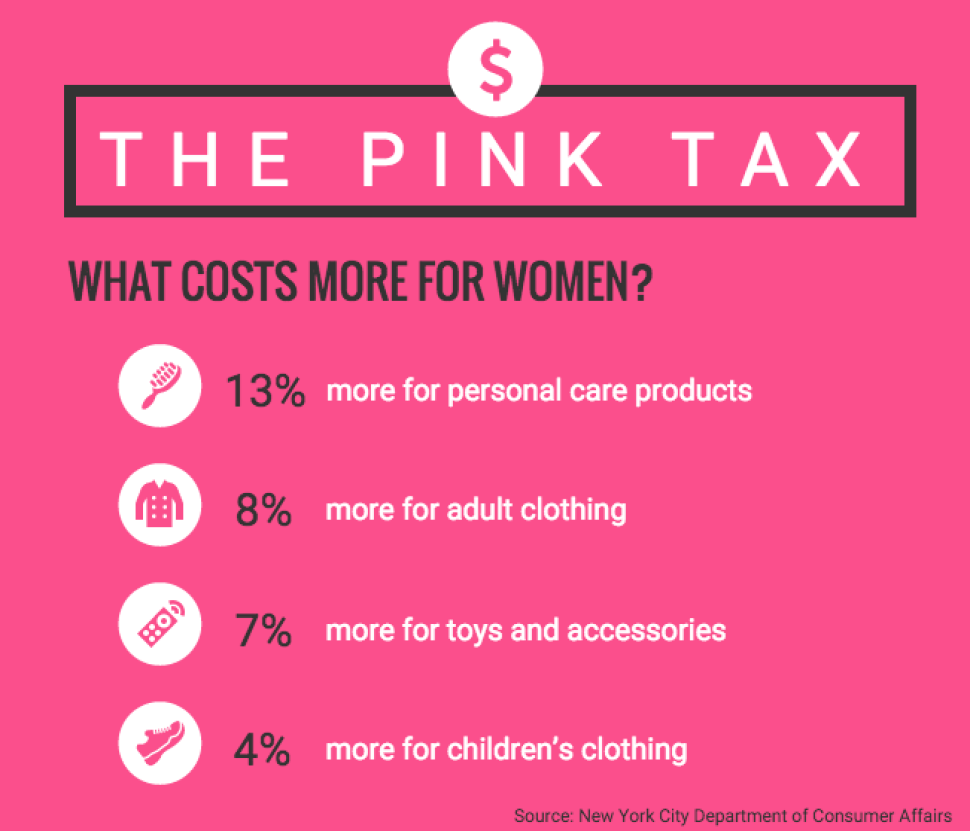
The Pink Tax can be traced back to the early 1990s in the United States when consumer advocates and researchers began to notice the discrepancy in prices between gender-segregated products. The New York City Department of Consumer Affairs conducted one of the first comprehensive studies on gender-based pricing in 1995. Their research revealed that women paid significantly more for nearly identical products than men, an average of around 7% more. This included items like razors, deodorants, and haircuts. In the toy sector, girls’ toys cost on average 7% more than boys’ toys. The study showed a side-by-side comparison of a Radio Flyer scooter where the red scooter costs $24.99 and a pink scooter, identical in all ways but colour, costs $49. In children’s apparel, girls’ clothes were 4% more expensive than boys’. Women’s clothing was 8% more expensive than men’s clothing. The largest discrepancy came to personal care and hygiene products, where women’s products cost 13% more than men’s. The researchers found that manufacturers and retailers justified the higher prices for women’s products, citing factors like higher production costs or special features. However, these justifications did not always align with the actual price differences. This raised concerns about a potential pattern of systematic gender discrimination.

Over the years, the Pink Tax debate gained momentum, attracting attention from activists, lawmakers, and media outlets worldwide. Consumer groups pushed for transparency and pricing equality, urging companies to end this discriminatory pricing practice. Despite increased awareness, progress remained slow.

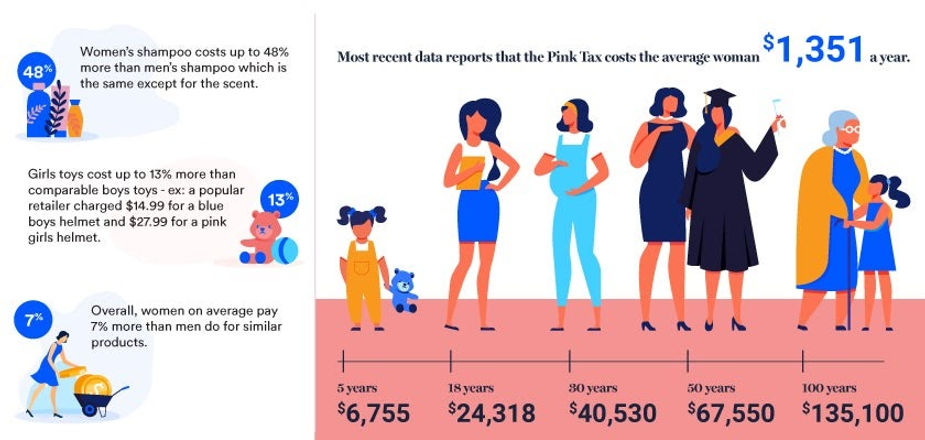
The Pink Tax is not confined to any one country or region. Its impact is felt across the world, perpetuating gender inequality and affecting women’s purchasing power. According to a 2018 study conducted by the European Parliament, women in Europe were found to spend about 7% more on everyday products compared to men. This extra cost amounted to an average of €1,370 per year per person.

In the UK, women and girls were being charged on average 37% more for toys, cosmetics, and clothes than their male counterparts. The UK also faces the Pink Tax on school uniforms. Girls’ school uniforms are 12% more expensive than boys’ uniforms. This goes for both primary and secondary school-age children. In recent times Argentina women pay 12% more than men for the same products. In 2021 the gap was at 11% and went up the following year in 2022.

In the United States, a study by the New York City Department of Consumer Affairs in 2015 found that women paid approximately 7% more than men for similar products. Another study by the University of Central Florida in 2018 revealed that, on average, products targeted at women cost 13% more than similar products marketed to men.

A study by the Times of India in 2018 found that products marketed to women were priced up to 50% higher than equivalent products for men. This disparity encompassed personal care items, clothing, and toys. Japan, known for its traditional gender roles, is not immune to the Pink Tax. A study conducted by Osaka City in 2018 revealed that women’s products were priced around 24% higher than men’s products. In South Korea, a survey by the Korean Women’s Development Institute in 2019 found that women’s personal care products were priced 11% higher than men’s. According to a 2017 study by the Ministry of Commerce, women’s clothing and personal care products in China were priced 17% higher than men’s. In Singapore, a check by The Sunday Times on ten companies found that women pay more for some products and services, like dry cleaning and razors, offered by about half of these companies. Additionally, women in Singapore have to pay more premiums for Careshield Life, a national long-term care insurance scheme introduced by the government.

There are many reasons why the pink tax exists, including tariffs, product discrimination, and product differentiation. There are many suggested causes of this discrepancy, including price elasticity and the belief that women are more prepared than men to pay higher prices for their purchases. Other reports suggest that marketing targets women to pay higher prices as ethical consumers. According to The Washington Post, women are more likely to spend more money on improving their appearance, because not doing so is associated with the risk of losing revenue. Some studies showed that attractive people tend to earn higher salaries, receive higher grades in school, receive shorter prison sentences, and are more likely to be hired and promoted in the workplace. This factor is not relevant for men.

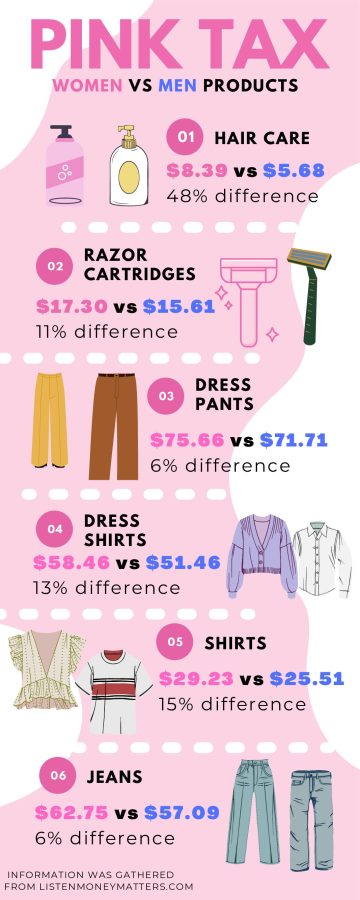
Some people argue that product differentiation can account for a portion of the difference between the prices of men’s goods and women’s goods. For example, a pink scooter may cost more than a red scooter because it is more expensive to paint a scooter pink than red, assuming such a large difference for this reason of production would be because the red scooters are the larger production, and pink scooters are in the minority. However, there has never been any evidence presented, for example, that pink paint costs more than red paint or blue paint, thereby creating cost differentials in colour-coded items geared toward different genders. The Pink Tax also arises in services like haircuts or dry cleaning. Likewise, in dry cleaning, some people argue that men’s clothing tends to be more uniform while women’s clothing tends to have a lot of variabilities which can make it harder to clean. They also argue that pressing machines, normally made for men’s clothing, are more difficult to use on women’s clothes, which results in the dry-cleaners resorting to hand-pressing the clothing.

The reason those who campaign against the pink tax claim it to be so problematic is that higher prices for goods and services arise from gender alone, with no underlying economic justification such as higher costs of production in goods. Women’s and men’s razors are essentially the same, and distinguishing between them is simply a marketing strategy. People who have a greater need to buy a product are often willing to pay much more, leading to price discrimination. Women are often subjected to this in the tampon and sanitary napkin market creating a marginalised group among women who are “period poor”.

Criticism of the pink tax includes the principle that the idea robs women of agency and choice by suggesting that women are so easily brainwashed by marketing that they are prevented from choosing the lesser-priced but otherwise “identical” male-marketed alternative. Instead, critics have attributed the pricing disparity to market forces and stated that if women continue to buy a more expensive pink razor, it is because they see some utility or additional aesthetic that they are willing to pay for. Substantive differences in price may indicate differences in the marketability of different products. Critics argue that although seemingly identical products and services may be differently priced, the emotional experiences and perceived value are different.

A more recent study pointed out methodological flaws in the influential 2015 study from the New York City Department of Consumer Affairs. According to the study, the products considered in the report account for less than 6% of category sales and were not selected at random. While the sample was constructed by subjectively pairing men’s and women’s products, the study found that most pairs in the sample differ in their ingredients. They argue that a systematic analysis of the evidence reveals when comparing products made by the same company with the same leading ingredients, men’s products were more expensive in 3 out of 5 categories and that the findings do not support the existence of a systematic price premium for women’s products.

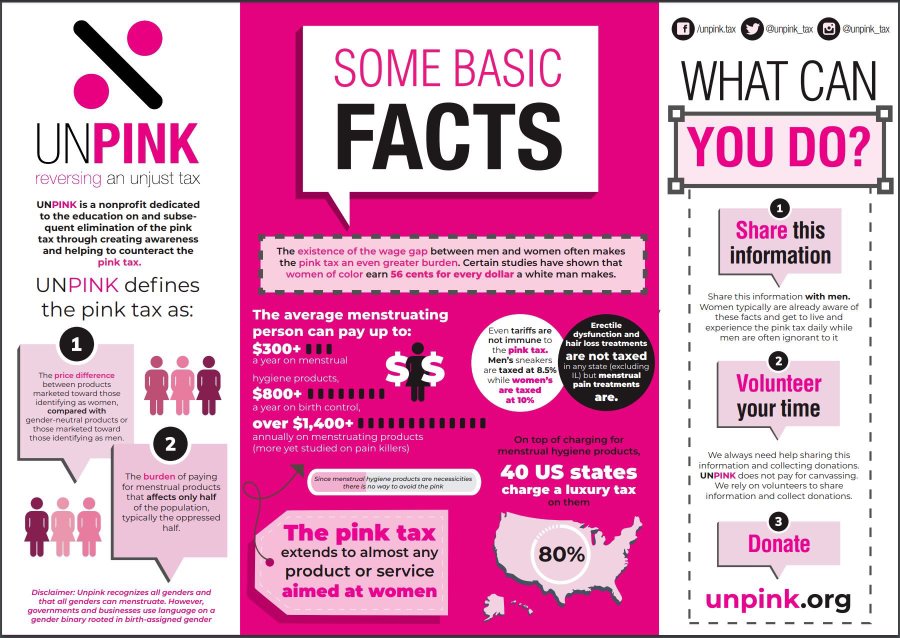
Activists and politicians argue that the economic impact of the pink tax is that women have less purchasing power, especially paired with the gender-based pay gap. Wage gaps and pension gaps already put women at a disadvantage when it comes to purchasing power. Women currently make a statistical average of 89 cents for every $1 a man earns in the United States, meaning women statistically, on average, have less income to spend on goods and services. This alone gives men more money and, ultimately, more buying power. The pink tax further contributes to the economic inequality between men and women. It is also argued that paying more for goods and services marketed to women while women earn less than men means men hold the majority of the purchasing power in the economy. Taxes on feminine hygiene products that men don’t need further contribute to this discrepancy. The Pink Tax’s impact extends beyond the financial burden on individual consumers. It reinforces harmful gender stereotypes and perpetuates the idea that women’s products and services are secondary or inferior. This discriminatory practice undermines gender equality efforts and restricts women’s economic empowerment.

Combatting the Pink Tax requires a multi-faceted approach involving consumers, policymakers, and businesses. There has to be an increase in awareness about the Pink Tax so that consumers are empowered to make informed choices and demand pricing transparency. Activists and policymakers should collaborate to introduce legislation that addresses gender-based pricing discrimination and ensures fair pricing practices. Companies should examine their pricing strategies and eliminate any unjustified price discrepancies between gender-segregated products.

The Pink Tax is a pervasive issue that demands attention and action from all segments of society. By understanding its origins and impact, we can work collectively to dismantle this discriminatory practice. Governments, businesses, and consumers must come together to challenge the status quo and build a more equitable future where gender-based pricing discrimination becomes a thing of the past. Empowering women economically should be a shared goal, and eradicating the Pink Tax is a significant step in that direction. Let us unite our voices to create a world where pricing is fair, just, and free from gender bias.

International Equal Pay Day

Today is the International Equal Pay Day. World over, irrespective of where women work, they always earn less than a man in the same position. This is something I have always rallied about why a man should earn more than a woman when both are doing what is essentially the same thing.

Across all regions, women are paid less than men, with the gender pay gap estimated at 23 per cent globally. Gender equality and the empowerment of women and girls continues to be held back owing to the persistence of historical and structural unequal power relations between women and men, poverty and inequalities and disadvantages in access to resources and opportunities that limit women’s and girls’ capabilities. Progress on narrowing that gap has been slow. Women earn 77 cents for every dollar men earn for work of equal value – with an even wider wage gap for women with children. At the current rate of progress, the World Economic Forum predicts that it will take another 217 years before the gender pay gap finally closes. While equal pay for men and women has been widely endorsed, applying it in practice has been difficult. Women are concentrated in lower-paid, lower-skill work with greater job insecurity and under-represented in decision-making roles and women carry out at least two and a half times more unpaid household and care work than men.

Recognising this to be something the world needs to take note of, this year for the first time, the United Nations has declared today, that is September 18 to be the International Equal Pay Day.

This day calls attention to the severe gender pay gap and the reasons for this gap are manifold and intertwined. The major causes of a pay gap between men and women include factors like women’s work being undervalued, the lack of women in certain sectors like perhaps construction and STEM subject fields, women still face a glass ceiling when moving up the career ladder, women working part-time more often than men, women interrupting their careers more frequently due to family-related breaks, and of course the widespread prevelance of gender stereotypes. Cultural bias, societal assumptions and a lack of progress in workplace design all contribute to the gender pay gap.

So why does this pay gap exist between the genders?

There are many reasons for this. At the heart of which is the assumption that senior roles can’t be done by women who can’t spend a lot of time at work which women who have to work at home too can’t do. And women who are in senior positions have not had the gender pay gap reduced in over almost half a century. But today with the world working from home and showing it can be done and effectively too lets us know that women can manage a home and a senior position, so that’s one excuse which can be thrown away.

Another reason for this pay gap could be attributed to the maternity leave that women of certain years take. Though it is illegal to ask this question in many countries, there are many Asian countries in which hiring managers do and will ask women who are in their twenties and thirties this question and not only does this discriminate hiring practices, it also enables hiring managers to offer women a lower starting pay as compared to a man with the same qualifications and career trajectory. Unfortunately, even if women try to return to work after having a child, they often face what is known as the “motherhood penalty”. As most workplaces still don’t offer much flexibility for mothers, they are often forced to take on lower-paying and less demanding jobs. However, even if they are able to find a job that suits them, mothers are much less likely to get an interview compared to fathers and childless women. What’s more, while women are penalised for having children, men are rewarded, with research from the University of Massachusetts finding fathers are more likely to be hired than childless men and tend to be paid more.

The third reason is that there is perceived wisdom that women choose low-paid occupations like that of teachers and nurses because they offer more flexibility, or are more family-friendly. Again, the perception that it is a choice to prioritise children over paid work, rather than being due to a lack of viable alternatives, positions the gender pay gap as a fact of life, and releases employers from responsibility for changing it.

Another reason is that although a study by Harvard Business Review found that women actually rank more highly than men in 12 out of the top 16 leadership qualities – including problem solving, communication skills and innovativeness – women are consistently overlooked by employers, who still tend to view men as being more competent.

And not only are women being short-changed when it comes to hiring decisions and negotiating salaries – we’re also receiving less in performance bonuses. An Australian study by Mercer found that men were receiving up to 35 per cent more in performance bonuses than women, despite receiving the same performance rating.

In some more developed countries like South Korea the gap is as much as 33% while other developed countries don’t fare well either with countries like Germany has a 22% income gap and the United Kingdom has 20%, Switzerland has 17%. On the other hand, less developed countries seem to have lower gender income gaps, with countries like Pakistan and Vietnam having a gap of almost 11%, Colombia with a gap of 0.3% and countries in southeast Asia like Thailand and Malaysia having a negative gap, meaning here women tend to earn more than men with women earning more than men by about 2.25% in Malaysia and 21.5% in Thailand.

So what can be done to bridge this income and pay gap between men and women? Economists say one thing hiring managers could do is share salary information during the hiring itself and not make sharing of your pay an unwritten offence in a organisation. The more information that is available, the easier it will be able to know what a man gets for the same role and women can be in a better position to negotiate salaries.

When both parents share in the household chores, it makes it easier for mums to be able to spend more time at work and is able to climb the career ladder. So if the mother is the one who is always called by school and child care about her child and is expected to drop everything to get there, then her career is bound to suffer. When both parents are equally responsible, then both will have a career trajectory. This is something cultural and will take some time before men step up, though many men are staunch defenders of a woman’s right to a successful career.

Women should be encouraged to work in occupations which are not traditionally female-centric like nursing and teaching. Yes, today more and more women are joining occupations not traditionally female, but there is still work to be done for more representation in sectors like construction and STEM related fields. I also believe that women should seek out and search for mentors in their fields of study and work who can guide them so they can achieve the success they deserve.

Source: United Nations

This gender pay gap is something all of us, women and men have to work on to ensure that our children and grandchildren get paid fairly for the work they do. Nobody should be penalised just because of their gender and everyone should have access to equal pay for the work they do. Let’s all work together for this!

Being a Woman…

The past few weeks have been quite frankly, disturbing to me as a woman. Like probably most people on this planet, I’ve been following the US Presidential elections and the news it throws up makes me very disturbed. It also doesn’t help that my Facebook feed is filled with news about the elections and mostly about how one of the candidates is so misogynist about women in general.

Then I read another bit of news, this time from India. Apparently, a couple who applied to divorce has had a judgement from the Supreme Court that because the ‘woman was trying to separate the man from his parents’, divorce should happen. What was so wrong about this judgement was the judge who decreed that after the wedding, in a marriage, when a woman said she didn’t want to live with the man’s parents, she is wrong and this is against the Indian, Hindu culture and so the man asking for a divorce is right and the divorce should be decreed. This is so wrong from so many angles. I, along with many Indian women worldwide have been incensed with this ruling. This turns the clock on so many decades of women empowerment in the country. This belittles a woman as nothing else can and makes parents of women little less than dirt.

Yes, the world over, patriarchal traditions insist that when a man and a woman get married, a woman leaves her home, her family and in some cases in India, even her name, to go and live with someone who is essentially a stranger.  A woman’s parents, who have brought her up and lived with her for the 20-30 odd years pre-marriage, have no rights over their daughter, whom they have brought up equally to any son they may have, have to hand her over quietly and when she raises any objection, tell her to be quiet and adjust and live with her husband and in-laws. In many cases, the woman who is a highly educated, career woman who has subordinates at work, has to have someone who has probably never done any work outside the home telling her what to eat, when to sleep, when to work etc.

There’s a Chinese saying attributed to Mao Zedong that says “Women hold up half the sky”. What does this mean actually? My interpretation of this means that in order for society to achieve anything, women should and must contribute their share of the hard work. Women, who account for half the world’s population (49.6% according to the World Bank), in reality, do not really account for even a fraction of that percentage.

So what’s it like to be a woman?

Being a woman starts young, young girls are told at a very early age that they are women in the making

Being a woman means covering yourselves up, just so you do not inflame the lustful eyes of men around you. Men don’t get taught to lower their eyes when talking to a woman.

Being a woman means that every word, deed and action is scrutinised, if you are assertive and know your mind, you are called arrogant and stuck-up and a bitch while a man is praised for this (as an example of this, please watch the US presidential elections).

A woman is supposed to pure and chaste while a man can sow his wild oats. A woman talking in a sexual way is a slut while for a man, it’s just boys talk or locker room talk and ‘boys will be boys’

A woman walking alone at night always has some pepper spray in her bag, but in many countries, this rarely happens as women are almost never allowed to go out at night.

A woman walking alone, irrespective of the time of the day will invariably attract catcalls and lewd glances, but a man has to never face being the object of sexual attention and feel people undressing him with their eyes.

Being a woman means having to listen to off colour jokes and sexual innuendoes at work and school and laugh it out with the guys as otherwise you are considered ‘not sporting enough’

It’s time, we as women started taking care of our kind. We are mothers, grandmothers, aunts and sisters. We nurture the next generation of both men and women. It’s up to us to make sure that this inequality stops with this generation. As we bring up the next generation, let’s all teach our daughters to be strong and not take any shit from anyone. Let’s, more importantly, teach our sons how to be good human beings, one who respects women, one who knows the line they should draw internally when talking to women. To teach our sons not to allow anyone around them to belittle women and make them feel any less than they deserve, to listen to them actively.

Most importantly to make women feel that they are really “Holding up half the sky”

Random Thoughts – Gender Equality

2000px-igualtat_de_sexes-svgThis week, I’ve had many thoughts swirling in my head, which I thought needed a post all by itself, rather than put it down in my weekly update, where it may not be really relevant.

One of the big news in the papers last week was about the risqué and sometimes obscene games played at the freshmen orientation at the National University of Singapore (NUS). Apparently, this is common in other Singapore universities too – Nanyang Technological University (NTU) and Singapore Management University (SMU). Reports said that the games were very sexualised in nature with some even invoking feelings of incest.

16d42f1Orientation camps are a chance for the incoming freshmen to meet other new students and make friends. As parents of young teens who will soon get into one of these universities (hopefully), this is cause for concern to me. Since all Singaporean and Singapore Permanent Resident males have to complete their national service before they enter university, this means that there is a two-year gap in age between the men and women who enter the freshman year. This becomes as much as six years or more when you compare a female freshman versus a male final year student.
Some students (both male and female) who were at the orientation didn’t feel that the games were wrong, which lead me to think how they thought of female emancipation. Games like this, which are often under the leadership of the student council and perhaps the university management tacitly condone sexism and misogyny at a very impressionable age. It becomes worse because, in these games, it’s often the men who play the aggressor and the women, the victims. I am a feminist and I strongly believe that when young men look at women in such a sexual way, in what is essentially a very non-sexual environment, then it leads them to be conditioned to think of women in such ways in other such non-sexual environments such as at work. This leads to a life-long tendency to believe that women are very inferior to them and always act in ways which do not demonstrate true gender equality. I guess when men who do not want to take part in such games, protest, they are then ridiculed and called names for being wimps!

The university has stopped all these games for this year at least and hopefully this will lead to a serious review on what can and cannot be acceptable.

stock-vector-colourful-hands-with-male-and-female-symbol-love-marriage-gender-equality-human-rights-and-120122377This actually leads to the other thing I have been thinking about for a week now. I usually steer clear of politics and since I am not a political commentator, I like to leave that to the experts. But I am sure everyone, including me, is watching the US Presidential elections run-up. I was very happy when the democrats finally (really finally!) elected a woman to become their nominee, in what was a historical moment in the history of the country. I along with millions of women worldwide cheered at this, but I was also a bit perturbed that it took them almost 240 years after independence to have a woman at spitting distance of the highest office in the country. For a country which calls itself the ‘greatest country in the world’, this is a bit disturbing as it does not really show that this greatness also lies in the equality of its daughters and sons.

However, the most disturbing part of the election campaign has been the republican nominee. I cringe each time I read about his comments on women, minorities, the disabled, (basically everyone except the traditional white male). At times I think nobody can be like this – misogynistic, rash and irresponsible, and wonder if this is the persona he has adopted to win the elections, then I read another article about him, going back to before he was the nominee and decide I was wrong, maybe he is like that in real life too. Then I really shudder and think of the country and its future.

As a woman, as someone who passionately believes in the equality of the sexes and as someone who believes in equal rights for everyone, I really hope this person does not win. If he does, women’s lib and emancipation will probably retrograde back to 1776 when America became free of the British and the words “Freedom”, “Liberty” and “Equality” are just words in the constitution