Entitled: How Male Privilege Hurts Women – Kate Manne
In this bold and stylish critique, Cornell philosopher Kate Manne offers a radical new framework for understanding misogyny. Ranging widely across the culture, from Harvey Weinstein and the Brett Kavanaugh hearings to “Cat Person” and the political misfortunes of Elizabeth Warren, Manne’s book shows how privileged men’s sense of entitlement – to sex, yes, but more insidiously to admiration, care, bodily autonomy, knowledge, and power – is a pervasive social problem with often devastating consequences.
In clear, lucid prose, Manne argues that male entitlement can explain a wide array of phenomena, from mansplaining and the under-treatment of women’s pain to mass shootings by incels and the seemingly intractable notion that women are “unelectable.” Moreover, Manne implicates each of us in toxic masculinity: It’s not just a product of a few bad actors; it’s something we all perpetuate, conditioned as we are by the social and cultural mores of our time. The only way to combat it, she says, is to expose the flaws in our default modes of thought while enabling women to take up space, say their piece, and muster resistance to the entitled attitudes of the men around them.
With wit and intellectual fierceness, Manne sheds new light on gender and power and offers a vision of a world in which women are just as entitled as men to our collective care and concern.
The Moment of Lift: How Empowering Women Changes the World – Melinda Gates
For the last twenty years, Melinda Gates has been on a mission. Her goal, as co-chair of the Bill & Melinda Gates Foundation, has been to find solutions for people with the most urgent needs, wherever they live. Throughout this journey, one thing has become increasingly clear to her: If you want to lift a society up, invest in women.
In this candid and inspiring book, Gates traces her awakening to the link between women’s empowerment and the health of societies. She shows some of the tremendous opportunities that exist right now to “turbo-charge” change. And she provides simple and effective ways each one of us can make a difference.
Convinced that all women should be free to decide whether and when to have children, Gates took her first step onto the global stage to make a stand for family planning. That step launched her into further efforts: to ensure women everywhere have access to every kind of job; to encourage men around the globe to share equally in the burdens of household work; to advocate for paid family leave for everyone; to eliminate gender bias in all its forms.
Throughout, Gates introduces us to her heroes in the movement towards equality, offers startling data, shares moving conversations she’s had with women from all over the world—and shows how we can all get involved.
A personal statement of passionate conviction, this book tells of Gates’ journey from a partner working behind the scenes to one of the world’s foremost advocates for women, driven by the belief that no one should be excluded, all lives have equal value, and gender equity is the lever that lifts everything.
Also called the Day of Girls and the the International Day of the Girl, the International Day of the Girl Child was first declared by the United Nations on 11 October 2012 to increase awareness of the gender inequality faced by girls worldwide and support more opportunity for girls. The inequality faced by girls include areas such as access to education, nutrition, legal rights, medical care, and protection from discrimination, violence against women and forced child marriage. The celebration of the day also reflects the successful emergence of girls and young women as a distinct cohort in development policy, programming, campaigning and research.
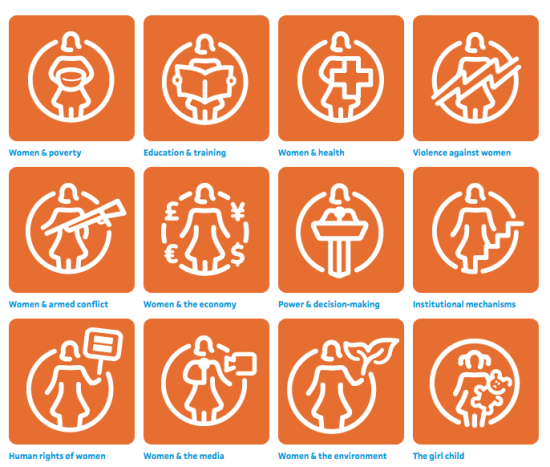
In 1995, before the girls of today were even born,the fourth World Conference on Women made history for the women’s rights agenda with the adoption of the Beijing Declaration and Platform for Action was adopted, the most visionary blueprint for the empowerment of women and girls. The Beijing Declaration and Platform for Action is the most progressive blueprint ever for advancing the rights of not only women but girls. Now, about half a century later, the Platform for Action remains a powerful foundation for assessing progress on gender equality. It calls for a world where every girl and woman can realize all her rights, such as to live free from violence, to attend and complete school, to choose when and whom she marries, and to earn equal pay for equal work. The Platform for Action specifically calls on the global community to eliminate all forms of discrimination against girls; eliminate negative cultural attitudes and practices against girls; promote and protect the rights of girls and increase awareness of their needs and potential; eliminate discrimination against girls in education, skills development and training; eliminate discrimination against girls in health and nutrition; eliminate the economic exploitation of child labour and protect young girls at work; eradicate violence against girls; promote girls’ awareness of and participation in social, economic and political life and strengthen the role of the family in improving the status of girls.
The International Day of the Girl increases awareness of issues faced by girls around the world. Many of the global development plans do not include or consider girls, and their issues have become “invisible.” More than 62 million girls around the world had no access to education, as of 2014, according to USAID. Worldwide and collectively, girls ages 5 to 14 spend more than 160 million hours more on household chores than boys of the same age do. Globally, one in four girls are married before the age of 18. Each year, 12 million girls under 18 are married; 130 million girls worldwide are still out of school; and approximately 15 million adolescent girls aged 15-19 have experience forced sex. The International Day of the Girl Child helps to raise awareness not only of the issues that girls face, but also of what is likely to happen when these problems are solved. For example, educating girls helps reduce the rate of child marriage, disease and helps strengthen the economy by helping girls have access to higher paying jobs.
This day began as a project of Plan International, a non-governmental organisation that operates worldwide through their “Because I Am a Girl” campaign, which raised awareness on the importance of nurturing girls globally and in developing countries in particular. Awareness for the initiative grew internationally and soon the United Nations got involved in this campaign which finally became the International Day of the Girl Child with the inaugural day on October 11, 2012.
The resolution states that the Day of Girls recognises the empowerment of and investment in girls, which are critical for economic growth, the achievement of all Millennium Development Goals, including the eradication of poverty and extreme poverty, as well as the meaningful participation of girls in decisions that affect them, are key in breaking the cycle of discrimination and violence and in promoting and protecting the full and effective enjoyment of their human rights, and recognizing also that empowering girls requires their active participation in decision-making processes and the active support and engagement of their parents, legal guardians, families and care providers, as well as boys and men and the wider community.
Each year’s Day of Girls has a theme; the theme for this year’s celebrations is “My voice, our equal future” where girls, especially adolescent girls will focus their their demands to live free from gender-based violence, harmful practices, and HIV and AIDS; learn new skills towards the futures they choose and lead as a generation of activists accelerating social change
If you want to get involved in the International Day of the Girl Child, you can do so by sharing stories of inspiring adolescent girls or girl-led organisations who are developing innovative solutions or leading efforts towards positive social change, including gender equality, in their communities and nations. Let’s amplify their leadership, actions and impact to inspire others. You can also participate in a youth-led digital activation which will be launched on the 11th. This will be led by young people across the world who are developing a digital activism campaign, aiming to raise the diversity of girls’ voices and their vision for a reimagined future.
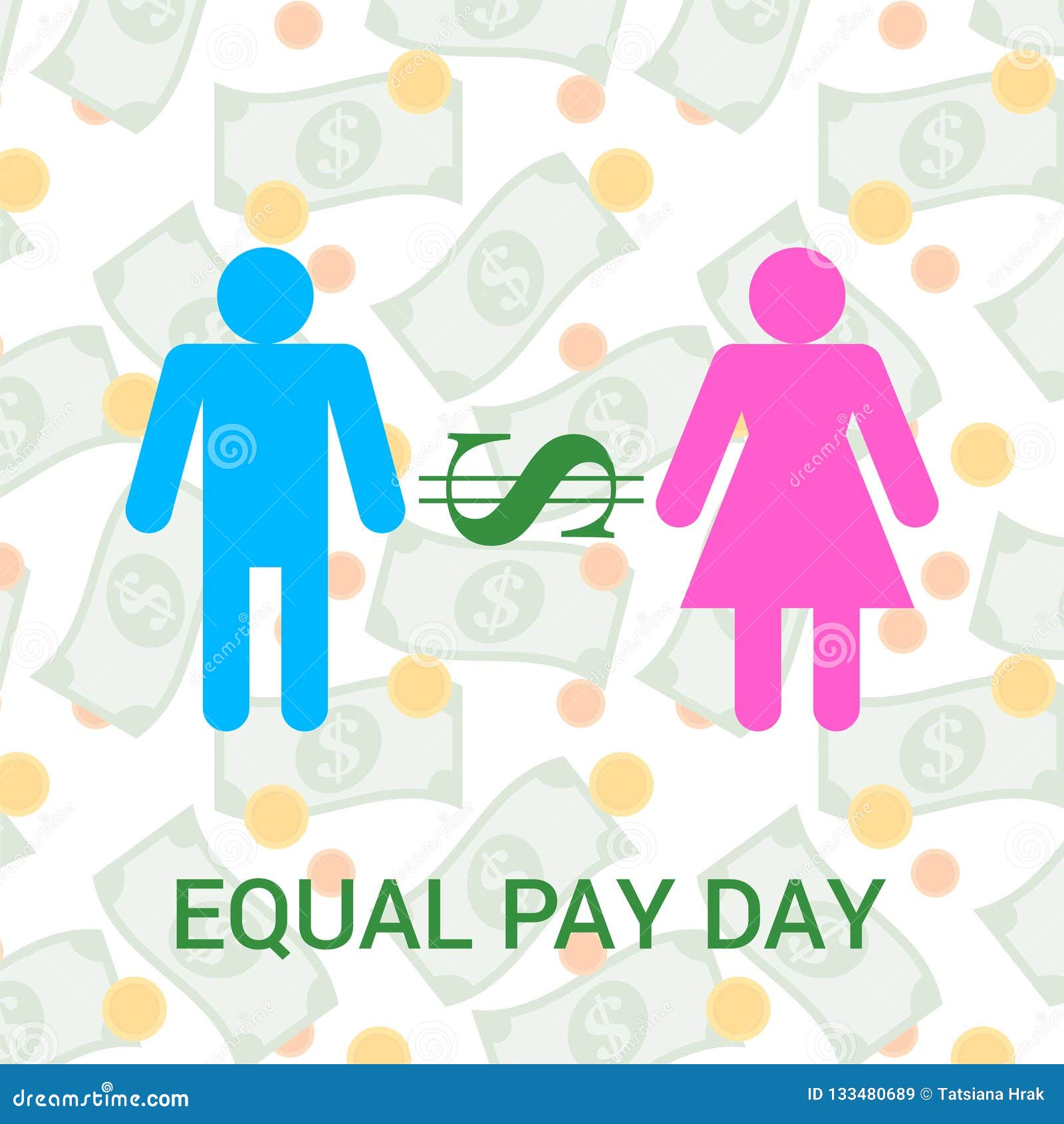
Today is the International Equal Pay Day. World over, irrespective of where women work, they always earn less than a man in the same position. This is something I have always rallied about why a man should earn more than a woman when both are doing what is essentially the same thing.
Across all regions, women are paid less than men, with the gender pay gap estimated at 23 per cent globally. Gender equality and the empowerment of women and girls continues to be held back owing to the persistence of historical and structural unequal power relations between women and men, poverty and inequalities and disadvantages in access to resources and opportunities that limit women’s and girls’ capabilities. Progress on narrowing that gap has been slow. Women earn 77 cents for every dollar men earn for work of equal value – with an even wider wage gap for women with children. At the current rate of progress, the World Economic Forum predicts that it will take another 217 years before the gender pay gap finally closes. While equal pay for men and women has been widely endorsed, applying it in practice has been difficult. Women are concentrated in lower-paid, lower-skill work with greater job insecurity and under-represented in decision-making roles and women carry out at least two and a half times more unpaid household and care work than men.
Recognising this to be something the world needs to take note of, this year for the first time, the United Nations has declared today, that is September 18 to be the International Equal Pay Day.
This day calls attention to the severe gender pay gap and the reasons for this gap are manifold and intertwined. The major causes of a pay gap between men and women include factors like women’s work being undervalued, the lack of women in certain sectors like perhaps construction and STEM subject fields, women still face a glass ceiling when moving up the career ladder, women working part-time more often than men, women interrupting their careers more frequently due to family-related breaks, and of course the widespread prevelance of gender stereotypes. Cultural bias, societal assumptions and a lack of progress in workplace design all contribute to the gender pay gap.
So why does this pay gap exist between the genders?
There are many reasons for this. At the heart of which is the assumption that senior roles can’t be done by women who can’t spend a lot of time at work which women who have to work at home too can’t do. And women who are in senior positions have not had the gender pay gap reduced in over almost half a century. But today with the world working from home and showing it can be done and effectively too lets us know that women can manage a home and a senior position, so that’s one excuse which can be thrown away.
Another reason for this pay gap could be attributed to the maternity leave that women of certain years take. Though it is illegal to ask this question in many countries, there are many Asian countries in which hiring managers do and will ask women who are in their twenties and thirties this question and not only does this discriminate hiring practices, it also enables hiring managers to offer women a lower starting pay as compared to a man with the same qualifications and career trajectory. Unfortunately, even if women try to return to work after having a child, they often face what is known as the “motherhood penalty”. As most workplaces still don’t offer much flexibility for mothers, they are often forced to take on lower-paying and less demanding jobs. However, even if they are able to find a job that suits them, mothers are much less likely to get an interview compared to fathers and childless women. What’s more, while women are penalised for having children, men are rewarded, with research from the University of Massachusetts finding fathers are more likely to be hired than childless men and tend to be paid more.
The third reason is that there is perceived wisdom that women choose low-paid occupations like that of teachers and nurses because they offer more flexibility, or are more family-friendly. Again, the perception that it is a choice to prioritise children over paid work, rather than being due to a lack of viable alternatives, positions the gender pay gap as a fact of life, and releases employers from responsibility for changing it.
Another reason is that although a study by Harvard Business Review found that women actually rank more highly than men in 12 out of the top 16 leadership qualities – including problem solving, communication skills and innovativeness – women are consistently overlooked by employers, who still tend to view men as being more competent.
And not only are women being short-changed when it comes to hiring decisions and negotiating salaries – we’re also receiving less in performance bonuses. An Australian study by Mercer found that men were receiving up to 35 per cent more in performance bonuses than women, despite receiving the same performance rating.
In some more developed countries like South Korea the gap is as much as 33% while other developed countries don’t fare well either with countries like Germany has a 22% income gap and the United Kingdom has 20%, Switzerland has 17%. On the other hand, less developed countries seem to have lower gender income gaps, with countries like Pakistan and Vietnam having a gap of almost 11%, Colombia with a gap of 0.3% and countries in southeast Asia like Thailand and Malaysia having a negative gap, meaning here women tend to earn more than men with women earning more than men by about 2.25% in Malaysia and 21.5% in Thailand.
So what can be done to bridge this income and pay gap between men and women? Economists say one thing hiring managers could do is share salary information during the hiring itself and not make sharing of your pay an unwritten offence in a organisation. The more information that is available, the easier it will be able to know what a man gets for the same role and women can be in a better position to negotiate salaries.
When both parents share in the household chores, it makes it easier for mums to be able to spend more time at work and is able to climb the career ladder. So if the mother is the one who is always called by school and child care about her child and is expected to drop everything to get there, then her career is bound to suffer. When both parents are equally responsible, then both will have a career trajectory. This is something cultural and will take some time before men step up, though many men are staunch defenders of a woman’s right to a successful career.
Women should be encouraged to work in occupations which are not traditionally female-centric like nursing and teaching. Yes, today more and more women are joining occupations not traditionally female, but there is still work to be done for more representation in sectors like construction and STEM related fields. I also believe that women should seek out and search for mentors in their fields of study and work who can guide them so they can achieve the success they deserve.
Source: United Nations
This gender pay gap is something all of us, women and men have to work on to ensure that our children and grandchildren get paid fairly for the work they do. Nobody should be penalised just because of their gender and everyone should have access to equal pay for the work they do. Let’s all work together for this!
It’s March and this means it’s time for another International Women’s Day which will take place on Sunday. I have written previously about the IWD as it is usually shortened to and you can read more about the history of this day there.
Every day the global IWD committee has a theme and this year’s theme is “Each for Equal”. An equal world is an enabled world. We are all responsible every day for our own thoughts and action, but we can actively choose to challenge stereotypes, fight bias, broaden perceptions, improve situations and celebrate women’s achievements. Together and collectively every one of us can help create a world where gender is a non-issue and this world we live in is a gender equal world.
Equality is not a women’s issue, it’s a business issue. For economies and communities to thrive, it is essential that those countries and communities practice gender equality. A world which is gender-blind is one which is healthier, wealthier and more harmonious, which makes for an ideal world, which is what we aim to reach for, right? The race is on for the gender equal boardroom, a gender equal government, gender equal media coverage, gender equal workplaces, gender equal sports coverage, more gender equality in health and wealth. So this International Women’s Day, let’s make it happen.
So why is this day important and why are government, non-governmental and other organisations making such a big deal about it each year in March? Well, I believe that women should be celebrated every day but since that does not really happen, we take what we get. IWD is the one day in the year that recognises the value that women bring to the table, both individually and collectively and showcases the struggles they have undergone just to pave the way for the next generation.
In today’s world where many women (and men) have the power of social media in their hands (and phones), it is important that we use that power and influence in our hands and get involved and passionate about this cause of ensuring our next generations don’t have to go through the struggles we went through. So take that step and not just campaign and influence, but also celebrate, support, motivate, high-five and hug the females in your life this International Women’s Day.





 Memories and Such