This is Part 2 of our temple pilgrimage to the Tirupati Balaji Temple, the Sri Padmavati Temple and the Sri Kalahasthi Temple on a road trip from Bengaluru.

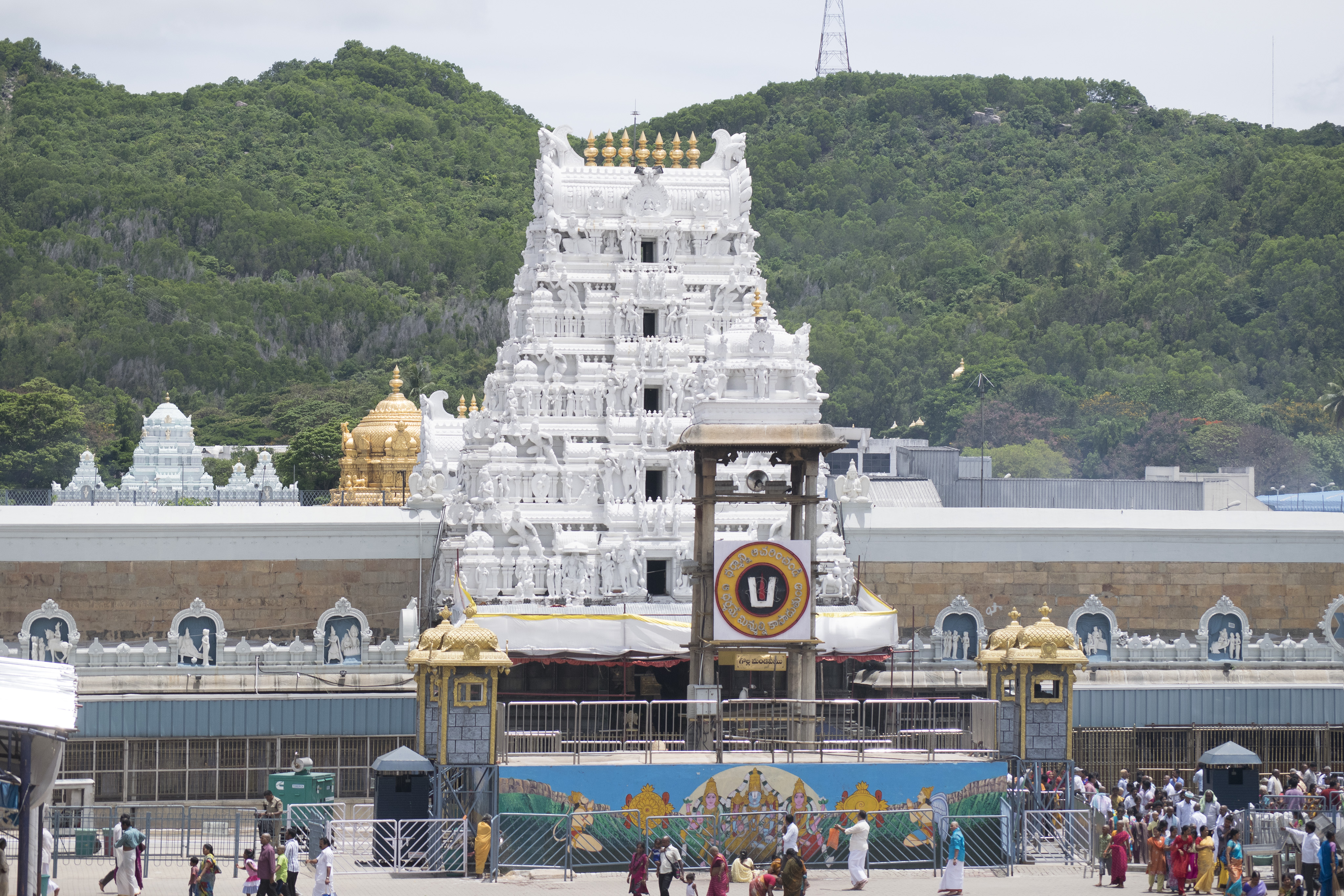
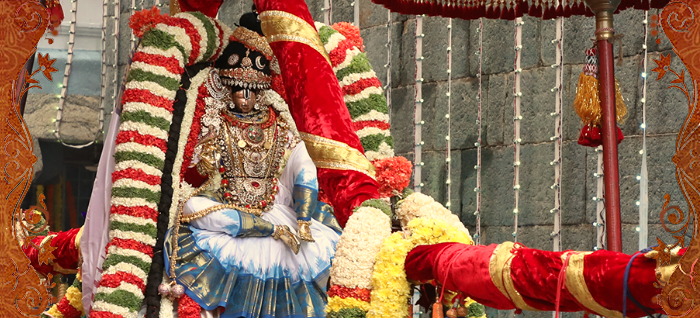
Coming down from Tirumala took almost an hour because there are speed restrictions and it took us about 45 minutes from the point of entering Tirupati to reaching the Padmavati temple. Located in Tiruchanur on the outskirts of Tirupati, the temple is under the administration of Tirumala Tirupati Devasthanams. Padmavathi or Alamelumanga is the main deity of the temple and faces the east. She is an incarnation of Goddess Lakshmi and the consort of Lord Venkateswara. It is believed that the Goddess Lakshmi was born as Alamelu to Akasha Raja, the ruler of this region, and wed Venkateshwara of Tirupati. Goddess Lakshmi gave darshan to Lord Venkateswara on a red Lotus flower or a Padma in Sanskrit at Alamelu Mangapuram after his deep penance for twelve years. According to tradition, the Mother Goddess manifested Herself in the holy Pushkarini called Padmasarovaram in a golden lotus. The Venkatachala Mahatyam states that Lord Suryanarayana was instrumental in the blossoming of the lotus in full splendour. A temple dedicated to Lord Suryanarayana is situated on the eastern side of the Pushkarini. The Padma Purana gives a vivid description of the advent of the Goddess and subsequent wedding with Lord Srinivasa. The manifestation of Sri Padmavathi Devi occurred in the month of Karthika on Sukla Paksha Panchami when the star Uttarashada was in the ascendant. The Brahmotsavam of the Goddess is celebrated with pomp and glory.
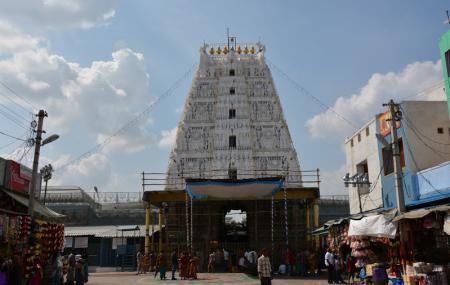
We reached the temple around 8:15 am and realised that the temple was closed after the early morning prayers and would reopen at 9 am. So while waiting, we had breakfast nearby. After breakfast, we brought the tickets for the express queue which were for about Rs 200 per person and started waiting. As with Tirumala, our belongings were scanned and all mobile phones asked to be deposited at a counter. My parents were sent on ahead in the senior citizen queue. The queue took about 20 minutes to reach the goddess who was beautiful! We had a very good darshan and then waited for my parents to come, after which we rushed to the last temple in our itinerary, the Sri Kalahasthi temple.

By the time we finished with the Padmavati temple, the time was nearly 10:45 am. On Friday, the day we were to go to the SriKalahasthi temple, the Rahu Kalam was between 10:30 am to 12 noon and I wanted to visit the temple during this time. Located in the town of Srikalahasti, about 40 km from the Padmavati temple, the temple is one of the most famous Shiva temples in South India and is said to be the site where Kannappa was ready to offer both his eyes to cover the blood flowing from the linga before Lord Shiva stopped him and granted him moksha. It is also famous for its Vayu or Wind Lingam, one of the Panchabhoota Sthalams, representing wind. The temple is also regarded as a Rahu-Ketu kshetra and Dakshina Kailasam. The inner temple was constructed around the 5th century and the outer temple was constructed in the 11th century by the Rajendra Chola I, later Chola kings and the Vijayanagara kings. Shiva in his aspect as Vayu is worshipped as Kalahasteeswara. This is the only temple in India which remains open during Solar and lunar eclipses, while, all other temples are closed. This temple is famous for Rahu-Kethu pooja where it is believed that performing this pooja will ward the people from the astrological effects of Rahu and Kethu.
Goddess Parvati is enshrined in the temple as Shiva-Gnanam Gnana Prasunamba or Gnana Prasunambika Devi. According to legend, Lord Shiva’s consort Goddess Parvati was cursed by him to discard her divine form and assume human form. To atone, Parvati performed penance at Srikalahasti and pleased Shiva. Shiva granted her a heavenly body, a hundred times better than her previous divine form. Cursed to become a ghost, Ghanakala prayed at Srikalahasti for 15 years and after chanting the Bhairava Mantra, Shiva restored her original form.
On reaching the temple, I was praying hard to Lord Shiva that we make it to the sanctum sanctorum before Rahu Kalam ends. Our driver was god-sent and raced down and made sure we reached and prayed to the Lord just as it turned noon. He also spoke to someone at the temple entrance and got us to alight at the VIP entrance. He also spoke to an employee who, on payment, became our guide and took us on a very good tour of the temple without standing in any line and also procured a wheelchair for my father. Goddess Parvati was decked out in gold and this is something only done twice a week, on Mondays and Fridays and we were fortunate to have a glimpse of the Goddess in this form. At this temple also, we were asked to deposit our phones and electronic devices, so I could not take any photos anywhere.
After an hour spent in the temple, we finally exited the temple and started our journey back to Bengaluru. The journey back to Bengaluru was uneventful and took us about seven hours because just as we entered the city, we caught the evening rush hour which added another hour to the journey. We had lunch at the same place we had brunch the day before and our next meal was at our home. We all slept a fair bit of the drive back and were pretty exhausted by the time we hit the bed. But our hearts were full because of the amazing darshans we had. I was happy that I could facilitate this trip for my parents. Hopefully, we can make another trip to all these temples again and soon.





 Memories and Such