
 Today is Deepavali (as it’s called in South India) or Diwali (as it’s called in the north). Since in Mumbai, people generally refer to it as Diwali, that’s what we call it and will continue to call it irrespective of whether I am referring to it being celebrated in the north or south.
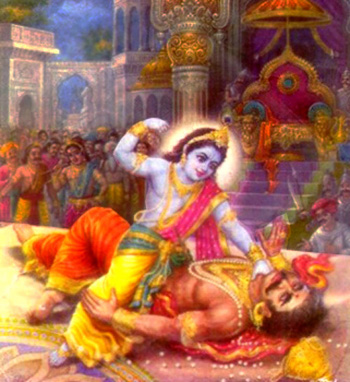 In the southern part of India, Diwali is celebrated as the day Lord Krishna killed the demon Narakasura and is called Naraka Chaturdasi. If the day falls on the new moon day or Amavasya, then you have to wake up very early and take a bath before daylight breaks. A special oil is made the previous night with herbs and spices and this is supposed to ward off the effects of winter. This oil is applied by the oldest woman in the family who is available and is done in front of the family altar. Once you bathe and get ready, you pray to the Lord and then to the elders in the family. You then eat the medicinal preparation made which prepares your stomach for the onslaught of food. Then it’s time to feast the yummy goodies you’ve slaved away at. Children and adults also light firecrackers in the early morning dawn to frighten the demons. Here in Singapore, firecrackers, especially the loud ones which make noise are banned, so we used to buy sparklers for the children when they were younger. Now that they are older, we stop at the goodie eating and visiting the temple.
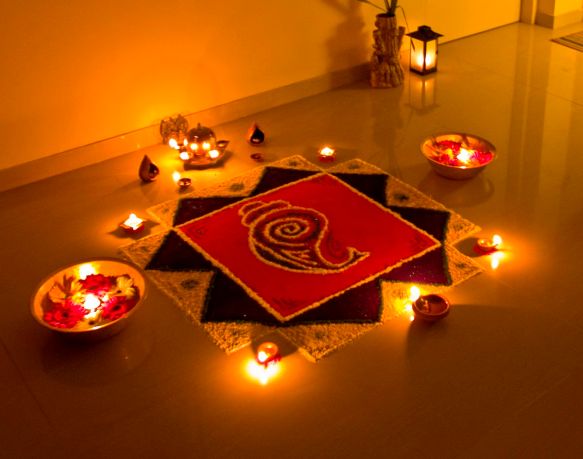
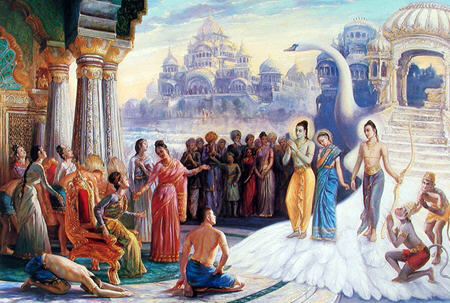 In North India, the day after Naraka Chaturdasi is usually celebrated as Diwali and is the day when Lord Rama reached Ayodhya after fulfiling the promise he made to his stepmother Keykeyi about going on a 14-year exile and in the process, killing the demon king Ravana in what is now present-day Sri Lanka which is celebrated as the festival of Dushhera. On that day, people decorate their homes with diyas and candles just like how the kingdom of Ayodhya had been decorated to welcome their beloved Lord Rama. People perform Laxmi Puja for wealth and also worship Goddess Saraswati for wisdom. Some Indian communities also celebrate their new year during this period and so there’s an additional celebration aspect during the three-four day long festivities.
 Some of the other legends from Indian mythology which are associated with this festival include:
- During the divine churning of the ocean, Goddess Lakshmi was incarnated on this day.
- In his fifth incarnation of Vaman, Lord Vishnu rescued Goddess Lakshmi from the clutches of King Bali, and this is another reason for celebrating Diwali.
- Another legend related in the Mahabharat has it that the Pandavas returned from their 12 years of exile on this day.
- It is also said that King Vikramaditya was coronated on this day, and Diwali festival is celebrated on this day which also gives it a historical significance.
Here’s wishing everyone who celebrates this festival a very Happy Diwali! To those who are also celebrating your new year, Saal Mubarak to you!
 Meet the Patel-Joneses—Babo, Sian, Mayuri, and Bean—in their little house with orange and black gates next door to the Punjab Women’s Association in Madras. Babo grew up here, but he and Sian, his cream-skinned Welsh love, met in London. Babo’s parents disapproved. And then they disapproved unless the couple moved back to Madras. So here they are. And as the twentieth century creaks and croaks its way along, Babo, Sian, and the children navigate their way through the uncharted territory of a “hybrid” family: the hustle and bustle of Babo’s relatives; the faraway phone-line crackle of Sian’s; the eternal wisdom and soft bosom of Great-Grandmother Ba; the perils of first love, lost innocence, and old age; and the big question: What do you do with the space your loved ones leave behind?
 This is the remarkable story of Hannah Easton, a unique woman born in the American colonies in 1670, “a person undreamed of in Puritan society.” Inquisitive, vital and awake to her own possibilities, Hannah travels to Mughal, India, with her husband, and English trader. There, she sets her own course, “translating” herself into the Salem Bibi, the white lover of a Hindu raja.
 This book is a crime thriller, set in the by-lanes of Mumbai. One muggy afternoon, a senior police officer is found murdered at his desk. When Inspector Virkar from the Crime Branch arrives at the scene, he finds a cryptic note that spills out of a student’s compass box. Then begins a series of killings and in each, a telltale compass box reveals more clues.
 Three commandos of the Indian Army’s elite Unit Kilo—Major Imtiaz Ahmed, Captain Shamsheer Suleiman and Lieutenant Rafiq Mehmood—are chosen for a one-of-a-kind ops mission: to enter Pakistan and eliminate dreaded underworld don, Irshad Dilawar. However, somehow, the Inter-Services Intelligence and Dilawar always seem to be one step ahead of them, foiling every plan they make. It doesn’t take long for Major Imtiaz to realize that something is amiss—the operation has been compromised. Will he be able to successfully complete his mission, or are he and his men, like Abhimanyu, entering a trap they cannot make their way out of? Set in the world of covert operations, where double-crossing and diabolical mind games are the norm, The Karachi Deception will keep you hooked till the very end.
 Memories and Such