A Geisha’s Journey: My Life as a Kyoto Apprentice – Komomo
This is the story of a contemporary Japanese teenager who, in a search for an identity, became fascinated with the world of geisha, and discovered in herself the will and the commitment to embark on the many years of apprenticeship necessary to become one.
It is also the story of a young Japanese photographer who grew up overseas, and who also was captivated by the traditional lives of these women who choose to dedicate themselves to their art. He began following and documenting the life of teenager Komomo as she studied and grew into her role.
Naoyuki Oginos photographs follow Komomos entire journey, from her first tentative visits after finding the geisha house on the internet through her commitment to the hard schedule of an apprentice, learning arts that go back centuries, all the way to the ceremony where she officially became a geiko, as Kyotos geisha are known and beyond. From the cobbled streets where she walks in her elaborate dress to the inner sanctums of her dressing room, these pages offer a rare look at a unique, living art.
The photographs are accompanied by autobiographical text and captions by Komomo, as she shares her thoughts and emotions, and describes the day-to-day existence of a Kyoto apprentice. It is an illuminating view of seven years in the life of a very special young woman.
A couple of months back, I came across this Japanese term, ‘Ikigai’ which essentially means finding your passion in life and leading your life according to that, in other words, your ‘raison d’être’ and the term really intrigued me. In other words, Ikigai is what makes you get up each morning and jeep going even when the going gets tough.
When I read more about this term, I thought that perhaps this was the missing link in our lives. If we lived a life worth living, if we did something which makes us jump out of bed each morning and looked forward to each new day, then wouldn’t that be the best thing ever? We would never have to work a day in our lives and life will be so much smoother without the usual angst work generates within us.
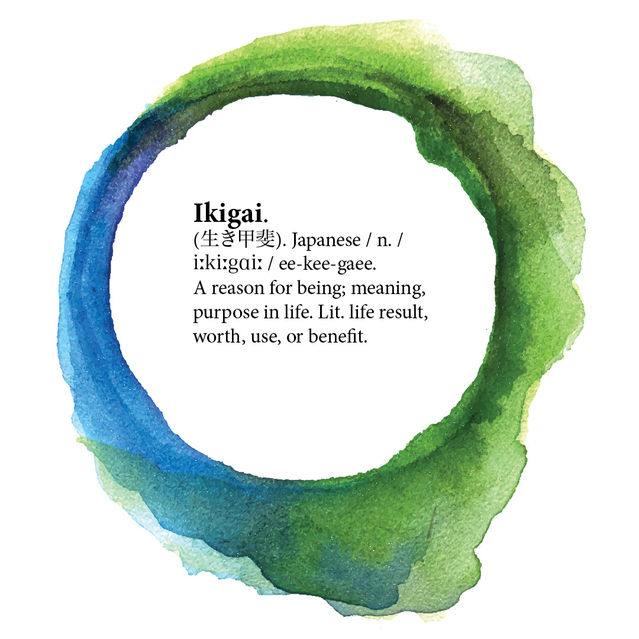
Ikigai which is pronounced as it is spelt, is a Japanese concept which means, “a reason for being”. The word “Ikigai” is usually used to indicate the source of value in one’s life or the things that make one’s life worthwhile. The word translated to English roughly means “thing that you live for” or “the reason for which you wake up in the morning.”
Each individual’s Ikigai is personal to them and specific to their lives, values and beliefs. It reflects the inner self of an individual and expresses that faithfully, while simultaneously creating a mental state in which the individual feels at ease. Activities that allow one to feel Ikigai are never forced on an individual; they are often spontaneous, and always undertaken willingly, giving the individual satisfaction and a sense of meaning to life.
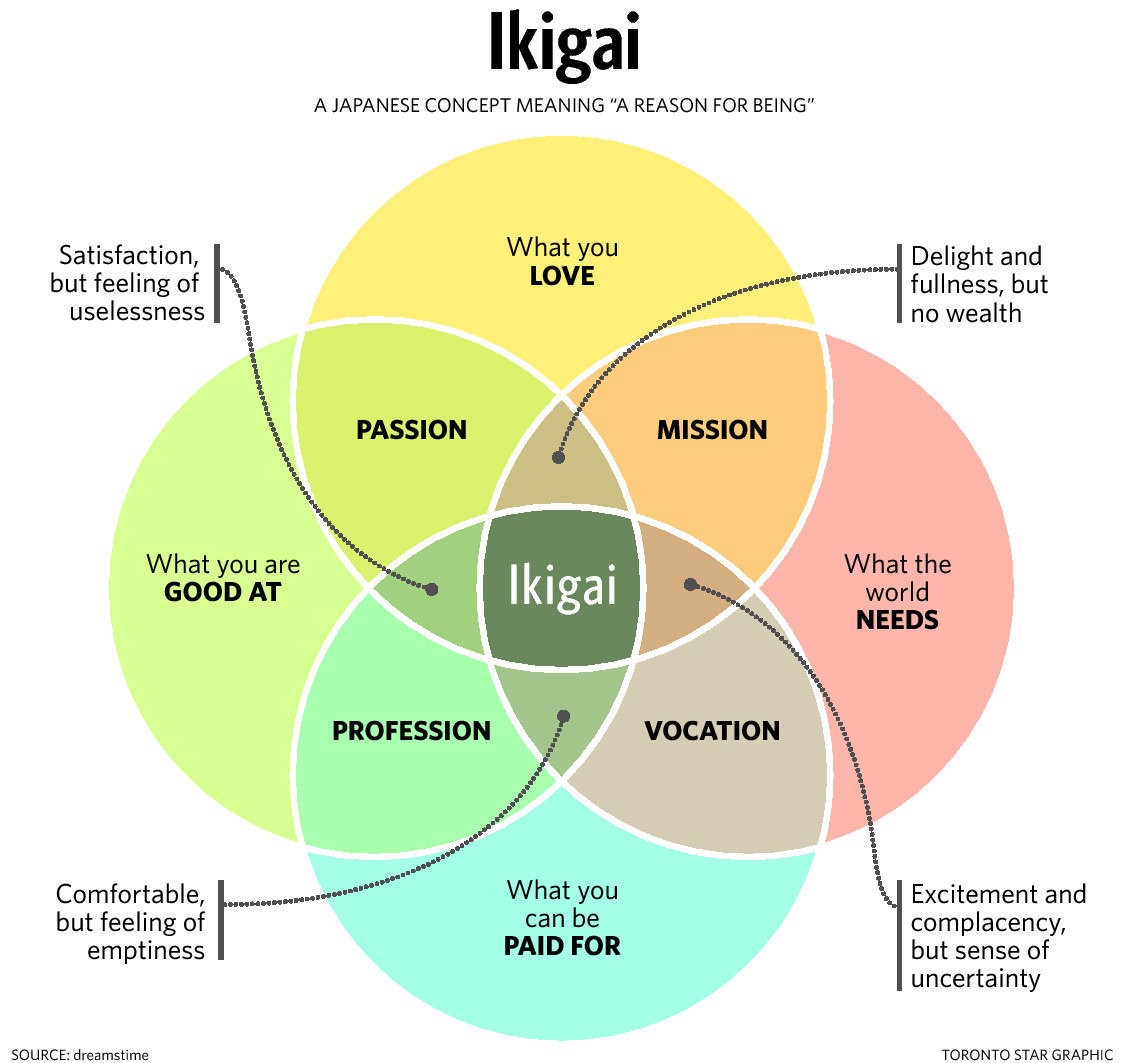
According to best seller author Dan Buettner, Ikigai lies at the cross section between your values, what you like to do and what you are good at. When you are able to figure that out, you have found your personal Ikigai.
So how do you find out your own personal Ikigai? Make four lists – the first one being your passion in life or what you love doing, the second being your mission in this world or what you feel this world needs, the third list being the able to figure what you are good at or your vocation in life and the last list being what you can get paid for doing your vocation which is essentially your profession. The intersection of these four lists will allow you to figure your personal and unique Ikigai.
In their book Ikigai: The Japanese Secret to a Long and Happy Life, Hector Garcia and Francesc Miralles break down the ten rules that can help anyone find their own Ikigai:
Stay active and don’t retire
Leave urgency behind and adopt a slower pace of life
Only eat until you are 80 per cent full
Surround yourself with good friends
Get in shape through daily, gentle exercise
Smile and acknowledge people around you
Reconnect with nature
Give thanks to anything that brightens our day and makes us feel alive.
Live in the moment
Follow your Ikigai
While the concept has been around for centuries now (it originated in the Heian period, sometime during the period 794 to 1185 AD), the majority of us, including the Japanese people haven’t quite figured it out yet.
There have been studies which say that Ikigai promotes a sense of wellbeing which is probably why the Japanese and particularly Okinawians where this concept is said to have originated live the longest. It was statistically proven that presence of Ikigai is correlated with a lower level of stress and an overall feeling of being healthy. The feeling of Ikigai balances out the secretion of neurotransmitters such as dopamine, serotonin and β-endorphin. Some studies demonstrate that a sense of purpose or goal in life or Ikigai is negatively correlated with a need for approval from others and anxiety and studies also found that Ikigai is associated with longevity among Japanese people.
Human beings are born curious. Our insatiable drive to learn, invent, explore, and study deserves to have the same status as every other drive in our lives. So go and channel that curiosity and maybe you will be able to find that sweet spot in your life which is your Ikigai. Once you do, use it every day. Find things to do, simple or complex in your day to day lives which would be an expression of your Ikigai and once you have found and pursued it, you will realise that anything else is just compromise.
I am going to leave you with a Youtube video where Dan Buettner speaks in a Ted-Ed video on how to live to more than a 100 where he also speaks about Ikigai.
When Tokyo falls victim to a deadly terrorist attack, Detective Sergeant Mariko Oshiro knows who is responsible, even if she doesn’t have proof. She urges her commanding officers to arrest the perpetrator—an insane zealot who was just released from police custody.
When her pleas fall on deaf ears, she loses her temper and then her badge, as well as her best chance of fighting back.
Left on her own, and armed with only her cunning and her famed Inazuma blade, Mariko must work outside the system to stop a terrorist mastermind. But going rogue draws the attention of an underground syndicate known as the Wind. For centuries, they have controlled Japanese politics from the shadows, using mystical relics to achieve their nefarious ends—relics like Mariko’s own sword and the iron demon mask whose evil curse is bound to the blade. Now the Wind is set on acquiring Mariko.
Mariko is left with a perilous choice: Join an illicit insurgency to thwart a deadly villain, or remain true to the law. Either way, she cannot escape her sword’s curse. As sure as the blade will bring her to victory, it also promises to destroy her….
The Waiting Years – Fumiko Enchi, translated by John Bester
The beautiful, immature girl whom she took home to her husband was a maid only in name. Tomo’s real mission had been to find him a mistress. Nor did her secret humiliation end there. The web that his insatiable lust spun about him soon trapped another young woman, and another … and the relationships between the women thus caught were to form, over the years, a subtle, shifting pattern in which they all played a part. There was Suga, the innocent, introspective girl from a respectable but impoverished family; the outgoing, cheerful, almost boyish Yumi; the flirtatious, seductive Miya, who soon found her father-in-law more dependable as a man than his brutish son…. And at the centre, rejected yet dominating them all, the near-tragic figure of the wife Tomo, whose passionate heart was always, until that final day, held in check by an old-fashioned code.
The Wind-Up Bird Chronicle – Haruki Murakami, translated by Jay Rubin
In a Tokyo suburb, a young man named Toru Okada searches for his wife’s missing cat. Soon he finds himself looking for his wife as well in a netherworld that lies beneath the placid surface of Tokyo. As these searches intersect, Okada encounters a bizarre group of allies and antagonists: a psychic prostitute; a malevolent yet mediagenic politician; a cheerfully morbid sixteen-year-old-girl; and an aging war veteran who has been permanently changed by the hideous things he witnessed during Japan’s forgotten campaign in Manchuria.



 The beautiful, immature girl whom she took home to her husband was a maid only in name. Tomo’s real mission had been to find him a mistress. Nor did her secret humiliation end there. The web that his insatiable lust spun about him soon trapped another young woman, and another … and the relationships between the women thus caught were to form, over the years, a subtle, shifting pattern in which they all played a part. There was Suga, the innocent, introspective girl from a respectable but impoverished family; the outgoing, cheerful, almost boyish Yumi; the flirtatious, seductive Miya, who soon found her father-in-law more dependable as a man than his brutish son…. And at the centre, rejected yet dominating them all, the near-tragic figure of the wife Tomo, whose passionate heart was always, until that final day, held in check by an old-fashioned code.
 In a Tokyo suburb, a young man named Toru Okada searches for his wife’s missing cat. Soon he finds himself looking for his wife as well in a netherworld that lies beneath the placid surface of Tokyo. As these searches intersect, Okada encounters a bizarre group of allies and antagonists: a psychic prostitute; a malevolent yet mediagenic politician; a cheerfully morbid sixteen-year-old-girl; and an aging war veteran who has been permanently changed by the hideous things he witnessed during Japan’s forgotten campaign in Manchuria.
