In My Hands Today…

Leadership: Six Studies in World Strategy – Henry Kissinger
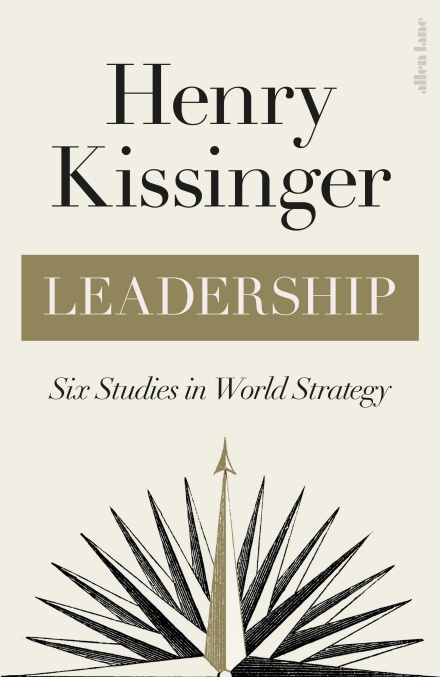
Henry Kissinger analyses how six extraordinary leaders he has known have shaped their countries and the world. ‘Leaders,’ writes Henry Kissinger in this compelling book, ‘think and act at the intersection of two the first, between the past and the future; the second between the abiding values and aspirations of those they lead.

They must balance what they know, which is necessarily drawn from the past, with what they intuit about the future, which is inherently conjectural and uncertain. It is this intuitive grasp of direction that enables leaders to set objectives and lay down a strategy. ‘In Leadership, Kissinger analyses the lives of six extraordinary leaders through the distinctive strategies of statecraft which he believes they embodied.

After the Second World War, Konrad Adenauer brought defeated and morally bankrupt Germany back into the community of nations by what Kissinger calls ‘the strategy of humility’. Charles de Gaulle set France beside the victorious Allies and renewed its historic grandeur by ‘the strategy of will’. During the Cold War, Richard Nixon gave geostrategic advantage to the United States by ‘the strategy of equilibrium’.

After twenty-five years of conflict, Anwar Sadat brought a vision of peace to the Middle East by a ‘strategy of transcendence’. Against the odds, Lee Kwan Yew created a powerhouse city-state, Singapore, by ‘the strategy of excellence’. Although when she came to power Britain was known as ‘the sick man of Europe’, Margaret Thatcher renewed her country’s morale and international position by ‘the strategy of conviction’.

To each of these studies, Kissinger brings historical perception, public experience and – because he knew each of their subjects, and participated in many of the events he describes – personal knowledge. The book is enriched by insights and judgements such as only he could make, and concludes with his reflections on world order and the indispensability of leadership today.

In My Hands Today…

The Art of Being Indispensable at Work: Win Influence, Beat Overcommitment, and Get the Right Things Done – Bruce Tulgan

What’s the secret to being indispensable—a true go-to person—in today’s workplace?

With new technology, constant change and uncertainty, and far-flung virtual teams, getting things done at work is tougher and more complex than ever. We’re in the midst of a collaboration revolution, working with everyone, all the time, across silos and platforms. But sometimes it feels like we’re stuck in a no-win cycle—dealing with an overwhelming influx of asks, with unclear lines of communication and authority. Overcommitment syndrome looms larger than ever before.

But even amid the seeming chaos, there’s always that indispensable go-to person who thrives on their many working relationships with people all over the organization chart. How do they do it? Go-to people consistently make themselves valuable to others, maintain a positive attitude of service, are creative and tenacious, and take personal responsibility for getting the right things done.

In this game-changing yet practical book, talent guru and bestselling author Bruce Tulgan reveals the secrets of the go-to person in our new world of work. Based on an intensive study of people at all levels, in all kinds of organizations, Tulgan shows how go-to people think and behave differently, building up their influence with others—not by trying to do everything for everybody but by doing the right things at the right times for the right reasons, regardless of whether they have the formal authority.

The Art of Being Indispensable at Work is the new How to Win Friends and Influence People for an era in which the guardrails of traditional management have been pulled away.

In My Hands Today…

She Thinks Like a Boss: Leadership—9 Essential Skills for New Female Leaders in Business and the Workplace – Jemma Roedel

Discover how to become an effective woman in leadership — even if you’re shy, avoid conflict at all costs, or lack confidence.

Are you tired of seeing men at work get promoted, be given better assignments, and enjoy pay raises even though you know your skills and results are just as good, if not better?

Do you find it difficult to express yourself during work meetings without being hostile or apologetic?

Perhaps you’re tired of coming home feeling frustrated because you didn’t speak up at the meeting, or maybe you feel as though, no matter what you try, people just walk all over you.

You know that there must be another way. And you’re right. But don’t help is at hand. In an incredibly male-dominated world, it’s crucial — now more than ever — to develop the necessary skills to become an effective leader and start demanding what you deserve.

Luckily, it’s easier than you think. You don’t have to buy into the self-help industry, which wastes your time, resources and energy on costly and often condescending life coaches and counselling sessions. All you need are easy, proven skills and traits that will help you gradually develop your self-esteem, sharpen your trust, and hone your boundary-setting and communication skills.

If you’re someone then Jemma Roedel can help you. Many people don’t understand that there’s a lot more to being a leader than just managing people. The first step to thinking like a boss is having the insight and understanding that pioneering successful women have — and using it to take constructive action. In She Thinks Like a Boss, here’s just a fraction of what you will, and much more.

Even if you feel uncomfortable or scared to face the issues that being a great leader brings, the key is to dive straight in. In She Thinks Like a Boss, you will be given specific and practical techniques to help you gradually overcome the problems you’re facing.

In My Hands Today…

How Big Things Get Done: The Surprising Factors That Determine the Fate of Every Project, from Home Renovations to Space Exploration and Everything In Between – Bent Flyvbjerg, Dan Gardner

Nothing is more inspiring than a big vision that becomes a triumphant, new reality. Think of how the Empire State Building went from a sketch to the jewel of New York’s skyline in twenty-one months, or how Apple’s iPod went from a project with a single employee to a product launch in eleven months.

These are wonderful stories. But most of the time big visions turn into nightmares. Remember Boston’s “Big Dig”? Almost every sizeable city in the world has such a fiasco in its backyard. In fact, no less than 92% of megaprojects come in over budget or over schedule, or both. The cost of California’s high-speed rail project soared from $33 billion to $100 billon—and won’t even go where promised. More modest endeavors, whether launching a small business, organizing a conference, or just finishing a work project on time, also commonly fail. Why?

Understanding what distinguishes the triumphs from the failures has been the life’s work of Oxford professor Bent Flyvbjerg, dubbed “the world’s leading megaproject expert.” In How Big Things Get Done, he identifies the errors in judgment and decision-making that lead projects, both big and small, to fail, and the research-based principles that will make you succeed with yours. For example:

  • Understand your odds. If you don’t know them, you won’t win.
  • Plan slow, act fast. Getting to the action quick feels right. But it’s wrong.
  • Think right to left. Start with your goal, then identify the steps to get there.
  • Find your Lego. Big is best built from small.
  • Be a team maker. You won’t succeed without an “us.”
  • Master the unknown unknowns. Most think they can’t, so they fail. Flyvbjerg shows how you can.
  • Know that your biggest risk is you.

Full of vivid examples ranging from the building of the Sydney Opera House, to the making of the latest Pixar blockbusters, to a home renovation in Brooklyn gone awry, How Big Things Get Done reveals how to get any ambitious project done—on time and on budget.

In My Hands Today…

Right Kind of Wrong: The Science of Failing Well – Amy C. Edmondson

We used to think of failure as the opposite of success. Now, we’re often torn between two “failure cultures”: one that says to avoid failure at all costs, the other that says fail fast, fail often. The trouble is that both approaches lack the crucial distinctions to help us separate good failure from bad. As a result, we miss the opportunity to fail well.

After decades of award-winning research, Amy Edmondson is here to upend our understanding of failure and make it work for us. In Right Kind of Wrong, Edmondson provides the framework to think, discuss, and practice failure wisely. Outlining the three archetypes of failure—simple, complex, and intelligent—Amy showcases how to minimize unproductive failure while maximizing what we gain from flubs of all stripes. She illustrates how we and our organizations can embrace our human fallibility, learn exactly when failure is our friend, and prevent most of it when it is not. This is the key to pursuing smart risks and preventing avoidable harm.

With vivid, real-life stories from business, pop culture, history, and more, Edmondson gives us specifically tailored practices, skills, and mindsets to help us replace shame and blame with curiosity, vulnerability, and personal growth. You’ll never look at failure the same way again.