In My Hands Today…

The Geek Way: The Radical Mindset that Drives Extraordinary Results – Andrew McAfee
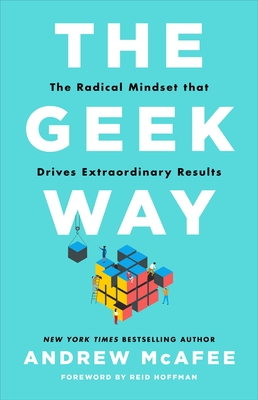
In this “handbook for disruptors” (Eric Schmidt), The Geek Way reveals a new way to get big things done. It will change the way you think about work, teams, projects, and culture, and give you the insight and tools you need to harness our human superpowers of learning and cooperation. What is “being geeky?” It’s being a perennially curious person, one who’s not afraid to tackle hard problems and embrace unconventional solutions. McAfee shows how the geeks have created a new culture based around four science, ownership, speed, and openness. The geek way seems odd at first. It’s not deferential to experts, fond of planning and process, afraid of mistakes, or obsessed with “winning.” But it explains everything from why Montessori babies turn out to be creative tinkerers to how newcomers are disrupting industry after industry (and still just getting started).

When all four norms are in place, a culture emerges that is freewheeling, fast-moving, egalitarian, evidence-driven, argumentative, and autonomous. Why does the geek way work so much better? McAfee provides an original because it taps into humanity’s superpower, which is our ability to cooperate intensely and learn rapidly. By providing insights from the young discipline of cultural evolution, McAfee shows that when we come together under the right conditions, we quickly figure out how to build reusable spaceships and self-correcting organizations. Under the wrong conditions, though, we create bureaucracy, chronic delays, cultures of silence, and the other classic dysfunctions of the Industrial Era.

Mixing cutting-edge science, history, analysis, and stories that show the geek way in action, McAfee offers a new way to see the world and empowering tools for seizing the big opportunities of today and tomorrow.

In My Hands Today…

How Big Things Get Done: The Surprising Factors That Determine the Fate of Every Project, from Home Renovations to Space Exploration and Everything In Between – Bent Flyvbjerg, Dan Gardner

Nothing is more inspiring than a big vision that becomes a triumphant, new reality. Think of how the Empire State Building went from a sketch to the jewel of New York’s skyline in twenty-one months, or how Apple’s iPod went from a project with a single employee to a product launch in eleven months.

These are wonderful stories. But most of the time big visions turn into nightmares. Remember Boston’s “Big Dig”? Almost every sizeable city in the world has such a fiasco in its backyard. In fact, no less than 92% of megaprojects come in over budget or over schedule, or both. The cost of California’s high-speed rail project soared from $33 billion to $100 billon—and won’t even go where promised. More modest endeavors, whether launching a small business, organizing a conference, or just finishing a work project on time, also commonly fail. Why?

Understanding what distinguishes the triumphs from the failures has been the life’s work of Oxford professor Bent Flyvbjerg, dubbed “the world’s leading megaproject expert.” In How Big Things Get Done, he identifies the errors in judgment and decision-making that lead projects, both big and small, to fail, and the research-based principles that will make you succeed with yours. For example:

  • Understand your odds. If you don’t know them, you won’t win.
  • Plan slow, act fast. Getting to the action quick feels right. But it’s wrong.
  • Think right to left. Start with your goal, then identify the steps to get there.
  • Find your Lego. Big is best built from small.
  • Be a team maker. You won’t succeed without an “us.”
  • Master the unknown unknowns. Most think they can’t, so they fail. Flyvbjerg shows how you can.
  • Know that your biggest risk is you.

Full of vivid examples ranging from the building of the Sydney Opera House, to the making of the latest Pixar blockbusters, to a home renovation in Brooklyn gone awry, How Big Things Get Done reveals how to get any ambitious project done—on time and on budget.

In My Hands Today…

Right Kind of Wrong: The Science of Failing Well – Amy C. Edmondson

We used to think of failure as the opposite of success. Now, we’re often torn between two “failure cultures”: one that says to avoid failure at all costs, the other that says fail fast, fail often. The trouble is that both approaches lack the crucial distinctions to help us separate good failure from bad. As a result, we miss the opportunity to fail well.

After decades of award-winning research, Amy Edmondson is here to upend our understanding of failure and make it work for us. In Right Kind of Wrong, Edmondson provides the framework to think, discuss, and practice failure wisely. Outlining the three archetypes of failure—simple, complex, and intelligent—Amy showcases how to minimize unproductive failure while maximizing what we gain from flubs of all stripes. She illustrates how we and our organizations can embrace our human fallibility, learn exactly when failure is our friend, and prevent most of it when it is not. This is the key to pursuing smart risks and preventing avoidable harm.

With vivid, real-life stories from business, pop culture, history, and more, Edmondson gives us specifically tailored practices, skills, and mindsets to help us replace shame and blame with curiosity, vulnerability, and personal growth. You’ll never look at failure the same way again.

In My Hands Today…

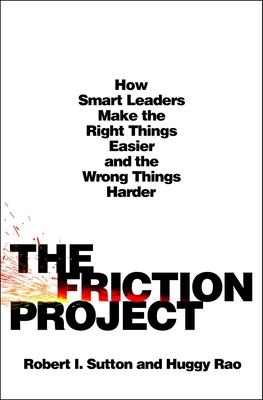
The Friction Project: How Smart Leaders Make the Right Things Easier and the Wrong Things Harder – Robert I. Sutton, Huggy Rao

Every organization is plagued by destructive friction—the forces that make it harder, more complicated, or downright impossible to get anything done. Yet some forms of friction are incredibly useful, and leaders who attempt to improve workplace efficiency often make things even worse. Drawing from seven years of hands-on research, The Friction Project by bestselling authors Robert I. Sutton and Huggy Rao teaches readers how to become “friction fixers,” so that teams and organizations don’t squander the zeal, damage the health, and throttle the creativity and productivity of good people—or burn through cash and other precious resources.

Sutton and Rao kick off the book by unpacking how skilled friction fixers think and act like trustees of others’ time. They provide friction forensics to help readers identify where to avert and repair bad organizational friction and where to maintain and inject good friction. Then their help pyramid shows how friction fixers do their work, which ranges from reframing friction troubles they can’t fix right now so they feel less threatening to designing and repairing organizations. The heart of the book digs into the causes and solutions for five of the most common and damaging friction oblivious leaders, addition sickness, broken connections, jargon monoxide, and fast and frenzied people and teams.

Sound familiar? Sutton and Rao are here to help. They wrap things up with lessons for leading your own friction project, including linking little things to big things; the power of civility, caring, and love for propelling designs and repairs; and embracing the mess that is an inevitable part of the process (while still trying to clean it up).

In My Hands Today…

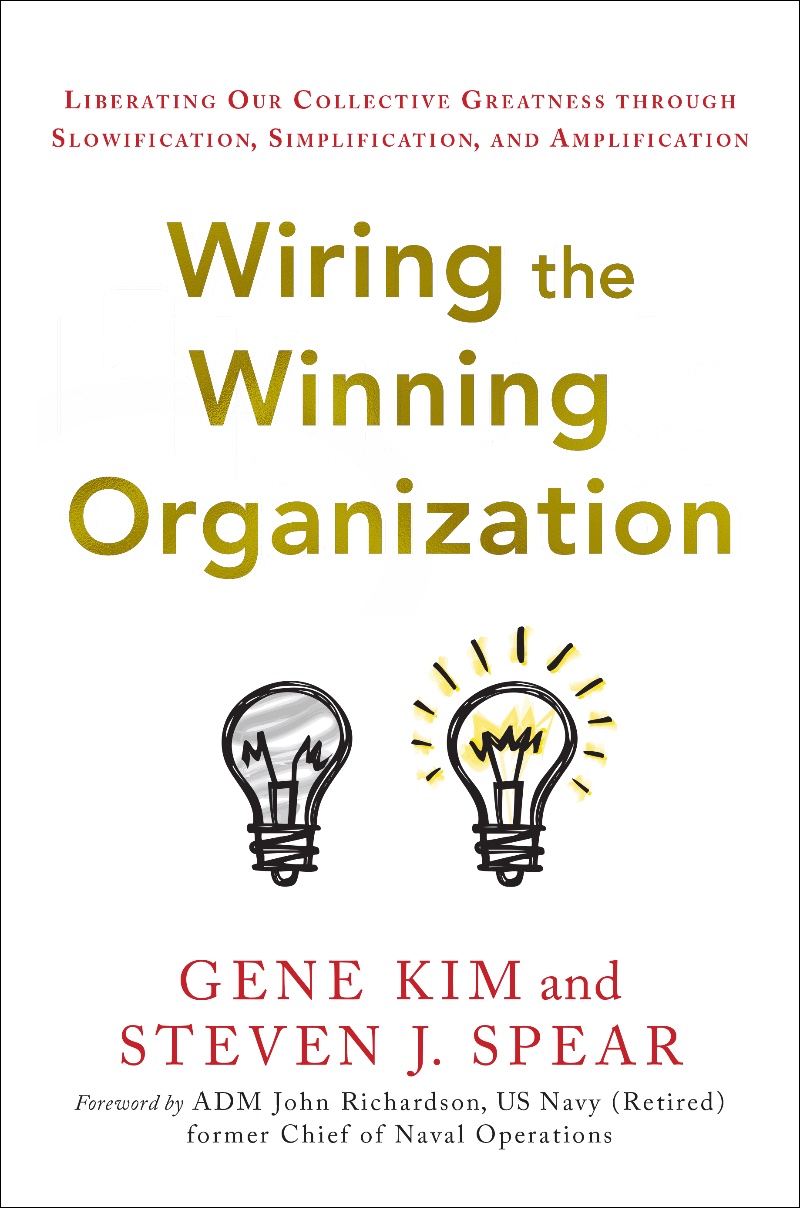
Wiring the Winning Organization: Liberating Our Collective Greatness through Slowification, Simplification, and Amplification – Gene Kim, Steven J. Spear

In this powerful new book, bestselling and award-winning authors Gene Kim and Dr. Steve Spear present a surprisingly simple theory to explain outstanding organizational performance… and show you how to replicate it in your own enterprise.

Each drawing on three decades of research and working with high-performing organizations across almost every industry and phase of value creation, Kim and Spear have come to a surprising winning comes from how leaders deliberately design their management systems around people’s ingenuity and how individuals’ creativity is integrated into a collaborative effort. This liberates the capabilities of the people within the organization, enabling them to continually push the frontiers of performance. These leaders have wired their organizations to win.

This is opposed to leaders who set their focus first on maximizing efficiency and optimizing for functional specialties, relying on planning, scheduling, and expediting, and yet never realizing those goals. Instead, they create high coordination costs and increase the cognitive burden, all of which constrain and sometimes even extinguish people’s ability to contribute. This is how leaders wire an organization for dismal outcomes. These results shouldn’t be surprising.

After all, on an otherwise level playing field, the only source of sustained competitive advantage is how well people’s intellectual capabilities can be engaged. Kim and Spear explain how organizations can move from the danger zone to the winning zone by employing three key slowification, which makes it easier to solve problems; simplification, which makes problems easier to solve; and amplification, which ensures problems are seen and solved.

Using over twenty case studies that span a wide variety of sectors, Kim and Spear present a new theory of performance and management that shows how the decisive factor in high-performing enterprises is organizational wiring that enables innovation, excellence, and greatness to flourish. Wiring the Winning Organization teaches leaders how to move from the danger zone to the winning zone to achieve greater agility, higher quality, faster time to market, greater resilience, and higher employee engagement and profitability.