In My Hands Today…

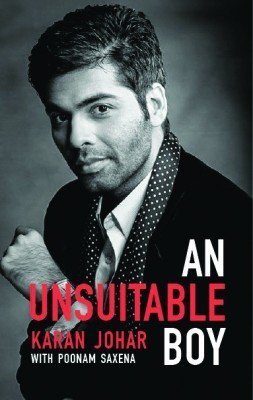
An Unsuitable Boy – Karan Johar and Poonam Saxena

Karan Johar is synonymous with success, panache, quick wit, and outspokenness, which sometimes inadvertently creates controversy and makes headlines. KJo, as he is popularly called, has been a much-loved Bollywood film director, producer, actor, and discoverer of new talent. With his flagship Dharma Productions, he has constantly challenged the norms, written and rewritten rules, and set trends. But who is the man behind the icon that we all know?

Baring all for the first time in his autobiography, An Unsuitable Boy, KJo reminisces about his childhood, the influence of his Sindhi mother and Punjabi father, obsession with Bollywood, foray into films, friendships with Aditya Chopra, SRK and Kajol, his love life, the AIB Roast, and much more.

This book is both the story of the life of an exceptional filmmaker at the peak of his powers and of an equally extraordinary human being who shows you how to survive and succeed in life.

In My Hands Today…

Rumours of Spring: A Girlhood in Kashmir – Farah Bashir

Rumours of Spring is the unforgettable account of Farah Bashir’s adolescence spent in Srinagar in the 1990s. As Indian troops and militants battle across the cityscape and violence becomes the new normal, a young schoolgirl finds that ordinary tasks—studying for exams, walking to the bus stop, combing her hair, falling asleep—are riddled with anxiety and fear.

With haunting simplicity, Farah Bashir captures moments of vitality and resilience from her girlhood amidst the increasing trauma and turmoil of passing years—secretly dancing to pop songs on banned radio stations; writing her first love letter; going to the cinema for the first time—with haunting simplicity. This deeply affecting coming-of-age memoir portrays how territorial conflict surreptitiously affects everyday lives in Kashmir.

In My Hands Today…

An American Martyr in Persia: The Epic Life and Tragic Death of Howard Baskerville – Reza Aslan

Little known in America but venerated as a martyr in Iran, Howard Baskerville was a twenty-two-year-old Christian missionary from South Dakota who traveled to Persia (modern-day Iran) in 1907 for a two-year stint teaching English and preaching the gospel. He arrived in the midst of a democratic revolution—the first of its kind in the Middle East—led by a group of brilliant young firebrands committed to transforming their country into a fully self-determining, constitutional monarchy, one with free elections and an independent parliament.

The Persian students Baskerville educated in English in turn educated him about their struggle for democracy, ultimately inspiring him to leave his teaching post and join them in their fight against a tyrannical shah and his British and Russian backers. “The only difference between me and these people is the place of my birth,” Baskerville declared, “and that is not a big difference.”

In 1909, Baskerville was killed in battle alongside his students, but his martyrdom spurred on the revolutionaries who succeeded in removing the shah from power, signing a new constitution, and rebuilding parliament in Tehran. To this day, Baskerville’s tomb in the city of Tabriz remains a place of pilgrimage. Every year, thousands of Iranians visit his grave to honor the American who gave his life for Iran.

In this rip-roaring tale of his life and death, Aslan gives us a powerful parable about the universal ideals of democracy—and to what degree Americans are willing to support those ideals in a foreign land. Woven throughout is an essential history of the nation we now know as Iran—frequently demonized and misunderstood in the West. Indeed, Baskerville’s life and death represent a “road not taken” in Iran. Baskerville’s story, like his life, is at the center of a whirlwind in which Americans must ask themselves: How seriously do we take our ideals of constitutional democracy and whose freedom do we support?

In My Hands Today…

The Uncaged Sky: My 804 Days in an Iranian Prison – Kylie Moore-Gilbert

‘The sky above our heads was uncaged and unlike us, free.’

On September 12, 2018 British-Australian academic Kylie Moore-Gilbert was arrested at Tehran Airport by Iran’s feared Islamic Revolutionary Guards. Convicted of espionage in a shadowy trial presided over by Iran’s most notorious judge, Dr Moore-Gilbert was sentenced to 10 years in prison.

Incarcerated in Tehran’s Evin and Qarchak prisons for 804 days, this is the full and gripping account of her harrowing ordeal. Held in a filthy solitary confinement cell for months, and subjected to relentless interrogation, Kylie was pushed to the limits of her endurance by extreme physical and psychological deprivation.

Kylie’s only lifeline was the covert friendships she made with other prisoners inside the Revolutionary Guards’ maximum-security compound where she had been ‘disappeared’, communicating in great danger through the air vents between cells, and by hiding secret letters in hava khori, the narrow outdoor balcony where she was led, blindfolded, for a solitary hour each day.

Cut off from the outside world, Kylie realised she alone had the power to change the dynamics of her incarceration. To survive, she began to fight back, adopting a strategy of resistance with her captors. Multiple hunger strikes, letters smuggled to the media, co-ordinated protests with other prisoners and a daring escape attempt led to her transfer to the isolated desert prison, Qarchak, to live among convicted criminals.

On November 25, 2020, after more than two years of struggle, Kylie was finally released in a high stakes three-nation prisoner swap deal orchestrated by the Australian government, laying bare the complex game of global politics in which she had become a valuable pawn.

In My Hands Today…

Option B: Facing Adversity, Building Resilience, and Finding Joy – Sheryl Sandberg and Adam Grant

After the sudden death of her husband, Sheryl Sandberg felt certain that she and her children would never feel pure joy again. “I was in ‘the void,’” she writes, “a vast emptiness that fills your heart and lungs and restricts your ability to think or even breathe.”

Her friend Adam Grant, a psychologist at Wharton, told her there are concrete steps people can take to recover and rebound from life-shattering experiences. We are not born with a fixed amount of resilience. It is a muscle that everyone can build.

Option B combines Sheryl’s personal insights with Adam’s eye-opening research on finding strength in the face of adversity. Beginning with the gut-wrenching moment when she finds her husband, Dave Goldberg, collapsed on a gym floor, Sheryl opens up her heart—and her journal—to describe the acute grief and isolation she felt in the wake of his death. But Option B goes beyond Sheryl’s loss to explore how a broad range of people have overcome hardships including illness, job loss, sexual assault, natural disasters, and the violence of war. Their stories reveal the capacity of the human spirit to persevere . . . and to rediscover joy.

Resilience comes from deep within us and from support outside us. Even after the most devastating events, it is possible to grow by finding deeper meaning and gaining greater appreciation in our lives. Option B illuminates how to help others in crisis, develop compassion for ourselves, raise strong children, and create resilient families, communities, and workplaces. Many of these lessons can be applied to everyday struggles, allowing us to brave whatever lies ahead. Two weeks after losing her husband, Sheryl was preparing for a father-child activity. “I want Dave,” she cried. Her friend replied, “Option A is not available,” and then promised to help her make the most of Option B.

We all live some form of Option B. This book will help us all make the most of it.