In My Hands Today…

Spy Stories: Inside the Secret World of ISI and Raw—Adrian Levy and Cathy Scott-Clark

From 9/11 to 26/11, Burhan Wani to Kulbhushan Jadhav—the India-Pakistan relationship told from the perspective of the R.A.W. and the I.S.I.

With unprecedented access to the R.A.W. and the I.S.I., the world’s most inscrutable spy agencies, Adrian Levy and Cathy Scott-Clark describe the workings of bitter rivals, mapping their complicated history from the 1960s to the present day. From the Parliament attacks to Pulwama, 9/11 to Osama bin Laden’s assassination, the rise of terror’s shadow armies to the fall of Kulbhushan Jadhav, here are some of the key events that have shaped the region, told from the split viewpoints of duelling enemies.

Levy and Scott-Clark also uncover a darker seam—the destructive impact of C.I.A. interference and how the I.S.I. fought for its life against dark forces it once funded, while the R.A.W. created ghost enemies to strengthen its hand.

In My Hands Today…

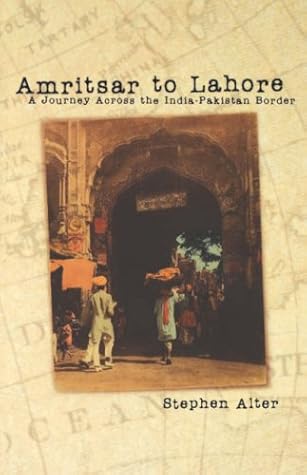
Amritsar to Lahore: A Journey Across the India-Pakistan Border – Stephen Alter

“During the course of my journey, many of the people I met in Pakistan and India expressed a curious combination of affection, indifference, and animosity toward their neighbors across the border. . . . The border divides them but it is also a seam that joins the fabric of their cultures.”

On 15 August 1947, in what some have argued was the final, cynical act of a collapsing empire, the British left India divided. Arbitrary borders that have profoundly affected the recent history of the subcontinent were drawn upon the map of India. In the violence that accompanied Partition, it has been estimated that close to a million people were killed and more than ten million uprooted and displaced. The hatreds created by what was one of the largest mass migrations in history only exacerbated the religious tensions that originally led to Partition. Since then, India and Pakistan have fought three devastating wars, and the danger of armed conflict is constant.

A sensitive and thoughtful look at the lasting effects of Partition on everyday people, Amritsar to Lahore describes a journey across the contested border between India and Pakistan in 1997, the fiftieth anniversary of Partition. Setting out from and then returning to New Delhi, Stephen Alter crossed the border into Pakistan, retraced the legendary route of the Frontier Mail toward the Khyber Pass, and made his return by bus along the Grand Trunk Road, stopping in major cities along the way.

During this journey and another in 1998, Alter interviewed people from all classes and castes: Hindus, Muslims, and Sikhs, men and women. In candid conversation, the older generation who lived through the events of 1947 shared their memories and opinions of that pivotal moment of Partition, while youths who have inherited the fragments of that past reflected upon the meaning of national identity. In an engaging account of peoples and places, Alter documents in evocative detail his meetings with varied individuals. He recalls the Muslim taxi driver who recognizes an air of confidence with which men in Pakistan walk the streets dressed in salwar kameez; the brigadier who saved the brass insignia of the British crown from Lord Mountbatten’s Rolls Royce; gold merchants, customs officers, fellow travelers, musicians, and many others.

Alongside these diverse and vivid interviews, chance conversations, and oral histories, Alter provides informed commentary to raise questions about national and individual identity, the territorial imperatives of history, and the insidious mythology of borders. A third-generation American in India, where he has spent much of his life, Alter reflects intimately upon India’s past and present as a special observer, both insider and outsider. His meaningful encounters with people on his journey illustrate the shared culture and heritage of South Asia, as well as the hateful suspicions and intolerance that permeate throughout the India-Pakistan frontier. Also woven into the narrative are discussions of the works of South Asian novelists, poets, and filmmakers who have struggled with the issue of identity across the borderlands.

Ongoing battles in Kashmir and nuclear testing by both India and Pakistan may prove that peace in this region can be achieved only when border disputes are resolved. Offering both the perspective of hindsight and a troubling vision of the future, Amritsar to Lahore presents a compelling argument against the impenetrability of boundaries and the tragic legacy of lands divided.

In My Hands Today…

The Nine Lives of Pakistan: Dispatches from a Precarious State – Declan Walsh

On assignment as the country careened between crises, Walsh traveled from the raucous port of Karachi to the salons of Lahore, and from Baluchistan to the mountains of Waziristan. He met a diverse cast of extraordinary Pakistanis—a chieftain readying for war at his desert fort, a retired spy skulking through the borderlands, and a crusading lawyer risking death for her beliefs, among others. Through these “nine lives” he describes a country on the brink—a place of creeping extremism and political chaos, but also personal bravery and dogged idealism that defy easy stereotypes.

Unbeknownst to Walsh, however, an intelligence agent was tracking him. Written in the aftermath of Walsh’s abrupt deportation, The Nine Lives of Pakistan concludes with an astonishing encounter with that agent, and his revelations about Pakistan’s powerful security state. Intimate and complex, attuned to the centrifugal forces of history, identity, and faith, The Nine Lives of Pakistan offers an unflinching account of life in a precarious, vital country.

In My Hands Today…

Changing Homelands: Hindu Politics and the Partition of India – Neeti Nair

Changing Homelands offers a startling new perspective on what was and was not politically possible in late colonial India. In this highly readable account of the partition in the Punjab, Neeti Nair rejects the idea that essential differences between the Hindu and Muslim communities made political settlement impossible. Far from being an inevitable solution, the idea of partition was a very late, stunning surprise to the majority of Hindus in the region.

In tracing the political and social history of the Punjab from the early years of the twentieth century, Nair overturns the entrenched view that Muslims were responsible for the partition of India. Some powerful Punjabi Hindus also preferred partition and contributed to its adoption. Almost no one, however, foresaw the deaths and devastation that would follow in its wake.

Though much has been written on the politics of the Muslim and Sikh communities in the Punjab, Nair is the first historian to focus on the Hindu minority, both before and long after the divide of 1947. She engages with politics in post-Partition India by drawing from oral histories that reveal the complex relationship between memory and history–a relationship that continues to inform politics between India and Pakistan.

In My Hands Today…

Beyond the Border: An Indian in Pakistan – Yoginder Sikand

Beyond the Border, based on two journeys that Yoginder Sikand undertook to Pakistan, covering Lahore, Multan, Hyderabad (Sindh), Moenjo Daro, Bhit Shah, and Islamabad, among others, is a strikingly unconventional account of what life is like for “ordinary” Pakistanis. The Pakistan he discovers only remotely resembles the stereotypical Muslim nation of the Hindu imagination. From Shiela, the daughter of a feudal lord, named after her mother’s Indian best friend to a rundown local eatery owner who offers the author free food because Sikand is the first Indian to visit his stall, encounters with Pakistanis from all walks of life draws up a very different picture – that Pakistan is a country as diverse, paradoxical and rich in narratives as India.

Departing from the fiercely polemical rhetoric common in Indian and Pakistani accounts of each other, Yoginder Sikand, not only gives lie to the strategist’s view of the India-Pakistan divide, but dispels the myths that have filtered into the Indian psyche about Pakistan being the terrible other. In this brilliantly perceptive and quirky travelogue, he illuminates the Pakistani side of the story, while telling his own tale of exploration and self-discovery.