In My Hands Today…

The Nine Lives of Pakistan: Dispatches from a Precarious State – Declan Walsh

On assignment as the country careened between crises, Walsh traveled from the raucous port of Karachi to the salons of Lahore, and from Baluchistan to the mountains of Waziristan. He met a diverse cast of extraordinary Pakistanis—a chieftain readying for war at his desert fort, a retired spy skulking through the borderlands, and a crusading lawyer risking death for her beliefs, among others. Through these “nine lives” he describes a country on the brink—a place of creeping extremism and political chaos, but also personal bravery and dogged idealism that defy easy stereotypes.

Unbeknownst to Walsh, however, an intelligence agent was tracking him. Written in the aftermath of Walsh’s abrupt deportation, The Nine Lives of Pakistan concludes with an astonishing encounter with that agent, and his revelations about Pakistan’s powerful security state. Intimate and complex, attuned to the centrifugal forces of history, identity, and faith, The Nine Lives of Pakistan offers an unflinching account of life in a precarious, vital country.

In My Hands Today…

Changing Homelands: Hindu Politics and the Partition of India – Neeti Nair

Changing Homelands offers a startling new perspective on what was and was not politically possible in late colonial India. In this highly readable account of the partition in the Punjab, Neeti Nair rejects the idea that essential differences between the Hindu and Muslim communities made political settlement impossible. Far from being an inevitable solution, the idea of partition was a very late, stunning surprise to the majority of Hindus in the region.

In tracing the political and social history of the Punjab from the early years of the twentieth century, Nair overturns the entrenched view that Muslims were responsible for the partition of India. Some powerful Punjabi Hindus also preferred partition and contributed to its adoption. Almost no one, however, foresaw the deaths and devastation that would follow in its wake.

Though much has been written on the politics of the Muslim and Sikh communities in the Punjab, Nair is the first historian to focus on the Hindu minority, both before and long after the divide of 1947. She engages with politics in post-Partition India by drawing from oral histories that reveal the complex relationship between memory and history–a relationship that continues to inform politics between India and Pakistan.

In My Hands Today…

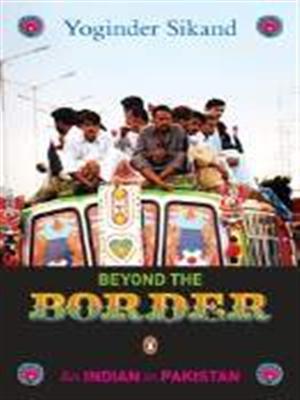
Beyond the Border: An Indian in Pakistan – Yoginder Sikand

Beyond the Border, based on two journeys that Yoginder Sikand undertook to Pakistan, covering Lahore, Multan, Hyderabad (Sindh), Moenjo Daro, Bhit Shah, and Islamabad, among others, is a strikingly unconventional account of what life is like for “ordinary” Pakistanis. The Pakistan he discovers only remotely resembles the stereotypical Muslim nation of the Hindu imagination. From Shiela, the daughter of a feudal lord, named after her mother’s Indian best friend to a rundown local eatery owner who offers the author free food because Sikand is the first Indian to visit his stall, encounters with Pakistanis from all walks of life draws up a very different picture – that Pakistan is a country as diverse, paradoxical and rich in narratives as India.

Departing from the fiercely polemical rhetoric common in Indian and Pakistani accounts of each other, Yoginder Sikand, not only gives lie to the strategist’s view of the India-Pakistan divide, but dispels the myths that have filtered into the Indian psyche about Pakistan being the terrible other. In this brilliantly perceptive and quirky travelogue, he illuminates the Pakistani side of the story, while telling his own tale of exploration and self-discovery.

In My Hands Today…

The Other Side of Silence: Voices from the Partition of India – Urvashi Butalia

The partition of India into two countries, India and Pakistan, caused one of the most massive human convulsions in history. Within the space of two months in 1947 more than twelve million people were displaced. A million died. More than seventy-five thousand women were abducted and raped. Countless children disappeared. Homes, villages, communities, families, and relationships were destroyed. Yet, more than half a century later, little is known of the human dimensions of this event.

In The Other Side of Silence , Urvashi Butalia fills this gap by placing people—their individual experiences, their private pain—at the center of this epochal event.Through interviews conducted over a ten-year period and an examination of diaries, letters, memoirs, and parliamentary documents, Butalia asks how people on the margins of history—children, women, ordinary people, the lower castes, the untouchables—have been affected by this upheaval.

To understand how and why certain events become shrouded in silence, she traces facets of her own poignant and partition-scarred family history before investigating the stories of other people and their experiences of the effects of this violent disruption. Those whom she interviews reveal that, at least in private, the voices of partition have not been stilled and the bitterness remains.

Throughout, Butalia reflects on difficult questions: what did community, caste, and gender have to do with the violence that accompanied partition? What was partition meant to achieve and what did it actually achieve? How, through unspeakable horrors, did the survivors go on? Believing that only by remembering and telling their stories can those affected begin the process of healing and forgetting, Butalia presents a sensitive and moving account of her quest to hear the painful truth behind the silence.

In My Hands Today…

Tales of Two Cities – Kuldip Nayar and Asif Noorani

In Tales of Two Cities, two eminent journalists – Kuldip Nayar and Asif Noorani – give their personal accounts of the Partition of India, the killings and massive migrations which it provoked and their subsequent impact on Indo-Pakistan relations.

As a young law graduate, Kuldip Nayar witnessed at first hand the collapse of trust between communities in Sialkot and was forced to migrate with his family to Delhi across the blood-stained plains of Punjab. He vividly describes his own perilous journey and his first job as a young journalist in an Urdu newspaper reporting on Gandhi’s assassination.

Asif Noorani, while still a schoolboy in Bombay, set off with his family by steamer across the Arabian Sea for the promised land of Pakistan, ultimately settling in Karachi. He gives his own compelling account of the difficulties faced by the new arrivals and the slow emergence of today’s megacity with its dominant Mohajir culture.

Both authors write with authority about their ancestral homes and their adopted cities, which have played so large a role in bilateral relations. This is a book about a trauma which transformed the subcontinent and still exerts a powerful influence today. These are personal narratives bringing to life a lost world of harmonious relations which each author in his own way is still to recreate.