Synchronicity: Everyday Magic?

“Synchronicity is an ever present reality for those who have eyes to see”

Carl Jung

There are times in your life when suddenly you see something popping up repeatedly in your life. For me this is in the form of multiple numbers. In any given week, I see numbers being repeated. This will be in the form of time where I will see time like 11:11 or 1:11 or 4:44 or even 5:55. Or maybe when I am reading book, online or offline and when I glance at the page number, it will show a double number like 44, 55 or even 77 or 99! I got curious about these coincidences and this is what I learnt.

When you notice the same coincidence happening more than once and it begins to take on meaning, then it becomes a Synchronicity. This type of serendipity can seem startling and mysterious when it happens often enough. Everyone has experienced these ‘meaningful coincidences’ in their life, but many don’t always pay attention to the meaning of the synchronicity itself, or realize how it came about in the first place. It is believed by many that this continued coincidence is a nudge from the universe telling you to go in a certain direction or maybe reassuring you that you on the right track, perhaps you are grappling with a decision and such coincidences show you the path to take?

A growing number of people believe that synchronicity is like a powerful ‘wink’ from the Universe telling us that yes, we’re on the right track. Synchronicity is also believed to be a form of guidance from the Higher Self; a way of showing you where to go and what to do next in your life as you proceed through your spiritual awakening.

Synchrocity is different from Serendipity. Serendipity is defined as the occurrence and development of events by chance in a happy or beneficial way, while synchrocity is a series of events which are symbolic in nature and which point out to something happening or going to happen in your life.

A concept first introduced by the analytical psychologist Carl Jung, synchronicity is defined as “the simultaneous occurrence of events which appear significantly related but have no discernible causal connection”. He says such events are “meaningful coincidences” if they occur with no causal relationship yet seem to be meaningfully related. According to Jung, synchronicity is an “acausal connecting (togetherness) principle,” “meaningful coincidence”, “acausal parallelism” or “meaningful coincidence of two or more events where something other than the probability of chance is involved”. He introduced the concept as early as the 1920s but gave a full statement of it only in 1951 in an Eranos lecture.

Synchronicity is considered pseudoscience because it is neither testable nor falsifiable. Mainstream science explains synchronicities as mere coincidences or spurious correlations which can be described by laws of statistics and confirmation biases.

According to Jung’s 1960 book, “Résumé”, Synchronicity: An Acausal Connecting Principle, the occurrence of a meaningful coincidence in time can take three forms:
a) The coincidence of a certain psychic content with a corresponding objective process which is perceived to take place simultaneously.
b) The coincidence of a subjective psychic state with a phantasm (dream or vision) which later turns out to be a more or less faithful reflection of a “synchronistic,” objective event that took place more or less simultaneously, but at a distance.
c) The same, except that the event perceived takes place in the future and is represented in the present only by a phantasm that corresponds to it.

For subjects like synchronicity, there will be skepctics who say that it’s all coincidence, chalking it up to what’s called “confirmation bias,” which is our very real tendency to remember our ‘hits,’ and forget our ‘misses’. They also point out to the fact that all experiences you hear from people about synchronicity are anecdotal, which means it’s a personal experience, something that happened only to them and can’t be replicated. But if you think about it, most of our experiences in life, spiritual or material are personal and what you experience and undergo may not be the same as someone in the same situation.

It is not very difficult to develop the ability to have synchronicity in your life. You need to be aware and have an open and receptive mind which pays attention to the now and present. Also be humble and don’t impose your desires on your experiences. Trust in yourself and the fact the universe will show synchronicity in your life. Lastly, listen to what your instincts tell you. Sometimes, and this is something I struggle with all the time, we tend to dismiss what our instincts tell us and instead use our mind and practicalities to make a decision. When this happens, when I have a disconnect between my mind and my heart and I let my mind win, I always regret it because my instincts were spot on. Our unconscious mind is vast and very wise and when we listen to our instincts, doors open and things happen for the better.

So the next time such coincidences happen in your life, don’t dismiss them. Stop and think and if you have a battle between your practical mind and your instincts, give the instinct a chance, you will be pleasantly surprised!

Have you had instances of synchronicity happen to you? Do comment and share it with me, I’d love to hear all about it!
Personality Types Part 2

Continuing from Wednesday’s post, here are the rest of the Mayer Briggs types of personalities:

ISTP aka The Virtuoso: Tolerant and flexible, quiet observers until a problem appears, then act quickly to find workable solutions. Analyze what makes things work and readily get through large amounts of data to isolate the core of practical problems. Interested in cause and effect, organize facts using logical principles, value efficiency. The explorers, virtuosos love to examine the world around them with cool rationalism and spirited curiosity and they are fairly uncommon, making around five percent of the population, with women being especially rare. People who are Virtuosos have strengths like being optimistic, energetic, creative, practical, spontaneous, rational, ability to prioritise and are great people to be around in a crisis. But they are also stubborn, insensitive, private, reserved, easily bored and dislike commitment.

ISFP aka The Adventurer: Quiet, friendly, sensitive, and kind. Enjoy the present moment, what’s going on around them. Like to have their own space and to work within their own time frame. Loyal and committed to their values and to people who are important to them. Dislike disagreements and conflicts, do not force their opinions or values on others. Artists of the world, these people use aesthetics, design and their choices and actions to push the limits of social conventions living out of the box. People with this personality type are charming, sensitive to others, imaginative, passionate, curious and artistic. They suffer from a number of weaknesses, including being fiercely independent, unpredictable, become easily stressed, overly competitive and have fluctuating self esteem.

INFP aka The Mediator: Idealistic, loyal to their values and to people who are important to them. Want an external life that is congruent with their values. Curious, quick to see possibilities, can be catalysts for implementing ideas. Seek to understand people and to help them fulfill their potential. Adaptable, flexible, and accepting unless a value is threatened. True idealists, these people are always looking for that hint of good, even in the worst of people and situations. Comprising of four percent of the population, the mediator’s strength lies in being idealistic, open minded, flexible and very creative. They are also passionate and energetic people but tend to be too idealistic and altruistic and somewhat impractical.

INTP aka The Logician: Seek to develop logical explanations for everything that interests them. Theoretical and abstract, interested more in ideas than in social interaction. Quiet, contained, flexible, and adaptable. Have unusual ability to focus in depth to solve problems in their area of interest. Skeptical, sometimes critical, always analytical. A fairly rare type making up only three percent of the population. Strengths include great analysis skills as well as being abstract thinkers who can take seemingly unrelated factors and tie them in ways that make no sense to the other personality types. They are also very imaginative, original and have open minds. This type should be careful not to seem very private and withdrawn, insensitive and absent-minded.

ESTP aka The Entrepreneur: Flexible and tolerant, they take a pragmatic approach focused on immediate results. Theories and conceptual explanations bore them – they want to act energetically to solve the problem. Focus on the here-and-now, spontaneous, enjoy each moment that they can be active with others. Enjoy material comforts and style. Learn best through doing. Full of passion and energy, these people are inspiring, colourful and natural group leaders. Entrepreneurs are bold, rational, practical, original, perceptive and direct. Their weakness include being insensitive to others, being impatient, risk-prone and unstructured and defiant, they sometimes miss the bigger picture.

ESFP aka The Entertainer: Outgoing, friendly, and accepting. Exuberant lovers of life, people, and material comforts. Enjoy working with others to make things happen. Bring common sense and a realistic approach to their work, and make work fun. Flexible and spontaneous, adapt readily to new people and environments. Learn best by trying a new skill with other people. People who are this personality are the born entertainers of our world, with the strongest aesthetic sense of any personality type with a very keen eye for fashion. The entertainers are bold, original, practical, observant and have a keen sense of aesthetics and showmanship. They need to work on being sensitive, conflict-averse, easily bored, unfocused and to become better long term planners.

ENFP aka The Campaigner: Warmly enthusiastic and imaginative. See life as full of possibilities. Make connections between events and information very quickly, and confidently proceed based on the patterns they see. Want a lot of affirmation from others, and readily give appreciation and support. Spontaneous and flexible, often rely on their ability to improvise and their verbal fluency. A true free spirit, these people are the life of a party making up around 7% of the population. Campaigners are curious, observant, energetic, enthusiastic, very popular and excellent communicators. However, they suffer from poor practical skills, have problems focusing, overthink things and get stressed easily.

ENTP aka The Debater: Quick, ingenious, stimulating, alert, and outspoken. Resourceful in solving new and challenging problems. Adept at generating conceptual possibilities and then analyzing them strategically. Good at reading other people. Bored by routine, will seldom do the same thing the same way, apt to turn to one new interest after another. The ultimate devil’s advocate, who thrive on the process of shedding arguments and beliefs and letting the ribbons drift in the wind for all to see. They are highly knowledgeable, original, quick thinkers and excellent brainstormers. But they are also very argumentative, insensitive and intolerant who dislike practical matters and find it difficult to focus.

ESTJ aka The Executive: Practical, realistic, matter-of-fact. Decisive, quickly move to implement decisions. Organize projects and people to get things done, focus on getting results in the most efficient way possible. Take care of routine details. Have a clear set of logical standards, systematically follow them and want others to also. Forceful in implementing their plans. Representatives of tradition and order, the executives utilise their understanding of right, wrong and socially acceptable to bring families and communities together and make up around 11% of the population. They are dedicated, strong-willed, direct, honest, loyal, patient, reliable, excellent organisers and enjoy creating order. However they suffer from being inflexible, stubborn, judgemental, focused on social status and being uncomfortable with unconventional situations.

ESFJ aka The Consul: Warmhearted, conscientious, and cooperative. Want harmony in their environment, work with determination to establish it. Like to work with others to complete tasks accurately and on time. Loyal, follow through even in small matters. Notice what others need in their day-by-day lives and try to provide it. Want to be appreciated for who they are and for what they contribute. Popular people, the consuls are one of the more common types making up 12% of the population. These people bring strong practical skills, strong sense of duty, loyalty, sensitivity and an ability to connect with others to the table.Their weaknesses include being worried about their social status, being inflexible, reluctant to innovate, being too selfless and being vulnerable to criticism.

ENFJ aka The Protagonist: Warm, empathetic, responsive, and responsible. Highly attuned to the emotions, needs, and motivations of others. Find potential in everyone, want to help others fulfill their potential. May act as catalysts for individual and group growth. Loyal, responsive to praise and criticism. Sociable, facilitate others in a group, and provide inspiring leadership. These are natural born leaders who are full of passion and charisma who form around two percent of the population and are usually our politicians, coaches and teachers who inspire others to do good in the world. People with this personality type are tolerant, reliable, charismatic and natural leaders. However, their weaknesses include being overly idealistic, selfless and sensitive. They also have fluctuating self-esteem and struggle to make tough decisions.

ENTJ aka The Commander: Frank, decisive, assume leadership readily. Quickly see illogical and inefficient procedures and policies, develop and implement comprehensive systems to solve organizational problems. Enjoy long-term planning and goal setting. Usually well informed, well read, enjoy expanding their knowledge and passing it on to others. Forceful in presenting their ideas. Making up around 3 percent of the population, these natural born leaders love a good challenge. Being efficient, energetic, strong-willed and self confident are their strengths, but they are also intolerant, stubborn, dominant, arrogant and impatient which are their biggest weaknesses.

Now that we have seen all 16 types, do click this link and take your own test to see which type you are?

I am an INTJ personality and when I read what the results said, I was really blown away! It was so close to what I am, as if they literally read me to write about this personality. The pages gave me good insight about myself, what are the strengths I have internally that I should play up and what are the things I should look out for as well as workplace habits!

I’d love to hear in the comments if anyone else did the test and whether it fit in with their own personality….

Personality Types – Part 1

I was reading something online and I chanced upon the explanation for the Mayer Briggs Type Indicator ® (MBTI®). Intrigued, I decided to spend time finding out more.

According to the official website,“The purpose of the Myers-Briggs Type Indicator® (MBTI®) personality inventory is to make the theory of psychological types described by C. G. Jung understandable and useful in people’s lives. The essence of the theory is that much seemingly random variation in the behavior is actually quite orderly and consistent, being due to basic differences in the ways individuals prefer to use their perception and judgment.”

The four parameters for the test are

  1. Do you prefer to focus on the outer (Extraversion – E) or your inner world (Introversion – I)
  2. Do you prefer to focus on the basic information that you take in (Sensing – S) or do you prefer to interpret and add meaning to it (Intuition – N)
  3. While making decisions, do you prefer to first look at logic and consistency (Thinking – T) or look at the people and special circumstances first (Feeling – F)
  4. In dealing with the outside world, do you prefer to get things decided (Judging – J) or you prefer to stay open to new information and options (Perceiving – P)

When the preferences in each category are decided, usually through a test, you have your own personality type, which is expressed as a code with four letters.

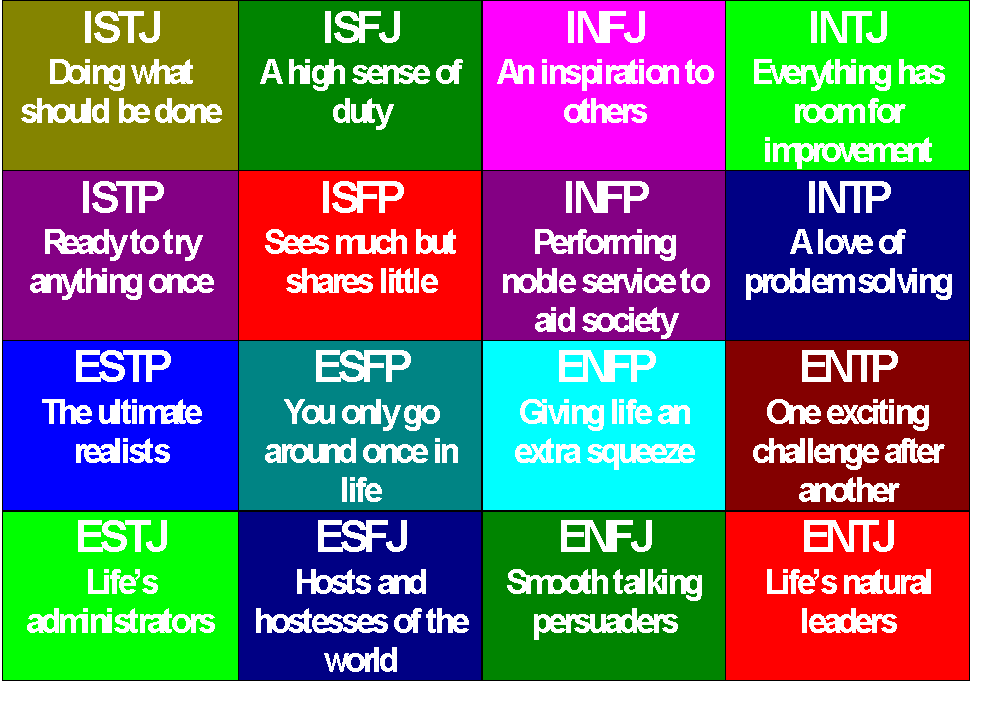
There are 16 personality types within the Mayer Briggs Type Indicator ® and are often listed in what they call a “type table”

A more detailed explanation of the different types is given below. The descriptions are combined from here and here:

ISTJ aka The Logistician: Quiet, serious, earn success by thoroughness and dependability. Practical, matter-of-fact, realistic, and responsible. Decide logically what should be done and work toward it steadily, regardless of distractions. Take pleasure in making everything orderly and organized – their work, their home, their life. Value traditions and loyalty. The most abundant, with around 13% of the population, this personality type is the vital core to many families as well as organisations. These people are honest, direct, strong-willed, dutiful, responsible, calm, practical and create and enforce order. However, they are stubborn, insensitive, work by the book and are seen as being judgemental.

ISFJ aka The Defender: Quiet, friendly, responsible, and conscientious. Committed and steady in meeting their obligations. Thorough, painstaking, and accurate. Loyal, considerate, notice and remember specifics about people who are important to them, concerned with how others feel. Strive to create an orderly and harmonious environment at work and at home. This is a unique personality type as many of their qualities defy the definition of their individual traits with these people being more than the sum of their parts and make up around 13% of the population. Defenders are supportive, reliable, patient, imaginative, observant, enthusiastic, loyal, hard-working and have good practical skills. They are also humble, shy, take things personally, repress their feelings, are reluctant to change and overload themselves.

INFJ aka The Advocate: Seek meaning and connection in ideas, relationships, and material possessions. Want to understand what motivates people and are insightful about others. Conscientious and committed to their firm values. Develop a clear vision about how best to serve the common good. Organized and decisive in implementing their vision. this personality type is very rare, making up less than one percent of the population. Born diplomats, they have an inborn sense of idealism and morality and capable of taking concrete steps to realise their goals and make a lasting positive impact. The Advocates are very creative, insightful, decisive, inspiring and convincing, but they need to work on being a less sensitive, perfectionistic and private person and stop burning out easily.

INTJ aka The Architect: Have original minds and great drive for implementing their ideas and achieving their goals. Quickly see patterns in external events and develop long-range explanatory perspectives. When committed, organize a job and carry it through. Skeptical and independent, have high standards of competence and performance – for themselves and others. One of the rarest and most strategically capable personality types with INTJ’s forming only 2% of the population. Strengths include a very quick, imaginative and strategic mind with high self confidence and very independent and decisive plus being Jacks of all trades. This type needs to be careful of being arrogant and judgemental as well as not fall into the trap of being overly analytical

These are the first four types. Since the post is now already too long, will do the rest on Friday. Do check in to see where you would be?