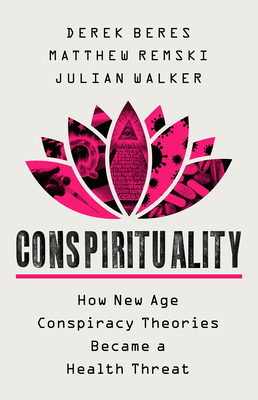
Conspirituality: How New Age Conspiracy Theories Became a Public Health Threat – Derek Beres, Matthew Remski, Julian Walker
Conspirituality takes a deep dive into the troubling phenomenon of influencers who have curdled New Age spirituality and wellness with the politics of paranoia—peddling vaccine misinformation, tales of child trafficking, and wild conspiracy theories.
In the early days of the COVID-19 pandemic, a disturbing social media trend a large number of yoga instructors and alt-health influencers were posting stories about a secretive global cabal bent on controlling the world’s population with a genocidal vaccine. Instagram feeds that had been serving up green smoothie recipes and Mary Oliver poems became firehoses of Fox News links, memes from 4chan, and prophecies of global transformation.
Since May 2020, Derek Beres, Matthew Remski and Julian Walker have used their Conspirituality podcast to expose countless facets of the intersection of alt-health practitioners with far-right conspiracy trolls. Now this expansive and revelatory book unpacks the follies, frauds, cons and cults that dominate the New Age and wellness spheres and betray the trust of people who seek genuine relief in this uncertain age.
Each of the three authors has witnessed firsthand the use of fear-based political agendas to manipulate the human desire for spiritual fulfillment. They throw a spotlight on the telltale signs of cult dynamics and expose how influencers have stoked suspicion of public health initiatives. And they show how charlatans and pseudo-doctors encourage their followers to oppose mainstream advice as a form of spiritual quest.
With analytical rigor and flashes of irreverent humor, Conspirituality offers an antidote to our times, helping readers recognize wellness grifts, engage with loved ones who’ve fallen under the influence, and counter lies and distortions with insight and empathy.
The Age of Magical Overthinking: Notes on Modern Irrationality – Amanda Montell
Utilizing the linguistic insights of her “witty and brilliant” first book Wordslut and the sociological explorations of her breakout hit Cultish, Amanda Montell now turns her erudite eye to the inner workings of the human mind and its biases in her most personal and electrifying work yet.
“Magical thinking” can be broadly defined as the belief that one’s internal thoughts can affect unrelated events in the external Think of the conviction that one can manifest their way out of poverty, stave off cancer with positive vibes, thwart the apocalypse by learning to can their own peaches, or transform an unhealthy relationship to a glorious one with loyalty alone. In all its forms, magical thinking works in service of restoring agency amid chaos, but in The Age of Magical Overthinking, Montell argues that in the modern information age, our brain’s coping mechanisms have been overloaded, and our irrationality turned up to an eleven.
In a series of razor sharp, deeply funny chapters, Montell delves into a cornucopia of the cognitive biases that run rampant in our brains, from how the “Halo effect” cultivates worship (and hatred) of larger than life celebrities, to how the “Sunk Cost Fallacy” can keep us in detrimental relationships long after we’ve realized they’re not serving us. As she illuminates these concepts with her signature brilliance and wit, Montell’s prevailing message is one of hope, empathy, and ultimately forgiveness for our anxiety-addled human selves. If you have all but lost faith in our ability to reason, Montell aims to make some sense of the senseless. To crack open a window in our minds, and let a warm breeze in. To help quiet the cacophony for a while, or even hear a melody in it.
Doppelganger: A Trip into the Mirror World – Naomi Klein
What if you woke up one morning and found you’d acquired another self―a double who was almost you and yet not you at all? What if that double shared many of your preoccupations but, in a twisted, upside-down way, furthered the very causes you’d devoted your life to fighting against?
Not long ago, the celebrated activist and public intellectual Naomi Klein had just such an experience―she was confronted with a doppelganger whose views she found abhorrent but whose name and public persona were sufficiently similar to her own that many people got confused about who was who. Destabilized, she lost her bearings, until she began to understand the experience as one manifestation of a strangeness many of us have come to know but struggle to define: AI-generated text is blurring the line between genuine and spurious communication; New Age wellness entrepreneurs turned anti-vaxxers are scrambling familiar political allegiances of left and right; and liberal democracies are teetering on the edge of absurdist authoritarianism, even as the oceans rise. Under such conditions, reality itself seems to have become unmoored. Is there a cure for our moment of collective vertigo?
Naomi Klein is one of our most trenchant and influential social critics, an essential analyst of what branding, austerity, and climate profiteering have done to our societies and souls. Here she turns her gaze inward to our psychic landscapes, and outward to the possibilities for building hope amid intersecting economic, medical, and political crises. With the assistance of Sigmund Freud, Jordan Peele, Alfred Hitchcock, and bell hooks, among other accomplices, Klein uses wry humor and a keen sense of the ridiculous to face the strange doubles that haunt us―and that have come to feel as intimate and proximate as a warped reflection in the mirror.
Combining comic memoir with chilling reportage and cobweb-clearing analysis, Klein seeks to smash that mirror and chart a path beyond despair. Doppelganger What do we neglect as we polish and perfect our digital reflections? Is it possible to dispose of our doubles and overcome the pathologies of a culture of multiplication? Can we create a politics of collective care and undertake a true reckoning with historical crimes? The result is a revelatory treatment of the way many of us think and feel now―and an intellectual adventure story for our times.
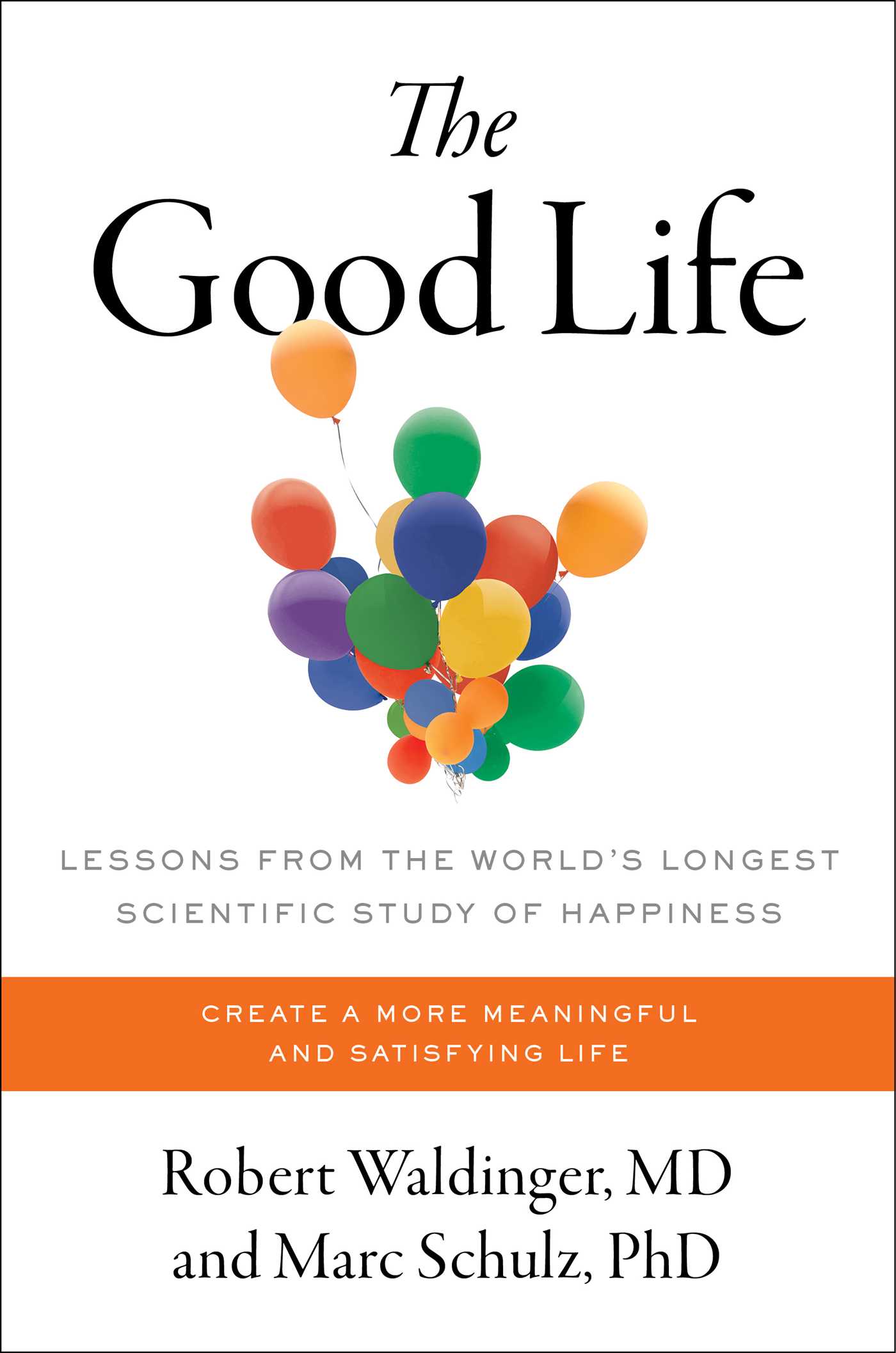
The Good Life: Lessons from the World’s Longest Scientific Study of Happiness – Robert Waldinger, Marc Schulz
What makes for a happy life, a fulfilling life? A good life? In their “captivating” ( The Wall Street Journal) book, the directors of the Harvard Study of Adult Development, the longest scientific study of happiness ever conducted, show that the answer to these questions may be closer than you realize.
What makes a life fulfilling and meaningful? The simple but surprising answer relationships. The stronger our relationships, the more likely we are to live happy, satisfying, and healthier lives. In fact, the Harvard Study of Adult Development reveals that the strength of our connections with others can predict the health of both our bodies and our brains as we go through life.
The invaluable insights in this book emerge from the revealing personal stories of hundreds of participants in the Harvard Study as they were followed year after year for their entire adult lives, and this wisdom was bolstered by research findings from many other studies. Relationships in all their forms—friendships, romantic partnerships, families, coworkers, tennis partners, book club members, Bible study groups—all contribute to a happier, healthier life. And as The Good Life shows us, it’s never too late to strengthen the relationships you already have, and never too late to build new ones. The Good Life provides examples of how to do this.
Dr. Waldinger’s TED Talk about the Harvard Study, “What Makes a Good Life,” has been viewed more than 42 million times and is one of the ten most-watched TED talks ever.
“Que sera, sera, whatever will be, will be. The future’s not ours to see.” – Ray Evans and Jay Livingston
This song was a favourite while growing up among my friends and myself and we would sing it frequently when we had time in class and when we went on picnics and camps. The phrase “Que sera, sera” (pronounced “kay sair-uh, sair-uh”) is Spanish for “Whatever will be, will be.” It gained widespread popularity in the 1950s through the song of the same name, written by the legendary songwriting duo of Jay Livingston and Ray Evans.
The song was first featured in the 1956 Alfred Hitchcock film “The Man Who Knew Too Much,” where it was sung by Doris Day. Although Day initially disliked the song and only recorded one take, it went on to become her signature song and a massive hit. The lyrics reflect the philosophy of accepting the future as it unfolds:
“When I was just a little girl, I asked my mother, ‘What will I be? Will I be pretty? Will I be rich?’ Here’s what she said to me: ‘Que sera, sera. Whatever will be, will be. The future’s not ours to see. Que sera, sera.'”
However, the phrase “Que sera, sera” actually predates the song. It was found carved in stone in the 1954 film “The Barefoot Contessa,” where it was translated by the character played by Rossano Brazzi as “What will be, will be.” Livingston and Evans recognised the potential of the phrase and crafted the now-iconic song around it.
The philosophy behind “Que sera, sera” is one of acceptance and letting go. It suggests that worrying about the future is futile, as it is not ours to control or predict. Instead, we should focus on the present moment and trust that whatever happens is meant to be.
The concept aligns closely with existentialist philosophy, which emphasises individual experience and the inherent uncertainty of life. Existentialism posits that life lacks inherent meaning, and individuals must navigate their existence amidst this ambiguity. So Que Sera, Sera reflects the acceptance of life’s unpredictability, resonating with existentialist themes of embracing uncertainty and the limits of control over one’s fate. This perspective encourages individuals to focus on the present and make choices despite the unknown future, embodying the existentialist belief in personal agency within an indifferent universe.
This concept is closely related to the Serenity Prayer, which asks for the wisdom to accept the things we cannot change, the courage to change the things we can, and the wisdom to know the difference. It is also reminiscent of the Buddhist teaching of non-attachment, which encourages letting go of desires and expectations to find peace and contentment.
In a world that often emphasises goal-setting, planning, and control, the idea of “Que sera, sera” can be a refreshing and liberating perspective. It acknowledges that life is unpredictable and that we cannot always predict or control the outcomes of our actions. By accepting this uncertainty and trusting in the flow of life, we can reduce stress, anxiety, and disappointment.
Adopting a “Que sera, sera” attitude can bring numerous benefits to our lives. When we let go of the need to control every aspect of our lives, we free ourselves from the burden of constant worry and stress. By accepting that some things are beyond our control, we can focus our energy on what we can influence and let go of the rest. By embracing the unpredictability of life, we build resilience and the ability to adapt to changing circumstances. When we face challenges or setbacks, we can approach them with a mindset of flexibility and openness rather than rigidity and resistance. By not fixating on the future, we can fully engage with and appreciate the present moment. We can savour the joys and pleasures of daily life rather than constantly looking ahead to the next goal or milestone. When we let go of expectations and attachments, we reduce the risk of disappointment. If things don’t turn out as we had hoped, we can more easily accept the situation and move forward, rather than getting stuck in regret or bitterness. Embracing “Que sera, sera” can foster a sense of trust in the larger forces at work in the universe. Whether one believes in God, fate, or simply the natural flow of life, trusting that things happen for a reason can provide a sense of comfort and security in the face of uncertainty.
Adopting a “Que sera, sera” mindset doesn’t mean abandoning all planning or goal-setting. It simply means striking a balance between taking action and letting go of the need to control the outcome. Here are some ways to incorporate this philosophy into your daily life:
Practice Acceptance: When faced with a situation that is out of one’s control, consciously practice acceptance. Acknowledge the reality of the situation, let go of any resistance or resentment, and focus the energy on what one can influence.
Cultivate Gratitude: Regularly expressing gratitude for the good things in one’s life can help shift one’s focus from what one lacks to what one already has. This practice can foster a sense of abundance and appreciation, even in the face of uncertainty.
Embrace Flexibility: Be willing to adapt and change course when necessary. Rigidly clinging to a specific outcome can lead to disappointment and frustration. Instead, approach life with a flexible mindset, ready to pivot and explore new possibilities as they arise.
Trust the Process: When working towards a goal or facing a challenge, trust that the process is unfolding as it should. Have faith that even if the outcome is not what one expected, one will learn and grow from the experience. Celebrate the small victories along the way.
Seek Balance: Strive for a balance between taking action and letting go. Set goals and make plans, but hold them lightly. Engage fully in the present moment while also keeping an eye on the future. By finding this balance, one can make the most of their life while still embracing the unpredictability of the journey.
The song “Que Sera, Sera” has endured for over 60 years, with covers by artists ranging from Sly and the Family Stone to The Carpenters. Its enduring appeal speaks to the timeless wisdom of its message. In a world that often feels chaotic and uncertain, the idea of accepting and embracing the flow of life can be a powerful antidote to stress and anxiety. By letting go of the need to control every aspect of one’s lives, one can find greater peace, joy, and resilience.
Of course, adopting a “Que sera, sera” mindset is not always easy. It requires practice, patience, and a willingness to step outside one’s comfort zone. But by making small steps towards acceptance and flexibility, one can gradually transform one’s relationship with uncertainty and embrace the adventure of life.
In the end, “Que sera, sera” is not just a catchy song lyric, but a profound invitation to live with greater presence, trust, and resilience. By embracing the uncertainty of the future and focusing on the beauty of the present moment, one can find a sense of freedom and joy that transcends the ups and downs of life.
So take a cue from Doris Day and her mother in the song and let go of worries about what the future may hold. Instead, trust in the flow of life, embrace the journey, and sing along with the chorus:
“Que sera, sera, whatever will be, will be. The future’s not ours to see. Que sera, sera.”







 Memories and Such