In My Hands Today…

Taking Manhattan: The Extraordinary Events That Created New York and Shaped America – Russell Shorto
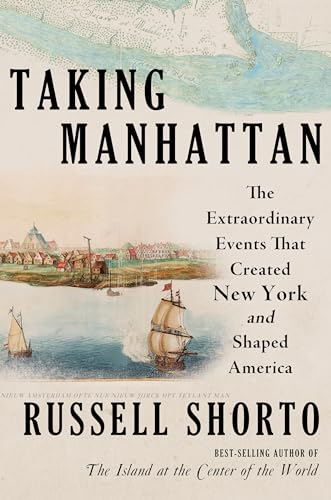
In 1664, England decided to invade the Dutch-controlled city of New Amsterdam on Manhattan Island. Charles II and his brother, the Duke of York, had dreams of empire, and their archrivals, the Dutch, were in the way. But Richard Nicolls, who led the English flotilla bent on destruction, changed his strategy once he began parleying with Peter Stuyvesant, the Dutch leader on Manhattan.

Bristling with vibrant characters, Taking Manhattan reveals the founding of New York to be an the result not of an English military takeover but of clever negotiations that led to a fusion of the multiethnic capitalistic society the Dutch had pioneered to the power of the rising English empire. But the birth of what might be termed the first modern city is also a story of the brutal dispossession of Native Americans and of the roots of American slavery. Taking Manhattan shows how the paradox of New York’s origins—boundless opportunity coupled with subjugation and displacement—reflect America’s promise and failure to this day. Russell Shorto, whose work has been described as “astonishing” (New York Times) and “revelatory” (New York magazine), has once again mined newly translated sources to offer a vibrant tale and a fresh and trenchant argument about American beginnings.

In My Hands Today…

The Island at the Center of the World: The Epic Story of Dutch Manhattan and the Forgotten Colony That Shaped America – Russell Shorto

When the British wrested New Amsterdam from the Dutch in 1664, the truth about its thriving, polyglot society began to disappear into myths about an island purchased for 24 dollars and a cartoonish peg-legged governor. But the story of the Dutch colony of New Netherland was merely lost, not destroyed: 12,000 pages of its records–recently declared a national treasure–are now being translated. Drawing on this remarkable archive, Russell Shorto has created a gripping narrative–a story of global sweep centered on a wilderness called Manhattan–that transforms our understanding of early America.

The Dutch colony pre-dated the “original” thirteen colonies, yet it seems strikingly familiar. Its capital was cosmopolitan and multi-ethnic, and its citizens valued free trade, individual rights, and religious freedom. Their champion was a progressive, young lawyer named Adriaen van der Donck, who emerges in these pages as a forgotten American patriot and whose political vision brought him into conflict with Peter Stuyvesant, the autocratic director of the Dutch colony. The struggle between these two strong-willed men laid the foundation for New York City and helped shape American culture.

In My Hands Today…

Amsterdam: A History of the World’s Most Liberal City – Russell Shorto

Tourists know Amsterdam as a picturesque city of low-slung brick houses lining tidy canals; student travelers know it for its legal brothels and hash bars; art lovers know it for Rembrandt’s glorious portraits.

But the deeper history of Amsterdam, what makes it one of the most fascinating places on earth, is bound up in its unique geography-the constant battle of its citizens to keep the sea at bay and the democratic philosophy that this enduring struggle fostered. Amsterdam is the font of liberalism, in both its senses. Tolerance for free thinking and free love make it a place where, in the words of one of its mayors, “craziness is a value.” But the city also fostered the deeper meaning of liberalism, one that profoundly influenced America: political and economic freedom. Amsterdam was home not only to religious dissidents and radical thinkers but to the world’s first great global corporation.

In this effortlessly erudite account, Russell Shorto traces the idiosyncratic evolution of Amsterdam, showing how such disparate elements as herring anatomy, naked Anabaptists parading through the streets, and an intimate gathering in a sixteenth-century wine-tasting room had a profound effect on Dutch-and world-history. Weaving in his own experiences of his adopted home, Shorto provides an ever-surprising, intellectually engaging story of Amsterdam from the building of its first canals in the 1300s, through its brutal struggle for independence, its golden age as a vast empire, to its complex present in which its cherished ideals of liberalism are under siege.