In My Hands Today…

Remember: The Science of Memory and the Art of Forgetting – Lisa Genova

Have you ever felt a crushing wave of panic when you can’t for the life of you remember the name of that actor in the movie you saw last week, or you walk into a room only to forget why you went there in the first place? If you’re over forty, you’re probably not laughing. You might even be worried that these lapses in memory could be an early sign of Alzheimer’s or dementia. In reality, for the vast majority of us, these examples of forgetting are completely normal. Why? Because while memory is amazing, it is far from perfect. Our brains aren’t designed to remember every name we hear, plan we make, or day we experience. Just because your memory sometimes fails doesn’t mean it’s broken or succumbing to disease. Forgetting is actually part of being human.

In Remember, neuroscientist and acclaimed novelist Lisa Genova delves into how memories are made and how we retrieve them. You’ll learn whether forgotten memories are temporarily inaccessible or erased forever and why some memories are built to exist for only a few seconds (like a passcode) while others can last a lifetime (your wedding day). You’ll come to appreciate the clear distinction between normal forgetting (where you parked your car) and forgetting due to Alzheimer’s (that you own a car). And you’ll see how memory is profoundly impacted by meaning, emotion, sleep, stress, and context. Once you understand the language of memory and how it functions, its incredible strengths and maddening weaknesses, its natural vulnerabilities and potential superpowers, you can both vastly improve your ability to remember and feel less rattled when you inevitably forget. You can set educated expectations for your memory, and in doing so, create a better relationship with it. You don’t have to fear it anymore. And that can be life-changing.

In My Hands Today…

Firestarters: How Innovators, Instigators, and Initiators Can Inspire You to Ignite Your Own Life – Raoul Davis Jr., Paul Eder and Kathy Palokoff

What is the difference between those bold enough to pursue their dreams and others who never get comfortable enough to ignite their lives? The doers are “Firestarters” and, because of them, the world is a much different, and often, better place.

This motivational how-to book provides insights into the crucial difference between people who make things happen and those who only think about making an impact. Based on research from many disciplines and interviews with professionals at the top of their fields, Firestarters creates a complete roadmap to achieve personal success and make an impact in the world.

The heart of the book features stories about successful entrepreneurs, CEOs, organizational leaders, and forward-looking thinkers from a variety of professions. They describe the factors and conditions that ignited their lives and helped them become achievers. Some are known to the public; others will be completely new. But all the stories demonstrate how they became–and you can become–a Firestarter.

The authors provide pragmatic advice on how individual readers can ignite the qualities that will lead them toward pursuing and realizing their dreams. Self-assessment exercises, checklists, and other tools will help readers apply Firestarter insights to their own lives. Also included are group exercises and discussion guides so the book can be used in business and nonprofit settings to develop the skills that help companies grow.

Whether you’re an individual seeking ways to realize personal ambitions or a leader trying to motivate your team, you’ll benefit from the Firestarter methods featured in this inspirational book.

In My Hands Today…

Option B: Facing Adversity, Building Resilience, and Finding Joy – Sheryl Sandberg and Adam Grant

After the sudden death of her husband, Sheryl Sandberg felt certain that she and her children would never feel pure joy again. “I was in ‘the void,’” she writes, “a vast emptiness that fills your heart and lungs and restricts your ability to think or even breathe.”

Her friend Adam Grant, a psychologist at Wharton, told her there are concrete steps people can take to recover and rebound from life-shattering experiences. We are not born with a fixed amount of resilience. It is a muscle that everyone can build.

Option B combines Sheryl’s personal insights with Adam’s eye-opening research on finding strength in the face of adversity. Beginning with the gut-wrenching moment when she finds her husband, Dave Goldberg, collapsed on a gym floor, Sheryl opens up her heart—and her journal—to describe the acute grief and isolation she felt in the wake of his death. But Option B goes beyond Sheryl’s loss to explore how a broad range of people have overcome hardships including illness, job loss, sexual assault, natural disasters, and the violence of war. Their stories reveal the capacity of the human spirit to persevere . . . and to rediscover joy.

Resilience comes from deep within us and from support outside us. Even after the most devastating events, it is possible to grow by finding deeper meaning and gaining greater appreciation in our lives. Option B illuminates how to help others in crisis, develop compassion for ourselves, raise strong children, and create resilient families, communities, and workplaces. Many of these lessons can be applied to everyday struggles, allowing us to brave whatever lies ahead. Two weeks after losing her husband, Sheryl was preparing for a father-child activity. “I want Dave,” she cried. Her friend replied, “Option A is not available,” and then promised to help her make the most of Option B.

We all live some form of Option B. This book will help us all make the most of it.

In My Hands Today…

The Infinite Game – Simon Sinek

Do you know how to play the game you’re in?

In finite games, like football or chess, the players are known, the rules are fixed, and the endpoint is clear. The winners and losers are easily identified.

In infinite games, like business or politics or life itself, the players come and go, the rules are changeable, and there is no defined endpoint. There are no winners or losers in an infinite game; there is only ahead and behind.

The more I started to understand the difference between finite and infinite games, the more I began to see infinite games all around us. I started to see that many of the struggles that organizations face exist simply because their leaders were playing with a finite mindset in an infinite game. These organizations tend to lag behind in innovation, discretionary effort, morale and ultimately performance.

The leaders who embrace an infinite mindset, in stark contrast, build stronger, more innovative, more inspiring organizations. Their people trust each other and their leaders. They have the resilience to thrive in an ever-changing world, while their competitors fall by the wayside. Ultimately, they are the ones who lead the rest of us into the future.

Any worthwhile undertaking starts with Why – the purpose, cause or belief that inspires us to do what we do and inspires others to join us. Good leaders know how to build Circles of Safety that promote trust and cooperation throughout their organizations. But that’s not enough to help us chart a course through the unpredictable, often chaotic landscape of today’s marketplace.

I now believe that the ability to adopt an infinite mindset is a prerequisite for any leader who aspires to leave their organization in better shape than they found it.

In My Hands Today…

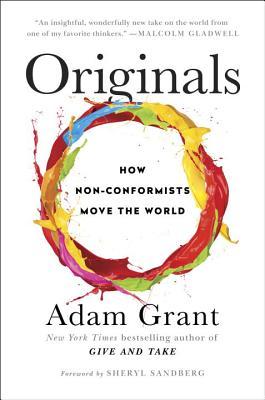
Originals: How Non-Conformists Move the World – Adam M. Grant

In Originals the author addresses the challenge of improving the world from the perspective of becoming original: choosing to champion novel ideas and values that go against the grain, battle conformity, and buck outdated traditions. How can we originate new ideas, policies, and practices without risking it all?

Using surprising studies and stories spanning business, politics, sports, and entertainment, Grant explores how to recognize a good idea, speak up without getting silenced, build a coalition of allies, choose the right time to act, and manage fear and doubt; how parents and teachers can nurture originality in children; and how leaders can build cultures that welcome dissent. Learn from an entrepreneur who pitches his start-ups by highlighting the reasons not to invest, a woman at Apple who challenged Steve Jobs from three levels below, an analyst who overturned the rule of secrecy at the CIA, a billionaire financial wizard who fires employees for failing to criticize him, and a TV executive who didn’t even work in comedy but saved Seinfeld from the cutting-room floor. The payoff is a set of groundbreaking insights about rejecting conformity and improving the status quo.