The Lazy Genius Way: Embrace What Matters, Ditch What Doesn’t, and Get Stuff Done – Kendra Adachi
Being a Lazy Genius isn’t about doing more or doing less. It’s about doing what matters to you.
The chorus of “shoulds” is loud. You should enjoy the moment, dream big, have it all, get up before the sun, track your water consumption, go on date nights, and be the best. Or maybe you should ignore what people think, live on dry shampoo, be a negligent PTA mom, have a dirty house, and claim your hot mess like a badge of honor.
It’s so easy to feel overwhelmed by the mixed messages of what it means to live well.
Kendra Adachi, the creator of the Lazy Genius movement, invites you to live well by your own definition and equips you to be a genius about what matters and lazy about what doesn’t. Everything from your morning routine to napping without guilt falls into place with Kendra’s thirteen Lazy Genius principles, including:
Decide once
Start small
Ask the Magic Question
Go in the right order
Schedule rest
Discover a better way to approach your relationships, work, and piles of mail. Be who you are without the complication of everyone else’s “shoulds.” Do what matters, skip the rest, and be a person again.
12 Rules for Life: An Antidote to Chaos – Jordan B. Peterson
What does everyone in the modern world need to know? Renowned psychologist Jordan B. Peterson’s answer to this most difficult of questions uniquely combines the hard-won truths of ancient tradition with the stunning revelations of cutting-edge scientific research.
Humorous, surprising, and informative, Dr. Peterson tells us why skateboarding boys and girls must be left alone, what terrible fate awaits those who criticize too easily, and why you should always pet a cat when you meet one on the street.
What does the nervous system of the lowly lobster have to tell us about standing up straight (with our shoulders back) and about success in life? Why did ancient Egyptians worship the capacity to pay careful attention as the highest of gods? What dreadful paths do people tread when they become resentful, arrogant, and vengeful? Dr. Peterson journeys broadly, discussing discipline, freedom, adventure, and responsibility, distilling the world’s wisdom into 12 practical and profound rules for life. 12 Rules for Life shatters the modern commonplaces of science, faith, and human nature while transforming and ennobling the mind and spirit of its listeners.
The 5 AM Club: Own Your Morning. Elevate Your Life – Robin S. Sharma
Legendary leadership and elite performance expert Robin Sharma introduced The 5am Club concept over twenty years ago, based on a revolutionary morning routine that has helped his clients maximize their productivity, activate their best health and bulletproof their serenity in this age of overwhelming complexity.
Now, in this life-changing book, handcrafted by the author over a rigorous four-year period, you will discover the early-rising habit that has helped so many accomplish epic results while upgrading their happiness, helpfulness and feelings of aliveness.
Through an enchanting—and often amusing—story about two struggling strangers who meet an eccentric tycoon who becomes their secret mentor, The 5am Club will walk you through:
How great geniuses, business titans and the world’s wisest people start their mornings to produce astonishing achievements A little-known formula you can use instantly to wake up early feeling inspired, focused and flooded with a fiery drive to get the most out of each day A step-by-step method to protect the quietest hours of daybreak so you have time for exercise, self-renewal and personal growth A neuroscience-based practice proven to help make it easy to rise while most people are sleeping, giving you precious time for yourself to think, express your creativity and begin the day peacefully instead of being rushed “Insider-only” tactics to defend your gifts, talents and dreams against digital distraction and trivial diversions so you enjoy fortune, influence and a magnificent impact on the world Part manifesto for mastery, part playbook for genius-grade productivity and part companion for a life lived beautifully, The 5am Club is a work that will transform your life. Forever.
Grit: The Power of Passion and Perseverance – Angela Duckworth
Why do some people succeed and others fail? Sharing new insights from her landmark research on grit, Angela Duckworth explains why talent is hardly a guarantor of success. Rather, other factors can be even more crucial such as identifying our passions and following through on our commitments.
Drawing on her own powerful story as the daughter of a scientist who frequently bemoaned her lack of smarts, Duckworth describes her winding path through teaching, business consulting, and neuroscience, which led to the hypothesis that what really drives success is not genius, but a special blend of passion and long-term perseverance. As a professor at the University of Pennsylvania, Duckworth created her own character lab and set out to test her theory.
Here, she takes readers into the field to visit teachers working in some of the toughest schools, cadets struggling through their first days at West Point, and young finalists in the National Spelling Bee. She also mines fascinating insights from history and shows what can be gleaned from modern experiments in peak performance. Finally, she shares what she’s learned from interviewing dozens of high achievers; from JP Morgan CEO Jamie Dimon to the cartoon editor of The New Yorker to Seattle Seahawks Coach Pete Carroll.
Winningly personal, insightful, and even life-changing, Grit is a book about what goes through your head when you fall down, and how that not talent or luck makes all the difference.
Merriam Webster defines curiosity as a desire to know, an inquisitive interest in others’ concerns, an interest leading to inquiry and intellectual curiosity.
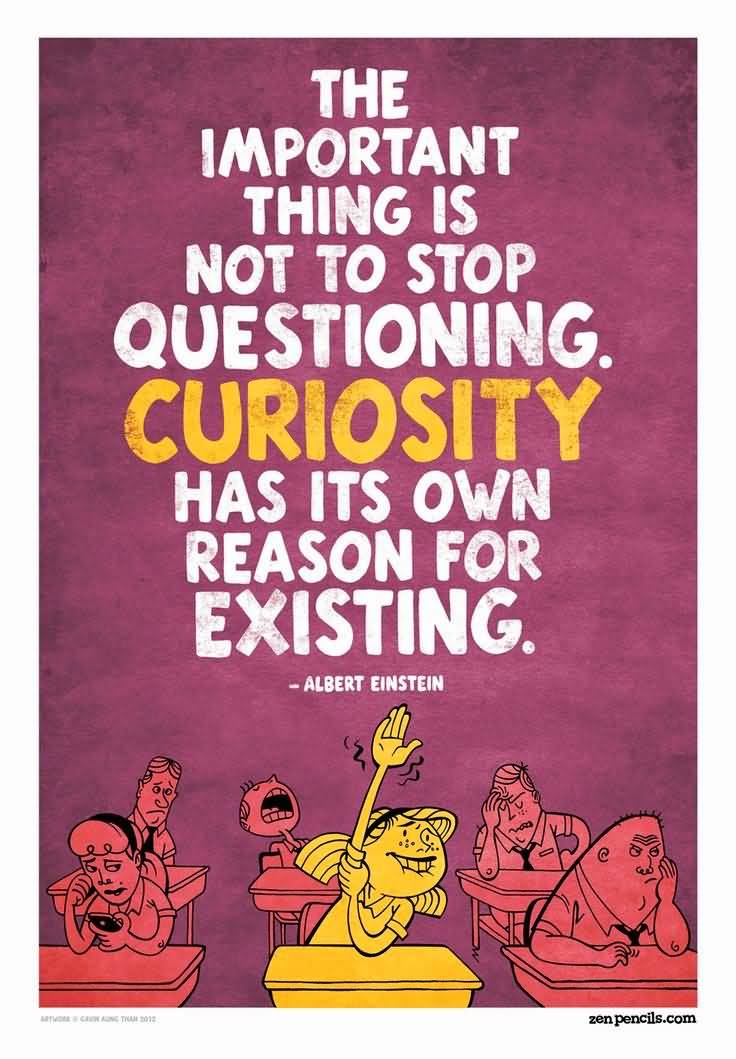
Curiosity is the desire to learn, to understand new things, and to know how they work. As children, we are naturally curious, born with the impulse to seek new information and experiences. As we age and gain more experience, we become less reliant on curiosity for answers and more reliant on knowledge. Curiosity gives way to comfort and certainty. Curiosity can be seen manifesting itself in geniuses, because they are inherently always curious, leading to the discoveries attributed to them. Curiosity is not only important for those with high IQs, but successful people across all walks of life often display a good measure of curiosity. Curiosity is the expression of the urge to learn and acquire facts and knowledge. It widens the mind and opens it to different opinions, different lifestyles and different topics.
Curiosity can manifest in many ways, as the desire to read the gossip columns or watch reality shows on TV, or as the desire to know about people and their lives. It can also manifest as the desire to accumulate knowledge about science, geography or other topics, or as the urge to know how to fix things. Curious people ask questions, read and explore. They are active about seeking information or experience, and are willing to meet challenges and to broaden their horizons. They are not shy to ask questions and delve deeply into the topic that interests them.
Curiosity throughout adulthood requires approaching experiences with the open-mindedness and naivete of a child. Buddhists call this the Beginner’s Mind. Curiosity pushes people toward uncertainty and allows them to approach it with a positive attitude. Empathy, creativity, innovation, and the ability to learn quickly all spring from curiosity. Curiosity lacks an agenda or desire to drive a specific outcome, which means it can open you up to experiences you never thought were possible. This is how ground-breaking discoveries are made, markets are disrupted, and barriers are overcome.
While curiosity comes naturally to some, many adults must develop it, and just like any other skill or habit, it takes practice. According to experts, to live a curiosity-driven life, an individual must commit to being vigilant about looking for what’s piquing their curiosity and to follow what is interesting to a person, even if that interest is faint at first. Curiosity is not only linked to success because it leads to creativity and discoveries, it also helps to develop meaningful relationships that enrich personal and professional lives. When curiosity leads conversations, it opens up possibilities, letting people establish deeper, more meaningful relationships because the interactions then moves towards discovering others, rather than using them to fulfil an agenda.
But why is curiosity so important? Here are some reasons
Curiosity makes your mind active instead of passive. Curious people always ask questions and search for answers. Their minds are always active. Since the mind is like a muscle that becomes stronger through continual exercise, mental exercise caused by curiosity makes the mind stronger and stronger.
Curiosity makes the mind observant of new ideas. When an individual is curious about something, their mind expects and anticipates new ideas related to the subject. When the ideas come they will recognise them and without curiosity, the ideas may pass right in front of them and yet they miss them because their mind is not prepared to recognise them.
Curiosity opens up new worlds and possibilities. By being curious, an individual will be able to see new worlds and possibilities that are normally not visible, which are hidden behind the surface of normal life, and it takes a curious mind to look beneath the surface and discover them.
Curiosity brings excitement to life. The lives of curious people are far from boring and are neither dull nor routine with new things always on the horizon that attracts the curious person’s attention. Instead of being bored, curious people have an adventurous life. Curiosity is important for excelling in any job and doing it better because it allows an individual to ask questions, learn from others, and look for ways to do their job better. The minds of curious people are active, they want to know and to understand which puts them in a better position to learn a job and do it better and more creatively, unlike a person who lacks curiosity. When curious people fail, they analyse their failure, because they are keen on knowing the reasons, to do better the next time, increasing future successes.
Keep an open mind: An open mind is essential to have a curious mind. Be open to learn, unlearn, and relearn. Some things you know and believe might be wrong, and one should be prepared to accept this possibility and change their minds.
Don’t take things at face value: If one just accepts the world as it is without trying to dig deeper, they will certainly lose the holy curiosity. Never take things at face value and try to dig deeper beneath the surface of what is around them.
Ask questions relentlessly: A sure way to dig deeper beneath the surface is asking questions. The five Ws and one H of Who, Why, When, What, Where and How are the best friends of curious people.
Don’t label something as boring: Whenever one labels something as boring, they close one more door of possibilities. Curious people are unlikely to call something boring. Instead, they always see it as a door to an exciting new world. Even if they don’t yet have time to explore it, they will leave the door open to be visited another time.
See learning as something fun: If one sees learning as a burden, there’s no way they will want to dig deeper into anything, and will just make the burden heavier. But if they think of learning as something fun, they will naturally want to dig deeper. So the lesson here is to look at life through the glasses of fun and excitement and enjoy the learning process.
Have diversity in your reading: Don’t spend too much time in just one world; take a look at other worlds, it will introduce an individual to the possibilities and excitement of the other worlds which may spark their interest to explore them further. One easy way to do this is by reading diverse genres and topics. The easiest way to do this is to pick a book or magazine on a new subject and let it feed the mind with the excitement of a new world.
Be Present: Don’t enter a conversation with the mind somewhere else or be focused on where you want the conversation to go. Be aware of thoughts drifting, and bring them back to the present, staying fully engaged with the person in front of you. Look at each interaction as an opportunity to learn something fascinating.
Give: Give others your full attention, give them an authenticity and give them time. When one shifts their focus from what they can get from a person to what they can give them, their relationship shifts from transactional to genuine.
Check Your Ego: A person’s ego can destroy curiosity because it fears insecurity. Curiosity requires embracing and exploring the unknown, which triggers insecurity. Don’t worry about how others will react to a person. Curiosity drives one to discover, not impress.
I will leave you to search more about this immensely interesting subject and allow you to flex your curiosity muscle with these TED Talks.





 Memories and Such