In My Hands Today…

Optimal: How to Sustain Personal and Organizational Excellence Every Day – Daniel Goleman, Cary Cherniss

In his groundbreaking #1 bestseller Emotional Intelligence , Daniel Goleman revolutionized how we think about intelligence. Now, he reveals practical methods for using these inner resources to more readily enter an optimal state of high performance and satisfaction while avoiding burnout.

There are moments when we achieve peak An athlete plays a perfect game; a business has a quarter with once-in-a-lifetime profits. But these moments are often elusive, and for every amazing day, we may have a hundred ordinary and even unsatisfying days.

Fulfillment doesn’t come from isolated peak experiences, but rather from many consistent good days. So how do we sustain performance, while avoiding burnout and maintaining balance?

In Optimal , Daniel Goleman and Cary Cherniss reveal how emotional intelligence can help us have a great day, any day. They explain how to set a realistic, attainable goal of feeling satisfied that you’ve had a productive day — to consistently work at your ‘optimal’ level.

Based on research of how hundreds of people build the inner architecture of having a good day, they sketch what an optimal state feels like, and show how emotional intelligence holds the key to our best performance. Optimal is the culmination of decades of scientific discoveries bearing on emotional intelligence. Enhanced emotional intelligence pays off in improved engagement, productivity, and more satisfying days.

In this book, you’ll find the keys to competence in emotional intelligence, and practical methods for applying this skill set more readily. It will equip you to become a highly effective leader and enable you to build an organizational culture that empowers workers to sustain high performance.

In My Hands Today…

The Power of Regret: How Looking Backward Moves Us Forward – Daniel H. Pink

Everybody has regrets, Daniel H. Pink explains in The Power of Regret. They’re a universal and healthy part of being human. And understanding how regret works can help us make smarter decisions, perform better at work and school, and bring greater meaning to our lives.

Drawing on research in social psychology, neuroscience, and biology, Pink debunks the myth of the “no regrets” philosophy of life. And using the largest sampling of American attitudes about regret ever conducted as well as his own World Regret Survey–which has collected regrets from more than 15,000 people in 105 countries–he lays out the four core regrets that each of us has. These deep regrets offer compelling insights into how we live and how we can find a better path forward.

As he did in his bestsellers Drive, When, and A Whole New Mind, Pink lays out a dynamic new way of thinking about regret and frames his ideas in ways that are clear, accessible, and pragmatic. Packed with true stories of people’s regrets as well as practical takeaways for reimagining regret as a positive force, The Power of Regret shows how we can live richer, more engaged lives.

In My Hands Today…

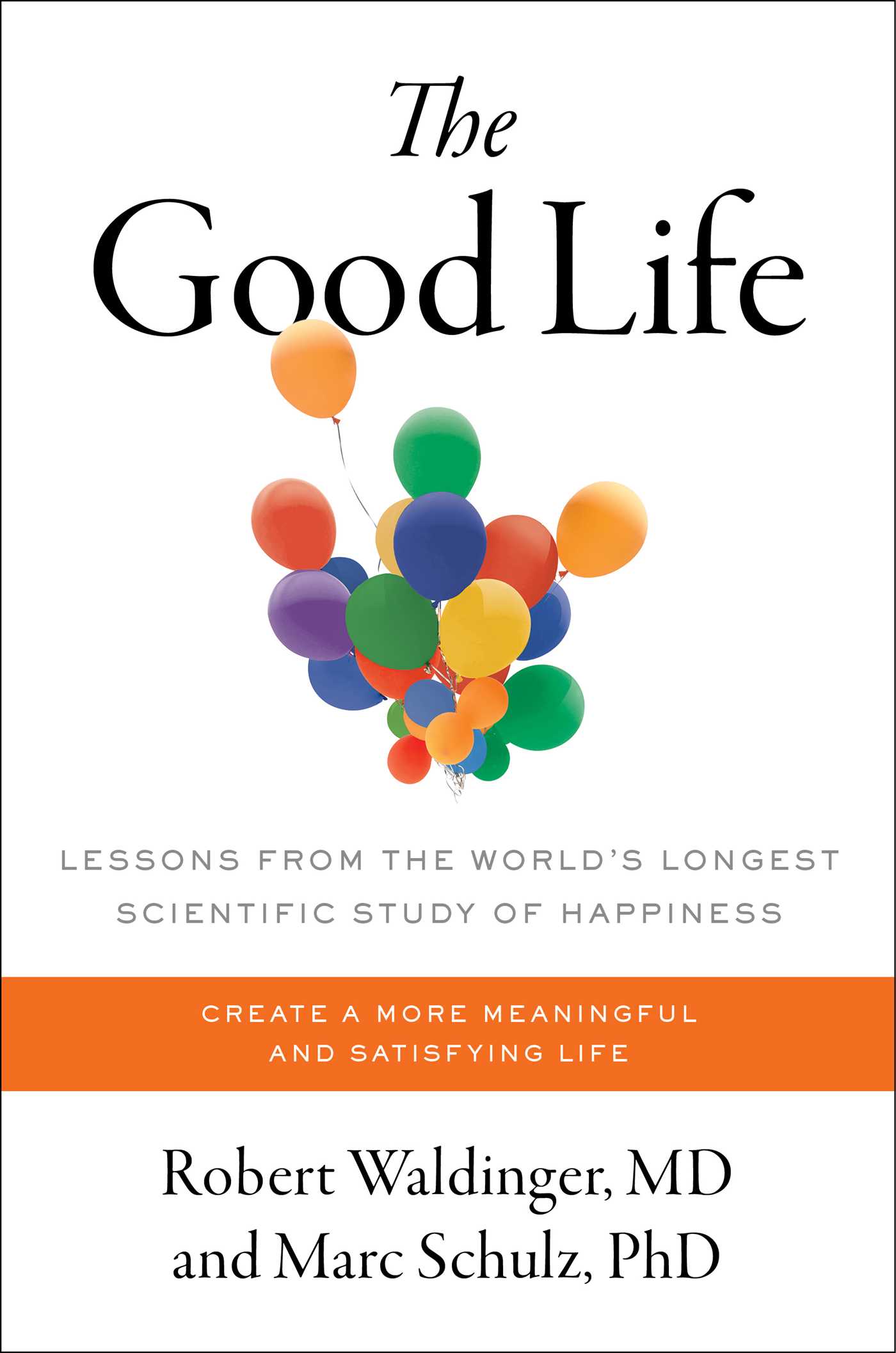
The Good Life: Lessons from the World’s Longest Scientific Study of Happiness – Robert Waldinger, Marc Schulz

What makes for a happy life, a fulfilling life? A good life? In their “captivating” ( The Wall Street Journal) book, the directors of the Harvard Study of Adult Development, the longest scientific study of happiness ever conducted, show that the answer to these questions may be closer than you realize.

What makes a life fulfilling and meaningful? The simple but surprising answer relationships. The stronger our relationships, the more likely we are to live happy, satisfying, and healthier lives. In fact, the Harvard Study of Adult Development reveals that the strength of our connections with others can predict the health of both our bodies and our brains as we go through life.

The invaluable insights in this book emerge from the revealing personal stories of hundreds of participants in the Harvard Study as they were followed year after year for their entire adult lives, and this wisdom was bolstered by research findings from many other studies. Relationships in all their forms—friendships, romantic partnerships, families, coworkers, tennis partners, book club members, Bible study groups—all contribute to a happier, healthier life. And as The Good Life shows us, it’s never too late to strengthen the relationships you already have, and never too late to build new ones. The Good Life provides examples of how to do this.

Dr. Waldinger’s TED Talk about the Harvard Study, “What Makes a Good Life,” has been viewed more than 42 million times and is one of the ten most-watched TED talks ever.

In My Hands Today…

The Art of Frugal Hedonism: A Guide to Spending Less While Enjoying Everything More – Annie Raser-Rowland, Adam Grubb

It sounds too good to be true. You can save money and the world, inoculate yourself against many of the ills of modern life, and enjoy everything more on both the sensual and profound levels? Preposterous!

Yet here is a toolkit to help you do just that.

A tweak here, a twiddle there; every strategy in The Art Of Frugal Hedonism has been designed to help you target the most important habits of mind and action needed for living frugally but hedonistically.

Apply a couple, and you’ll definitely have a few extra dollars in your pocket and enjoy more sunsets. Apply the lot, and you’ll wake up one day and realise that you’re happier, wealthier, fitter, and more in love with life than you’d ever thought possible.

In My Hands Today…

Make It Stick: The Science of Successful Learning – Peter C. Brown, Henry L. Roediger III, Mark A. McDaniel

To most of us, learning something “the hard way” implies wasted time and effort. Good teaching, we believe, should be creatively tailored to the different learning styles of students and should use strategies that make learning easier. Make It Stick turns fashionable ideas like these on their head. Drawing on recent discoveries in cognitive psychology and other disciplines, the authors offer concrete techniques for becoming more productive learners.

Memory plays a central role in our ability to carry out complex cognitive tasks, such as applying knowledge to problems never before encountered and drawing inferences from facts already known. New insights into how memory is encoded, consolidated, and later retrieved have led to a better understanding of how we learn. Grappling with the impediments that make learning challenging leads both to more complex mastery and better retention of what was learned.

Many common study habits and practice routines turn out to be counterproductive. Underlining and highlighting, rereading, cramming, and single-minded repetition of new skills create the illusion of mastery, but gains fade quickly. More complex and durable learning come from self-testing, introducing certain difficulties in practice, waiting to re-study new material until a little forgetting has set in, and interleaving the practice of one skill or topic with another. Speaking most urgently to students, teachers, trainers, and athletes, Make It Stick will appeal to all those interested in the challenge of lifelong learning and self-improvement.