In My Hands Today…

The Map That Changed the World: William Smith and the Birth of Modern Geology – Simon Winchester

William Smith was not rich or well connected, but his passion for rocks and fossils, and his twenty-year obsession with single-handedly mapping the geology of Britain made him one of the most significant men of the nineteenth century.

However his vision cost him dear – his wife went mad, his work was stolen by jealous colleagues who eventually ruined him, and he was imprisoned for debt.

Simon Winchester tells the fascinating story of ‘Strata’ Smith, a man who crossed boundaries of class, wealth and science to produce a map that fundamentally changed the way we view the world.

In My Hands Today…

Knowing What We Know: The Transmission of Knowledge: From Ancient Wisdom to Modern Magic – Simon Winchester

From the creation of the first encyclopedia to Wikipedia, from ancient museums to modern kindergarten classes–this is a look at how humans acquire, retain, and pass on information and data, and how technology continues to change our lives and our minds.

With the advent of the internet, any topic we want to know about is instantly available with the touch of a smartphone button. With so much knowledge at our fingertips, what is there left for our brains to do? At a time when we seem to be stripping all value from the idea of knowing things–no need for math, no need for map-reading, no need for memorization–are we risking our ability to think? As we empty our minds, will we one day be incapable of thoughtfulness?

Addressing these questions, Simon Winchester explores how humans have attained, stored, and disseminated knowledge. Examining such disciplines as education, journalism, encyclopedia creation, museum curation, photography, and broadcasting, he looks at a whole range of knowledge diffusion–from the cuneiform writings of Babylon to the machine-made genius of artificial intelligence, by way of Gutenberg, Google, and Wikipedia to the huge Victorian assemblage of the Mundanaeum, the collection of everything ever known, currently stored in a damp basement in northern Belgium.

Throughout this tour, Winchester forces us to ponder what rational humans are becoming. What good is all this knowledge if it leads to lack of thought? What is information without wisdom? Does Rene Descartes’s Cogito, ergo sum–“I think therefore I am,” the foundation for human knowledge widely accepted since the Enlightenment–still hold? And what will the world be like if no one in it is wise?

In My Hands Today…

The Professor and the Madman: A Tale of Murder, Insanity and the Making of the Oxford English Dictionary – Simon Winchester

The Professor and the Madman, masterfully researched and eloquently written, is an extraordinary tale of madness, genius, and the incredible obsessions of two remarkable men that led to the making of the Oxford English Dictionary — and literary history.

The compilation of the OED, begun in 1857, was one of the most ambitious projects ever undertaken. As definitions were collected, the overseeing committee, led by Professor James Murray, discovered that one man, Dr. W. C. Minor, had submitted more than ten thousand.

When the committee insisted on honoring him, a shocking truth came to light: Dr. Minor, an American Civil War veteran, was also an inmate at an asylum for the criminally insane.

In My Hands Today…

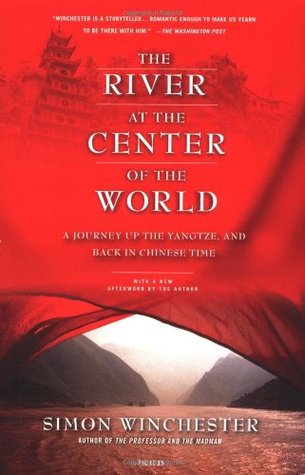
The River at the Center of the World: A Journey Up the Yangtze & Back in Chinese Time – Simon Winchester

25015

Rising in the mountains of the Tibetan border, the Yangtze River, the symbolic heart of China pierces 3,900 miles of rugged country before debouching into the oily swells of the East China Sea.

Connecting China’s heartland cities with the volatile coastal giant, Shanghai, it has also historically connected China to the outside world through its nearly one thousand miles of navigable waters.

To travel those waters is to travel back in history, to sense the soul of China, and Simon Winchester takes us along with him as he encounters the essence of China–its history and politics, its geography and climate as well as engage in its culture, and its people in remote and almost inaccessible places.