Memories: Growing up in an urban agraharam

I grew up in Mumbai, very close to what is the heart of the tambram community in the city, Matunga. Where we lived was a 15 minute walk to the heart of the community, to the market and the temples, to the flower shops and the vegetable vendors, some of whom though they came from the northern states of Bihar and Uttar Pradesh, but could banter with the mamas and manis in Tamil. Before COVID-19 stuck and life changed, my mother used to make the thrice weekly trip every week to Matunga to get her fix of all of the above.

The other day while I was thinking about this, I realised that I actually grew up in an urban agraharam. So what is an agraharam you may ask? An Agraharam or Agrahara was a grant of land and royal income from it, typically by a king or a noble family in India, for religious purposes, particularly to Brahmins to maintain temples in that land or a pilgrimage site and to sustain their families. Agraharams were also known as Chaturvedimangalams in ancient times as well as known as ghatoka, and boyas. Agraharams were built and maintained by dynasties such as the Cholas and Pallavas. The name originates from the fact that the agraharams have lines of houses on either side of the road and the temple to the village god at the centre, thus resembling a garland around the temple. According to the traditional Hindu practice of architecture and town-planning, an agraharam is held to be two rows of houses running north–south on either side of a road at one end of which would be a temple to Shiva and at the other end, a temple to Vishnu. An example is Vadiveeswaram in Tamil Nadu.

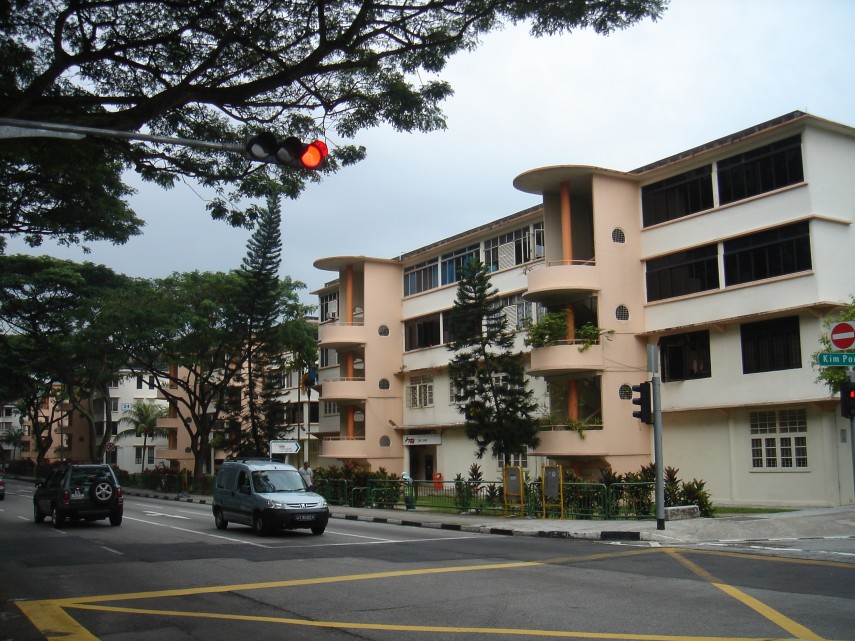
Where we grew up was a collection of about 50-60 two to three storey buildings set in a sort of square with roads intersecting them. We were framed by educational institutes on three sides and a main road on the fourth. While our small community comprised of people from different communities across the various states of India, if I look back, I can see the Tamil Brahmin community most predominant here, with most of them from Kerala or the Palakkad Iyers. Most buildings, with some exceptions which only had people from a certain community as residents, had a few tambram families in residence. Everyone was a mama or mami and not uncle or aunty and everyone knew everyone, or at the very least knew our parents and grandparents, many of whom they were either together at school, in the same class or from the same village in Tamil Nadu or Kerala.

In my own building, the bulk of our neighbours were from my own community and this is why I call my small slice of area an urban agraharam. Everyone was solidly middle class and if you probed enough, you found some connection with them, either through family or friends and once the connection was made, you were part of them. I know now that even living in a secular and multi-community city like Mumbai made us quite insular when it came to Tamil culture. The only Tamil culture I knew was the Tambram one and coming to Singapore, to a culture similar to my own was actually a culture shock to me.

But, growing up in a community made mostly of people who had the same values, the same traditions as us was just as charming. Festivals which are unique to my community was commonplace here and I never questioned why the rest didn’t celebrate it. For example, the annual Avani avittam festival which is the only festival for the men who on this day would change their sacred threads used to be held in a nearby school with a few priests from one of the temples in Matunga coming over to conduct the rituals. Since there were enough men who wore the sacred thread, it probably made sense for the organizers to hold a mini session in our area. Since the day was not a public holiday, they used to do the session fairly early so the men and boys could then go on to work and school. And in all the years my grandfather and then father went here instead of to our temple in Matunga, I never questioned why. It all seemed normal to me. We loved going to each other’s homes for festivals like Diwali, Navratri and Ganesh Chaturti in our pavadais and sing songs and gorge on the delicacies.

That was a lovely time growing up. Everyone looked out for each other and mamas and mamis didn’t heaitate to scold or tell on a child they knew if the said child did something wrong. We thought nothing of going into anyone’s house for a drink of water or to use the bathroom. We were also quite safe in our little enclave and most of us pretty much lived our whole lives there till we moved out.

Source

Life in our small community has changed now. Many buildings are being knocked down to make way for high rises, especially since this area is now a prime area, within what is considered the original Bombay and close, but not too close to the city. A lot of people from the community moved to suburbs like Chembur, Thane and Dombivili when the real estate prices here started picking up in the nineties. I think my grandparents and parents even explored the idea of moving to Chembur, but thankfully dropped the idea very soon. Life goes on, but in our area, the percentage of tambrams has reduced tremendously, so much so it can’t be called an agraharam anymore. I mourn for this loss, but c’est la vie and life must go on. The chakra of life never stops and I am sure in some of the suburbs I mentioned newer urban agraharams have been created.

Recipes: Mixed Pumpkin Poritcha Kozambu

Tamil Brahmin cooking is generally considered to be quite healthy and satvik. In our everyday cooking, onions and garlic are generally not used and there are people even today who can’t stand the smell of garlic being cooked. My grandmother is one of them. When we make anything with garlic, she generally leaves the kitchen and in fact goes to the room furthest away from the kitchen so the smell does not bother her.

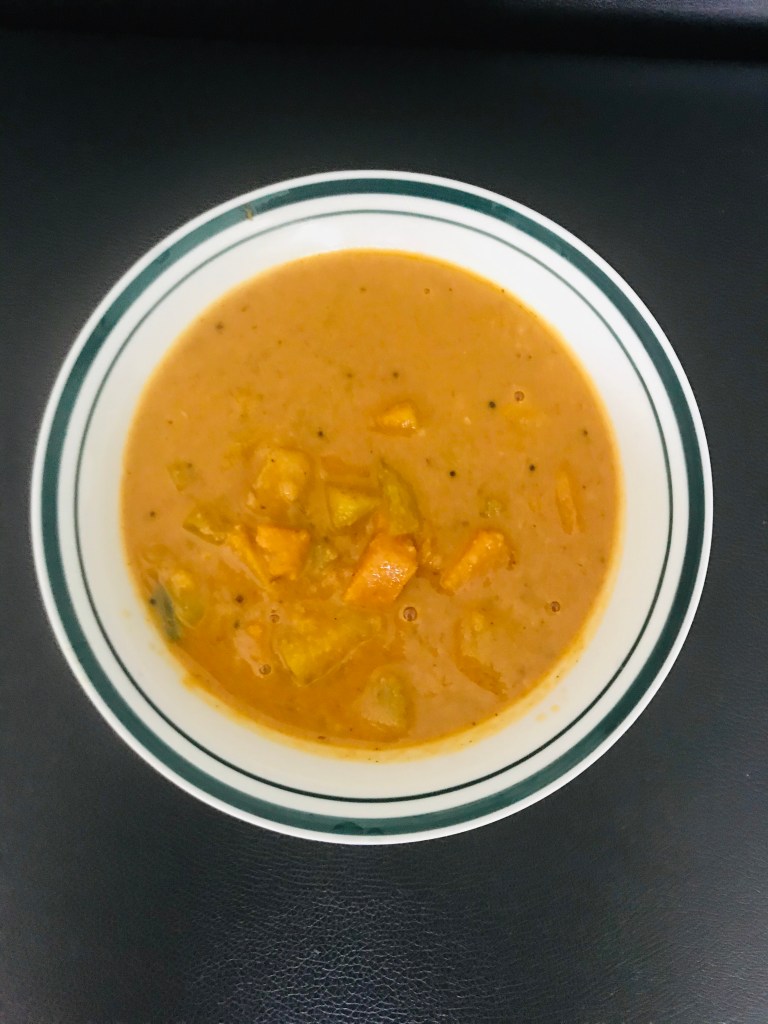
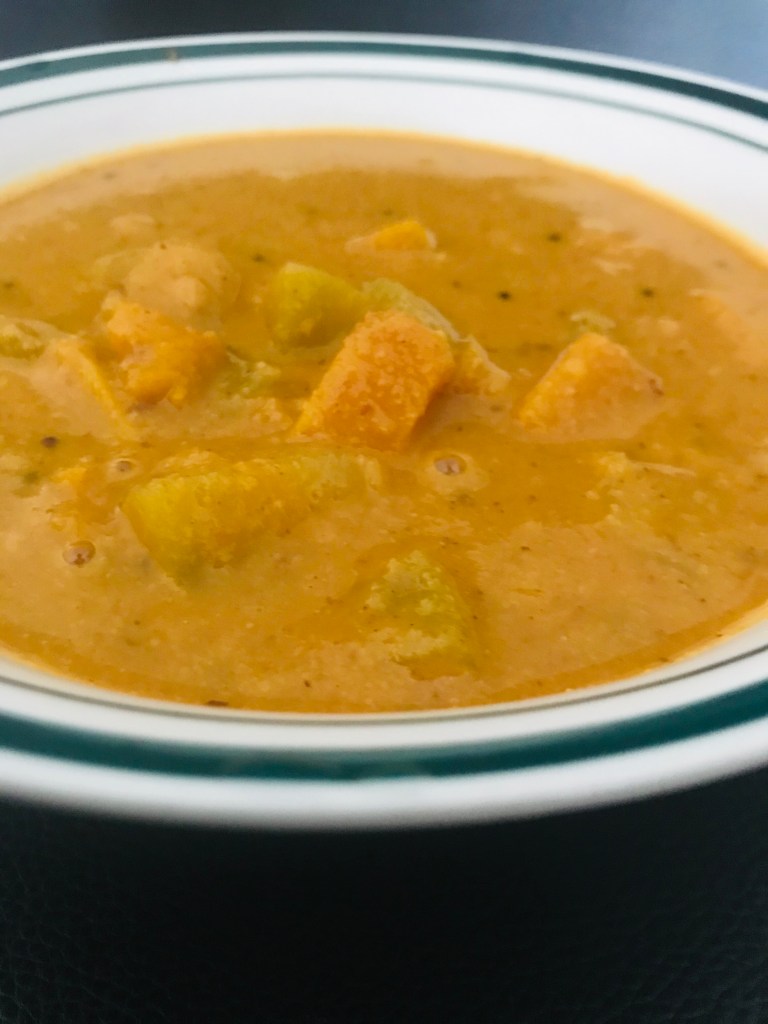
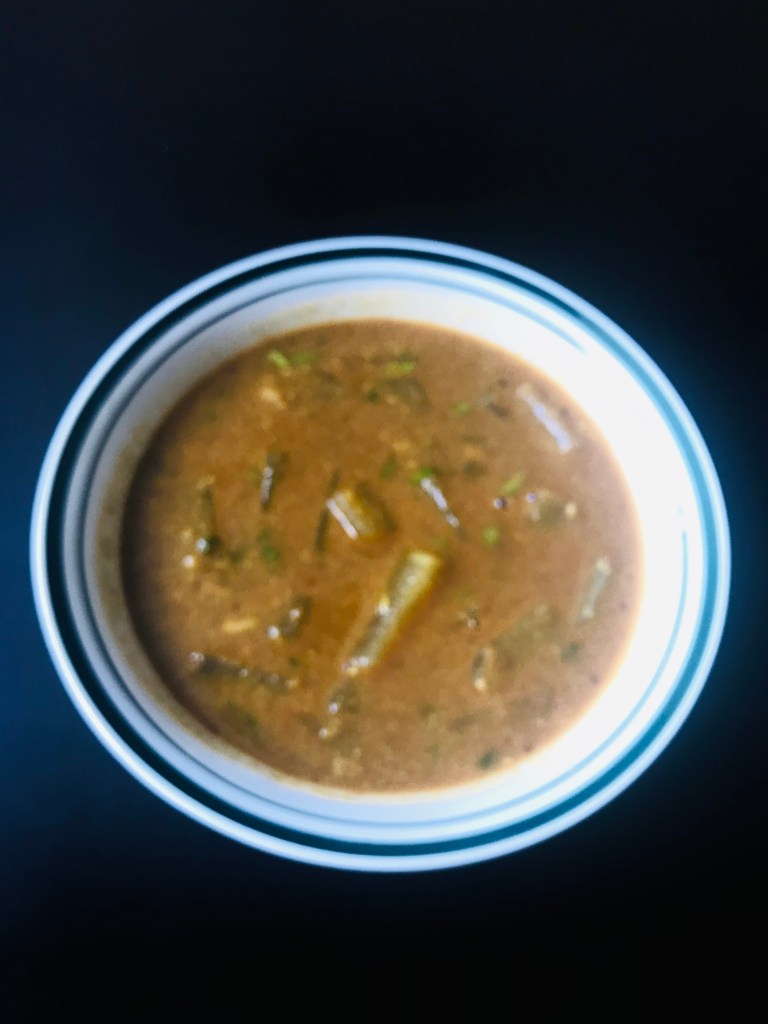
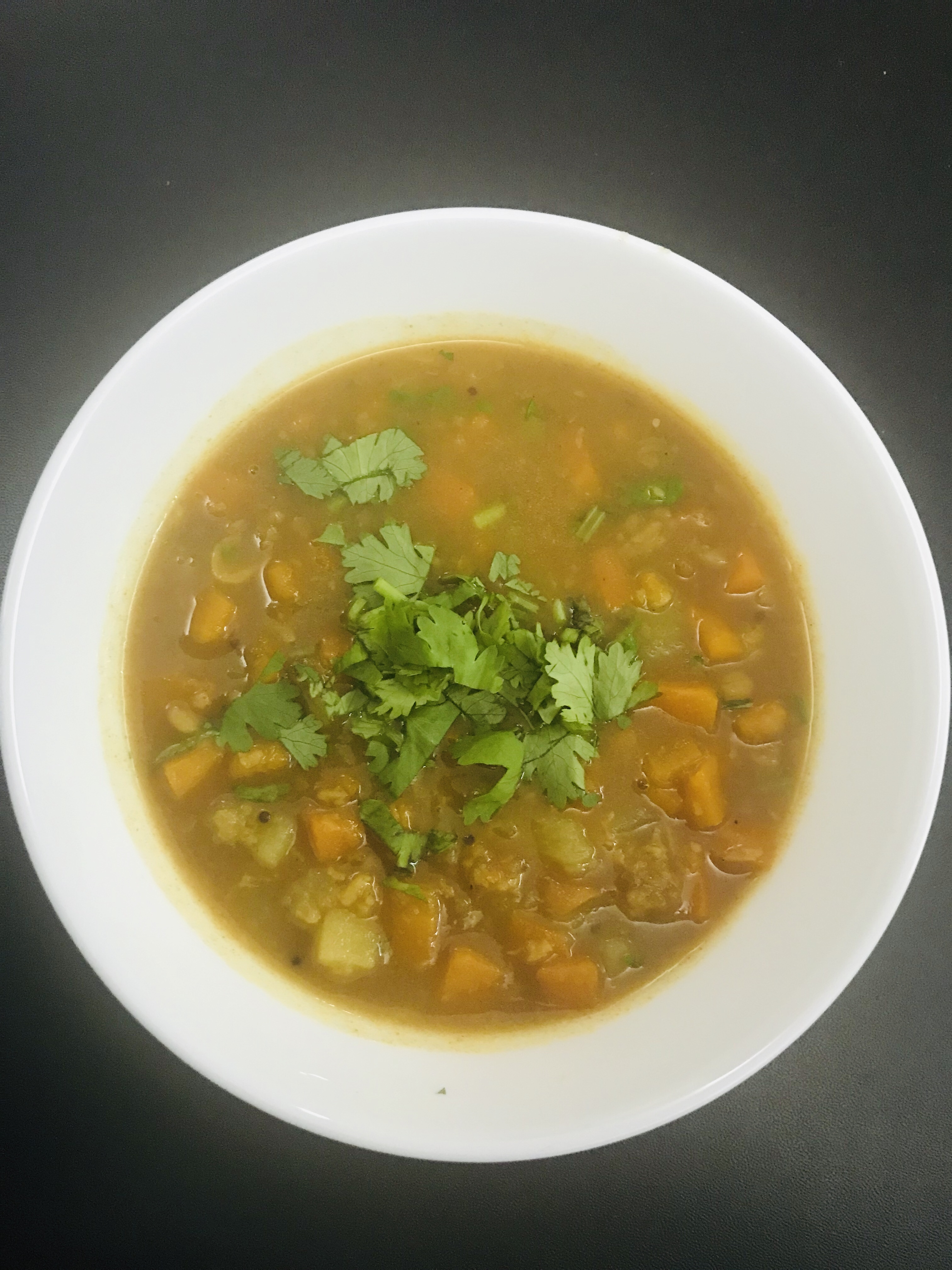
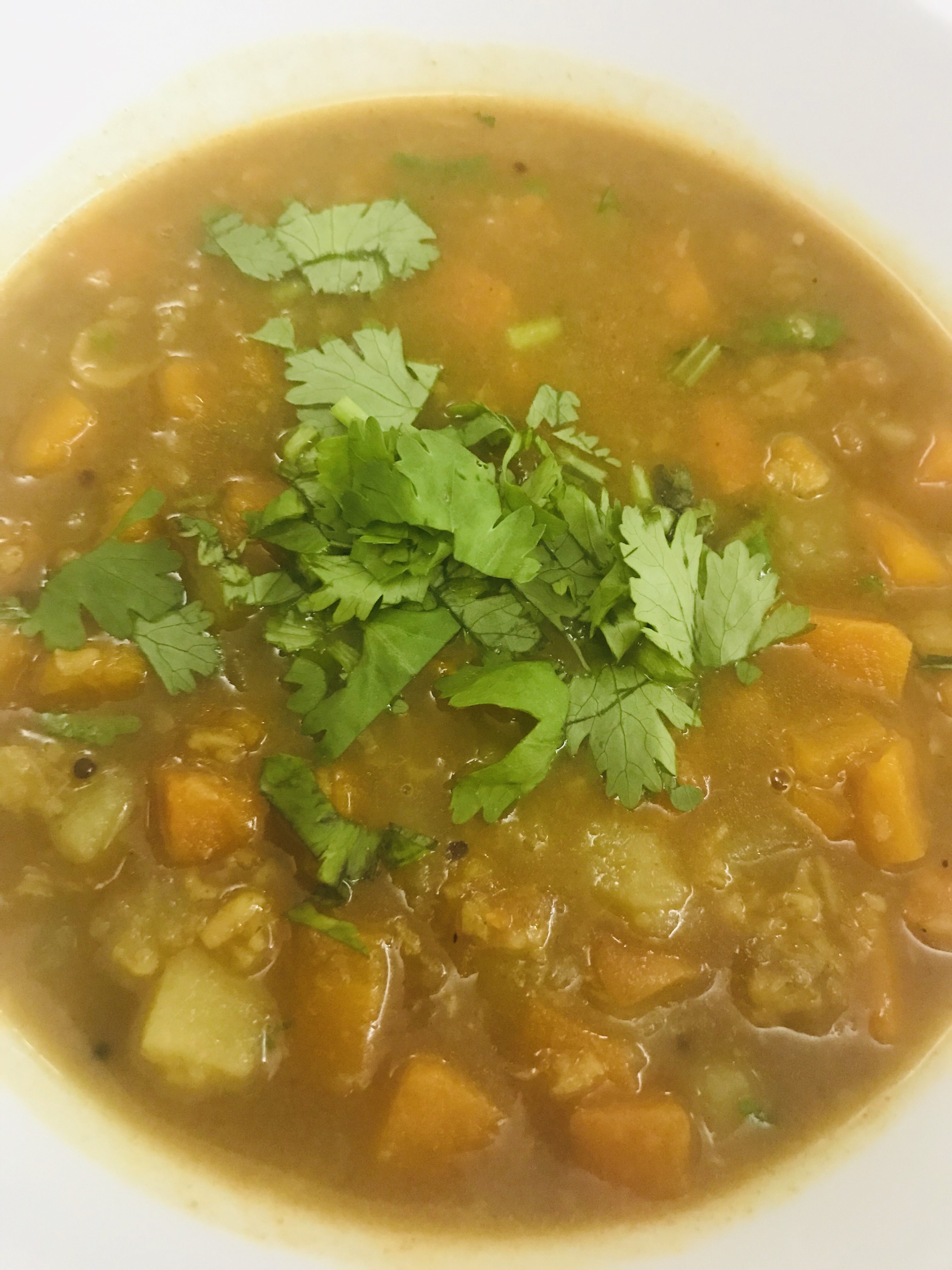
A Poritcha Kozambu is something like a stew which is made by cooking a mixture of vegetables with a paste made of coconut, urad dal and peppercorns and some cooked dal. I had some yellow and orange pumpkin left over when I made some Avial and these were too little to make something with just one of them. So I decided to combine the two to make a fusion kozambu and kootu out of the two vegetables. Generally pumpkins are not used for a poritcha kozambu but this recipe was a huge success. I loved it as did S and the children and this recipe will find its way to my cooking repertoire and I will make it often.

Mixed Pumpkin Poritcha Kozambu

Ingredients:
½ yellow pumpkin, peeled and chopped into bite-sized pieces
½ white pumpkin, peeled and chopped into bite-sized pieces
1 cup toor dal,
½ tsp turmeric powder
3 tbsp coconut
1 tsp broken urad dal
3-4 dried red chillies
1 tsp cumin seeds
1 tsp black peppercorns
1 tbsp tamarind paste
1 tbsp oil
Salt to taste
Chopped coriander leaves to garnish

Method:
Wash the toor dal and soak in hot water for 10 minutes. Then pressure cook the dal with ¼ tsp turmeric powder until it is soft and mushy. Once the pressure reduces and you are able to open the cooker, mash the dal well and keep aside.
Heat the oil in a small skillet and when it warms up, add the cumin seeds, dried red chillies, urad dal, and pepper corns and fry till the urad dal changes colour to a nice brown. Then add the grated coconut and stir constantly until the coconut is brown and completely devoid of water. Keep aside and let it cool.
When the coconut is cool, grind it completely to a smooth paste using water as needed.
In the same pan, add the chopped pumpkins, ¼ tsp turmeric powder and some salt and cook until the pumpkins are about 70% cooked.
When the pumpkins are cooked, but still have a bite to them, add the mashed dal and the coconut paste and stir well.
Add the tamarind paste and check for seasoning. Let it boil for about 5-7 minutes.
Garnish with coriander leaves and serve hot over steamed rice and a stir fried vegetable of your choice.

Recipes: Arachavitta Vellai Pooshnikkai Sambar or Ground White Pumpkin Sambar

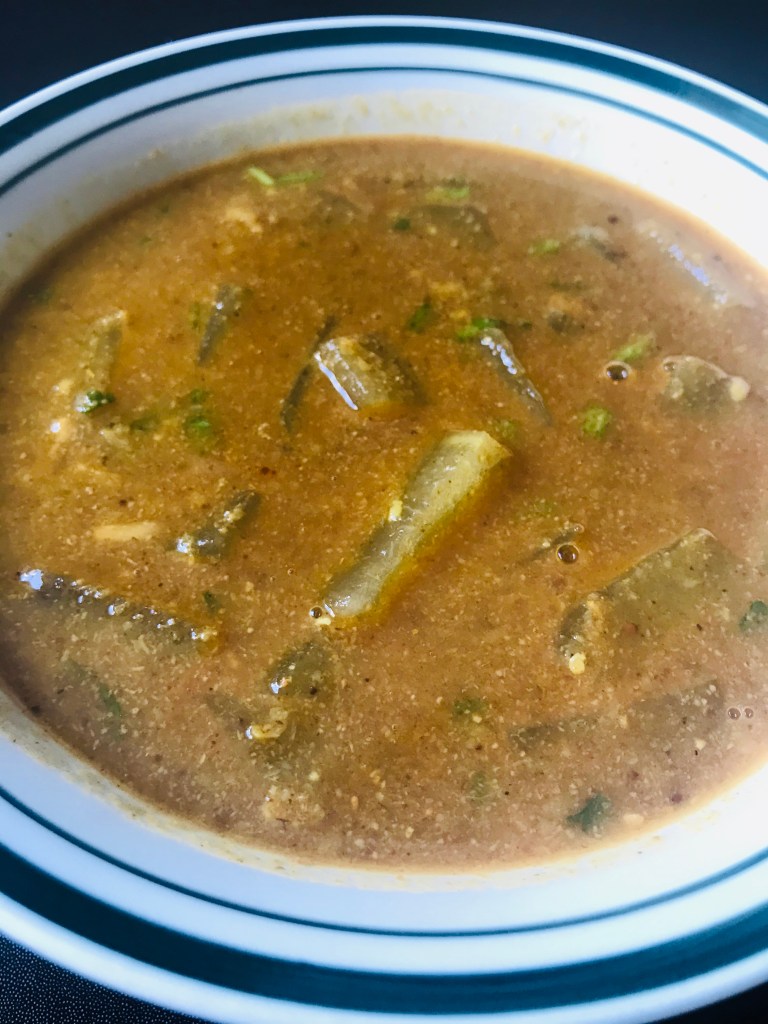
This recipe initially started its life as an experiment, but it was quite successful and the resulting sambar was so tasty, I was pleasantly surprised. While any arachavitta or ground sambar is yummy, the addition of the white pumpkin or Winter Melon or Ash Gourd as its called in English and Vellai Pooshnikkai in Tamil elevated this recipe. This recipe is perfect for the days you can’t use onions in your recipe. I have blogged about both Arachivitta Sambar and White Pumpkin Rasavangi and this is a lovely marriage between the two. So let’s go to the recipe.

Arachavitta Vellai Pooshnikkai Sambar or Ground White Pumpkin/Ash Groud/Winter Melon Sambar

Ingredients:

  • 2 cups white pumpkin, peeled, the seeds removed and cut into 1 inch cubes
  • 1 lemon sized piece of tamarind, soaked in hot water for 30-40 minutes
  • 1 cup toor dal
  • 2 tbsp oil
  • 1 tsp mustard seeds
  • 1 tbsp chana dal
  • 2 tbsps coriander seeds
  • 6-8 dried red chillies
  • ¼ cup fresh grated coconut
  • 1 tbsp sambar powder (optional)
  • 1-2 tbsp jaggery (optional)
  • Salt to taste
  • 2 tbsp finely chopped coriander leaves to garnish

Method:

  • In a small pressure cooker, pressure cook the toor dal with ¼ tsp turmeric powder till it is soft and the dal has broken down complety. This usually will take around 3 whistles in the cooker. When the pressure reduces, open the cover of the cooker and then whisk the dal well. Keep aside.
  • Mash the tamarind when it becomes cool to touch and then squeeze tamarind and drain the water so the fibres get separated and you have the water. Alternatively use 3-4 tbsp tamarind paste which you can get at any Indian store.
  • Heat 1 tbsp oil in a small pan and put the chana dal, coriander seeds and dried red chillies and stir a while till the chana dal starts to brown. At this point add the fresh grated coconut and constantly stir until all the water from the coconut dries up and you have a crisp brown coconut with no water whatsoever. Note that if there is any water left in this, your sambar may spoil later in the day.
  • Once this coconut mixture is cool, grind it to a fine paste using some water in a blender. Make sure the paste is as fine as you can make it.
  • In a large pan, heat the balance 1 tbsp oil and when the oil is warm, add the mustard seeds and when the seeds pop, add the chopped white pumpkin and cook the cubes for about 5 minutes.
  • Then add the tamarind water which has been thinned to suit your taste and add salt to taste. You can also add sambar powder at this point if you want. Also add the jaggery if you are using here.
  • Let the white pumpkin cook until it is cooked, but still has a bite to it.
  • At this point, add the ground paste and the cooked dal and cook for another 5-10 minutes.
  • Check for seasoning at this point before switching off the gas.
  • Garnish with coriander leaves and serve hot with plain rice, white or brown and a curry of your choice.
  • This is also very tasty with any South Indian food like Upma, Idli or Dosai.

Recipes: Kalyana Gotsu

Earlier in the week, we celebrated the harvest festival of Pongal and on that day I made Venn Pongal for dinner. I wanted to make something to go with this but was not in the mood for Coconut chutney, so decided to search for something else to make to go with Pongal.

I came across Gotsu, which is also a traditional accompaniment to Pongal, but this is usually made with Brinjals or Aubergines. S is allergic to this vegetable, so I decided to substitute it with other vegetables. This is also a one-pot recipe and I made it from start to end in my pressure cooker. It can also be made in a large pan or dutch oven but will take longer than if you use a pressure cooker. It was so yummy and tasty and everyone gobbled it up.

This Gotsu is also served in weddings, especially for breakfast with Idlis, Vadai and Pongal.

Kalyana Gotsu

Ingredients:

  • 2 carrots, chopped finely
  • 2 potatoes, chopped finely
  • 1 large tomato, chopped finely
  • 1 lemon sized ball of tamarind or 3 tbsp tamarind paste
  • 1/4 cup moong dal
  • 3 tbsp chana dal
  • 1 tbsp oil
  • 1 tsp mustard seeds
  • 2 green chillies, slit lengthwise
  • 5-6 curry leaves
  • 2 tbsp sambhar powder
  • 1 tbsp jaggery (can omit this or even substitute with sugar)
  • 1/4 tsp asafoetida
  • Salt to taste

Method:

  • Soak the tamarind in hot water for 30 minutes, then squeeze the pulp out and strain the water. Keep aside.
  • Soak the dals together in warm water for 30 minutes, strain and keep aside.
  • Heat the oil in the pressure cooker and add the mustard seeds. When the seeds pop, add the curry leaves, asafoetida and green chillies and stir for a few seconds.
  • Now add the finely chopped tomatoes and stir for a few minutes.
  • Then add the finely chopped potatoes and carrots and stir well.
  • Then add the soaked dals and give it a good stir.
  • Now add the tamarind water, sambhar powder and salt to taste and stir everything well.
  • Cover the pressure cooker and cook for 3-4 whistles.
  • If you are using a pan or dutch oven to cook, cover and cook, stirring occasionally. Periodically check and add water if needed. You need the vegetables to be fully cooked and the dals to be soft and mushy.
  • When the pressure reduces in the cooker, open and lightly mash the gotsu with a potato masher. Don’t mash it completely like we do for Pav Bhaji, but just a bit to make the gotsu thicker.
  • Add the jaggery and check for seasoning. Garnish with coriander leaves and serve hot with Idli, Dosai, Vadai or Pongal.

Notes:

  • I made this without onions or shallots because I made it on a festival day. If you want, you can add onions or shallots and the place to add it is just after popping the mustard seeds.
  • You can use any vegetables you like though it’s usually made with Brinjals or Aubergines.


Recipes: Pineapple Rasam

A special variety of Rasam, this one is made usually during weddings and is something we don’t usually make during a normal lunch. I have made this many aeons ago and so this week when I opened a tin of pineapple, I decided to keep aside some to make this yummy rasam.

Rasam is a spicy soup made in south India using tamarind juice, pepper, tomato, cumin and other spices and each household has their own unique recipe which they make on a daily or regular basis. Rasam has a distinct sour, peppery and chilly taste that makes it a true repository of flavours. Rasam is either eaten along with rice or savoured after a meal. The British also adapted this rasam and what is Mulligatawny Soup is nothing more than rasam. In Tamil, this word translates to “Pepper Water”

Rasam prevents constipation, is a powerhouse of vitamins and minerals, facilitates digestion, is rich in antioxidents, helps in weight loss, is an excellent food for patients recovering from illness and the best food when introding babies to solids.

Pineapple Rasam

Ingredients:

  • 1/4 cup Toor Dal
  • 6 rings of pineapple
  • 1 tsp rasam powder
  • 1/2 tsp turmeric powder
  • 2 large tomatoes
  • 1 tsp peppercorn
  • 1 tsp cumin seeds
  • 4-6 dried red chillies
  • 1 tbsp ghee
  • 1 tsp mustard seeds
  • 1/4 tsp asafoetida
  • Coriander leaves to garnish

Method:

  • Pressure cook the toor dal with 1/4 tsp turmeric powder and enough water till it is soft and mushy. Keep aside.
  • Chop 2 of the pineapple rings into small pieces and keep aside.
  • Chop one tomato into small pieces and keep aside.
  • Powder the cumin seeds, peppercorns and 2 dried chillies into a coarse powder and keep aside.
  • Blend together the balance pineapple slices into a smooth paste and keep aside.
  • Blend the remaining tomato into a smooth paste and keep aside.
  • In a largish pan, mix together the tomato puree, 1 cup water, the remaining turmeric powder and half the quantity of the blended peppercorn, cumin and dried chilli powder and let it start boiling.
  • When it comes to a boil, add the pineapple paste and rasam powder and let it continue to boil. Allow the pineapple paste and tomato puree to cook well.
  • In a separate pan, add the ghee and when the ghee warms up, add the mustard seeds. When the mustard seeds start to pop, add in the red chillies, after breaking them into halves, the asafoetida, rest of the ground pepper-cumin-chilli powder and saute it for 20 seconds
  • Add the chopped pineapple and tomato pieces and saute it for 2 minutes in a medium flame
  • Add the ingredients in the pan to the rasam which has been boiling all along.
  • At this point, add the mushed dal and mix well.
  • Then add 1.5 – 2 cups of water and keep the flame in a medium level until the rasam starts to froth. Finally, garnish with coriander leaves and remove from flame.
  • The delicious and spicy pineapple rasam is ready to serve. Serve with rice and an Indian dry vegetable stir fry.

Notes:

  • If you don’t have access to rasam powder, just omit it, the taste should be just as good.
  • You can also blend together some garlic pods along with the cumin seeds, peppercorns and red chillies for a different taste.
  • This is wonderful as a slightly spicy and tangy soup during the winters.