In My Hands Today…

Troubled Pilgrimage: Passage to Pakistan – Balwant Bhaneja

17865164Troubled Pilgrimage: A Passage to Pakistan is about a journey by the author, a retired Canadian diplomat, who is visiting his ancestral land of Sindh and Punjab in Pakistan, the first visit since he was five. Bhaneja’s Hindu family had to leave their homeland following the Partition of the Indian subcontinent in August 1947.

The author’s journey begins at the Birla House in New Delhi, India where Mahatma Gandhi was assassinated by a Hindu extremist over sixty years ago, from where he travels into Pakistan during the troubled and violent spring of 2006. The reader is taken through bustling Islamabad, the back streets of the author’s birthplace Lahore, and to the more remote, and mysterious towns of Sukkur, Rohiri, and Shikarpur in Upper Sindh, the ancestral land from which he and his family were exiled. After revelations about his past, his nation and his people he returns to Delhi for an audience with the “Refugee” Prime Minister I.K. Gujral.

The trans-cultural narrative deals with the universal theme of displacement and how it impacts mind and psyche of those involved. It is a thoughtful work about how our multiple identities shape and get played out in a globalized world. What makes some to leave their homelands while others to stay on despite fears and uncertaint

In My Hands Today…

No Fullstops In India – Mark Tully

791184India’s Westernized elite, cut off from local traditions, ‘want to write a full stop in a land where there are no full stops’. From that striking insight Mark Tully has woven a superb series of ‘stories’ which explore Calcutta, from the Kumbh Mela in Allahabad (probably the biggest religious festival in the world) to the televising of a Hindu epic. Throughout, he combines analysis of major issues with a feel for the fine texture and human realities of Indian life. The result is a revelation. ‘The ten essays, written with clarity, warmth of feeling and critical balance and understanding, provide as lively a view as one can hope for of the panorama of India.

In My Hands Today…

The Sewing Circles of Herat: A Personal Voyage Through Afghanistan – Christina Lamb

498164Twenty-one-year-old Christina Lamb left suburban England for Peshawar on the frontier of the Afghan war. Captivated, she spent two years tracking the final stages of the mujaheddin victory over the Soviets, as Afghan friends smuggled her in and out of their country in a variety of guises.

Returning to Afghanistan after the attacks on the World Trade Center to report for Britain’s Sunday Telegraph, Lamb discovered the people no one else had written about: the abandoned victims of almost a quarter century of war. Among them, the brave women writers of Herat who risked their lives to carry on a literary tradition under the guise of sewing circles; the princess whose palace was surrounded by tanks on the eve of her wedding; the artist who painted out all the people in his works to prevent them from being destroyed by the Taliban; and Khalil Ahmed Hassani, a former Taliban torturer who admitted to breaking the spines of men and then making them stand on their heads.

Christina Lamb’s evocative reporting brings to life these stories. Her unique perspective on Afghanistan and deep passion for the people she writes about make this the definitive account of the tragic plight of a proud nation.

Yogyakarta Day 3 & 4: Ramayana Ballet and Malioboro Street

DSCN8902

The three main performers L-R Rama, Sita and Hanuman waiting to take pictures with the audience before the start of the performance. They do this at the intermission too

I was really anticipating the last segment of our two day Yogya sightseeing which was the enactment of the Ramayana. I wanted to see how another culture interprets what is essentially a very special Hindu story and one, which probably every Indian, irrespective of their religion, knows intimately.

DSCN8907

The lit up Prambanan temple which provides a magical backdrop to the performance

Another reason for the performance was the fact that this ballet is performed outdoors in the background of the Prambanan temple which is lit up beautifully. The whole scene looks very ethereal and magical! The enactment of the Ramayana is the Javanese version of the story and the music is the Indonesian gamelan and the whole performance (songs, some dialogues etc) are in Bahasa Indonesia, but they have two screens on either side of the stage with subtitles in English. At points, there are also two emcees, who move the story forward and while one speaks in Bahasa, the other does the same in English. All costumes are also very Indonesian and oh so beautiful…

DSCN8914

Sita and King Janak

The ballet is performed by around 200 odd trained dancers and is based on the stone reliefs in the Prambanan temple which made it especially interesting. The performance is outdoors during the dry season (May-October) and indoors during the wet season (Jan – April, November – December). In the event of sudden downpours in the dry season (it happens), the performance is shifted indoors.

We were there on a Saturday and I had heard that the performance gets filled up fast over the weekend, so I had asked Ibot, whom I was liaising with for this trip, to help me book the tickets. I gave him my preferred seats and he had gotten the ticket office to block the tickets for me. When we went to the ticket office, Yus helped me speak to the person manning the counter and we had our tickets in hand immediately.

DSCN8905

Our class of seats on the left and the VIP seats further down

We booked the second tier class tickets which is called Special class seating. This cost us IDR 275,000 (approximately USD 21). The tickets in this class have seat numbers and though you sit in cement seats, you get a cushion for your back as well as a drink. The top class ticket, called VIP Class Seating is IDR 375,000 (~USD 29) which is actually quite plush seating. Other than the drink I mentioned earlier, they also get a souvenir (though I have no idea what was in it). The seats were also front centre in front of the stage whereas our seats were slightly to the right, but we still had amazing front views of the performance.
We also got to see the whole story performed, though there were some days which were termed episodic. I guess the episodic performances will go into the story more in detail, while the full story will be in bits and pieces so that they can finish it in two hours. The best part of the performance is when Hanuman burns Lanka and they use actual fire in the stage, which was awesome. That part also ends act one and there’s a 15 minute intermission after this.

DSCN8916

Entry of King Ravana

DSCN8927

Sita’s Svayamvar (wedding)

For those who want to know more about the epic that is the Ramayana, please click this Wikipedia link which is quit comprehensive and has further links. There’s a very famous television series on the Ramayana which was aired in the mid-to-late-eighties in India. Here’s a link to see the episodes of that series. The series is in Hindi and I don’t think there are any subtitles.

DSCN8922

The burning of Lanka

DSCN8923

Hanuman devastating Lanka

IMG_5897

When Rama and Sita meet after Rama defeats Ravana

IMG_5892

Another picture which shows Lanka burning

IMG_5888

Rama doubting Sita’s fidelity after their reunion

We got back quite late from the performance and found a mini drama waiting for us at the hotel. One of the two rooms had been locked from inside when we left the room in the morning and so we couldn’t get in. After involving the hotel technicians, they finally got the room open (through the balcony, thank the Lord we were on the ground floor) and we finally went to bed.

The next day, our last full day in Jogya was supposed to be a rest cum shopping day. We decided to hit Malioboro Street after breakfast. The hotel had a shuttle to the street and we took advantage of it. We spent some time walking the street and looking around as well as doing some shopping. After lunch at Pizza Hut (go figure!) we came back for some rest before we hit Ambarrukmo Plaza for more shopping and dinner before we ended our holiday.

Our flight back to Singapore was at 7:30 am and we were out of the hotel by 5:30 am. Like when we arrived, we got the hotel to send us to the airport using their vehicle and the return trip was not hassled. I was actually impressed with Air Asia and if I am flying short haul and regional, this is one option I will definitely consider.

The only parts I didn’t like was the fact they charge you quite a bit for credit card payment (which for people in Singapore is a must as there is no direct payment facility) and they only have 7 kgs as cabin baggage. Compare this to Tiger Airways which we took when we went to Penang last year, we could pay locally at the AXS machine (so avoiding credit card charges, since it is a local airline) and the airline also had 10 kgs cabin baggage allowance.

So this was all about our Yogyakarta trip. It’s taken me quite long to write this, but I hope it’s been worth it! Now to plan our next trip….

Yogyakarta Day 3: Prambanan Temple, Sewu Temple and Sunset at Ratu Boko


DSCN8798

The Prambanan Temple Complex

Top tip for Prambanan – since the temple is a UNESCO World Heritage site, if you are a student (and can prove it), you get to enter at half price. Yus did ask us about BB & GG’s student cards and if I had known this earlier, we would have saved a bit as the temple entrance fee for an adult is IDR 250,000 (approximately USD 19). We also saw this information when we entered the temple. The student discount is not dependent on age, according to the temple, even if you are a mature student, as long as you have valid student ID, they will give you the discount. You can also opt to hire a guide for IDR 100,000 which was very useful.


DSCN8803

The entrance to the complex

Prambanan Temple


A UNESCO World Heritage site, Candi Prambanan or Candi Rara Jonggrang is a 10th-century Hindu temple compound, dedicated to the Trimurti, the three cosmic functions in Hinduism which are the Creator (Brahma), the Preserver (Vishnu) and the Destroyer (Shiva). The temple compound, is the largest Hindu temple in Indonesia, and one of the biggest in Southeast Asia. It is characterized by its tall and pointed architecture, typical of Hindu temple architecture, and by the towering 47-metre-high (154 ft) central building inside a large complex of individual temples. Rising above the centre of the last of these concentric squares are three temples decorated with reliefs illustrating the epic of the Ramayana, dedicated to the three great Hindu divinities (Shiva, Vishnu and Brahma) and three temples dedicated to the animals (Nandi, Garuda and Hamsa) who serve them.

IMG_5817

The main Shiva temple

The Prambanan Temple Compounds consist of the Prambanan Temple, Sewu Temple, Bubrah Temple and Lumbung Temple. Prambanan Temple itself is a complex consisting of 240 temples. All the mentioned temples form the Prambanan Archaeological Park and were built during the heyday of Sailendra’s powerful dynasty in Java in the 8th century AD.
While the Prambanan temple is Hindu, Sewu, with its four pairs of Dwarapala giant statues, is Indonesia’s largest Buddhist complex including the temples of Lumbung, Bubrah and Asu (Gana temple). The Hindu temples are decorated with reliefs illustrating the Indonesian version of the Ramayana epic which are masterpieces of stone carvings. These are surrounded by hundreds of shrines that have been arranged in three parts showing high levels of stone building technology and architecture from the 8th century AD in Java.


IMG_5832

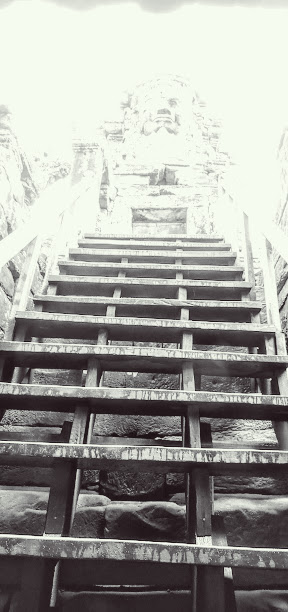
The steep steps at the temple!

One thing that really struck me when we were walking across the temples was how steep the steps were and I kept thinking if those who lived at the time these temples were built and use were really tall, though anecdotally, this does not seem very possible. I noticed the same thing about the steps at Angkor Wat too.


DSCN8810

B

DSCN8807

Bas reliefs at the temple…

Our guide took us through the temples for around an hour or so, and showed us the important bas reliefs, which we probably would not have been able to see without his help. With some interesting anecdotes, he managed to keep our attention for the hour or so it took him to guide us through the complex. He was also a font of information on the best angles and places to photograph the monument.


IMG_5833

The reconstruction work against the background of the temple

The temples are still undergoing reconstruction and I understand that over the years, many villagers take back the stones from the compound to build their own homes as they believe the stones from the temple are blessed. Archaeologists are still scouring the area for these stones to bring back to complete the reconstruction. Also they are using modern stones, but all those not from the original temple are specially marked, so that they will know which stones are ancient and which are modern, but made to look ancient!
Spamming some gorgeous pictures from the temple…


IMG_5814

A rakshasha statue at one of the temples

IMG_5822

Statue of Sage Agastya

DSCN8809

The statue of Durga who is supposed to be Rara Jonggrang

DSCN8840

Statue of Lord Brahma

DSCN8830

Statue of Lord Ganesh

After spending about 90 minutes at the temple, we decided to take the free tram shuttle to the Sewu temple which is close by. You can also walk there, but we were tired and decided to just take the tram. The tram stop is in the side of the main entrance to the temple. Sewu was a 5 minute drive away.

Sewu Temple

DSCN8850

Candi Sewu

Candi Sewu is an 8th-century Mahayana Buddhist temple located 800 meters north of the Prambanan temple and predates the Prambanan temple by around some 70 years. Sewu is actually the second largest Buddhist Temple complex in Indonesia after Borobudur. Although the complex consists of 249 temples, the name in Javanese translates to ‘a thousand temples,’ which originated from popular local folklore; The Legend of Loro Jonggrang.


The Legend of Loro Jonggrang

The legend tells the story about two ancient and neighbouring kingdoms in Java, Pengging and Boko. Pengging was prosperous, and wisely ruled by its king Prabu Damar Moyo who had a son named Bandung Bondowoso. By contrast, Boko was ruled by a cruel man-eating giant named Prabu Boko, supported by another giant Patih Gupolo. Despite his unpleasant nature, Prabu Boko had a beautiful daughter named Rara Jonggrang.

The story relates that Prabu Boko desired to expand his kingdom, and so began training an army and raising taxes for an invasion of Pengging. His forces launch a surprise attack on Pengging, and the ensuring war causes devastation and famine on both sides. In order to defeat the invader, Prabu Damar Moyo sends his son Bandung Bondowoso to fight Prabu Boko. After a furious battle, Prabu Boko is killed by the prince’s supernatural powers. His assistant, the giant Patih Gupolo, leads his armies away from the battlefield in defeat.
Returning to Boko Palace, Patih Gupolo tells Princess Rara Jonggrang of the death of her father. The princess is heartbroken, but before she can recover from her grief the Pengging army besieges and captures the palace. Prince Bandung Bondowoso is mesmerized by the beauty of the mourning princess and propose marriage, but his offer is swiftly rejected. Bandung Bondowoso insists on the union, and finally Rara Jonggrang agrees on two impossible conditions: first the prince must build a well named Jalatunda, and second, he must construct a thousand temples in only one night.

The lovestruck prince agrees, and immediately starts work on the well. Using his supernatural powers once again, the prince swiftly finishes construction and proudly displays his work for the princess. As a trick, she urges him to enter the well and when he does so, Patih Gupolo piles stones into it and buries him alive. With great effort Bandung Bondowoso escapes, but his love for the princess is so strong that he forgives her the attempt on his life. To fulfill the second condition, the prince enters into meditation and conjures up a multitude of demon spirits from the earth. With their help he builds the first 999 temples and starts work on the final one. To thwart his efforts the princess and her maids light a fire in the east and begin pounding rice, a traditional dawn activity. Fooled into thinking the sun is about to rise, the spirits flee back into the earth leaving the last temple unfinished.

The prince is furious when he learns of this deception, and places a curse on Rara Jonggrang which turns her into a stone statue. In this way she herself becomes a feature of the final temple, completing its construction and fulfilling the conditions for their marriage.

IMG_5854

Reconstruction waiting to happen….

The main Sewu temple has been reconstructed, but the other temples in the complex were still unfinished as there were many stone slabs, indicating that perhaps the reconstruction work was not finished. We didn’t spend a lot of time here and went back to the main Prambanan temple when the tram came by again. This temple is quieter, with much less people around. When we were there, we were pretty much the only people around, which helps in taking great pictures!


DSCN8851

The main temple at Sewu

Our next stop, the penultimate stop for the day was to see the sunset at the Ratu Boko hill. This is around 20-30 minutes’ drive away from Prambanan.


Ratu Boko

DSCN8862

The main structure at Ratu Boko – some standing walls

DSCN8864

Entrance to the sunset point


Ratu Boko is often mistakenly called a temple, which is incorrect. It is actually the ruins of a palace. The palace is attributed to the King Boko who is mentioned in the legend of the Loro Jonggrang legend.

DSCN8869

Mount Merapi framed between the trees

DSCN8870

Prambanan temple as seen from Ratu Boko

This spot seems to be a favourite of locals, especially courting couples as we saw many families enjoying the evening while we were there.

If you go to the highest point in the area, you can see the Prambanan temple framed with the majestic Mount Merapi in the background and greenery in the foreground.

DSCN8878

The start of the glorious sunset

The complex has three levels, or terraces. On the first terrace, no ruins remain but the rock wall supporting the second terrace, several steps above. A 3.5-meter wall of andesite rock divides the second and third terrace. A small tunnel which may have been a moat also marks the division. To the south, are scattered rocks.

DSCN8879

The setting sun in a blaze of orange and gold

DSCN8890

The sunset framed by the structure

There is a café just as you enter the complex and your entrance ticket entitles you to a drink in the café. The views from the café are great and I wished we could stay there a while, but since we were not paying customers, we didn’t get a table to sit. Also dusk was approaching and there was not much to see. If you plan to go to Ratu Boko at sunset, maybe do your free drink before you go up to the ruins and take in the views before the crowds come down after the sunset.

Entrance fees to the complex are IDR 110,000 per person. This entrance fee is only for sunset and includes a drink at the café at the entrance of the complex.

Sunset is quite early in Indonesia and it gets quite dark before 6:30. Yus took a few minutes to say his prayers at the mosque in the complex and we went to have dinner near Prambanan before our Ramayana performance.