

Lush landscape of the Dieng Plateau
After the aborted sunrise at Borobudur, we headed down to the car to start the three hour drive to the Dieng Plateau. I’d heard of this plateau in a couple of guidebooks and wanted to check it out. I had a lot of naysayers to this trip as it is a three hour drive from Borobudur and a four hour drive from Yogyakarta, and to be honest, I also had some doubts whether this trip was going to be worth it. But it was and I am really glad that we did make the long, winding drive up the mountains to the Dieng Plateau.

View of the Dieng Plateau from the lookout
The word Dieng word was formed from Sanskrit words Di (Abode) and Hyang (Gods), so Dieng means Abode of the Gods. The plateau is a volcanic plateau which forms the floor of a caldera complex on the Dieng Volcanic Complex. It sits at around 2,000 meters (6,600 feet) above sea level and is home to small scattered villages. It is a glorious, verdant landscape laced with terraced potato and tobacco fields, which is the home to some of the oldest Hindu temple architecture in Java. It is said this plateau is the cradle of the Javanese Hindu civilization. The original inhabitants built more than 400 temples, most dating from the 8th and 9th centuries, but they were abandoned and forgotten as the original inhabitants, the Hindus, moved on to Bali and were only rediscovered in 1856 by the archaeologist Van Kinsbergen and only 8 or so exist today, most of which are in the process of being restored. When the temples were rediscovered, the locals, who were now Muslims, and who had no idea of what the temples were about, named them after the Pandavas, who are the heros of the Hindu epic, the Mahabharata. These temples were the oldest known standing stone structures in Java. We found most of the temples were built to house the Shivling, which is the symbol for Lord Shiva, but also found images of the other gods of the Hindu trinity, namely Brahma and Vishnu.
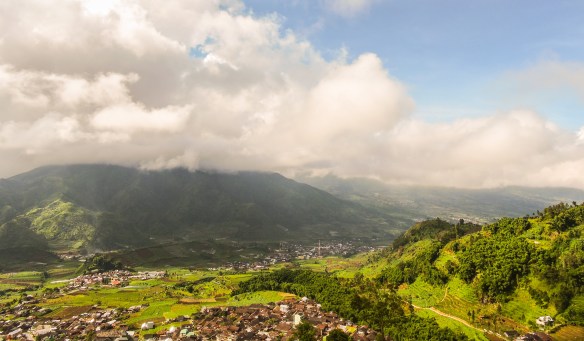
Another view from the lookout…We felt we could touch the clouds!
We stopped by a lookout point when we were around an hour or so away from Dieng and the scenery just blew us away. After a drive of slightly over three hours, we reached the main Arjuna temple complex slightly after 10 am. All of us, slept in the car at different points in the drive as we had a really early start to see the sunrise at Borobudur. After reaching the town, Yus, our driver made some calls to hire us a guide. We got a good guide named Prono (not sure of the spelling of his name) who charged us IDR 150,000 per person for the whole Dieng experience, which included the Arjuna temple, the Sikidang Crater and the Telaga Warna.

The Arjuna Complex. See the other temples being restored
The Arjuna Complex was the first place we went to in Dieng. The temples are in the process of being restored and so we could only see one temple properly. The complex consists of five main temples which are clustered together on the central plain. They are Shiva temples, but like the other Dieng temples they have been named after the heroes of the wayang stories of the Mahabharata epic: Arjuna, Puntadewa, Srikandi, Sembadra and Semar. All have mouth-shaped doorways and strange bell-shaped windows and some locals leave offerings, burn incense and meditate here.

The main temple in the complex
Raised walkways link the temples (as most of this land is waterlogged), and you can see the remains of ancient underground tunnels, which once drained the marshy flatlands.
Candi Gatutkaca is a small Shiva temple (a yoni was found inside) with a square base south of the main complex.

The moonscape landscape of the Sikidang Crater
After spending some time in the temple complex, we moved on to the Sikidang Crater.
The Sikidang Crater looks what the moon would probably look like in daytime. It’s nothing what coes to your mind when you think of a volcanic crater. Instead, it’s open and covered with rocks and ash, with steam raising out of the many crevices in the rocks and many frantically bubbling mud pools. We were told the temperature in the mud pools is around 800 degrees celcius and even putting your hands lightly over any of the vents will give you the impression of the immense pressure and heat inside the earth!

A closeup of one of the smaller mud pools
There is loads of hydrogen sulphide beneath the rocks and this gives the area, the distinctive rotting eggs odour. You can actually buy eggs at the crater and cook them at the edge of the crater to have cooked sulphuric eggs. We passed this as we are vegetarians though.
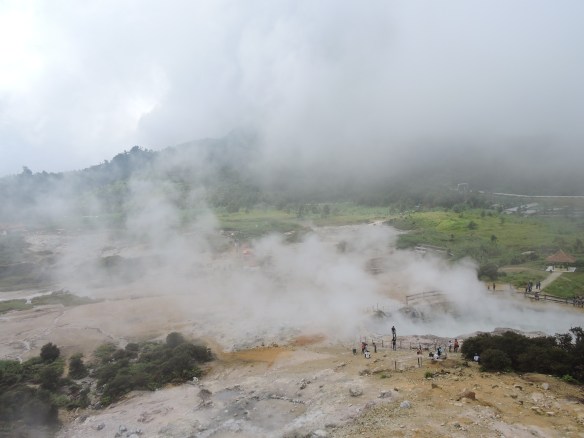
View of the Crater from the small hill we climbed. See the steam from the crater…
We also climbed a small hillock there and up at the top, we had the impression we were among the clouds. There were some low lying clouds which reinforced this impression.
Exercise extreme caution at the crater – there are no guard rails to keep you from slipping off the sometimes-muddy trails into the scalding-hot waters. The rocks are also very slippery and it was only because of our guide we were able to make the climb to the top. Unless you have someone who knows the area, do keep care and watch where you go.
The government is now harnessing all that geothermal energy and there is a huge geothermal electricity plant in Dieng which harnesses this energy and supplies power to the Java power grid.
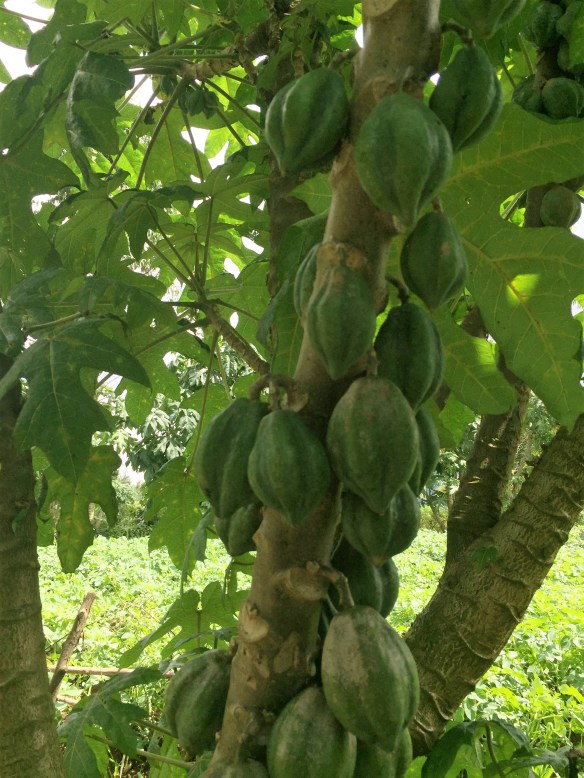
A Carica tree….
We also got to hear and see a local fruit here, called the Carica. This fruit is supposedly found only in Dieng and in far-away Brazil. This looks like a tiny papaya and is quite sweet and has a rubbery texture. We found this fruit and products made from the fruit all over Dieng.
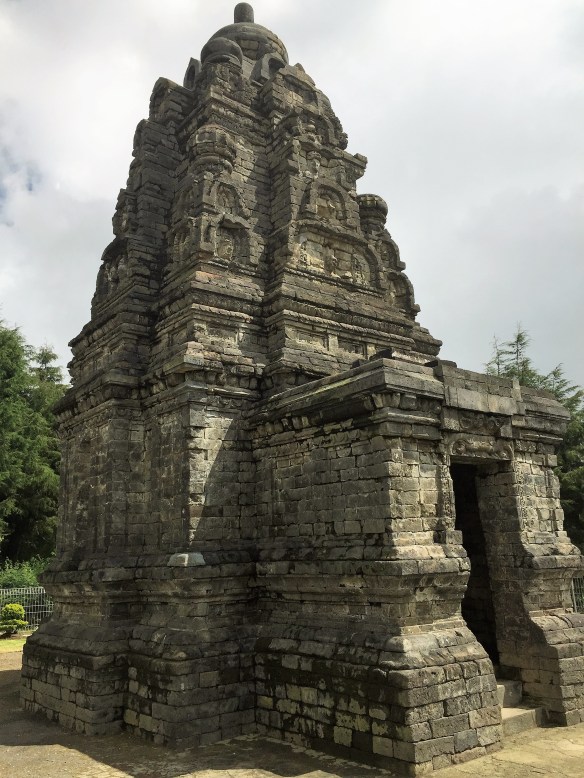
Candi Bhima
After the Crater, we wanted to go to the Coloured lake, but our guide asked us to make a small detour to the Candi Bhima or the Bhima temple (the second Pandava brother in the Mahabharat). After a small stroll in the temple, we moved to the lake.

Telaga Warna

Telaga Warna
Exquisitely beautiful and ringed by highland forest, the Telaga Warna (coloured lake) has turquoise and cobalt hues from the bubbling sulphur deposits around its shores. Instead of taking us to the lake shore, our guide took us to the top of a hill where we had to clamber some steps to see the lake from a different perspective. The lake shore is supposed to be very dirty and this was the reason we were given. My guess is that he pocketed the entrance fee to the lake and took us to a place where there was no entrance fees!
The lake is one of the three main sights on the Dieng Plateau. The lake appears to be a water-filled caldera with several active gas vents below the water’s surface, and signs there are sometimes some active vents around the shore. There are actually two lakes, the bigger one is the coloured lake while the smaller one is supposed to be clear, but with pollution and littering, it is now muddy in colour. The larger lake displays bands of color from pale yellow to emerald green, depending on the proximity to the vents.
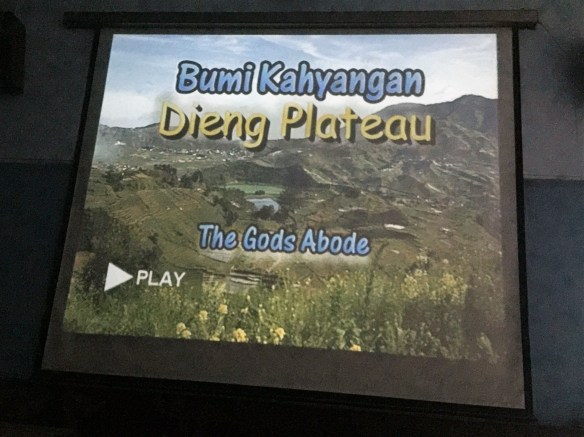
The documentary we saw…
After the lake, we visited the visitor centre which was just 400 meters from the point we saw the lake. We waited a while and saw a documentary on the history of the plateau. The documentary was in Bahasa Indonesia, but had English subtitles and with this we heard more than the guide told us about the area.
At the end of the movie, it was past one and we were starving. The guide took us back to the big village near the Arjuna complex and we had one of the best meals in Yogyakarta. Simple, homely fare, but bursting with fresh vegetables, the meal was awesome!
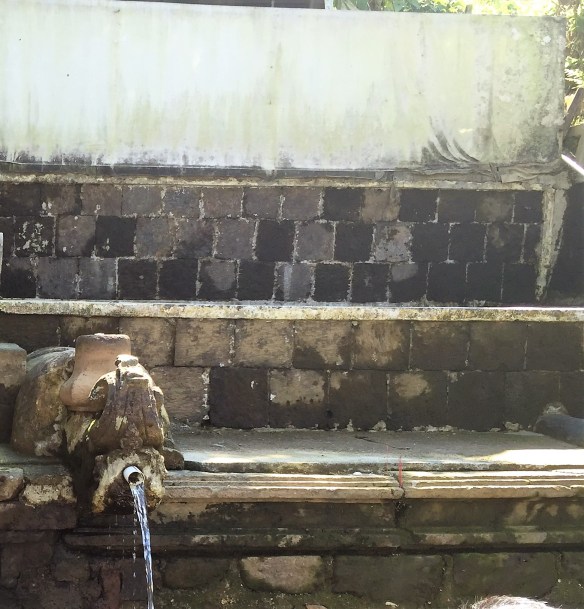
The source of the River Serayu….
After the meal, the guide took us to the source of the Serayu river which is supposed to be a very holy river in Central Java. The source was just a few hundred yards from our lunch place and comes out through a sprout. Local legend says that if you bathe your water in the water, you will look young forever! We did wash our faces and sprinkled some of the holy water on our bodies before saying good-bye to the guide and the plateau.
The return back to Yogyakarta was a long one, especially since there were many traffic jams on the winding roads. We went on a Friday, which is traditionally market days in the small towns between Dieng and Yogyakarta and the 3.5 hour journey took slightly more than 5 hours to get back….
Once back at the hotel, we quickly freshened up and went to the Sheraton for dinner. The Sheraton has an Indian restaurant in-house called Ganesha Ek Sanskriti which served delicious food. The price for the quality was very reasonable. The only problem was that after the meal, we had to wait for quite a while to get a taxi to get back to the hotel. The Sheraton is set a bit away from the main road and so unless a taxi drops off someone, you have to wait a while for your turn!
We were extremely tired and went to bed immediately. The next day was also going to be an action packed one, but we were going to start a bit later, which was small consolation. We were going to see the Palace, the Prambanan temple, Batu Rako and the icing on the cake being the Ramayan ballet performance we were going to see later that night.
Blog posts for all that coming up real soon, so watch this space!


 Sacred India is a close-focus view of spirituality in India with a very God-is-in-the-details approach. Lonely Planet tackles a bafflingly large subject with admirable grace in this loosely structured, accessibly sized coffee-table book. A florid painting of Ganesh, a hundred capped heads bowed in prayer, weather-beaten flags whipped in the Himalayan wind: all are diverse glimpses of India’s spiritual cultures. India’s four major religions–Hinduism, Islam, Sikhism, and Buddhism–are gathered in an impressionistic collage of vibrant photos and text. Christianity, Jainism, Judaism, Zoroastrianism, as well as tribal religions and gurus are also covered in smaller sections. The book’s photos are lavish in color and pungently evocative–but decidedly not opulent. They excel at the intensely personal (a lotus flower, a turban-swathed camel trader, a Muslim woman reading the Quran), but their zoomed-in style sometimes falls short of capturing the sense of awe and grandeur we like to associate with religion. Sacred India offers brief glimpses of a wide-ranging and multicolored land; but unlike the fable of the blind men and the elephant, the picture formed in the mind’s eye from these richly textured details will be greater than the sum of its parts.
 Memories and Such