Family Footprints: An Unforgettable Italian Adventure – Part 3

View from the train on the way to Florence

Early the next day, we checked out of our Airbnb and made our way to the Roma Termini station for our Frecciarossa train to Florence. We had booked business class tickets, and other than two other people in the carriage, we had the carriage to ourselves. We reached Florence around 10:30 am and took a taxi to our next Airbnb. Our Florence host had graciously allowed us to leave our luggage in the Airbnb while it was being cleaned. So after dropping our luggage, we started our short Florence trip. We walked to the Duomo, and I had a jaw-dropping moment there. It dominates the landscape and made me think of St. Paul’s Cathedral in London.

The Duomo

Construction of Florence’s Duomo complex began in 1296 under Arnolfo di Cambio; Filippo Brunelleschi crowned it with his revolutionary double-shell dome in 1436, still the world’s largest in masonry at 43 m wide. We did not go inside and climb the dome, but the next time, I will climb all 463 steps in Brunelleschi’s Dome and brush past Vasari’s Last Judgment fresco before stepping onto a 91 m-high lantern terrace for city-wide views. One can also climb the 414 steps up Giotto’s Campanile for a front-row view of the dome’s herringbone brickwork. At the Museo dell’Opera del Duomo, one can stand inches from Ghiberti’s original Gates of Paradise and Michelangelo’s Pietà Bandini before they return outdoors.

Piazza della Signoria, Time Unfolding

After lunch in the shadow of Brunelleschi’s Dome, we walked to Piazza della Signoria, which has anchored Florentine civic life since 1330. Its irregular “w-shaped” stones still front the crenellated Palazzo Vecchio, the seat of government from the medieval Republic to today’s city council. Under the tower’s shadow, the square doubles as an open-air sculpture gallery. A copy of Michelangelo’s David guards the palace door; the neighbouring Loggia dei Lanzi frames masterpieces from Cellini’s Perseus to Giambologna’s Sabine Women. Ammannati’s marble-and-bronze Fountain of Neptune returned to full sparkle in 2019 after a €1.5 million Ferragamo-funded overhaul that replaced long-silent pumps and cleaned centuries of grime. I loved the sculpture of the young woman holding a smartphone. Apparently, it is a four-metre contemporary bronze by Thomas J. Price called Time Unfolding, which will remain until 14 September 2025. Beyond statuary, one can climb the Arnolfo Tower for 360° city views or follow the freshly reopened Vasari Corridor from Palazzo Vecchio toward the Uffizi and Ponte Vecchio, walking the same secret Medici passage first built in 1565.

While we were relaxing amidst the statues, we were told our Airbnb was ready for us. So we quickly gathered our things and checked in. After resting for a while, we decided to head out, this time just walking and taking in Florence. We split up initially and then met up and did some shopping before heading out for dinner. After dinner, it was time for some gelato and then bed before our Tuscan road trip the next day.

The beautiful Tuscan countryside

We woke up early, and two of us went out to get the car we had reserved. Here is where we hit the first of the many snags of the day. Our plan was to be out of Florence by 8:30 am, but when we reached the car rental place by 8 am, it was still shut, and there was a queue of about 10ish people ahead of us. By the time we collected the car, it was almost 10 am, and our ticket at Pisa was for 10:30 am. The distance between Florence and Pisa is between 60 and 90 minutes, and so we were late even before we started the drive.

Leaning Tower of Pisa

The Leaning Tower of Pisa looms improbably over the Campo dei Miracoli, tilting 3.97° off-plumb because the alluvial clay beneath its foundations started to give way soon after work began in 1173; the bell tower was finally completed in 1372. A decade-long engineering rescue from 1990 to 2001 removed 70 tonnes of soil, nudged the structure upright by 45 cm, and reopened it to visitors; a web of fibre-optic sensors now feeds live data to engineers who forecast at least 200 years of stability. Climbing the 251 spiral steps is a disorienting thrill; the gradient alternately steepens and eases as the tilt shifts underfoot before one steps onto the belfry terrace for wide-angle views of Tuscany and a close-up of the seven medieval bells. Back on the lawn, look for the delicate reliefs at ground level and indulge in the obligatory “holding-up-the-tower” photo.

We reached Pisa and the Leaning Tower around noon, and after parking the rented car close to the complex, we walked over. We tried going inside but were not allowed and were told to purchase new tickets. Since we were getting late, we left the Leaning Tower complex and had a quick meal before making our way to the next stop on our itinerary.

The beautiful Tuscan countryside

Perched on a ridge of Tuscan vineyards, San Gimignano still thrusts 14 medieval tower-houses skyward, remnants of more than 70 that once broadcast family pride and rivalries. Their unmistakable skyline, intact walls, and 14th-century fresco cycles earned the town UNESCO World Heritage status in 1990. At the Piazza del Duomo, you begin at the Torre Grossa, where one can climb 218 wooden steps for sweeping views of the Apuan Alps and Siena’s dome. Inside the adjoining Palazzo Comunale, Benozzo Gozzoli’s pastoral frescoes frame a camera-ready civic courtyard. Steps away, the Romanesque Collegiata cathedral dazzles with a near-complete Old and New Testament cycle by the 14th-century Sienese school. But we didn’t make it into the town. By the time we reached the town’s car park, we realised we had to leave if we were to make it to our wine tasting session at the Castello di Brolio on time. Reluctantly, we left and took the route passing through Siena, which we wanted to come back to.

Castello di Brolio

Driving through the Tuscan countryside is amazing! We took the long route and stopped frequently to take in the views and photos. And we finally made it to the Castello di Brolio just in time for the wine tasting session. Castello di Brolio has belonged to the Ricasoli family since 1141, making it Italy’s oldest continuously run wine estate. The brick-red battlements you see today are a 19th-century neo-Gothic rebuild commissioned by Baron Bettino Ricasoli, the statesman who also penned the original Chianti Classico formula. We circled the ramparts for postcard vistas that sweep across 240 hectares of vineyards to Siena and distant Monte Amiata, then wandered Renaissance box gardens and the family chapel. We had the Classic wine tasting with three wines, and after the session, some of my sisters brought bottles of wine to take home. I am not a drinker, but even I loved the wines we tasted.

After the wine tasting, it was time for dinner. As I mentioned, some of my sisters are big foodies, and one of them found a Michelin-starred vegetarian restaurant in Siena, so we decided to go there because they were not picking up the phone to make a reservation. Another sister wanted to visit Siena, so this worked for everyone.

Siena

We reached Siena around 7 pm. Set atop three converging ridges in southern Tuscany, Siena preserves one of Europe’s purest Gothic cityscapes; UNESCO inscribed the entire historic centre in 1995 for the way its 13th- and 14th-century street plan and ochre-brick facades survive almost intact. The fan-shaped Piazza del Campo is still the civic stage: twice a year it morphs into the thundering Palio horse race. Just above the square, the zebra-striped Cathedral of Santa Maria Assunta dazzles. Climb the 102-m Torre del Mangia for vineyard-striped horizons.

The restaurant was completely booked, and they turned us away. So we frantically googled alternatives. And then it started raining. We went back to the car park and tried alternatives. But it was decided unanimously that we would walk to Piazza del Campo for dinner. The streets of this part of Siena are extremely hilly and winding. But after walking to the Piazza, the views were worth it. We had dinner at one of the restaurants in the Piazza before making our way back to the car park and then the drive back to Florence.

Piazza del Campo

Piazza del Campo is the red-brick heart of Siena. Its distinctive shell unfurls in nine cream-travertine wedges, a permanent tribute to the “Nine” oligarchs who guided the city’s 14th-century heyday, and a key reason UNESCO protected the entire historic centre in 1995. On the square’s lower rim rises the Palazzo Pubblico with its soaring Torre del Mangia. While the belfry’s 400-step climb rewards you with views over Chianti hills, the palace itself offers a rarer thrill: scaffold-level tours of Ambrogio Lorenzetti’s Allegory of Good and Bad Government frescoes. Opposite, Jacopo della Quercia’s marble Fonte Gaia gleams again after a laser cleaning completed in February 2024; its wolves and Genesis reliefs now sparkle against the Sienese brick.

We left Siena around 10 pm for the 1-hour-plus drive back to Florence. I had a headache because of the rain, and so I pretty much slept the drive. I think in the entire trip, this road trip would stand out as a highlight because of all the fun we had. We stored the car in a local garage to be returned the next day.

David at the Galleria dell’Accademia

The next day was our last in Florence, and we had tickets to see David at the Academia. Our original plan was to take a 2 pm train to Venice, but because we wanted to spend more time in the city, we moved our ticket to about 6 pm. Our slot to the Academia was at noon, so after a good breakfast, a couple of us went to return the car while the rest of us worked on clearing the house and getting ready to leave. Our host very graciously offered to let us keep our luggage at a restaurant they co-owned close by, so after checking out and leaving the luggage, we walked to the Academia. We had to wait in a queue for about 15-20 minutes before we could enter.

The Galleria dell’Accademia was founded in 1784 as a teaching museum; today its seven rooms orbit Michelangelo’s David: the five-metre marble hero carved 1501-1504 and installed here in 1873 to shield him from the elements. Every two months, restorers vacuum dust from his curls and scan for micro-cracks, a ritual that keeps the icon in “remarkable health” despite drawing more than two million visitors a year.

Sculpture of Stitch at the Galleria dell’Accademia

The Hall of the Prisoners, where four unfinished slaves wrestle with their marble bonds, comes first before a long hallway with David at the very end. It was not very crowded, and we could walk around the statue, taking in the sculpture’s beauty. Then we walked into the Hall of the Colossus to see Giambologna’s life-size plaster for The Rape of the Sabines flanked by early-Renaissance altarpieces. The luminous Gipsoteca Bartolini showcases 19th-century plaster casts under skylights restored in 2021, while the adjoining Museum of Musical Instruments, home to a Stradivari “Medici” violin and one of Cristofori’s earliest pianos, was amazing. Towards the exit, unexpectedly, I came across a sculpture of Stitch from the film, Lilo and Stitch, draped in a toga. The project is a three-way partnership between Disney Italy, the Italian Ministry of Culture and the museum, timed to promote the live-action Lilo & Stitch remake and to pull new, younger audiences into Florence’s most visited art space. I enjoyed this ode to modern art amidst all the classical and Renaissance art and sculptures.

After visiting the Academia, we decided to have Indian for lunch and walked to one about 10 minutes away. After lunch, we each wandered away, to do our own thing before agreeing to meet at the place where we had stored our luggage around 4 pm. Then it was time to go back to the station to catch another high-speed train to the last stop of our holiday.

Our last stop, Venice, comes up next, along with lessons learned and some tips.

Poem: Celestial Whispers

The night sky is an ancient storyteller, its shimmering lights are a silent language that speaks across time and space. Each twinkling star holds a secret, a tale of wonder, of love lost and found, of ancient dreams and distant destinies. As we gaze upward, the cosmos invites us to listen to its quiet, celestial whispers, urging us to uncover the mysteries hidden within its luminous script.

Celestial Whispers

In the velvet cloak of night, the stars convene,
Scattering silver tales on a canvas unseen.
Each tiny spark a word in a language so old,
Whispering secrets that time has long told.

Constellations form mythic runes in the sky,
Heroes and lovers, their legends still nigh.
They murmur of battles fought in the cosmic embrace,
Of journeys through darkness, of finding one’s place.

The silent chorus hums of dreams yet unfurled,
Of hope and of wonder in a vast, timeless world.
Through the flicker of light, messages unfold—
Of passion and starlight, of mysteries untold.

Listen closely to the language of the night,
Where every star sings with radiant might.
Their whispers carry wisdom, soft and profound,
A celestial lullaby in silence unbound.

Sacred Stones, Spaces and Stories: Shakthipeeta Part 17

Bakreshwar Temple, Siuri Town, West Bengal
The Bakreshwar Temple, located in the Birbhum district, near Siuri Town, is also known as the Mahishamardini Shakti Peetha. The temple is dedicated to Goddess Mahishamardini, a fierce form of Durga, and Lord Shiva, worshipped here as Vakranath Bhairava. Nestled amidst serene surroundings on the banks of the Paaphra River, Bakreshwar Temple’s origins are deeply rooted in Hindu mythology and history. The name Bakreshwar is derived from two Sanskrit words: Vakra or curve or deformity and Ishwar or Lord, referring to Lord Shiva’s manifestation here as Vakranath. The temple complex is believed to have been established during ancient times, with its current structure dating back to 1761 AD, when it was rebuilt by King Darpanarayan.

It is believed that Sati’s eyebrows, symbolic of her mind fell at this location when Lord Vishnu dismembered her body with his Sudarshan Chakra to pacify Lord Shiva’s grief-stricken Tandava. This sanctified Bakreshwar as a Shakti Peetha. The temple also has historical ties to Sage Ashtavakra, who performed intense penance here for 10,000 years. His devotion led Lord Shiva to bless him and declare Bakreshwar a sacred site. The temple’s construction is attributed to Vishwakarma, the celestial architect, who built it on Shiva’s command.

Goddess Sati is worshipped as Mahishamardini, meaning the slayer of Mahishasura. Lord Shiva is worshipped as Vakranath Bhairava, symbolising his protective and meditative aspects. The portion between Sati’s eyebrows, symbolising her mind is believed to have fallen here.

The temple complex houses two main shrines: one dedicated to Goddess Mahishamardini and another to Lord Vakranath. This dual worship reflects the harmonious convergence of Shaivite and Shakta traditions. Bakreshwar is famous for its ten geothermal hot springs, which are considered sacred by devotees. These springs are believed to have been created by Lord Shiva’s tears when he carried Sati’s body. The most prominent spring is called Agni Kund, with water temperatures reaching up to 93°c. Devotees believe bathing in these springs purifies sins and cures ailments. The temple features intricate carvings and domes inspired by Oriya architectural styles. The sanctum houses a beautiful idol of Mahishamardini with ten hands slaying Mahishasura while seated on a lion. A shrine dedicated to Sage Ashtavakra lies within the temple complex. Devotees traditionally visit this shrine before entering the main sanctum. A unique red platform called Panchamukhi Asana or the seat of five skulls is used for Tantric rituals. It is believed that performing sadhana here enhances spiritual power.

The rituals at Bakreshwar Temple are deeply rooted in Tantric practices and traditional Hindu worship. The day begins with Mangala Aarti, the early morning prayers followed by offerings of flowers, fruits, coconuts, and sweets. Devotees chant hymns like the Mahishasura Mardini Stotram during pujas. Navratri is celebrated grandly with special rituals honoring Mahishamardini. Devotees offer red hibiscus flowers, symbolic of power and victory. Cultural programmes and community feasts are organised during this time. Dedicated to Vakranath Bhairava, Maha Shivratri involves night-long prayers and abhishekam, the ritual bathing with milk, honey, ghee, curd, and holy water. Bathing in the hot springs before entering the temple is considered an essential purification ritual for devotees. Tantriks perform esoteric rituals on the Panchamukhi Asana during auspicious nights like Amavasya or the new moon to invoke divine blessings.

One of the most popular legends associated with Bakreshwar revolves around Goddess Mahishamardini slaying the demon Mahishasura. According to Hindu mythology, Mahishasura terrorised heaven and earth with his tyranny. Unable to defeat him, the gods sought help from Goddess Durga, who manifested as Mahishamardini at this site. A fierce battle ensued between the goddess and Mahishasura at Bakreshwar. Armed with divine weapons in her ten hands and riding her lion mount, she vanquished the demon after days of combat. This victory symbolises the triumph of good over evil and establishes Bakreshwar as a site of immense spiritual power.

Sage Ashtavakra performed rigorous penance at Bakreshwar for 10,000 years after being cursed by Rishi Subrita during Satya Yuga, the age of truth. His body was twisted into eight deformities due to his anger but was healed by Lord Shiva after his intense devotion. Shiva not only cured him but also blessed him with enlightenment at this sacred spot. It is believed that those who worship Ashtavakra first before offering prayers at Vakranath Bhairava receive abundant blessings.

Another legend attributes Bakreshwar’s hot springs to Lord Shiva’s grief over Sati’s death. It is said that his tears fell on this land while carrying Sati’s body during his cosmic dance or Tandava, creating these geothermal springs as manifestations of his sorrowful energy. Devotees believe these springs possess healing properties due to their divine origin.

The Bakreshwar Temple offers a unique blend of spirituality, mythology, natural beauty, and cultural heritage. The convergence of Shaivite and Shakta traditions reflects India’s rich spiritual diversity while rituals like Tantric sadhana on Panchamukhi Asana make it an important center for esoteric practices. Whether you seek spiritual solace or wish to explore ancient traditions, visiting this sacred shrine will leave you enriched in mind and spirit!

Kankalitala Temple, Bolpur West Bengal
Located in the serene village of Kankalitala near Bolpur in Birbhum district, the Kankalitala Temple is dedicated to Goddess Sati, worshipped here as Kankaleshwari Devi, and Lord Shiva, revered as Ruru Bhairava. The temple holds immense spiritual significance as it is believed to be the site where Sati’s waist or kankal fell, sanctifying the location as a Shakti Peetha. Nestled on the banks of the Kopai River and surrounded by natural beauty, Kankalitala is a destination for devotees seeking divine blessings and spiritual solace.

According to legend, it is believed that Sati’s waist or kankal fell at this site, creating a depression in the earth that later filled with water to form a sacred pond or kund. The temple has been a center of devotion for centuries. Unlike many grand temples in India, Kankalitala stands out for its simplicity and natural surroundings. The sacred kund near the temple is considered the original form of the goddess at this Shakti Peetha and continues to be worshipped by devotees. The temple structure has undergone renovations over time but retains its ancient charm. The garbhagriha or sanctum sanctorum houses no traditional idol but instead features a large framed painting of Goddess Kali in her Dakshina Kali form, standing atop Lord Shiva.

Goddess Sati is worshipped as Kankaleshwari Devi, symbolising nurturing energy and protection. Lord Shiva is revered as Ruru Bhairava, representing his fierce yet meditative aspect. Sati’s waist or kankal is believed to have fallen here. The combination of Kankaleshwari Devi and Ruru Bhairava represents the union of nurturing feminine energy with protective masculine power, making this Shakti Peetha a site of immense spiritual energy.

The most sacred feature of Kankalitala is the kund or the pond, believed to have formed where Sati’s waist fell. Known as Dudh Pukur, this shallow pond is surrounded by protective walls and steps leading down to its waters. Devotees consider this kund to be imbued with divine energy. However, bathing or collecting water from it is strictly prohibited out of reverence for its sanctity. Unlike most temples that house idols made of stone or metal, Kankalitala features a framed painting of Goddess Kali in her Dakshina Kali form. This unique representation underscores the temple’s simplicity and spiritual focus. The garbhagriha or sanctum santorum is capped by a curved pyramidal roof adorned with a metal spire. Connected to it is a raised rectangular platform called the natmandir, which serves as an area for devotees to view the goddess and participate in rituals. The natmandir also provides respite from the sun and serves as a space for meditation and quiet reflection. Situated on the banks of the Kopai River, the temple offers a tranquil environment surrounded by greenery.

The rituals at Kankalitala Temple reflect traditional Hindu practices combined with local customs. The day begins with Mangala Aarti at dawn. Devotees offer flowers (especially hibiscus), coconuts, fruits, sweets, and incense sticks while chanting hymns dedicated to Goddess Kali. Navratri is celebrated grandly over nine days with special pujas honoring Kankaleshwari Devi. Devotees participate in rituals such as Kumari Puja, the worshipping young girls as manifestations of Shakti, and offer bhog made from rice, fruits, and sweets. During Durga Puja, elaborate rituals are performed to honor Mahishamardini Durga’s victory over evil forces. The temple witnesses large gatherings of devotees who come to seek blessings during this auspicious time.

Dedicated to Ruru Bhairava, Shivratri involves night-long prayers and abhishekam with milk, honey, ghee, curd, and holy water. On Sharad Poornima, the full moon night of the Hindu lunar month of Ashvin which falls in September/October and marks the end of the monsoon season, special prayers are held at the kund under moonlight to invoke divine blessings.

According to legend, when Sati’s waist fell at this site, it created a deep indentation in the earth that later filled with water from divine sources. This pond became known as Dudh Pukur due to its milky-white appearance under moonlight. Devotees believe that Sati’s waist bones lie beneath this pond, making it one of the most sacred features of Kankalitala. Another story explains why there is no traditional idol at Kankalitala Temple. It is said that when priests attempted to install an idol of Goddess Kali here, they experienced divine visions instructing them to preserve her presence through a painting instead. This framed image has since become the focal point of worship at this Shakti Peetha. Local lore suggests that Ruru Bhairava once appeared before devotees who were struggling with hardships and granted them boons after they prayed earnestly at his shrine within the temple complex.

The Kankalitala Temple on the banks of the Kopai River provides an ideal setting for meditation and introspection. Its unique features like the sacred kund and absence of traditional idols emphasise simplicity in worship while preserving ancient traditions. Whether one seeks spiritual solace or wishes to explore India’s rich cultural heritage, visiting this ancient shrine will leave one feeling connected to divine feminine energy.

Kiriteswari Temple, Kiritkona West Bengal
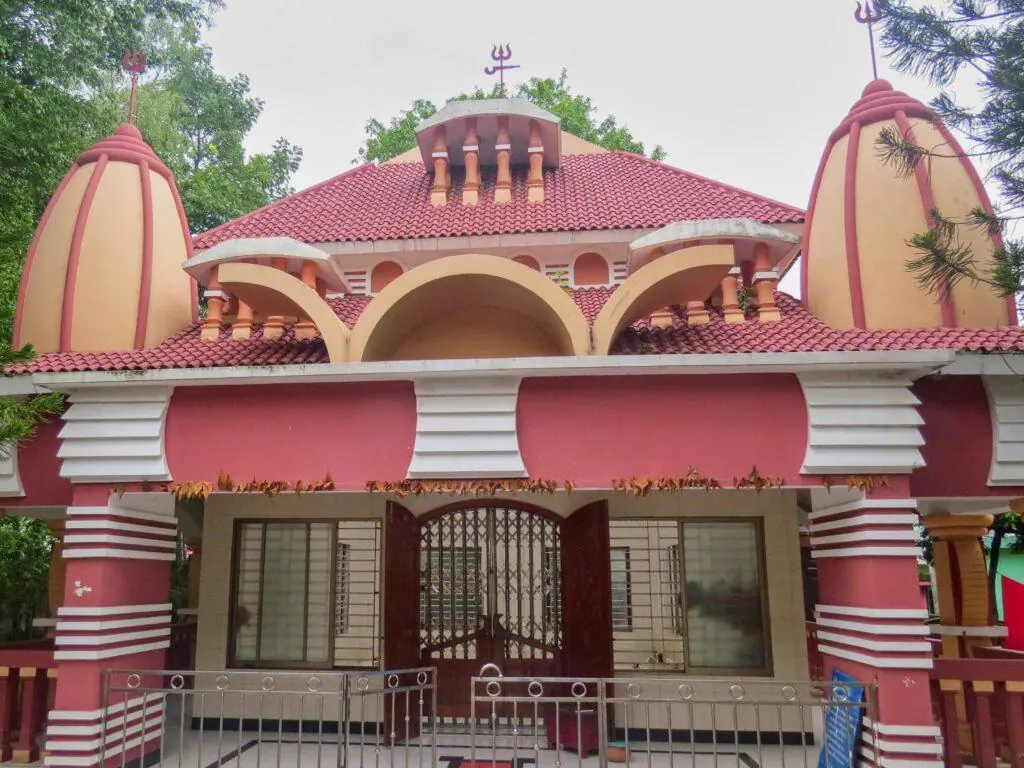
The ancient Kiriteswari Temple, located in the tranquil village of Kiritkona near Lalbagh in Murshidabad district is dedicated to Maa Kiriteswari, also known as Mukuteshwari, and Lord Shiva, revered here as Samvarta Bhairava. Known for its simplicity, spiritual energy, and unique rituals, the Kiriteswari Temple is one of Bengal’s oldest and holiest shrines.

According to legend, it is believed that Sati’s crown or kirit fell at this site in Kiritkona village, sanctifying it as a Shakti Peetha. The temple is one of the oldest in Bengal and has been a centre of devotion for over 1,000 years. Historical records indicate that the original temple was constructed in 1405 but was destroyed by a fire. The present structure was rebuilt in the 19th century by King Darpanarayan Roy of Lalgola. The temple served as the presiding deity for the ruling families of Murshidabad during its golden age. The temple’s architecture reflects a blend of Hindu, Buddhist, and Islamic styles, symbolising harmony and inclusivity. Despite its simplicity, it exudes an aura of divinity that draws devotees from across India.

Goddess Sati is worshipped as Vimala or Mukuteshwari, symbolising purity and divine power. Lord Shiva is revered as Samvarta Bhairava, representing his fierce yet protective aspect. Sati’s crown is believed to have fallen here. Unlike other Shakti Peethas where body parts fell, Kiriteswari is considered an Upa Peetha since an ornament, the crown, fell here instead. This makes it unique among the Shakti Peethas.

The temple does not house a conventional idol or deity. Instead, Maa Kiriteswari is represented by a red-colored stone placed on a high altar within the sanctum sanctorum. The red stone is veiled and is only unveiled during special occasions like Durga Puja Ashtami when it is given a sacred bath. The temple’s architecture reflects a blend of Hindu, Buddhist, and Islamic influences. Its garbhagriha, the sanctum sanctorum, features intricate carvings and a curved roof adorned with a metal spire. The original crown or kirit of Goddess Sati is preserved at Rani Bhabani’s Guptamath, located opposite the temple. Devotees believe this crown radiates divine energy and blessings.

The temple is often referred to as the sleeping place of Mahamaya due to its serene ambiance and association with Goddess Durga’s nurturing aspect. Local legends suggest that Nawab Mir Jafar sought Maa Kiriteswari’s blessings during his final days while suffering from leprosy. He requested her holy Charanamrita or sacred water, which reportedly alleviated his suffering.

Daily pujas are performed by priests who offer flowers, fruits, incense sticks, and sweets to Maa Kiriteswari. Devotees chant hymns like the Devi Mahatmyam during prayers. Durga Puja is celebrated with great fervour at this Shakti Peetha. On Ashtami, the eighth day of the Navaratri festival, special rituals are conducted where the red stone representing Maa Kiriteswari is bathed with milk, honey, ghee, curd, and holy water. A grand feast is organised on Ashtami that attracts thousands of devotees from nearby villages. On Sharad Poornima, special prayers are held under moonlight to invoke divine blessings. The Mahaprasad prepared in the temple kitchen using traditional methods is considered sacred by devotees who partake in it for spiritual fulfilment. Samvarta Bhairava’s shrine within the temple complex witnesses special pujas during Shivratri when devotees offer abhishekam with milk and water to seek his blessings for protection and prosperity.

According to legend, when Sati’s crown fell at this site, it radiated such immense divine energy that it created an aura visible across Murshidabad. Devotees believe this energy still permeates the area around Kiritkona village. Another intriguing story ties Nawab Mir Jafar to this sacred site. On his deathbed, while suffering from leprosy, he sought Maa Kiriteswari’s blessings through her holy Charanamrita. It is believed that her blessings eased his pain and brought him peace during his final moments. Rani Bhabani of Natore played a significant role in preserving Maa Kiriteswari’s legacy by safeguarding her crown at Guptamath. Her devotion ensured that future generations could continue worshipping the goddess with reverence.

The Kiriteswari Temple with its unique features like the absence of traditional idols emphasises simplicity in worship while preserving ancient traditions. Whether you seek spiritual solace or wish to explore India’s rich cultural heritage, visiting this ancient shrine will leave you feeling connected to the divine feminine energy embodied by Maa Kiriteswari.

Family Footprints: An Unforgettable Italian Adventure – Part 2

First glimpse of Italy from the air

Rome
We reached the airport about 2.5 hours before our flight because we had heard all sorts of horror stories about the airport. But we were pleasantly surprised and checked in and were sent on our way in less than 10 minutes. After breakfast at the airport, we started our journey. We landed in Rome in the afternoon, and there was a bit of a rush in Italian immigration. We could have taken the train to Roma Termini, but because there were six of us, a taxi was cheaper. Though Italy has Uber, only the premium taxis can be hired. Instead, the FreeNow app is more widely used, from which we got our taxi. We used Airbnb all through the trip, and our Airbnb in Rome was close to the Colosseum.

After checking in and freshening up, we headed out to go to the Vatican. We had a 5:30 slot at the Vatican Museum and a slightly earlier slot at St. Peter’s Basilica. We missed the basilica slot but made it to the Vatican Museum. Because it is a Jubilee year and a new Pope has just been selected, the crowds were crazy in all the Italian cities we visited. The Vatican Museum was no exception. But what a museum!

Courtyard of Vatican Museum

Founded in 1506 by Pope Julius II and expanded by successive pontiffs, the Vatican Museums form a 7-km labyrinth of galleries that chart 3,000 years of human creativity. The Sistine Chapel is the last but probably the most visited part of the museum, where Michelangelo’s ceiling and Last Judgment remain the undisputed stars of the collection. The recently restored four Raphael Rooms are gorgeous, their luminous frescoes now glowing as they did for Leo X’s court. In the Pio-Clementine Museum, the newly restored Apollo of the Belvedere once again commands the Octagonal Courtyard, its marble surface revealing subtle details lost for generations. At the Anima Mundi, the reimagined ethnographic wing, the freshly installed Africa and Americas galleries place sacred masks, bark-cloths, and Inuit carvings on equal footing with the Western canon. I loved the Gallery of Maps with its intricate illustrative maps, the jewel-like Pinacoteca, and the vertiginous modern Bramante/Momo spiral ramp. When you are finally exhausted, you reach the Sistine Chapel, where photography is prohibited, and just find space in the benches in the perimeter of the room to sit and take in the beauty of the room and the ceiling!

After this assault on the senses, it was time for dinner. Our group was comprised of foodies, so we ate really well during this trip. The first evening, we had a fancy dinner at the Raphael hotel. We could not get the rooftop dining experience, but the food was so, so good. I was practically falling asleep at my plate, so around 10 pm, we finally called it a day.

Colosseum

The next day was for the Colosseum. Our timed entry was for 9:30 am, but since we were less than 10 minutes away on foot, we took our time in the morning. Carved into the heart of ancient Rome, the Colosseum and neighbouring Palatine Hill form a single archaeological park that distils two millennia of power, spectacle, and imperial luxury into a walkable circuit. We began with the Colosseum, inaugurated in AD 80 by Emperor Titus. We only had the normal ticket, so we only went to the main area. But if you purchase the full experience ticket, you cam go onto the partly reconstructed arena floor, gaze down into the fully accessible hypogeum with its maze of lifts, cages, and service corridors reopened to visitors after a recent restoration campaign, and then climb to the upper ring for skyline views stretching from the Capitoline to the distant dome of St. Peter’s. We spent quite a bit of time at the Colosseum, marvelling at its grandeur. After a quick lunch nearby, we walked back to tackle Palatine Hill, mythical birthplace of Romulus and later the postcode of choice for Rome’s emperors. We walked around and caught the vividly painted private rooms of Augustus and Livia that survive in remarkable condition. We last headed to the Farnese Gardens, Europe’s first botanical garden, which offers fragrant terraces with postcard views over the Circus Maximus. After spending a couple of hours here, we headed back to our Airbnb to freshen up before dinner near Piazza del Popolo.

Trevi Fountain

On our last full day in Rome, we decided to head to the Trevi Fountain first. The Trevi Fountain is carved into a palace façade at the junction of “tre vie,” channels the 1st-century BCE Aqua Virgo aqueduct, and crowns Rome’s Baroque age. Pope Clement XII commissioned Nicola Salvi in 1732; after Salvi’s death, Giuseppe Pannini finished the marble theatrics in 1762, centring Oceanus in a shell chariot that surges from craggy rocks toward the city’s ancient heart. A 16-month restoration funded by Fendi in 2014-15 scrubbed the travertine, replaced hidden pumps, and relit the basin, ensuring its moonlit shimmer endures.

We walked about 25-30 minutes from our Airbnb to get to the fountain. It was so crowded, but we managed to get up close in front to take photos and do the coin toss. It is believed that if you stand facing away from the fountain and toss a coin over your left shoulder, you will return to Rome. And for those who are seeking love, it is believed that tossing three coins will get you the love of an Italian!

Source

From the Trevi Fountain, we walked to the Pantheon, but not before a gelato. As with every other attraction in Rome, the Pantheon was also crowded, and so we just saw it from the outside before making our way to Piazza Navona.

Rebuilt by Emperor Hadrian around AD 118–125 atop Agrippa’s earlier temple, the Pantheon still boasts the world’s largest unreinforced concrete dome and an oculus that rains sunlight, and, each Pentecost, rose petals into the marble rotunda. Converted to the church of Santa Maria ad Martyres in 609, it shelters the tombs of Raphael and Italy’s first kings. A €5 timed-entry system introduced in July 2023 now funds ongoing conservation, including 2025 dome reinforcement and portico cleaning backed by Tod’s. One should not miss the noon sunbeam illuminating the floor, the original bronze door leaves, and the Latin portico inscription (“M·AGRIPPA·L·F·COS TERTIVM·FECIT”) linking two Roman ages.

Piazza Navona

Occupying the footprint of Domitian’s first-century athletics stadium, Piazza Navona is an elongated “living room” and is Rome’s Baroque set piece. At its heart lies Bernini’s Fontana dei Quattro Fiumi, personifying the Nile, Danube, Ganges, and Río de la Plata. Framing it are Giacomo della Porta’s Neptune and Moor fountains and Borromini’s undulating façade of Sant’Agnese in Agone.

After spending some time admiring the gorgeous sculptures, we made our way for lunch, after which we did a spot of shopping, and then two of my sisters decided they wanted a break. The rest of us decided to walk to the Spanish Steps, which took us about 20 minutes of walking. We also stopped for coffee on the way.

Spanish Steps

One of Rome’s iconic sights, the Spanish Steps, is fashioned from creamy travertine and was built between 1723 and 1726. With 138 steps, it was financed by France to link its embassy-church above with Spanish diplomatic territory below. A €1.5 million Bulgari-backed restoration scrubbed the balustrades in 2016, and since 2019, anyone who sits or rolls a suitcase on the monument risks fines of €250-€400, preserving the marble for posterity. Crowning the staircase is the Church of Trinità dei Monti, a French-Gothic twin-tower basilica whose nave shelters delicate 16th-century frescoes and an 1864 Cavaillé-Coll organ. While we didn’t go inside the church, we were impressed with the views from the porch of the church.

View from outside the Pincio Terrace

A few minutes’ stroll farther up Viale Trinità dei Monti leads to the pine-fringed Pincio Terrace, the southern gateway to Villa Borghese’s gardens. We walked to the gardens and took in the atmosphere. Then, tired, we sat down at a lake in the garden to chit-chat for a while and take a break. While there, I was entranced by a young Roman family with their toddler. All this while, my bag had been strapped crossbody with my phone on a strap around my neck. I was so engrossed with the toddler’s antics that when it was time to leave, I forgot that I had removed my bag from my shoulder and kept it aside. So, I just got up and started walking. We left the garden and walked across the street, and were contemplating whether we should take a taxi or the metro to get back to our Airbnb. It was then I realised that I didn’t have my bag with me! I immediately started running back to where we were sitting, and during those five minutes, my mind was frantically cataloguing the contents of my bag and wondering which cards I should cancel and how. It was one of the longest five minutes of my life. I reached the lake where we were sitting, and in a huge miracle, my bag was exactly where I had left it. With all that I had read about Rome, this was my Roman miracle, and I thanked all the gods, Indian and Roman, for my good fortune! We then walked to the nearest metro station, which happened to be in Piazza Poppolo. Our time in Rome had come to an end as we were going to have a quiet night with a cheese board, wine, and gossip.

Our next destination, Florence, is coming up soon.

Sacred Stones, Spaces and Stories: Shakthipeeta Part 16

Varahi Devi Temple, Panchsagar, Uttarakhand
The Varahi Devi Temple, located in the sacred land of Uttarakhand, in the town of Panchsagar is dedicated to Goddess Varahi. According to historical records, the temple’s present structure dates back to the 14th century, though much of its early history remains shrouded in mystery. According to tradition, it is believed that the lower teeth of Goddess Sati fell here. Interestingly, there is some debate about the exact location of this Shakti Peetha. While some sources place it in Varanasi, Uttar Pradesh, others identify it in Panchsagar, Uttarakhand.

At the Varahi Devi Temple, the goddess is worshipped as Varahi, a fierce form of Shakti. The name Varahi itself is significant, meaning with the face of a boar in Sanskrit. This unique representation of the goddess is closely associated with Lord Vishnu’s Varaha avatar. The Bhairava, the fierce manifestation of Lord Shiva who accompanies the goddess at each Shakti Peetha, is known here as Maharudra.

Goddess Varahi is depicted with the head of a female boar, wearing a red sari and adorned with jewels. The temple is revered by all three branches of Sanatana Dharma – Vaishnavism, Shaivism, and Shaktism. Unlike most temples, this shrine is open for only two hours daily, typically between 5:30 and 7:30 am. The temple is believed to be located near a sacred water body while the temple’s structure is said to glow uniquely when sunlight falls upon it, creating mesmerising views.

Despite its limited opening hours, the temple sees a constant flow of devotees offering prayers and seeking blessings. Navratri is celebrated with great gaiety at the temple, with Varahi Navaratri celebrated around June and July each year. Daily rituals include Kshirabhishekam or a milk bath and Kumkumarchana or a vermilion offering to the goddess. Sahasranamam and Ashtottara Shata Namavali are powerful chants that are recited during the daily pujas. The Rath Yatra is a major event celebrated with great devotion and festivals like Durga Puja, Vijaya Dashami, and Kalabham Festival are also celebrated with enthusiasm.

According to the Matsya Purana, Maa Varahi was created by Lord Shiva from the incarnation of Lord Vishnu’s Varaha avatar to slay a demon. She is primarily worshipped at night. It is said that there are two holes at the temple site, believed to be where Sati’s teeth fell. Legend has it that when someone tried to measure their depth years ago, he lost his power of sight. It is believed that Maa Varahi protects the holy city of Varanasi during the night, which is why the temple remains closed during the day. Some devotees believe that worshipping at this temple can help improve eyesight, likely connected to the legend of the unmeasured depth.

The Varahi Devi Temple, with its blend of myth, history, and living faith serves as a cultural centre, preserving ancient traditions and fostering community bonds. Its unique blend of Vaishnava, Shaiva, and Shakta traditions, coupled with its mysterious origins and limited accessibility, makes it a fascinating destination for both devotees and those interested in India’s spiritual heritage.

Attahas Temple, Attahas, West Bengal
The Attahas Temple, also known as the Phullara Shakti Peetha, is located in the village of Dakshindihi, near Katwa in Birbhum district. As one of the 51 Shakti Peethas, it is believed that this is where her lower lip is believed to have fallen. Here, the goddess is worshipped as Maa Phullora, symbolising blooming energy, and Lord Shiva is revered as Vishwesh Bhairava, her eternal consort and protector.

The origins of the Attahas Temple are deeply rooted in Hindu mythology and history. The name Attahas is derived from two Sanskrit words: Atta or excessive and Hasa or laughter, translating to loud laughter. This name is linked to the belief that Goddess Sati’s divine laughter resonates at this sacred site. The exact date of the temple’s establishment remains unknown, but archaeological evidence suggests that an ancient temple existed here centuries ago. The current structure was renovated and re-enshrined in 1915, after the original idol was moved to a museum for preservation. The temple houses a massive 15-foot-long stone that symbolises Sati’s lower lip, making it a unique representation among Shakti Peethas.

The temple’s location on the banks of the Ishani River, locally known as Kandor River, adds to its serene and spiritual ambience. Surrounded by natural beauty and dense forests, it is not only a place of worship but also a haven for environmentalists and birdwatchers who visit during December-January to observe migratory birds like Asian openbill storks and fruit bats.

As Goddess Sati is worshipped as Maa Phullora here, the name reflects her nurturing aspect that promotes growth and prosperity. Devotees offer items grown from the soil—such as grains, fruits, and flowers—as a symbol of gratitude for her blessings. Lord Shiva, in his fierce form as Bhairava, is worshipped here as Vishwesh, meaning Lord of the Universe. His presence ensures protection and balance at this powerful site of divine feminine energy.

Unlike conventional idols or murtis, the main deity at Attahas is represented by a massive stone measuring approximately 15 feet in length. This stone symbolises Sati’s lower lip and serves as a focal point for worship. The stone emanates an aura of divinity and uniqueness, making it one of the most distinctive representations among all Shakti Peethas. Though not grand in scale or opulence, the temple’s marble structure exudes elegance and serenity. Its understated design allows devotees to focus on spiritual connection rather than material grandeur. Adjacent to the main shrine is a smaller shrine dedicated to Lord Shiva as Vishwesh Bhairava, and Kal Bhairava.

A large pond near the temple holds immense religious significance. According to legend, Lord Hanuman collected 108 blue lotuses from this pond when Lord Rama required them for Durga Puja during his battle against Ravana. Devotees believe that bathing in this pond purifies sins and brings prosperity. The temple is surrounded by lush greenery and wildlife. Migratory birds like storks and butterflies add to its tranquil environment, attracting not just devotees but also nature enthusiasts.

The Attahas Temple follows traditional rituals steeped in Tantric practices and Shakta traditions. The day begins with Mangala Aarti or the early morning prayers, followed by offerings of flowers, especially hibiscus, coconuts, fruits, and grains. Devotees chant mantras dedicated to Maa Phullora while circumambulating the sanctum sanctorum. Navratri is celebrated with great fervour at Attahas. Special Tantric rituals are performed during these nine nights to invoke Maa Phullora’s blessings. Devotees offer anna bhoga or cooked rice offerings during these days as part of their prayers for prosperity.

A grand 10-day fair is held annually during Magh Purnima in January-February. Thousands of devotees gather at this time to offer prayers and participate in cultural programmes. The fair includes traditional music performances, stalls selling religious items, and community feasts. The temple is an important centre for Tantrik Shaktism. Many Tantriks perform rituals here seeking spiritual enlightenment or mastery over esoteric powers. These rituals often involve chanting mantras over specific yantras that are sacred geometric diagrams placed near Maa Phullora’s stone representation.

One legend explains how the name Attahas came into being. At Attahas, where her lower lip fell, it is believed that Shiva momentarily experienced divine laughter amidst his sorrow upon realising Sati’s eternal presence through these sacred sites. This laughter resonated across the cosmos and gave this place its name—Attahas or Loud Laughter. Another story links Lord Hanuman to this sacred site. During Lord Rama’s preparation for battle against Ravana in Lanka, he sought Maa Durga’s blessings through Durga Puja. As part of the ritual, he needed 108 blue lotuses. Hanuman searched far and wide until he discovered a pond near Attahas filled with these rare flowers. He collected them with devotion and presented them to Rama for his worship of Maa Durga. This act sanctified not only the pond but also reinforced Attahas as a site blessed by divine intervention.

An ancient terracotta inscription was discovered near the temple complex during archaeological excavations. While researchers are still deciphering its script, it is believed to contain information about early worship practices at Attahas or possibly references to Tantric rituals performed here centuries ago. This inscription adds an air of mystery to the temple’s history and underscores its significance as an ancient center of spirituality.

The Attahas Temple offers devotees a unique spiritual experience rooted in mythology, history, and natural beauty. Its distinct representation of Maa Phullora through a massive stone symbolising Sati’s lower lip sets it apart from other temples dedicated to Shakti. Whether you seek blessings for prosperity or wish to immerse yourself in serene surroundings steeped in divine energy, visiting this sacred site provides solace for both mind and soul.

Bahula Temple, Ketugram, West Bengal
Located in Ketugram village near Katwa in the Bardhaman district, the Bahula Temple is dedicated to Goddess Bahula, a manifestation of Shakti. The temple holds immense significance for devotees who come seeking blessings from the goddess, known for her nurturing and lavish nature. Here, Lord Shiva is worshipped as Bhiruk Bhairava, the divine protector of the Shakti Peetha.

The Bahula Temple is believed to date back to ancient times and is associated with the legend of Goddess Sati’s self-immolation during Daksha Yajna. It is said that Goddess Shakti’s left arm fell at this site in Ketugram and sanctified the location as a Shakti Peetha. The name Bahula has dual meanings: Bahu in Sanskrit means arm, signifying the part of Sati’s body that fell here, while Bahula translates to lavish or abundant, symbolising the prosperity and blessings bestowed by Goddess Bahula.

Historical records suggest that the temple was established by Raja Chandraketu, a local ruler who installed the stone idol of Goddess Bahula along with those of her sons, Lord Kartikeya and Lord Ganesha. Over time, the temple has undergone renovations but retains its ancient charm.

Goddess Sati is worshipped as Bahula, representing abundance and prosperity. Lord Shiva is revered as Bhiruk Bhairava, meaning one who has attained the highest levels of meditation or Sarvasiddhidayak or the grantor of all attainments.

The sanctum sanctorum houses a stone idol of Goddess Bahula in a serene form. She is depicted alongside her sons, Lord Kartikeya, symbolising war and fertility, and Lord Ganesha, representing auspicious beginnings and wisdom. The idol exudes simplicity yet radiates divine energy, drawing devotees into deep devotion. A separate shrine within the temple complex is dedicated to Bhiruk Bhairava, who protects this sacred site. His presence ensures balance and harmony at this powerful Shakti Peetha.

The temple features a spacious courtyard paved with red stone. This open space provides an area for meditation and spiritual reflection amidst the chiming of bells and chanting of mantras. The temple is located near the banks of the Ajay River, adding to its serene ambiance. The river is considered sacred by devotees who often take ritual baths before entering the temple. Unlike grand temples with elaborate carvings, the Bahula Temple boasts a simple yet elegant structure that emphasises spiritual connection over material grandeur.

The daily rituals and special ceremonies at Bahula Temple reflect deep-rooted traditions. The day begins with Mangala Aarti or early morning prayers at dawn. Devotees offer flowers, especially hibiscus, coconuts, fruits, sweets, and incense sticks as part of their prayers. Evening prayers include Sandhya Aarti followed by lighting lamps around the temple premises.

Navratri is celebrated with great grandeur at this Shakti Peetha. Special pujas are performed over nine days to honour Goddess Bahula’s nurturing aspect. Devotees offer bhog or sanctified food made from rice, fruits, and sweets during these celebrations. Durga Puja and Kali Puja are marked by elaborate rituals conducted by priests using tantric practices. Devotees participate in community feasts organised within the temple premises. Maha Shivratri is dedicated to Bhiruk Bhairava, where devotees perform night-long prayers seeking his blessings for spiritual growth and protection. Chhoti Navratri, a lesser version of Navratri celebrated in April includes yajnas or fire sacrifices performed to invoke divine blessings.

According to local lore, Raja Chandraketu was a devout follower of Goddess Shakti who had a vision instructing him to establish a temple at Ketugram where Sati’s left arm had fallen. Following this divine command, he installed stone idols of Goddess Bahula along with those of Kartikeya and Ganesha. It is said that Raja Chandraketu’s devotion was so intense that he never left empty-handed after praying at this temple—a belief that continues among devotees today. Another popular legend highlights how Maa Bahula blesses her devotees with prosperity and abundance. Farmers in Ketugram believe that offering prayers at this temple ensures bountiful harvests and protection from natural calamities.

The name Bahula, meaning lavish or abundant, reflects her role as a giver of wealth and well-being. Bhiruk Bhairava’s association with meditation as Sarvasiddhidayak has inspired many sages and ascetics to practice intense penance near this temple. It is believed that meditating here under Bhiruk Bhairava’s guidance leads to spiritual enlightenment and liberation from worldly attachments.

The Bahula Temple offers a unique spiritual experience rooted in mythology, history, and devotion. Its status as one of the 51 Shakti Peethas makes it a must-visit for devotees seeking divine blessings. The serene environment near Ajay River provides an ideal setting for meditation and introspection while the simple yet powerful representation of Maa Bahula through her stone idol emphasises humility in worship. Whether you seek prosperity or spiritual growth, visiting this ancient shrine will leave you feeling connected to divine feminine energy embodied by Maa Bahula!