In My Hands Today…

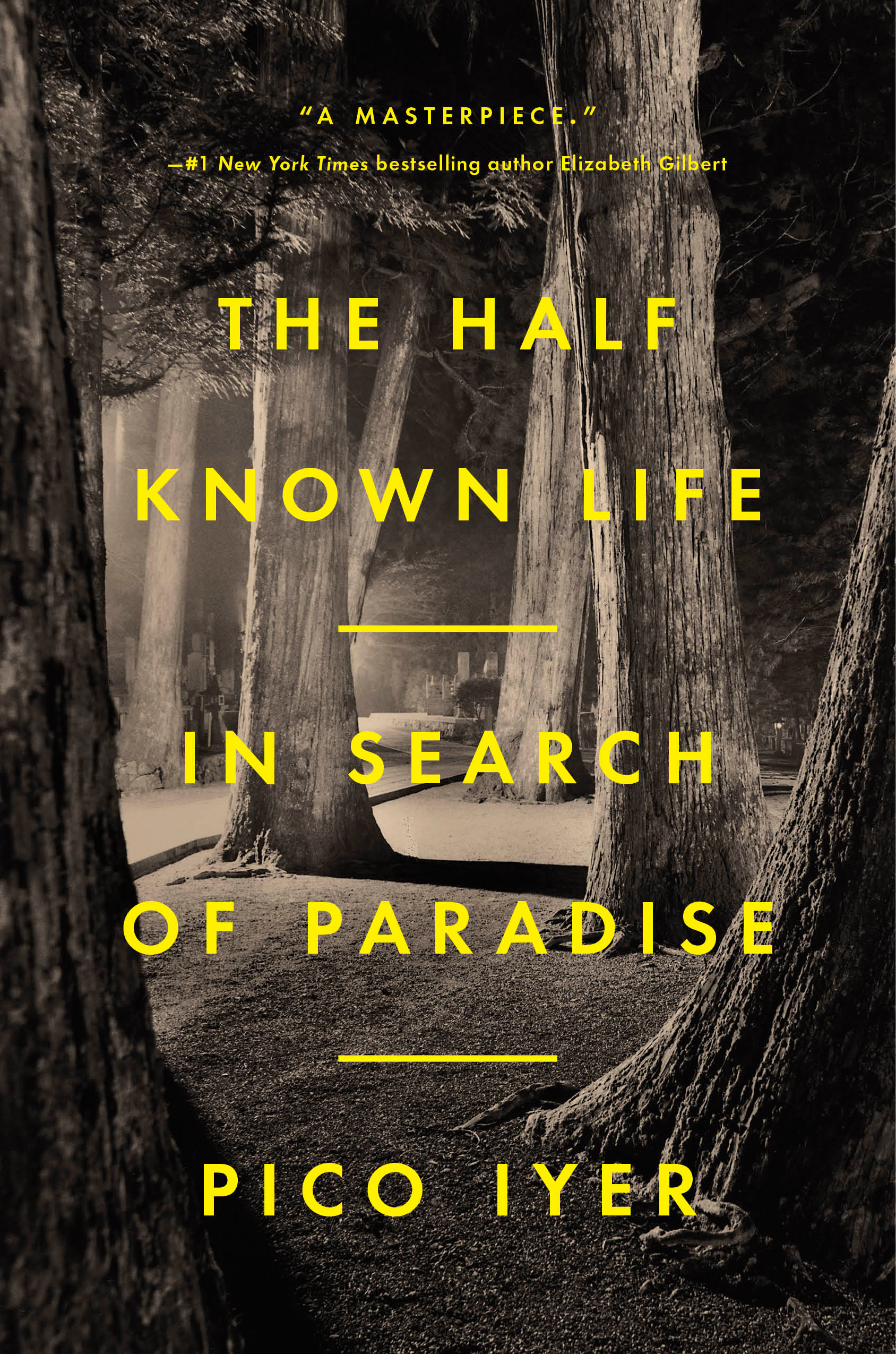
The Half Known Life: In Search of Paradise – Pico Iyer

Paradise: that elusive place where the anxieties, struggles, and burdens of life fall away. Most of us dream of it, but each of us has very different ideas about where it is to be found. For some it can be enjoyed only after death; for others, it’s in our midst–or just across the ocean–if only we can find eyes to see it.

Traveling from Iran to North Korea, from the Dalai Lama’s Himalayas to the ghostly temples of Japan, Pico Iyer brings together a lifetime of explorations to upend our ideas of utopia and ask how we might find peace in the midst of difficulty and suffering. Does religion lead us back to Eden or only into constant contention? Why do so many seeming paradises turn into warzones? And does paradise exist only in the afterworld – or can it be found in the here and now?

For almost fifty years Iyer has been roaming the world, mixing a global soul’s delight in observing cultures with a pilgrim’s readiness to be transformed. In this culminating work, he brings together the outer world and the inner to offer us a surprising, original, often beautiful exploration of how we might come upon paradise in the midst of our very real lives.

Racial Harmony Day Singapore

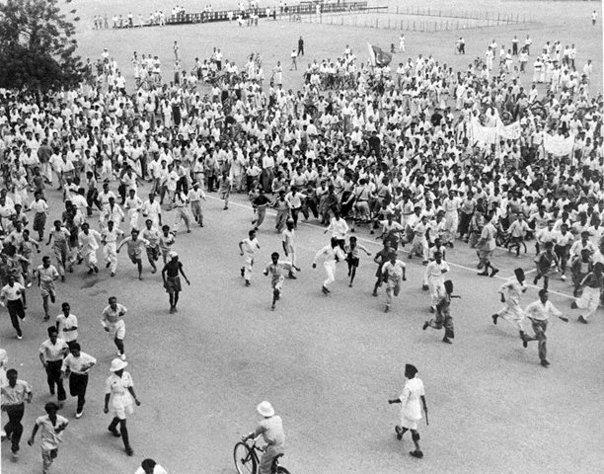
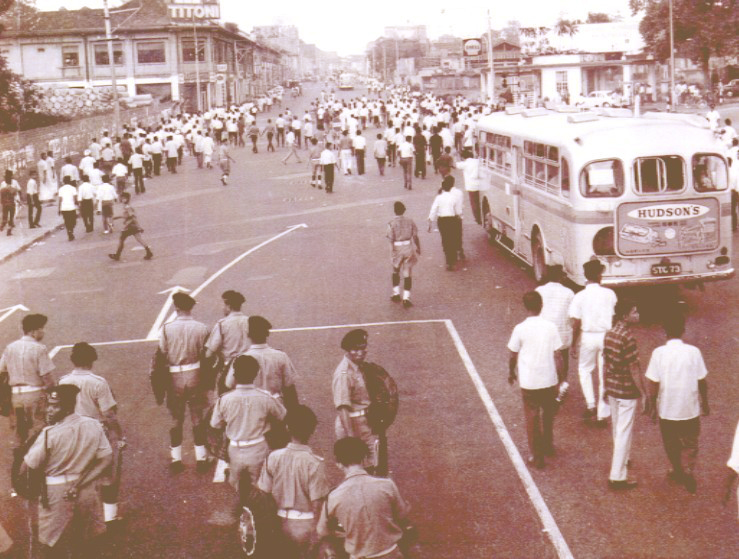
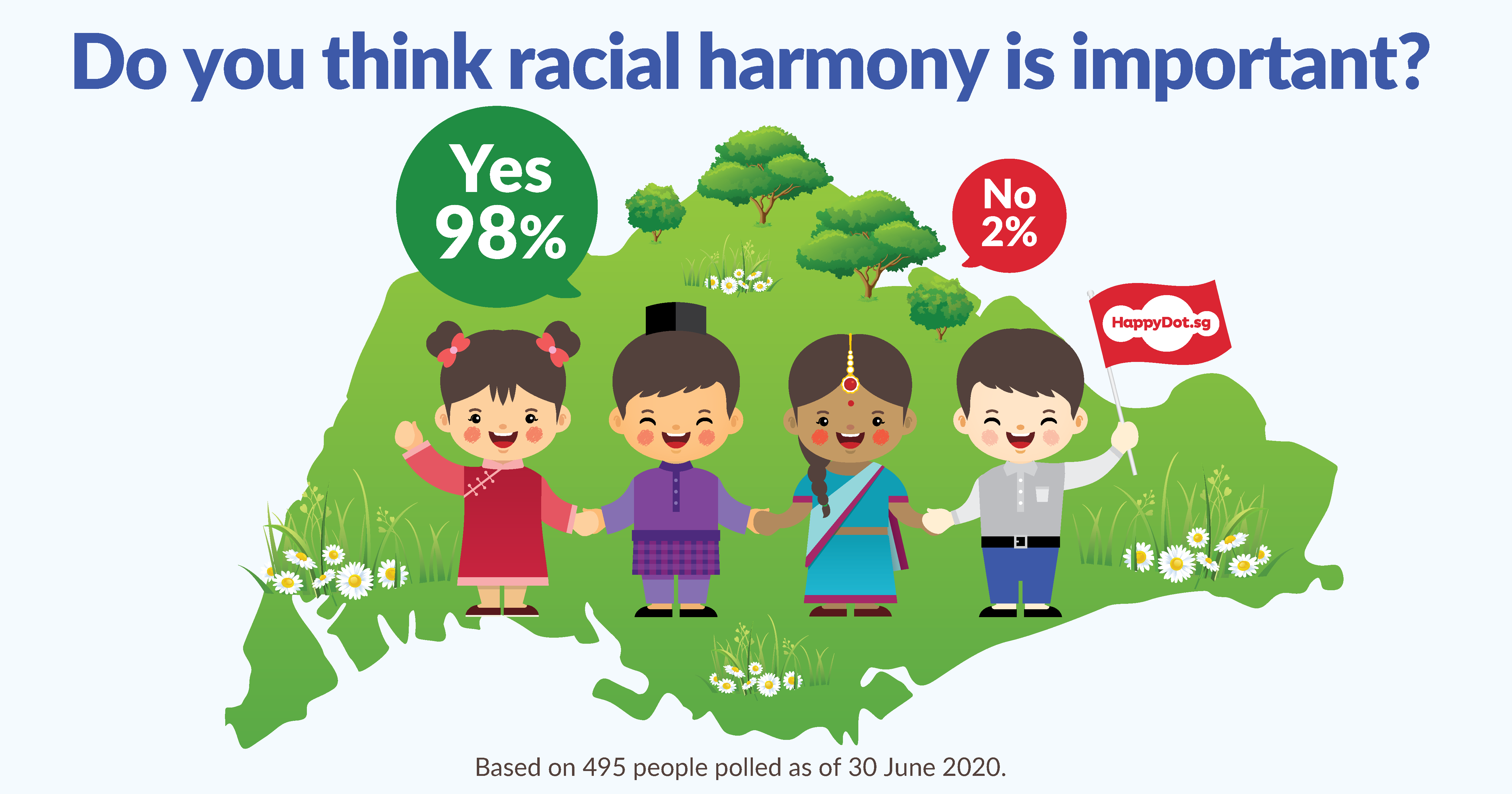
Today in Singapore, we celebrate Racial Harmony Day. The day is celebrated to commemorate the country’s success as a racially harmonious nation and is mostly celebrated in schools and other educational institutions. First launched in 1997 by the Ministry of Education in schools, the event commemorates the 1964 race riots which took place on 21 July 1964 when Singapore was still part of Malaysia, in which 22 people lost their lives and hundreds were severely injured. There were numerous other communal riots and incidents throughout the 50s and 60s leading to and after Singapore’s independence in August 1965.

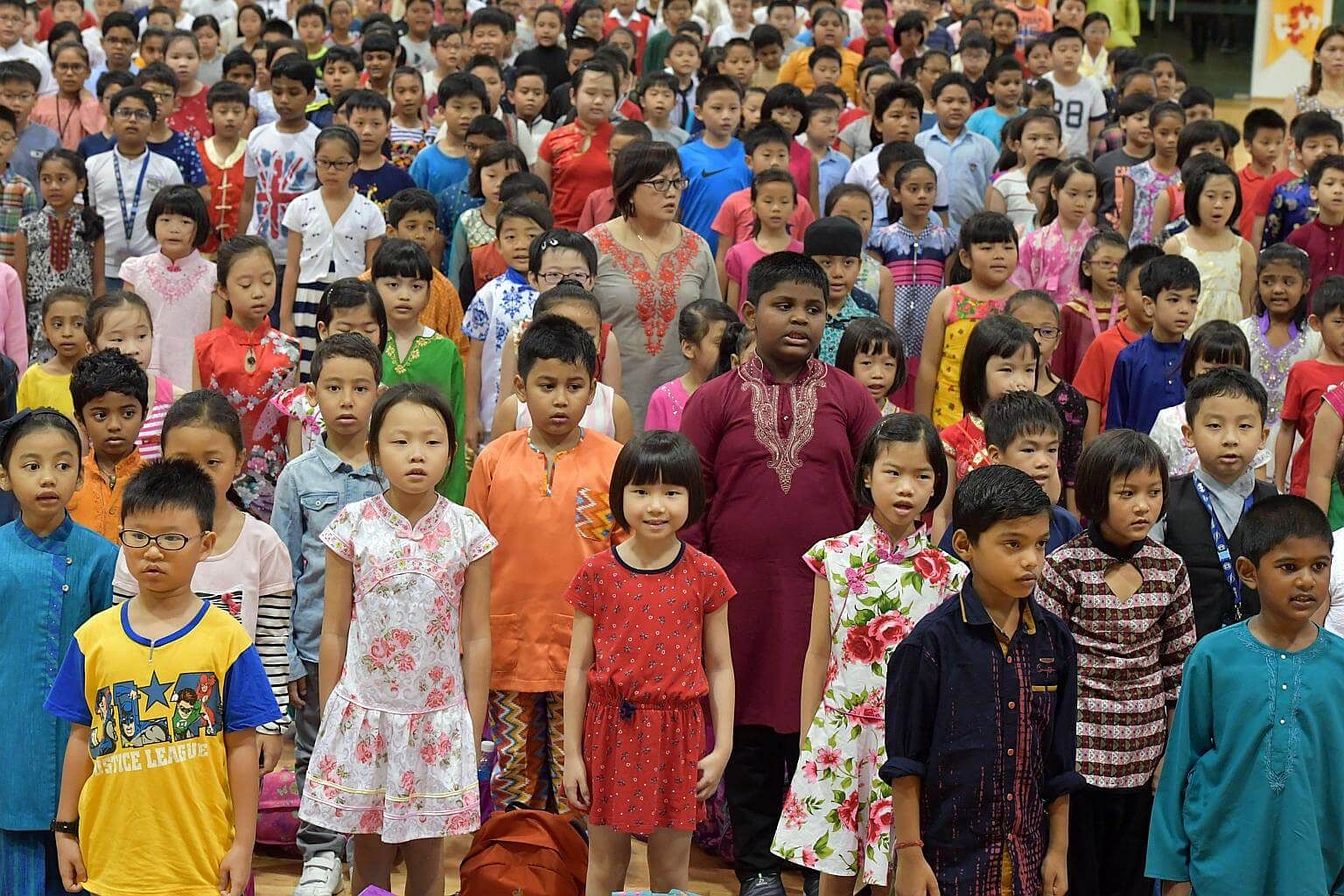
On this day, students in schools across the nation are encouraged to be dressed in other cultures’ traditional costumes such as the Cheongsam, the Baju Kurung and the Saree. Traditional delicacies are a feature of the celebration with traditional games such as five stones, zero points, and hopscotch played and students are encouraged to try out foods from other cultures. Schools are also encouraged to recite a Declaration of Religious Harmony during the celebrations. During this week, representatives from the Inter-Religious Harmony Circle or IRHC comprising various religious groups also get together to pledge their support and to promote the Declaration.

The 1964 race riots in Singapore involved a series of communal race-based civil disturbances between the Malays and Chinese in Singapore following its merger with Malaysia in 1963 and were considered to be the worst and most prolonged in Singapore’s postwar history. The term is also used to refer specifically to two riots on 21 July 1964 and 2 September 1964, particularly the former, during which 23 people died and 454 others suffered severe injuries. The riots are seen as pivotal in leading up to the independence of Singapore in 1965, its policies of multiracialism and multiculturalism, and justifying laws such as the Internal Security Act.

This riot occurred during the procession to celebrate Mawlid, the birthday of the Islamic prophet Muhammad. 25,000 Muslim Malay people had gathered at the Padang. Aside from the recital of some prayers and engagement in some religious activities, a series of fiery speeches were also made by the organisers, instigating racial tensions. During the procession, clashes occurred between the Malays and the Chinese which eventually led to a riot spreading to other areas.  There are multiple accounts and reports on how the riots began. The dominant narration of the July 1964 Racial riot on public forums and history textbooks is simplified and remembered as a riot that involved 20,000 Chinese throwing bottles and rocks at the Malays at the Padang. In reality, some scholars argue that the bottles and rocks being thrown and the clash with a Malay policeman who tried to restrain the Malays were not the reasons for the cause of the riots. But rather, part of the reasons could be also attributed to the distribution of leaflets to the Malay community before the start of the procession by a group named Pertobohan Perjuangan Kebangsaan Melayu Singapore.

The official Malaysian state narrative on the cause of 21 July 1964 characterises the UMNO and Malay-language newspaper Utusan Melayu controlled by UMNO as playing an instigating role. It points to the publishing of anti-PAP headlines and incitement of the Malays against the PAP. To address the grievances of the Malays, PM Lee Kwan Yew held a meeting with various Malay organisations on 19 July. This angered UMNO, as it was not invited to attend this meeting. In that meeting, Lee assured the Malays that they would be given ample opportunities in education, employment and skill training for them to compete effectively with the non-Malays in the country. However, PM Lee refused to promise the granting of special rights to the Malays. This meeting satisfied some Malay community leaders and agitated some, who had the view that the needs and pleas of the Malays were not being heard. To rally the support of the Malays to go against the PAP government, leaflets containing rumours of the Chinese in Singapore trying to kill the Malays were published and distributed throughout the island on 20 July 1964. The spread of such information was also carried out during the procession of Muhammad’s birthday celebration, triggering the riots.

From the Malaysian government’s point of view, Lee Kuan Yew and the PAP were responsible for instigating the series of riots and discontent among the Malay community in Singapore. UMNO and Tun Razak had attributed to the Malay’s anger and hostility towards the Chinese and Lee Kuan Yew’s former speech made on 30 June 1964 for passing inflammatory remarks of the UMNO’s communal politics. Whereas the PAP and Lee Kuan Yew strongly believed that the 1964 July riot was not a spontaneous one, as UNMO had always tried to stir anti-PAP sentiments and communal politics among the Singapore Malays. They often used fiery speeches and Utusan Melayu as a tool to propagate pro-Malay sentiments and to sway their support towards UMNO.

The riots occurred around 5 pm, when a few Malay youths were seen to be hitting a Chinese cyclist along Victoria Street, which was intervened against by a Chinese constable. The riots which occurred around Victoria and Geylang had spread to other parts of Singapore such as Palmer Road and Madras Street. The police force, military and the Gurkha battalion were activated to curb the violence and at 9:30 pm, a curfew was imposed whereby everyone was ordered to stay at home. The riot saw serious damage to private properties, loss of lives, and injuries sustained. According to reports, a total of 220 incidents were recorded with 4 being killed and 178 sustaining some injuries. Close to 20 shophouses owned by the Chinese around Geylang and Jalan Eunos were burnt down. The curfew was lifted at 6 am on 22 July 1964, but clashes and tensions between the Malays and Chinese re-arose, so the curfew was re-imposed at 11:30 am. The racial riots subsided by 24 July 1964, as the number of communal clashes reported was reduced to seven cases. On 2 August, the imposition of the curfew since 21 July was completely lifted and the high police and military supervision was removed.

After the July riots, a period of peace was broken by another riot on 2 September 1964. This riot was triggered by the murder of a Malay trishaw rider along Geylang Serai and this incident sparked attempts of stabbings and heightened violence. 13 people were killed, 106 sustained injuries and 1,439 were arrested.

Following the July riots, the Singapore government requested that the Malaysian federal government appoint a commission of inquiry to investigate the causes of the riots, but this was declined by the Malaysian government. Following the September riots, the Malaysian government finally agreed to form such a commission, with closed-door hearings beginning in April 1965, but the findings of the report have remained confidential.

The racial riots in July 1964, triggered and intensified the political rift between PAP and UMNO, which led to the separation between Malaysia and Singapore in 1965.

The July 1964 racial riots played a significant role in shaping some of Singapore’s fundamental principles such as multiculturalism and multiracialism after independence from Malaysia. The Singapore Constitution emphasised the need to adopt non-discriminatory policies based on race or religion by guaranteeing the grant of minority rights and ensuring that the minorities in Singapore are not mistreated. During Racial Harmony Day, schools recall the racial riots that occurred but the emphasis on the event is focused on the tension between the Malays and the Chinese rather than on the political and ideological differences between UMNO and PAP.

In My Hands Today…

A Woman of Influence: The Spectacular Rise of Alice Spencer in Tudor England – Vanessa Wilkie

Alice Spencer was born in 1560 to a family on the rise. Her grandfather had amassed a sizeable estate of fertile grazing land and made a small fortune in sheep farming, allowing him to purchase a simple but distinguished manor house called Althorp.

With her sizable dowry, Alice married the heir to one of the most powerful aristocratic families in the country, eventually becoming the Countess of Derby. Though she enjoyed modest renown, it wasn’t until her husband’s sudden death (after he turned in a group of Catholics for plotting against Queen Elizabeth I) that Alice and her family’s future changed forever.

Faced with a lawsuit from her brother-in-law over her late husband’s fortune, Alice raised eyebrows by marrying England’s most powerful lawyer. Together, they were victorious, and Alice focused her attentions on securing appropriate husbands for her daughters, increasing her land ownings, and securing a bright future for her grandchildren and the entire Spencer family. But they would not completely escape scandals, and as the matriarch, Alice had to face an infamous trial that threatened everything she had worked so hard for.

Now, the full story of the remarkable Alice Spencer Stanley Egerton is revealed in this comprehensive and colorful biography. A woman both ahead of and part of her time, Alice’s ruthless challenging of the status quo has inspired future generations of Spencers and will change the way you view Tudor women.

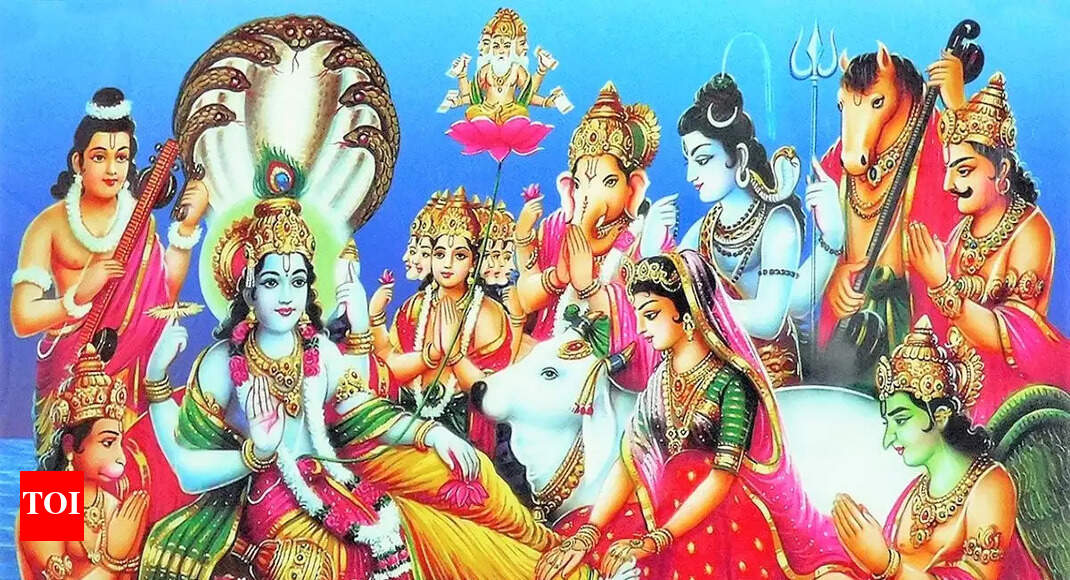
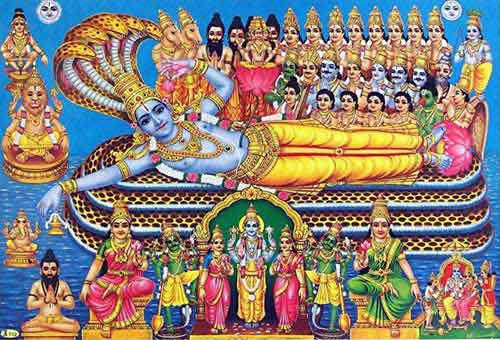
Adhika Masa: A spiritual month to align oneself to the Divine

In Hinduism, the lunar calendar plays a significant role in determining auspicious times for various rituals, festivals, and ceremonies. While most lunar calendars consist of 12 months, occasionally, an extra month called the Adhik Masa is added to align the lunar and solar calendars. In 2023, after a gap of 19 years, this extra month returns from 18 July to 16 August.

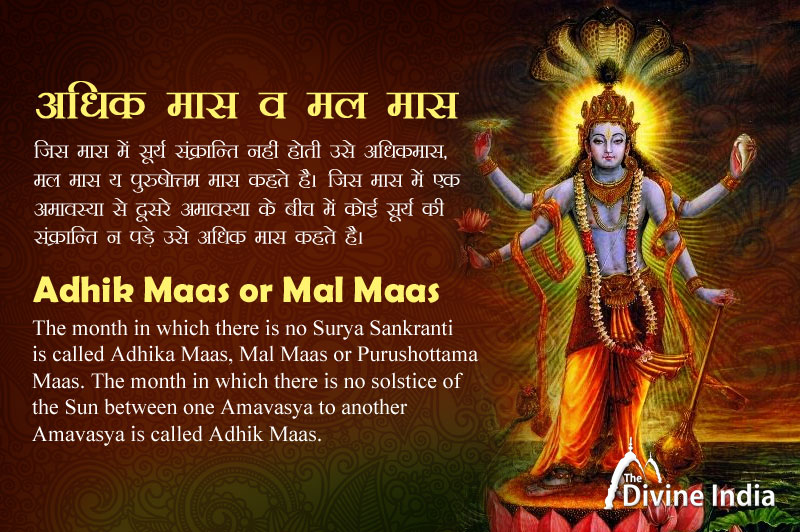
Also known as Purushottam Maas or Mala Masa, the Adhik Maas is a rare additional month that occurs in the Hindu calendar to adjust the discrepancy between the lunar and solar cycles. This intercalary month, approximately 30 days long, is considered highly auspicious and is believed to be under the special blessings of Lord Vishnu, the preserver of the universe. The adhika-masa is an extra lunar month added to the solar calendar every three years so that the lunar and the solar years are synchronised, along with the agricultural cycle and seasons. Adhika refers to the Sanskrit word for additional or extra, while masa means month.

According to the mythology, all the gods refused to become the master of this month due to it supposedly being dirty, then the month prayed to Lord Vishnu, who pleased with the prayer of the month, gave his name to this month, and so the month is known as Purushottam Maas. Lord Vishnu gave the boon to this month that any devotee who worships Lord Shiva during this month does religious work, listens to the Bhagwat Katha, and donates to charity during this month, will get the never-ending virtue.

When the Sun does not at all transit into a new rāshi or zodiac sign which is 30 degrees sidereal zodiac, but simply keeps moving within a rāshi in a lunar month before a new moon, then that lunar month will be named according to the first upcoming transit. It will also take the epithet adhika or extra. The transition of the Sun from one rāshi to the next is called Sankranti. The next month will be labelled according to its transit as usual and will get the epithet nija or original or shuddha or clean. The terms Pratham or first Chaitra and Dvitiya or second Chaitra may also be used.

An extra month, or adhika-masa, falls every 32.5 months on average. The solar year is made up of 365 days and about 6 hours, and the lunar year is made up of 354 days. This causes a gap of 11 days, 1 hour, 31 minutes and 12 seconds between the lunar and the solar years. As this gap accumulates each year, it approximates 2.7 years to one month. No adhika-masa falls during the months of Margashirsha to Magha or November/December to about January/February. An adhika-masa during the month of Kartika or October/November is extremely rare, but in the 250 years between 1901 to 2150, it occurred once, in 1963. The Moon takes about 27.3 days to make one complete orbit around the Earth. The Earth orbits around the Sun once every 365.2422 days. The Earth and the Moon, in 27.3 days, have moved as a system about 1/12 of the way around the Sun. This means that from one full moon to the next full moon, the Moon must travel 2.2 extra days before it appears again as a full moon due to the curve of the Earth’s orbit around the Sun. This creates a variance of 10.87 days a year between a lunar year and a solar year. And so, to compensate for this difference, the additional month is added after every 32.5 months on average.

Adhik Masa is dedicated to Lord Vishnu, and devotees observe this month with great devotion and reverence. Lord Vishnu is believed to be more accessible and responsive during this time, making it an ideal period for intensifying spiritual practices such as meditation, prayer, and reading sacred scriptures. The month is also considered a sacred opportunity to cleanse oneself of accumulated karmic debts. Devotees engage in acts of charity, self-discipline, and selfless service, seeking to purify their souls and seek forgiveness for any past wrongdoings. By engaging in these virtuous acts, individuals aim to elevate their spiritual consciousness and bring about positive transformation in their lives.

During Adhik Masa, specific rituals and observances are followed to appease Lord Vishnu. Devotees often perform pujas which are ritualistic worship, and offer prayers to the deity. Fasting, particularly on Ekadashi, the eleventh day of each fortnight, holds great significance during this month. Observing fasts is believed to enhance spiritual growth and foster self-control and discipline.

Many devotees undertake pilgrimages to holy places associated with Lord Vishnu during Adhik Masa. Places like Badrinath, Jagannath Puri, and Rameswaram are particularly popular destinations during this auspicious month. These pilgrimages allow individuals to immerse themselves in a spiritually charged atmosphere, fostering a deeper connection with the divine. Regarded to be a holy month, many people perform the adhika masa vrata. People engage in practices such as mala japas, pradakshinas, pilgrimages, scriptural reading, and parayanas. During adhika-masa, people perform various types of religious rituals such as keeping fast, recitation of religious scriptures, mantras, and prayers, and performing various types of puja and havan. Vratas or fasts of various durations, including for the full day, half day, weekly, fortnight, and full month are often undertaken. The vratas may be complete fasting with liquids only or without liquids, fasting with fruits only or keeping fast with vegetarian food, as the individual can tolerate. It is said that the persons performing good deeds or satkarma in this month conquer their senses and they come out of the cycle of rebirth. This month is often regarded to be inauspicious, where the performance of rites such as weddings do not take place. It also serves as a compensatory period for adherents who had previously neglected their religious duties.

A month-long mela or fair is celebrated in Machhegaun village in Nepal during adhika-masa. It is believed that one can wash away all his sins by taking a bath in the pond at Machhenarayan temple. Specific festivals such as Dussehra or Deepavali are not marked during this month. In the Beed district of Maharashtra, there is a small village called Purushottampuri, where there is a temple dedicated to Lord Purushottam, a regional form of Krishna. Every adhika-masa, there is a big fair, and thousands of people come from various places to invoke the blessings of the deity.

Adhik Masa offers a unique opportunity to deepen one’s devotion and connection with the divine. By engaging in daily spiritual practices and rituals, individuals can experience a heightened sense of spirituality and devotion. Regular prayer, chanting of mantras, and meditation can help cultivate a deeper connection with Lord Vishnu and nurture a sense of inner peace and tranquillity. The month encourages devotees to engage in self-reflection and introspection and provides an ideal time to assess one’s spiritual progress, identify areas for improvement, and set new goals for personal growth. Through introspection, individuals can gain clarity, overcome obstacles, and strengthen their resolve to lead a more righteous and virtuous life. Adhik Masa is an opportune time to delve into the study of sacred texts and scriptures. Devotees can spend time reading spiritual literature, participating in satsangs which are spiritual discourses, and attending religious lectures to expand their understanding of the teachings and principles of Lord Vishnu. This knowledge serves as a guiding light in one’s spiritual journey. The Adhik Masa is considered a season of giving and selflessness. Devotees actively participate in acts of charity and service, extending kindness and compassion to the less fortunate. By contributing to the welfare of others, individuals can not only alleviate the sufferings of those in need but also cultivate a sense of gratitude and humility.

So do try and spend time deepening your devotion, engaging in self-reflection, and immersing in sacred rituals and practices. The return of Adhik Masa after a gap of 19 years serves as a powerful reminder of the importance of aligning oneself with the divine and seeking spiritual elevation. May this Adhik Masa bring blessings, peace, and spiritual upliftment to everyone.

In My Hands Today…

It. Goes. So. Fast.: The Year of No Do-Overs – Mary Louise Kelly

The time for do-overs is over.

Ever since she became a parent, Mary Louise Kelly has said “next year.” Next year will be the year she makes it to her son James’s soccer games (which are on weekdays at 4 p.m., right when she is on the air on NPR’s All Things Considered, talking to millions of listeners). Drive carpool for her son Alexander? Not if she wants to do that story about Ukraine and interview the secretary of state. Like millions of parents who wrestle with raising children while pursuing a career, she has never been cavalier about these decisions. The bargain she has always made with herself is this: this time I’ll get on the plane, and next year I’ll find a way to be there for the mom stuff.

Well, James and Alexander are now seventeen and fifteen, and a realization has overtaken Mary Louise: her older son will be leaving soon for college. There used to be years to make good on her promises; now, there are months, weeks, minutes. And with the devastating death of her beloved father, Mary Louise is facing act three of her life head-on.

Mary Louise is coming to grips with the reality every parent faces. Childhood has a definite expiration date. You have only so many years with your kids before they leave your house to build their own lives. It’s what every parent is supposed to want, what they raise their children to do. But it is bittersweet. Mary Louise is also dealing with the realities of having aging parents. This pivotal time brings with it the enormous questions of what you did right and what you did wrong.

This chronicle of her eldest child’s final year at home, of losing her father, as well as other curve balls thrown at her, is not a definitive answer―not for herself and certainly not for any other parent. But her questions, her issues, will resonate with every parent. And, yes, especially with mothers, who are judged more harshly by society and, more important, judge themselves more harshly. What would she do if she had to decide all over again?

Mary Louise’s thoughts as she faces the coming year will speak to anyone who has ever cared about a child or a parent. It. Goes. So. Fast. is honest, funny, poignant, revelatory, and immensely relatable.