
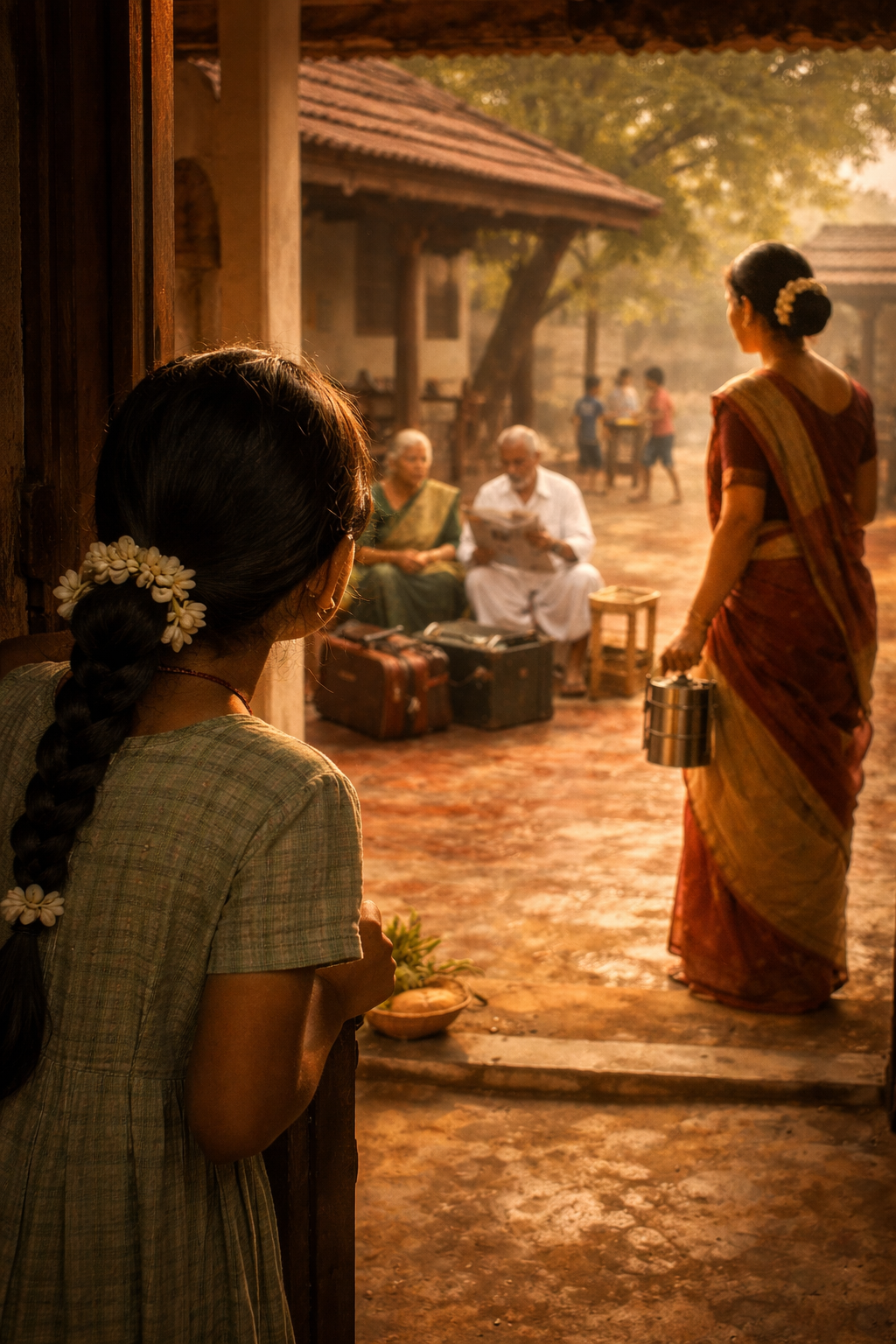
In the late eighties and early nineties, summer did not arrive alone in Tirunelveli.
It arrived with families.
It came with rope-tied suitcases, steel trunks dented by railway platforms, and parents who crossed the threshold and quietly became younger versions of themselves. It came with children who had grown taller since last year and adults who pretended not to notice.
The house on North Car Street sensed it first. The neem tree stood still. The red oxide floor was scrubbed until it caught the light. The kitchen smelled of coffee and spice long before anyone arrived.
Paati had been ready for days.
The first family came from Chennai.
The elder son stepped out of the hired Ambassador, already loosening his collar, the long drive still clinging to his shoulders. His wife followed, adjusting her pallu without thinking, her eyes moving carefully over the house she knew well but never loosely.
Their son, Arjun, fifteen and all angles, jumped out last.
“Too much heat,” he said.
“It was hotter in our time,” his father replied, already sounding less like a man from Chennai and more like a son from this street.
Inside, Paati did not look up from the garlic she was peeling.
“You’ve come,” she said.
The daughter-in-law bent to touch her feet. The gesture was practised, precise. Paati’s hand rested briefly on her head, then withdrew.
“Wash your hands,” Paati said. “Help.”
The knife was placed in her palm before she could respond.
She moved into the kitchen, uncertain whether she had been welcomed or assigned, and began chopping as if the motion itself might clarify the difference.
Much later, when Meera arrived from Delhi and learned to read the house properly, she would remember this moment without having seen it. She would notice how her aunt’s shoulders always relaxed once she had work to do, as if usefulness was the only language that made the house fully intelligible.
The rest arrived in waves.
Delhi brought noise and opinions. Mumbai brought stories and twins who ran everywhere. The last daughter arrived from a town whose name changed often, her husband shaped by transfer orders, their children hovering uncertainly.
Paati gathered them all in with the same sentence.
“This is your house.”
The daughter-in-law from Chennai heard it from the kitchen. She paused, knife hovering, unsure whether the words reached her too.
Mornings settled into rhythm.
The kitchen filled with women. Daughters moved freely, laughing, arguing, interrupting. Daughters-in-law worked more quietly, exchanging glances, correcting themselves before being corrected.
Paati supervised without hovering.
The Chennai daughter-in-law watched everything. How rice was rinsed. How sambar was tasted without flinching. How vessels were placed back exactly where they belonged. She mirrored these movements without realizing it.
Meera noticed. She noticed how her aunt never sat unless told. How her voice softened automatically around elders. How she laughed most easily with the children, as if they required no performance.
The men occupied the verandah. In their parents’ house, their authority thinned. Thaatha read the newspaper with ritual precision.
“Don’t bring work home,” he told his elder son one evening.
The son nodded, chastened.
The daughter-in-law poured coffee, placed the tumbler beside her husband, stepped back.
The days unfolded.
Cricket matches with arguments. Mango raids. Afternoon naps enforced by Paati’s stare.
Evenings softened the town. Walks with Thaatha. Ice melting down wrists. One television, one antenna, one version of the world.
During power cuts, everyone moved to the terrace.
Adults talked in small circles. Children lie on mats. Stories surfaced carefully. About ageing parents. About distance. About how cities swallowed time.
At some point, the Chennai daughter-in-law spoke.
Just once.
“It’s hard,” she said, not looking at anyone, “when children grow up where neighbours don’t know their names.”
There was a pause.
Then Paati said, “That is why they must come here.”
The sentence was not directed at her. But it stayed with her.
The defining moment came three days later.
It was mid-afternoon. The heat had settled heavily. Most people were resting.
In the kitchen, Paati was alone, sorting lentils slowly, methodically.
The Chennai daughter-in-law entered, unsure why she had come. Perhaps to check something. Perhaps because the house felt too quiet.
Without being asked, she sat on the floor opposite Paati and reached for another bowl.
For a while, they worked in silence.
Then Paati said, without looking up, “You add too much water to the rice.”
The daughter-in-law froze. She waited for instruction, correction, judgment.
Instead, Paati pushed the bowl toward her.
“Tomorrow,” she said, “you make.”
It was not a test. It was not praise.
It was a transfer.
The kitchen, for one meal, was being handed over.
The daughter-in-law felt something tighten in her chest. Not fear. Something closer to responsibility.
“Yes,” she said.
That night, she barely slept.
The next morning, she woke early. She washed the rice the way she had watched Paati do it. She measured water by feel, not cup. She cooked slowly, deliberately.
When she served it, she stood waiting.
Paati took a mouthful. Chewed. Swallowed.
“Correct,” she said.
Nothing more.
Meera saw it all. The waiting. The stillness. The quiet approval.
She understood then that in this house, love did not announce itself. It assigned work.
After that, something shifted.
The daughter-in-law moved differently. Not louder. Not freer. Just steadier.
She corrected Arjun without glancing at her husband. She laughed once, openly, when the twins spilt rasam. She sat down without asking.
Paati noticed. Said nothing.
On the final day, when suitcases reappeared and the house began to empty, Paati handed food parcels wrapped in newspaper.
When the daughter-in-law bent to touch her feet, Paati held her hand.
“Don’t forget,” she said, finally looking at her, “this is also your house.”
The words landed fully this time.
Meera watched her aunt blink once. Then nod.
After the others had left, the house exhaled.
Paati sat down heavily. “Too much noise.”
Thaatha folded the newspaper. “They came.”
In the kitchen, the daughter-in-law rinsed the last vessel. She ran her hand once over the counter, switched off the light, and closed the door without hesitation.
Years later, Meera would remember that moment.
Not the cricket. Not the mangoes.
But the day her aunt stopped asking where she belonged.

