Short Story: The Summer Holidays

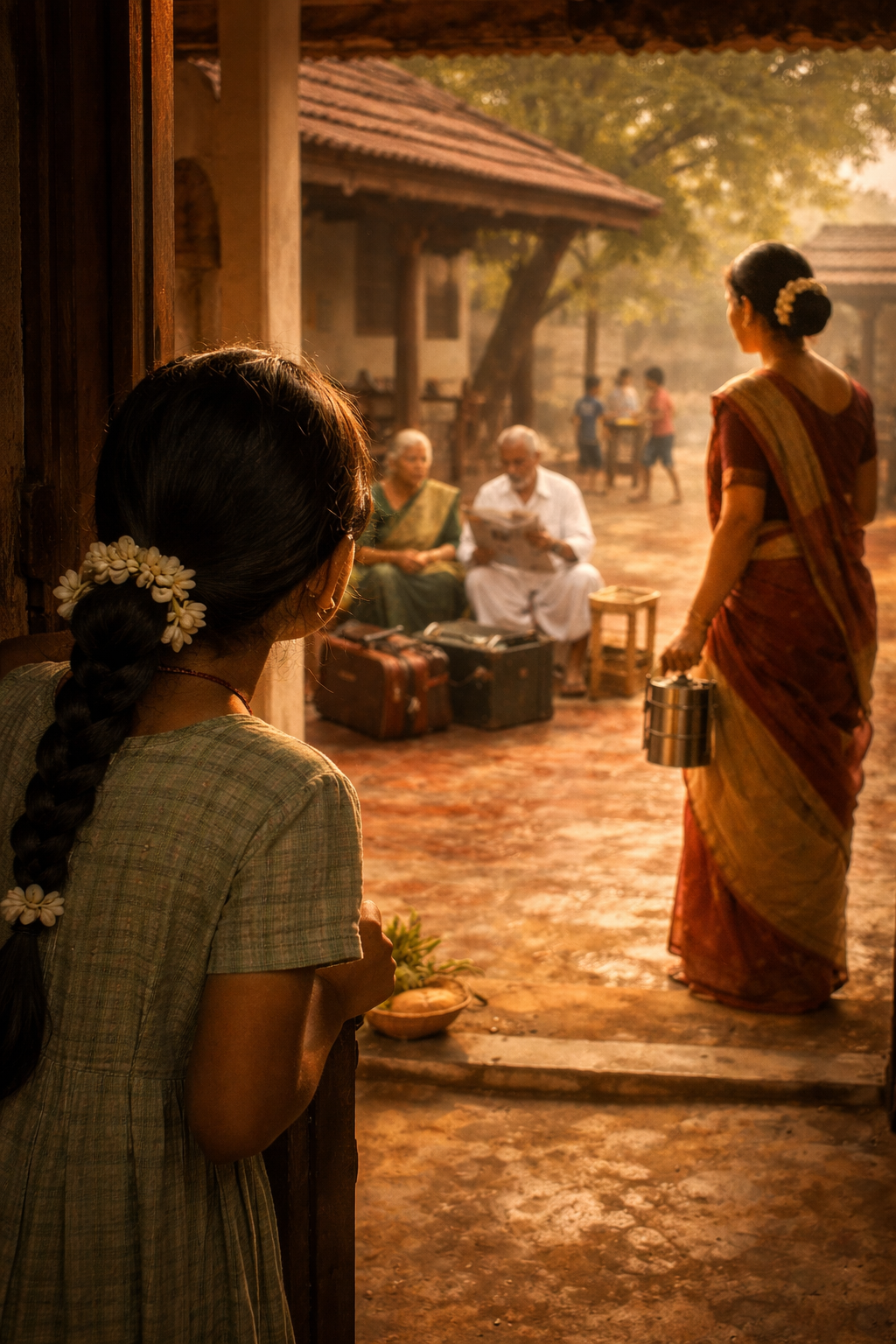
In the late eighties and early nineties, summer did not arrive alone in Tirunelveli.

It arrived with families.

It came with rope-tied suitcases, steel trunks dented by railway platforms, and parents who crossed the threshold and quietly became younger versions of themselves. It came with children who had grown taller since last year and adults who pretended not to notice.

The house on North Car Street sensed it first. The neem tree stood still. The red oxide floor was scrubbed until it caught the light. The kitchen smelled of coffee and spice long before anyone arrived.

Paati had been ready for days.

The first family came from Chennai.

The elder son stepped out of the hired Ambassador, already loosening his collar, the long drive still clinging to his shoulders. His wife followed, adjusting her pallu without thinking, her eyes moving carefully over the house she knew well but never loosely.

Their son, Arjun, fifteen and all angles, jumped out last.

“Too much heat,” he said.

“It was hotter in our time,” his father replied, already sounding less like a man from Chennai and more like a son from this street.

Inside, Paati did not look up from the garlic she was peeling.

“You’ve come,” she said.

The daughter-in-law bent to touch her feet. The gesture was practised, precise. Paati’s hand rested briefly on her head, then withdrew.

“Wash your hands,” Paati said. “Help.”

The knife was placed in her palm before she could respond.

She moved into the kitchen, uncertain whether she had been welcomed or assigned, and began chopping as if the motion itself might clarify the difference.

Much later, when Meera arrived from Delhi and learned to read the house properly, she would remember this moment without having seen it. She would notice how her aunt’s shoulders always relaxed once she had work to do, as if usefulness was the only language that made the house fully intelligible.

The rest arrived in waves.

Delhi brought noise and opinions. Mumbai brought stories and twins who ran everywhere. The last daughter arrived from a town whose name changed often, her husband shaped by transfer orders, their children hovering uncertainly.

Paati gathered them all in with the same sentence.

“This is your house.”

The daughter-in-law from Chennai heard it from the kitchen. She paused, knife hovering, unsure whether the words reached her too.

Mornings settled into rhythm.

The kitchen filled with women. Daughters moved freely, laughing, arguing, interrupting. Daughters-in-law worked more quietly, exchanging glances, correcting themselves before being corrected.

Paati supervised without hovering.

The Chennai daughter-in-law watched everything. How rice was rinsed. How sambar was tasted without flinching. How vessels were placed back exactly where they belonged. She mirrored these movements without realizing it.

Meera noticed. She noticed how her aunt never sat unless told. How her voice softened automatically around elders. How she laughed most easily with the children, as if they required no performance.

The men occupied the verandah. In their parents’ house, their authority thinned. Thaatha read the newspaper with ritual precision.

“Don’t bring work home,” he told his elder son one evening.

The son nodded, chastened.

The daughter-in-law poured coffee, placed the tumbler beside her husband, stepped back.

The days unfolded.

Cricket matches with arguments. Mango raids. Afternoon naps enforced by Paati’s stare.

Evenings softened the town. Walks with Thaatha. Ice melting down wrists. One television, one antenna, one version of the world.

During power cuts, everyone moved to the terrace.

Adults talked in small circles. Children lie on mats. Stories surfaced carefully. About ageing parents. About distance. About how cities swallowed time.

At some point, the Chennai daughter-in-law spoke.

Just once.

“It’s hard,” she said, not looking at anyone, “when children grow up where neighbours don’t know their names.”

There was a pause.

Then Paati said, “That is why they must come here.”

The sentence was not directed at her. But it stayed with her.

The defining moment came three days later.

It was mid-afternoon. The heat had settled heavily. Most people were resting.

In the kitchen, Paati was alone, sorting lentils slowly, methodically.

The Chennai daughter-in-law entered, unsure why she had come. Perhaps to check something. Perhaps because the house felt too quiet.

Without being asked, she sat on the floor opposite Paati and reached for another bowl.

For a while, they worked in silence.

Then Paati said, without looking up, “You add too much water to the rice.”

The daughter-in-law froze. She waited for instruction, correction, judgment.

Instead, Paati pushed the bowl toward her.

“Tomorrow,” she said, “you make.”

It was not a test. It was not praise.

It was a transfer.

The kitchen, for one meal, was being handed over.

The daughter-in-law felt something tighten in her chest. Not fear. Something closer to responsibility.

“Yes,” she said.

That night, she barely slept.

The next morning, she woke early. She washed the rice the way she had watched Paati do it. She measured water by feel, not cup. She cooked slowly, deliberately.

When she served it, she stood waiting.

Paati took a mouthful. Chewed. Swallowed.

“Correct,” she said.

Nothing more.

Meera saw it all. The waiting. The stillness. The quiet approval.

She understood then that in this house, love did not announce itself. It assigned work.

After that, something shifted.

The daughter-in-law moved differently. Not louder. Not freer. Just steadier.

She corrected Arjun without glancing at her husband. She laughed once, openly, when the twins spilt rasam. She sat down without asking.

Paati noticed. Said nothing.

On the final day, when suitcases reappeared and the house began to empty, Paati handed food parcels wrapped in newspaper.

When the daughter-in-law bent to touch her feet, Paati held her hand.

“Don’t forget,” she said, finally looking at her, “this is also your house.”

The words landed fully this time.

Meera watched her aunt blink once. Then nod.

After the others had left, the house exhaled.

Paati sat down heavily. “Too much noise.”

Thaatha folded the newspaper. “They came.”

In the kitchen, the daughter-in-law rinsed the last vessel. She ran her hand once over the counter, switched off the light, and closed the door without hesitation.

Years later, Meera would remember that moment.

Not the cricket. Not the mangoes.

But the day her aunt stopped asking where she belonged.
School Stories: The School Library

As regular readers know, I am a voracious reader. I have been teased about this all my school life because I used to prefer going to the library to playing with my friends.

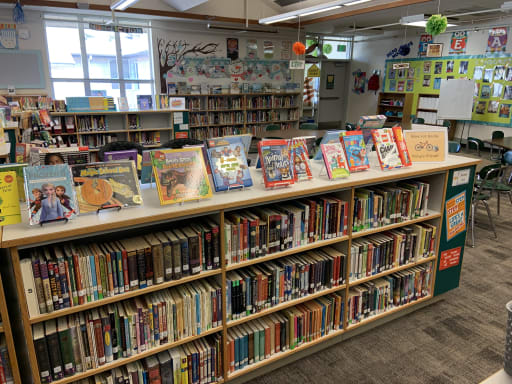
My school had two libraries: the bigger one, which was located in the secondary section, and a smaller one in the primary section. The primary section was meant for the younger readers, and I had outgrown this library by the time I reached grade three.

I was what I now know to be hyperlexic. Hyperlexia is a syndrome characterized by a child’s precocious ability to read. Children with hyperlexia have a significantly higher word-decoding ability than their reading comprehension levels and also show an intense fascination for written material at a very early age. Hyperlexic children are characterised by word-reading ability well above what would be expected given their age.

Because the books in the primary school library were below my reading ability, I used to use the lunch hour to go to the secondary school library to read. Our lunch hour was divided into two, and even if I was put in the second half, I used to eat quickly in the first half, return my lunch box to my mom, and then run to the secondary school library to read. The way my school was constructed, the primary and kindergarten sections were in one building, then we had our school hall with the laboratories, and then the secondary building with the library on level 2 of that building. To get to my class from the library, walking at a normal pace would take about five minutes. So the minute the bell would ring to indicate the end of lunch, I would get up and make a run to my class. During the monsoon season, there have been many instances where I have slipped and gotten my uniform dirty, and I have also been late to class countless times and would have gotten a scolding from my teacher. If I were lucky, I would reach the class just before the teacher and escape the scolding, but those times were few and far between.

Once I reached secondary school, life became slightly easier. I used to still go to the main library, and because this library catered to students from the secondary section, we used to go there as a class once a week to borrow books. Again, because I was already reading way above my level, I also became the librarian’s favourite. And I was given a privilege that I don’t think anyone else until then had received. I was allowed to borrow books from the adult section. So while still in school, when my peers were still reading Nancy Drew and Hardy Boys, I had graduated to reading unabridged versions of Shakespeare and George Orwell. It used to be so much fun because when it was our class’ turn to visit the library, while the others used to use the age-appropriate shelves, I would go to the librarian and get the key to the locked cupboard, which the teachers and other adults used, and borrow books from there. I was also the unofficial book consultant for my class and used to advise them on books to read based on what they wanted to read.

After eighth grade, our weekly visits to the library ended as they were replaced by other subjects as we got closer to our version of the O levels, but I continued to visit the library during my lunch break and read so many wonderful books. In fact, at some point in time, I wanted to become a librarian when I grew up, but after I realised the practicalities of life, I gave up that dream. But my love for books, which was ignited in that little school library, has never gone away, if anything, it has increased, and I am forever reading and espousing the love of reading to everyone I meet.

School Stories: Memories and an Alternate Reality

Source

As you now I studied in JB Vachha High School. What you don’t know was that my paternal grandparents were strictly against me and then my sister attending this school. They wanted me to attend the nearby South Indian school which was my father, his siblings and all his cousins alma mater. But my mother stood strong and in the face of intense opposition, went ahead and got me enrolled into my school. Amma, my mother, used to see my neighbours and other girls in our neighbourhood wear the blue and white uniform on their way to school and insisted her daughters also should be in the same school.

The biggest objection my grandparents had was that my father’s alma mater offered Tamil as the mother tongue language and this was not offered in my school, which offered French as the second language. They worried, and probably rightly, that if we didn’t learn the language of our ancestors, we would no longer be good Tamil girls. But amma had her way and we started school in the school of her choice.

The other day, I was thinking what if amma did not get her way and me and my sister ended up in the school of my grandparents choice? Actually I don’t have to look too far to see this, as I did have friends in the building and in the neighbourhood who did go to the school. I would say, we would be fluent in Tamil, which today, we can only speak, but can’t read or write. And this in turn, would have made me get BB & GG to take Tamil as their mother tongue language instead of Hindi which they took.

It’s quite likely that we would be slightly more conservative and not have too many friends from other community groups. In our school, we developed a more liberal mindset and because our classmates came from not only different strata of society, but also from different communities, we learnt to be able to have a live and let live attitude.

And the most important thing, according to me is our school is a girls school while the other school is a co-ed school. And if I think back, with the exception of our physical education teacher, a music teacher and some peons in the school, all our teachers and staff were women. This means that while in school, we had no filter! We spoke what we wanted, especially when teachers were not around and because there were no boys, we spoke about things that may have been either taboo or spoken in a hush-hush way in a co-ed school. Remember, this was the eighties India where the country was still in the throes of socialism and liberalisation was still at least four-five years away. The con, atleast for me was that I was unconfortable with boys, until I entered graduate school because my degree programme also had a higer percentage of girls compared to boys and so I barely interacted with them. Being in a single sex school does allow the school to tailor the teaching style according to the students and my school also offered a whole suite of extra curricular activities which in that day and age, hardly any school offered. Of course, the bulk of these extra curricular activities were geared towards making us good moms and housewives, but still in that India, when we used to speak with our friends and family from other schools, they barely had anything more than a library and physical education period. We used to have music, dance, cookery, laundry, stiching, embroidery, girl guides, social service and typing. I am probably missing some, but in hindsight, all these are things that probably would have made more sense half a century back.

If my amma had not had her way, I would not be the person I am today and because we spent a good portion of our early lives in school, we spent 12 to 13 years in the same school, the school and its ethos and philosophy have moulded us. For this I am so very thankful that amma took a stand and ensured she gave us the opportunities going to this school offered us.

So how did your school mould you? I would love to hear in the comments below.

School Stories: Sports Day

A couple of weeks back, in our class WhatsApp chat, we started talking about our school days and the conversation veered towards our sports day. I enjoyed that conversation so much that I decided to take a trip down memory lane to reminisce about those days.

Our school sports day was the highlight of the second term, which happened after the Diwali holidays in the second term. The main sports day would happen sometime in December/early January before the class X students had their prelims.

Our school was divided into four houses and this was only for the secondary section. Unlike other schools, we didn’t have house named for flowers, national leaders or even landmarks. Since my school is a Parsi school, our houses were named for ancient Persian princesses. Selection of students to the different houses was completely random and we’ve tried to think of the various ways they may have done the choosing, but other than randomness, we have never been able to figure it out. In one family, you would have sisters in different houses, as it was in my house and also in my neighbour’s place where all the sisters were in different houses. I was in the green house while my sister was in the yellow house. As part of our school uniform, along with our school badge which was pinned on the top left of our uniform, above our hearts, we had to pin our house badge to the left of the school badge.

For a few months before the actual day, we would have what was known as indoor games as well as sports for which the school did not have the facilities to play and which needed to be played at a nearby gymkhana. These included sports like carrom, chess, badminton and table tennis. We also had some games like square ball and volley ball, which we played in our school grounds, competing with each other. The sports day was held in a small stadium not very close to the school, but in a centrally located area. A month or so before the actual sports day, we all trooped to the stadium for our heats. This was usually a half day and those of us who were not so inclined, used that half day to just chill and gossip with friends and cheer those who are competing. For children in the primary and kindergarten sections, they had their heats in a small garden behind the school.

In the days leading to the sports day, while the other events were held, we would anxiously keep track of the wins of each house and at the same time start the practice for the march past. Usually the class five students will be super eager to take part in the march past and would audition for the same. By the time we reached class eight, it was the other way around – we had to be forced to go down and take part. The march past contingent was made up of one girl who would carry the placard with the name of the house followed by the house captain who carried the house flag who would be followed by the march past contingent made up of 30 girls in 10 rows of three girls each. Every one on the field will be in white shorts and the school shirt which was our PE uniform and anyone representing a house will have a length of silk ribbon in the colour of the house stitched down both sides of their shorts.

The primary, kindergarten sections and any guests and parents sit together, but the secondary girls sit in their houses. This means that we would get very noisy, especially when we are cheering for our team and booing the opposition. The day’s finale was the march past and the house which scored the highest number of points aka the winner for the year had the honour of leading the march past. During my school years, it had always been the green house which led the march past with usually the red house coming second, the blue house at third position and the yellow house bringing up the rear. And usually, it would be the yellow house which would win the march past trophy. I only remember one year when I was probably in class 6, when there was a three-way tie for first position. Green, red and blue houses all tied and there was a toss to determine who would lead the march past and who would walk in second. I remember red house winning the toss and the captain of the house, who later became famous, was screaming and jumping with joy, because under her captaincy, the red house led the march past.

Our sports day would always be on a Sunday afternoon and would usually start around 2 pm and end around 6ish in the evening. We would go home tired but happy that day, especially since the next day used to be school holiday to help us (and more likely the teachers) recuperate from a hectic day.

This blog post was a blast to write as memories all kept flooding in and I wrote this post with a huge smile on my face. For most of us, our school days are the golden days which we remember fondly, with all the bad parts edited out. Maybe it’s our way of keeping our innocent and young years in our heart?

School Stories: Sports Day

One more story from my school days. Last week I was speaking with GG and BB and we started talking about sports days in school. BB’s school usually alternates between sports day and cross country running every other year and so I shared some stories about sports days in my school.

In my school, sports day usually happened in the second term, which would be after the winter holidays (you could not schedule anything before that because of the Mumbai monsoon) so it would be sometime in December/January.

Our primary school races are the standard ones and happen without much fanfare. It’s the Secondary school that has all the fun in my opinion. I’ve mentioned before how our houses are allocated and during the main sports day, one half of the stadium is split into four parts – each section for a house. So we generally sit in our house section and not with friends, because that day it’s house loyalty before family and friends.

The sports day would usually be on a Sunday and would start around noon. Once we reached secondary school, we would go on our own and my parents would come by later to pick us up. It’s usually a festive air there with hundreds of school girls screaming and shouting.

There’s fierce competition to see which house comes first and a blackboard in the centre of the field will usually have the current point tally going on. The prize for the best house, in addition to the champions trophy is the honour to lead the march past at the end of the sports day and this would be fought relentlessly.

The house I was allocated to, Shenaz or the Green House used to always win the championship and we used to lead the March past each year. I can only remember one year we did not. I must have been in grade 5 then and was the first time in the Secondary bleacher when this happened. What happened was unprecedented in the history of the school. Three houses were joint first and since three houses can’t march together, they had to toss and Godafried or the Red House won the toss! I can still see the red house captain coming excitedly to the stands to the house teacher and shouting that they were going to lead the march past while our captain walked by crying. We were second in the march past that year.

In the last few years in school, I used to get pulled into the march past contingent. We used to march wrongly while practicing thinking we will be kicked out, but no such luck for us! Being in the march past meant that we had to wait all the way till the sports day ended and could not sneak out earlier.

But it also meant a month or so of missing the last few periods in school going for march past practise in the garden behind the school. As I type this, I can hear the commands in head and the one arm length we had to stand behind each other. We used to wear a strip of ribbon in the house colour on the sides of our white shorts (we were one of those rare schools at that time who had to wear white shorts for PE and sports) and a cap in the house colour.

I just checked my school website and Shernaz is still continuing to rule, they are still overall champions, though some of the uniforms we used to play in has changed over the years. The march past is no longer in shorts, but in black long pants and they wear a house tee shirt over it, while we used to wear our school uniform shirt. The cap still remains and the school head girls and captains and vice captains all wear black long pants and a blazer (with the captains and vice captains also wearing the house cap). During the the I was in school, they all used to only wear their usual school uniform. And we also have a school band now! That looks so much fun, wish that was there when we were studying too.

The march past would be like in major sporting events. The head would be the school head girl carrying the school flag with her deputies behind her followed by the junior head girl and her deputies. Then we would have the first contingent which would have one girl (usually a small grade 5 girl) carrying the house name, followed by the house captain with the house flag and her deputies behind her. Behind them would be 30 girls marching in three columns. This would be followed by the house which came second and then the third house and the last house bringing up the rear. We would make one circuit of the stadium and the guest of honour would get the salute after which would be the prize distribution ceremony including that for the best march past contingent (which I can’t remember us ever winning). We would go home late evening, tired but happy with the day. The next day would be a holiday from school which was very warmly welcomed by all.

As with other school memories, this post brought many smiles to me as I went back decades to relive my school days. For more stories about my school, click here and here