Short Story: Incognito Heart

The scooter had been making that sound for weeks. Not a dramatic sound. Not even a complaint. More like a quiet, sulking wheeze. As if it had opinions about her choices and had decided to express them through the engine.

Nandini Rao patted the handlebars the way her mother used to pat her head when she couldn’t fix a problem but wanted it to behave anyway.

“Bas. Just get me there,” she murmured. “I’m not asking for much.”

The scooter responded by dying right outside the shuttered entrance of the old Bhandarkar Hall, where somebody had recently put up fresh hoardings with glossy visuals: REVIVAL. HERITAGE. A NEW CHAPTER.

Nandini stared at the hoarding and felt an unhelpful urge to laugh. Mumbai loved the idea of revival. It loved new chapters. It also loved forgetting the old ones.

She pushed the scooter to the side, wiped sweat from her forehead with the end of her dupatta, and checked her phone. One bar. Low battery. A bank balance that looked like a scolding.

Of course.

She stood there for a second, between the traffic and the hoarding and her own tiredness, and tried to decide which was worse: the scooter breaking down, or the fact that she’d started expecting breakdowns like they were part of the monthly budget.

A tap on her elbow made her flinch.

“Madam, scooter bandh?” a watchman asked, leaning on a metal railing like he’d been born there.

“It’s… taking a pause,” she said, as if she could negotiate with it using language.

The watchman grinned. “Pause toh theek hai, par yeh road pe pause mat karna.”

Behind him, a man stepped out from the construction site, wiping his hands on a rag. He wore a faded T-shirt and jeans that looked like they’d seen too many monsoons. There was dust in his hair. Not styled dust. Real dust. He had the kind of face that would disappear in a crowd until it didn’t.

“Need help?” he asked, and his voice was calm in a way that made her suspicious. Calm usually came with privilege. Calm usually meant people had options.

“It’s fine,” Nandini said automatically.

The man glanced at the scooter, then at her. Not in a dramatic up-and-down way. More like he was assessing the situation and doing the math quietly.

“You’re not from the It’s fine school,” he said.

“Excuse me?”

He smiled a little. “You said it’s fine, like you were trying to convince yourself. Not me.”

Nandini felt her cheeks heat. She hated being read. She made a living reading people, matching them to books. She did not enjoy the same attention coming back at her.

“I’m Nandini,” she said, mostly because she didn’t know how to end the conversation without being rude, and she was tired of being rude to strangers. It turned life into a long fight.

“Mihir,” he said. “I’m working there.” He tilted his head toward the building.

She followed the gesture. The place smelled of wet cement and old paint. Bhandarkar Hall had once hosted plays, debates, charity shows, and at least three weddings that had spilt onto the road. Now it was being reborn with a name that sounded like a bank.

“You can’t fix it?” she asked, half-hopeful, half-defensive.

“I can try.” He crouched near the scooter, peered under the side panel, and made a small sound of disapproval. “When was the last time you serviced it?”

Nandini made a face.

“That long, huh?”

“I’ve been… busy,” she said.

He looked up. “Everyone’s busy. The scooter doesn’t care.”

He opened the panel and nudged something with his thumb. “Battery connection is loose. Also, your plug cap looks like it wants to retire.”

Nandini blinked. “You… know what you’re doing.”

“Just enough to survive Mumbai,” he said.

The watchman chuckled. “Yeh Mumbai hai, madam. Sabko sab aata hai.”

Mihir tightened the connection, tapped the panel back into place, and gestured. “Try now.”

Nandini started the scooter. It coughed, complained, and then—like a child who didn’t want to be late to school but didn’t want to admit it—came alive.

Relief washed through her so hard she nearly closed her eyes.

“Thank you,” she said, and meant it in the way you mean things when your day was about to fall apart and then didn’t.

Mihir wiped his hands again, then glanced at her scooter basket. There was a cloth bag in it, bulging with what looked suspiciously like books.

“Where are you going?” he asked.

“Banyan & Paper,” she said, before she could stop herself.

He frowned. “That second-hand bookstore near the station?”

Nandini’s pride stirred, even though it was a small, exhausted pride. “Yes.”

“I’ve walked past it,” he said. “Always wanted to go in.”

“You haven’t?”

“I keep meaning to. I…” He paused, as if he was choosing words. “I haven’t had the habit in a while.”

Nandini didn’t ask what habit. She knew what he meant. Everyone knew what he meant. Reading had become something people claimed to love the way they claimed to love fitness. A virtue, not a practice.

“Well,” she said, surprising herself, “you should come in.”

“I will,” he said, and she got the sense that he actually meant it.

The watchman called out behind them, “Arre Mihir, kaam pe aa. Boss chillayega.”

Mihir lifted a hand in acknowledgement, then looked at Nandini again. “Don’t ignore the service, haan. Battery connection is a symptom. The scooter is basically you.”

“What’s that supposed to mean?”

He smiled. “Overworked. Still functioning. One bad day away from collapsing dramatically on a main road.”

Nandini stared at him, offended and amused at the same time. Before she could come up with a reply, he turned and walked back into the dusty half-reborn building.

She rode off with her scooter, behaving, and her mind mildly unsettled.


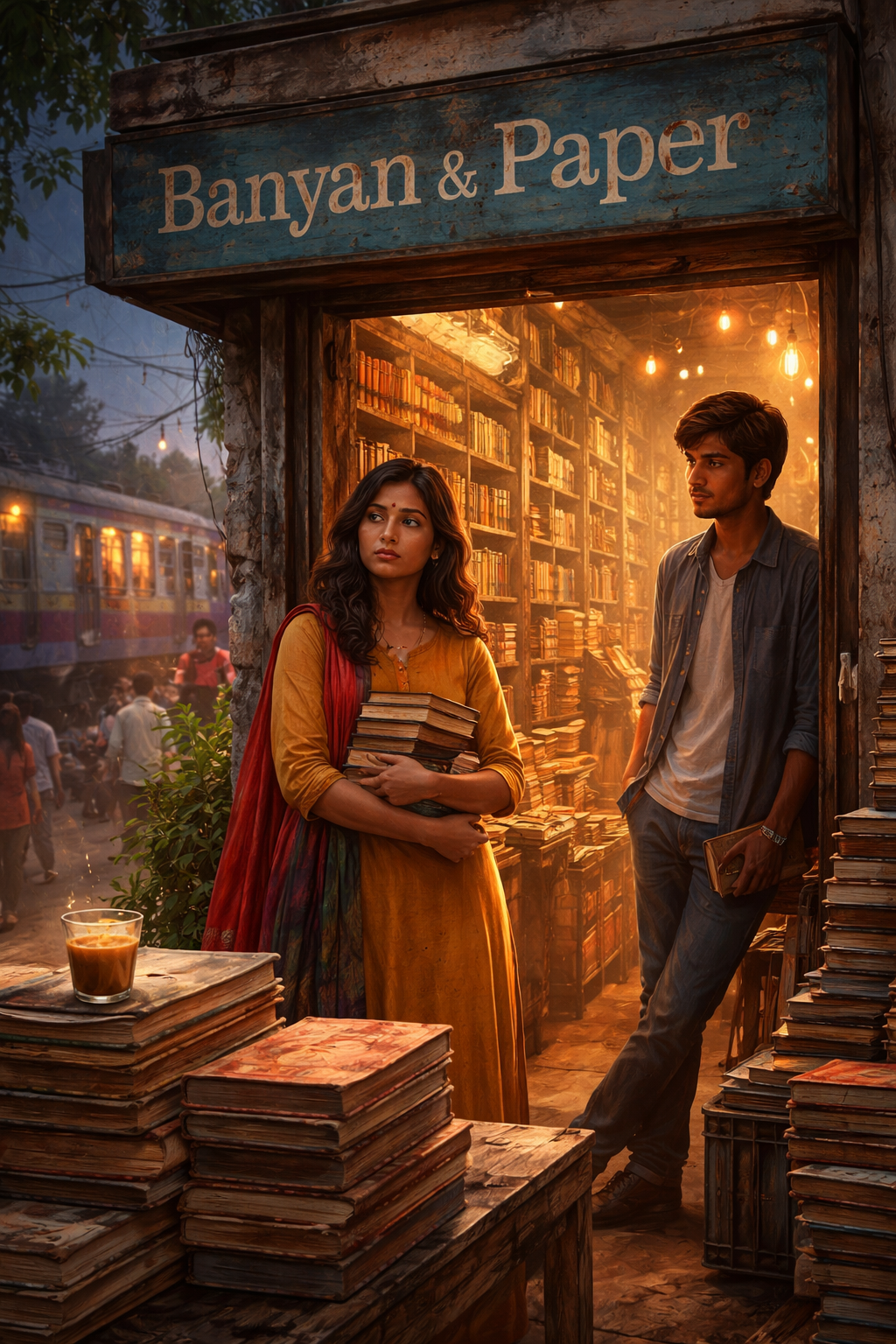
Banyan & Paper sat between a photocopy shop and a tiny snack stall that sold vada pav with alarming confidence. The bookstore didn’t have a glossy sign. Just painted letters that had faded unevenly, and a handwritten note taped near the entrance:

Yes, we buy old books. No, we can’t take your college textbooks from 2009. Please don’t argue.

Inside, the air was cooler than outside, not because of AC; she couldn’t afford to run it all day, but because books held a different kind of temperature. The place smelled like paper, dust, and the faint perfume of mothballs that Nandini kept in strategic corners like tiny guards.

Her mother had named the shop when Nandini was eight. Her father had wanted something sensible. Something like Rao Books & Stationery.

Her mother had insisted on a banyan tree.

“A banyan doesn’t look like it’s doing anything,” her mother had said. “But it holds everything together.”

Nandini unlocked the shutter, pulled it up with a grunt, and stepped inside.

Her phone buzzed. A text from her neighbour, Aarti:
Ma ate?

Nandini typed back quickly:
Yes. Dawa de diya. Sleeping.

Chronic but stable, her mother’s condition was a constant hum in the background of their lives: medication, BP checks, occasional dizzy spells, and a general fragility that made Nandini’s choices feel less like choices and more like a line drawn on a map.

She couldn’t move for work. She couldn’t “just try something else.” She couldn’t relocate, restart, reinvent herself in the way LinkedIn loved to suggest. Her life was tethered to this suburb, this shop, and the upstairs bedroom where her mother slept with a fan pointed directly at her face like it was a personal assistant.

Nandini flipped on the lights, dust motes rising like tiny spirits.

At ten thirty, the regulars drifted in.

A retired uncle who came to argue about politics and borrow old Marathi novels.

A teenage girl who pretended she was browsing but actually just wanted to sit in the corner and breathe for twenty minutes away from her tuition schedule.

A man who bought self-help books and looked disappointed every time a book failed to fix him.

The shop didn’t make money the way shops were supposed to. It made meaning. And meaning, unfortunately, didn’t pay rent.

At noon, the bell above the door rang.

Nandini looked up and saw Mihir standing there, freshly washed, wearing a clean shirt that looked surprisingly well-fitted. Not expensive exactly, but… deliberate.

He stepped in slowly, like someone entering a temple without knowing the rules.

“Hi,” he said.

“You came,” Nandini said, and immediately hated the warmth in her own voice.

He glanced around, taking in the shelves, the mismatched chairs, the handwritten category signs: Old Loves, Weird But Good, Marathi Classics, Women Who Don’t Apologise.

“It’s… exactly how I imagined it,” he said.

“What did you imagine?”

“A place where people come to feel less alone,” he said, like it was obvious.

Nandini’s throat tightened, annoyed at herself. She moved behind the counter and busied her hands with a stack of books.

“So,” she said, brisk, “what are you looking for?”

Mihir smiled at her tone. “Something that doesn’t make me feel like I’m doing homework.”

“Welcome to the club,” Nandini muttered.

He wandered into the aisles. He picked up a thin book of poetry, flipped through a few pages, put it back carefully.

“You read poetry?” Nandini asked before she could stop herself.

“I used to,” he said. “When I was younger.”

“And now?”

He shrugged. “Now I scroll.”

Nandini snorted. “You and the rest of the country.”

He looked at her then, properly. “Do you ever feel like everyone is tired but pretending they’re fine?”

Nandini paused. “Yes.”

“And do you ever feel like reading is the only thing that makes the tiredness… manageable?”

She swallowed. “Yes.”

He nodded, like something inside him settled. “Okay. Give me something.”

Nandini came out from behind the counter, walked to the shelves, and started pulling books without overthinking.

A slim novel in English that carried quiet grief like a second skin.

A book of essays by an Indian writer that made you laugh and then feel guilty for laughing.

A Marathi short story collection she’d grown up reading, translated on the facing page because she didn’t know what his Marathi was like and she didn’t want to ask.

She handed the stack to him. “Start here.”

He stared at the books as if she’d handed him a key.

“You’re good at this,” he said.

“I’ve been doing it forever,” she said, and then, because honesty slipped out sometimes when you weren’t watching, she added, “and because I can tell when someone is trying to remember themselves.”

Mihir’s mouth opened, then closed. For a second, he looked like he wanted to say something and didn’t trust it.

He paid in cash.

Nandini noticed because she always noticed. Cash was inconvenient. Cash was usually a habit, or a decision.

He took the bag and hesitated. “I’ll come back and tell you what I think.”

“You better,” she said. “Otherwise I’ll assume you didn’t like it and I’ll take it personally.”

He laughed. It was a full laugh. Not polite.

“Deal,” he said, and left.

Nandini watched the door for a second longer than she needed to, then turned back to the counter, annoyed with her own heart for being so easy to wake up.


Over the next two weeks, Mihir became a pattern in her day.

Not daily. That would have felt like too much too fast. But often enough that she started expecting him in the way you start expecting the train to arrive, even though it never arrives when you want.

He’d come in, buy one book, then talk about it like it mattered. Not like he was showing off. Like he was trying to understand why it hit him.

He brought her cutting chai once, and she nearly cried because nobody brought her chai unless they wanted something from her.

“Don’t make it weird,” she told him.

“You’re making it weird,” he said, grinning.

Sometimes he’d help her shift cartons. Sometimes he’d sit in the corner and read for twenty minutes without speaking. The shop accepted him the way old spaces accepted people who didn’t try to dominate them.

Even her mother, who noticed everything despite pretending she didn’t, asked one evening while Nandini was crushing tablets into curd:

“Who is this boy who keeps coming?”

“He’s not a boy,” Nandini said.

“Men are boys until they prove otherwise,” her mother replied, unbothered.

Nandini rolled her eyes. “He’s… a customer.”

Her mother made a soft sound. “Hmm.”

“Stop doing that.”

“Doing what?”

“That hmm. That I-know-more-than-you hmm.”

Her mother smiled. “I’m only saying, if he’s making you smile, don’t immediately find a reason to punish yourself for it.”

Nandini stared at the curd like it had answers.


One Thursday, after the shop had closed, Aarti stuck her head in with her usual lack of boundaries.

“You’re coming for the open mic, right?” she asked. “Don’t back out.”

Nandini groaned. “Aarti, I said maybe.”

Aarti widened her eyes theatrically. “Maybe is what cowards say when they want to sound brave.”

Behind Aarti, Mihir walked in, carrying a book under his arm.

“What open mic?” he asked.

Nandini shot Aarti a look that could have peeled paint. Aarti smiled innocently and disappeared.

Nandini exhaled. “There’s this small thing. At the community library. People read their writing.”

Mihir’s eyes lit up in a way that made her want to throw something at him. “You write?”

“Not like… professionally,” she said quickly. “Just. Sometimes.”

“I’d like to hear you,” he said.

The way he said it was not flirtatious. It was earnest. That made it worse. Earnestness didn’t give you room to be cynical.

“I don’t do public reading,” she said.

“Why?”

Because in public, people decided who you were and then told you. Because the moment you offered your words, they belonged to everyone.

Nandini shrugged instead. “I’m not that person.”

Mihir studied her for a second, then said quietly, “You already are. You just haven’t admitted it out loud.”

Nandini stared at him. “You’ve known me for two weeks.”

“And in two weeks,” he said, “I’ve seen you tell a teenager that her feelings aren’t a problem to solve. I’ve seen you put a book in an uncle’s hand and make him look less lonely. I’ve seen you run a shop that shouldn’t survive and keep it alive anyway. Don’t tell me you’re not that person.”

Nandini’s eyes stung, and she hated that too.

“You’re saying all this because you want me to read something,” she said, trying for sarcasm.

“I’m saying all this because you deserve to hear it,” he replied. “Reading is just… one way.”

Nandini looked away, pretending to straighten a pile of books.

Finally, she said, “Fine. I’ll go. But if I faint, I’m blaming you.”

Mihir’s grin returned. “Fair. I’ll bring water. And a chair.”


The community library in their suburb wasn’t fancy. It had plastic chairs, yellowing posters, and a librarian who treated overdue books like personal betrayal.

About thirty people showed up for the open mic. Mostly students. A few aunties. One man who read jokes like he was performing at a corporate event.

Nandini sat in the back, holding a sheet of paper so tightly it was beginning to crease.

Mihir sat one row ahead, turned halfway in his chair so he could see her, as if she might bolt.

When her name was called, her body moved before her brain agreed.

She walked up to the front, faced the microphone, and saw the room: not hostile, not kind, just waiting.

She took a breath.

“This is…” Her voice caught. She tried again. “This is called Banyan & Paper.

And then the words came.

She spoke about the shop. About her mother’s hands pricing books with a pencil. About the way people came in looking for one thing and left with another. About the slow grief of watching reading become unfashionable. About holding a space together when the world told you it didn’t matter.

She didn’t mention her mother’s illness. She didn’t mention her bank balance. She didn’t perform pain.

She just told the truth.

When she finished, there was a beat of silence. Then applause. Real applause, not polite.

Nandini stepped down, slightly dizzy, and returned to her seat.

Mihir looked at her like she’d done something impossible.

“I told you,” he whispered.

“Don’t,” she whispered back. “Don’t make me cry in public.”

He smiled, but his eyes were damp. “Okay.”

Outside, later, under the streetlight near the paan shop, he said, “You were brilliant.”

Nandini exhaled shakily. “I feel like I ran a marathon without training.”

“That’s what it looks like when you do something you’ve been avoiding,” he said.

And then he kissed her.

Not dramatically. Not to prove a point. Just like it was the next honest thing.

Nandini kissed him back, and for a moment, the suburb felt suspended: the local train rumble in the distance, the smell of rain on concrete, the fact of tomorrow waiting.


After that, their closeness grew faster.

It always did once you crossed that line.

Mihir started coming over. Not often, because her mother was home, and Nandini had a complicated relationship with private life being witnessed. But sometimes he’d stand at the door with fruits or masala biscuits and say, “Aunty ke liye.”

Her mother would eye him with suspicious fondness.

“Tumhara kaam kya hai?” her mother asked one evening, not bothering with softness.

Mihir paused. “Consulting,” he said.

Nandini’s mother raised an eyebrow. “That word means nothing.”

Mihir smiled politely. “I help companies… fix problems.”

Her mother gave him the look only Indian mothers could give: the look that said I’m letting you speak, but don’t think I’m believing you.

Nandini watched Mihir carefully. He didn’t seem offended. He didn’t seem defensive. He seemed… careful.

Careful was okay. Careful was better than arrogant.

Still, there were things that didn’t add up.

He knew how to talk to people. Not just in a friendly way. In a practised way.

He was too comfortable in expensive spaces. Not showy, but unbothered.

He paid in cash, always.

And sometimes, when his phone rang, his entire face would change for a second. Like someone had called him by a name he wasn’t using.

Nandini told herself she was being dramatic. She told herself she was looking for problems because peace felt unfamiliar.

Then, one evening, she walked back to the shop after locking up, because she’d forgotten her keys.

She took the side lane behind the building, where the photocopy shop dumped paper scraps, and the snack stall stored gas cylinders.

She heard voices.

Low. Urgent.

A woman’s voice, sharp and controlled. “You can’t keep doing this.”

Mihir’s voice. Different. Cleaner. “I told you, I’m not available.”

“You’re not a college boy playing house in the suburbs,” the woman snapped. “You have responsibilities.”

Nandini froze behind a stack of cardboard, heart climbing into her throat.

“You can handle it,” Mihir said.

“I can handle it for a week,” the woman said. “Not indefinitely. And not when you’re ignoring calls. This is getting noticed.”

A pause.

Then the woman said, “Mihir Mehta, this isn’t romantic. It’s reckless.”

Nandini’s blood went cold.

Mehta.

Not an unusual surname. But the way she said it. Like it carried weight. Like it was a name that opened doors.

Mihir’s voice softened, but there was steel under it. “Don’t use my full name like you’re scolding a child.”

“You’re behaving like one,” she shot back. “The board meeting is tomorrow. The Pune acquisition is hanging. Your father is asking questions.”

Nandini felt dizzy. Father. Board. Acquisition.

This wasn’t just consulting. This was a life she hadn’t been invited into. A life that didn’t include second-hand bookstores and open mic nights.

“You’re going to get attached,” the woman said, and now there was something almost weary in her voice. “And then what? You think she’ll just… fit?”

“She doesn’t need to fit,” Mihir said.

“You’re not listening.” The woman lowered her voice. “She’ll pay the price for this long before you do. That’s how it works.”

Nandini pressed her hand to her mouth because something between a laugh and a sob threatened to come out.

Mihir said, very quietly, “I’m not lying to hurt her.”

“You’re lying to be loved safely,” the woman replied. “That’s still lying.”

Silence.

Then footsteps. The woman’s heels clicked away.

Mihir exhaled like someone who’d been holding his breath for days.

Nandini stumbled backwards, stepped on a plastic bottle, and the sound made Mihir turn.

Their eyes met across the lane.

For half a second, both of them looked like strangers.

“Nandu,” he said, and the nickname landed wrong. Like a stolen intimacy.

Nandini’s voice came out thin. “Who are you?”

Mihir opened his mouth, closed it, then said, “Can we talk inside?”

Nandini shook her head. “No. You don’t get inside. Not right now.”

His face tightened. He took one step toward her.

Nandini held up her hand. “Stop.”

He stopped.

“Tell me,” she said, voice steady now in a way that surprised her. “Don’t perform. Don’t manage my emotions. Just tell me.”

Mihir swallowed. “My name is Mihir Mehta,” he said. “That part is true. I… didn’t lie about my name. I lied by omission.”

Nandini laughed once, sharply. “That’s a fancy way to say you lied.”

He flinched. “Yes.”

“What are you?” she asked. “Consultant? Business heir? What? Because the lane behind my shop is not where ‘board meetings’ happen.”

Mihir looked down for a second, then back up. “My family… has businesses,” he said. “I work in them. I run a part of it.”

“And you thought saying ‘consulting’ was… what? Charming?”

“It was cowardly,” he said, and at least he didn’t deny it.

Nandini felt something inside her go very quiet, the way a room goes quiet when someone says something true and ugly.

“Why?” she asked.

Mihir’s voice broke slightly. “Because when people know, they don’t see me. They see the name. They see what I can offer. They see access. And with you—” He stopped, as if the sentence scared him.

“With me?” Nandini prompted, even though she already knew she’d regret it.

“With you,” he said, “I felt like I could be… a person.”

Nandini stared at him. She wanted to be moved. She wanted to soften. But something harder rose in her chest.

“You didn’t trust me,” she said.

Mihir’s face tightened. “I did—”

“No,” she cut in. “You trusted your own fear. You trusted your own script. You didn’t trust me to choose.”

He went still.

Nandini continued, words coming now like they’d been waiting. “Do you understand what you did? You let me imagine a future. You let me… step into something. And you knew, somewhere in your head, you knew that if this went wrong, it would cost me more than it would ever cost you.”

Mihir’s eyes shone. “I wasn’t trying to…”

“I know you weren’t trying,” Nandini said, and the fact that she believed that made her angrier. “That’s the problem. You didn’t even see the imbalance. Or you saw it and didn’t want to look at it.”

He whispered, “I did see it.”

Nandini held his gaze. “And?”

“And I still wanted to be with you,” he said, voice raw. “I still do.”

For a moment, the lane felt too small for the truth sitting between them.

Nandini looked away because if she looked too long, she’d remember the other version of him: the one who held her hand in the library, the one who listened to her words like they mattered, the one who sat on the shop floor and read quietly like he belonged there.

Her voice came out tired. “I don’t know what to do with this.”

“I’ll tell you everything,” Mihir said quickly, like he’d been waiting for permission. “Not managed. Not filtered. Everything.”

Nandini stared at the broken plastic bottle on the ground. Then she said, softly, “You should have done that before.”

“I know,” he said, and it sounded like it hurt.

Nandini felt tears rise, annoying and hot. She wiped them away with the heel of her hand, angry at her own body for being loyal to feelings.

Mihir took a cautious step closer. “Nandini…”

She stepped back. “Not today.”

He stopped, visibly restraining himself. “Okay.”

Nandini swallowed. “Tell me one thing. And don’t answer like a man in a boardroom.”

He nodded.

She asked, “Was any of it real?”

His voice turned quiet, almost rough. “All of it.”

“The books?” she demanded.

“Yes.”

“The way you looked at me?”

“Yes.”

“The kiss?”

He didn’t hesitate. “Yes.”

Nandini’s chest tightened painfully. “Then why ruin it with a lie?”

Mihir’s laugh was small and bitter. “Because I didn’t know how to be loved without one.”

That sentence landed hard. Not romantic. Not redeeming. Just honest in a way that made the skin on her arms prickle.

Nandini reached into her bag, pulled out her keys, and stared at them as if they were instructions.

Mihir stood there in the lane, not reaching for her, not touching her, as if he’d finally understood that touching was not the same as staying.

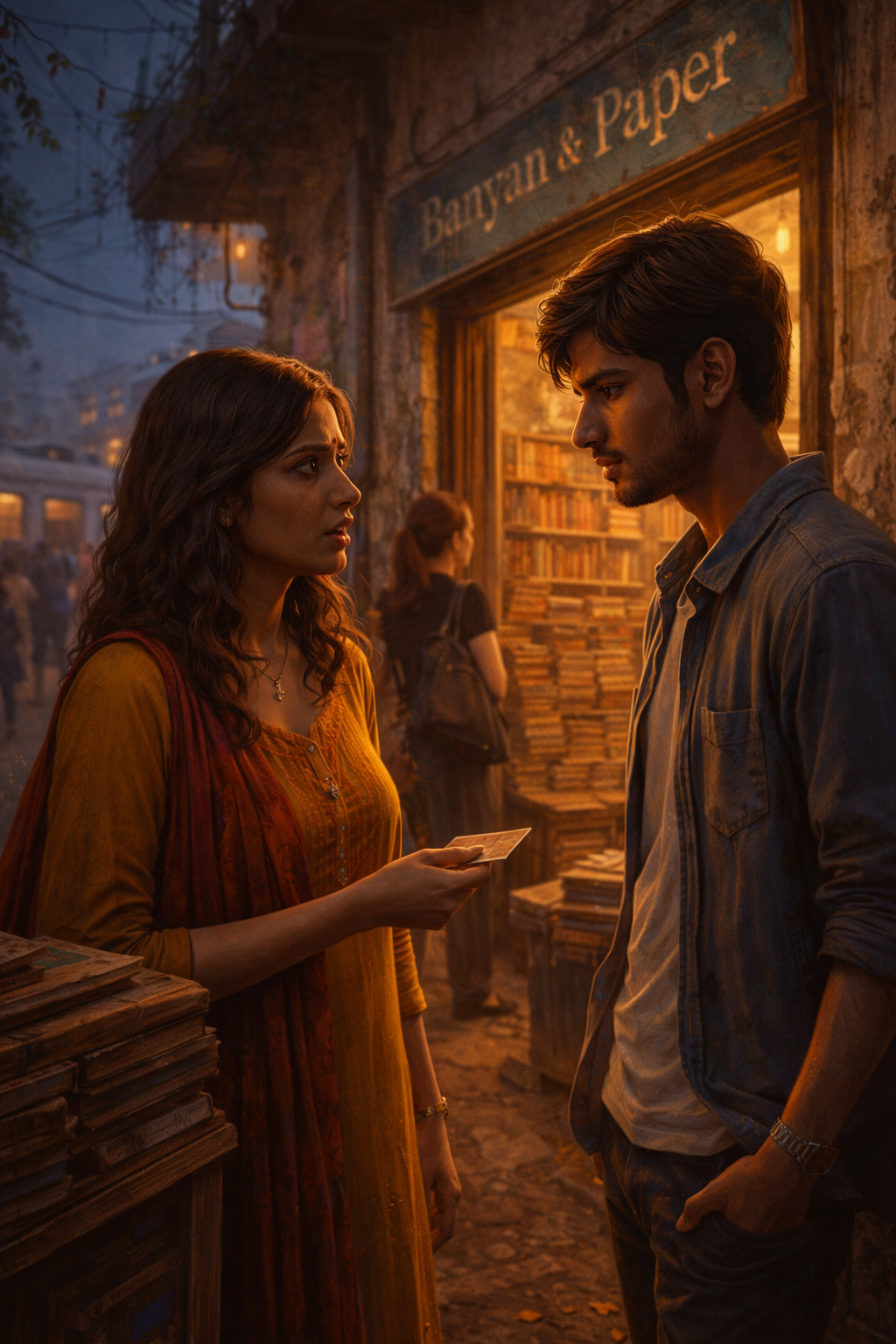
He took out his wallet, hesitated, then pulled out a card and held it out to her.

Nandini didn’t take it.

“It’s my number,” he said. “My real number. Not the one I’ve been using.”

“Why are you giving it to me?” she asked.

“Because I’m done hiding,” he said. “And because I’m not going to chase you. I don’t have the right. But I also don’t want to disappear and let you think you did something wrong.”

Nandini’s throat tightened. She hated that he was saying the right thing now. She hated that she still wanted to believe him.

She reached out and took the card, not because she forgave him, but because she wanted the truth to remain available if she chose it later.

Mihir watched her fingers close around it as if it were a fragile thing.

“I’m sorry,” he said again. Not dramatic. Not pleading. Just plain.

Nandini nodded once. She didn’t trust her voice.

She unlocked the shop door, stepped inside, and turned on the light. The shelves stood there, patient and familiar, like they’d seen everything and survived anyway.

Mihir stayed outside. She could feel him, even without looking.

After a minute, she heard his footsteps retreat.

When she finally turned back toward the glass door, the lane was empty.


That night, Nandini sat on the balcony of their flat, listening to the local train rattle past in the distance.

Her mother slept inside, the fan still aimed at her face like a stubborn guardian.

Aarti had texted twice. Kya hua? and then Don’t be stupid, ya. Nandini didn’t reply.

She held Mihir’s card between two fingers, turning it over and over like a coin.

On the other hand, her phone glowed with an unsent message.

I don’t know what to do with you.

She didn’t send it.

Below, someone argued with a delivery boy. Somewhere, a dog barked. The city continued, indifferent and intimate at once.

Nandini thought about the shop. About her mother. About the years she’d spent making peace with staying.

She thought about Mihir’s face when she read at the open mic, like he’d seen her become someone she’d been hiding from.

She thought about the lane behind the shop, about that one sentence that had cut clean:

You’re lying to be loved safely.

Nandini didn’t know what tomorrow would hold. She didn’t know whether love could survive the kind of truth that arrived late and messy.

But she knew this: she was done being treated like an afterthought in someone else’s escape plan.

The phone screen dimmed. She tapped it awake again.

The message still sat there, unsent.

She stared at it a long time, then deleted the text entirely.

And then, because she was not a saint and because she was human, she didn’t delete the number.

Short Story: The Summer Holidays

In the late eighties and early nineties, summer did not arrive alone in Tirunelveli.

It arrived with families.

It came with rope-tied suitcases, steel trunks dented by railway platforms, and parents who crossed the threshold and quietly became younger versions of themselves. It came with children who had grown taller since last year and adults who pretended not to notice.

The house on North Car Street sensed it first. The neem tree stood still. The red oxide floor was scrubbed until it caught the light. The kitchen smelled of coffee and spice long before anyone arrived.

Paati had been ready for days.

The first family came from Chennai.

The elder son stepped out of the hired Ambassador, already loosening his collar, the long drive still clinging to his shoulders. His wife followed, adjusting her pallu without thinking, her eyes moving carefully over the house she knew well but never loosely.

Their son, Arjun, fifteen and all angles, jumped out last.

“Too much heat,” he said.

“It was hotter in our time,” his father replied, already sounding less like a man from Chennai and more like a son from this street.

Inside, Paati did not look up from the garlic she was peeling.

“You’ve come,” she said.

The daughter-in-law bent to touch her feet. The gesture was practised, precise. Paati’s hand rested briefly on her head, then withdrew.

“Wash your hands,” Paati said. “Help.”

The knife was placed in her palm before she could respond.

She moved into the kitchen, uncertain whether she had been welcomed or assigned, and began chopping as if the motion itself might clarify the difference.

Much later, when Meera arrived from Delhi and learned to read the house properly, she would remember this moment without having seen it. She would notice how her aunt’s shoulders always relaxed once she had work to do, as if usefulness was the only language that made the house fully intelligible.

The rest arrived in waves.

Delhi brought noise and opinions. Mumbai brought stories and twins who ran everywhere. The last daughter arrived from a town whose name changed often, her husband shaped by transfer orders, their children hovering uncertainly.

Paati gathered them all in with the same sentence.

“This is your house.”

The daughter-in-law from Chennai heard it from the kitchen. She paused, knife hovering, unsure whether the words reached her too.

Mornings settled into rhythm.

The kitchen filled with women. Daughters moved freely, laughing, arguing, interrupting. Daughters-in-law worked more quietly, exchanging glances, correcting themselves before being corrected.

Paati supervised without hovering.

The Chennai daughter-in-law watched everything. How rice was rinsed. How sambar was tasted without flinching. How vessels were placed back exactly where they belonged. She mirrored these movements without realizing it.

Meera noticed. She noticed how her aunt never sat unless told. How her voice softened automatically around elders. How she laughed most easily with the children, as if they required no performance.

The men occupied the verandah. In their parents’ house, their authority thinned. Thaatha read the newspaper with ritual precision.

“Don’t bring work home,” he told his elder son one evening.

The son nodded, chastened.

The daughter-in-law poured coffee, placed the tumbler beside her husband, stepped back.

The days unfolded.

Cricket matches with arguments. Mango raids. Afternoon naps enforced by Paati’s stare.

Evenings softened the town. Walks with Thaatha. Ice melting down wrists. One television, one antenna, one version of the world.

During power cuts, everyone moved to the terrace.

Adults talked in small circles. Children lie on mats. Stories surfaced carefully. About ageing parents. About distance. About how cities swallowed time.

At some point, the Chennai daughter-in-law spoke.

Just once.

“It’s hard,” she said, not looking at anyone, “when children grow up where neighbours don’t know their names.”

There was a pause.

Then Paati said, “That is why they must come here.”

The sentence was not directed at her. But it stayed with her.

The defining moment came three days later.

It was mid-afternoon. The heat had settled heavily. Most people were resting.

In the kitchen, Paati was alone, sorting lentils slowly, methodically.

The Chennai daughter-in-law entered, unsure why she had come. Perhaps to check something. Perhaps because the house felt too quiet.

Without being asked, she sat on the floor opposite Paati and reached for another bowl.

For a while, they worked in silence.

Then Paati said, without looking up, “You add too much water to the rice.”

The daughter-in-law froze. She waited for instruction, correction, judgment.

Instead, Paati pushed the bowl toward her.

“Tomorrow,” she said, “you make.”

It was not a test. It was not praise.

It was a transfer.

The kitchen, for one meal, was being handed over.

The daughter-in-law felt something tighten in her chest. Not fear. Something closer to responsibility.

“Yes,” she said.

That night, she barely slept.

The next morning, she woke early. She washed the rice the way she had watched Paati do it. She measured water by feel, not cup. She cooked slowly, deliberately.

When she served it, she stood waiting.

Paati took a mouthful. Chewed. Swallowed.

“Correct,” she said.

Nothing more.

Meera saw it all. The waiting. The stillness. The quiet approval.

She understood then that in this house, love did not announce itself. It assigned work.

After that, something shifted.

The daughter-in-law moved differently. Not louder. Not freer. Just steadier.

She corrected Arjun without glancing at her husband. She laughed once, openly, when the twins spilt rasam. She sat down without asking.

Paati noticed. Said nothing.

On the final day, when suitcases reappeared and the house began to empty, Paati handed food parcels wrapped in newspaper.

When the daughter-in-law bent to touch her feet, Paati held her hand.

“Don’t forget,” she said, finally looking at her, “this is also your house.”

The words landed fully this time.

Meera watched her aunt blink once. Then nod.

After the others had left, the house exhaled.

Paati sat down heavily. “Too much noise.”

Thaatha folded the newspaper. “They came.”

In the kitchen, the daughter-in-law rinsed the last vessel. She ran her hand once over the counter, switched off the light, and closed the door without hesitation.

Years later, Meera would remember that moment.

Not the cricket. Not the mangoes.

But the day her aunt stopped asking where she belonged.

Short Story: The Lonavala Getaway

The train screeched to a halt at Lonavala station, and Arjun practically bounced out of his seat. “Finally! Fresh air!” he declared dramatically, throwing his arms wide as if he could already breathe in the hill station’s crisp atmosphere through the train’s grimy windows.

Calm down, Mountain Man,” laughed Priya, adjusting her oversized sunglasses. “We haven’t even gotten off yet.”

Their group of six had been planning this weekend trip for months. There was Arjun, the eternal optimist and self-appointed trip organiser; Priya, sharp-tongued but fiercely loyal; Rohit, quiet and thoughtful, who’d been harboring feelings for Priya since their first year; Kavya, bubbly and Instagram-obsessed; Vikram, the skeptic who complained about everything but never missed a hangout; and Neha, practical and level-headed, often the voice of reason.

I still think we should have booked a proper hotel,” Vikram grumbled, hefting his designer backpack. “This Airbnb thing sounds sketchy.

It’s not sketchy, it’s authentic,” Arjun countered. “The listing said it’s a colonial-era bungalow with ‘old-world charm.’ How cool is that?”

Old-world charm usually means no Wi-Fi and questionable plumbing,” Vikram muttered.

Kavya, who had been frantically taking selfies since they’d entered the Western Ghats, looked up from her phone. “Guys, I’m getting no signal. Like, zero bars. How am I supposed to post our trip?”

That’s the point!” Arjun said. “Digital detox! Quality time! Bonding!”

I’m already feeling detoxed,” Neha said dryly. “Mainly of my will to live.”

After a bumpy auto-rickshaw ride through winding roads flanked by misty hills and cascading waterfalls, they arrived at their destination. The bungalow stood at the end of a narrow dirt path, surrounded by dense trees that seemed to lean in conspiratorially. It was exactly as advertised: a sprawling colonial structure with weathered white walls, green shutters, and a wraparound veranda that had seen better decades.

It looks like something out of a horror movie,” Rohit observed quietly.

Or a romantic period drama,” Priya added, and Rohit’s heart did a little skip.

Why not both?” Kavya said cheerfully, finally finding one tiny bar of signal and immediately snapping photos.

The caretaker, an elderly man named Raman uncle, greeted them with a mixture of warmth and what seemed like concern. He was lean and weathered, with kind eyes that seemed to hold secrets.

Welcome, welcome,” he said, jangling a large set of keys. “You are the college group, yes? From Mumbai?”

“That’s us!” Arjun beamed. “Ready for the best weekend ever!”

Raman uncle’s smile faltered slightly. “Ah, yes. Well, let me show you the house. There are just a few… guidelines.”

As he led them through the musty interior, pointing out the kitchen, bathrooms, and bedrooms, his tone grew more serious. “Please, do not go to the third floor. It is not safe, old floorboards, you understand. And after sunset, it is better to stay inside. The forest can be… confusing at night.”

“Confusing how?” Neha asked, her practical mind immediately catching the euphemism.

“Animals,” Raman uncle said quickly. “Leopards, sometimes. And the paths, they all look the same in the dark.”

Vikram shot Arjun a pointed look. “Leopards. Great choice, organiser.”

Leopards are scared of humans,” Arjun said dismissively. “And look at this place! It’s perfect!

After Raman uncle left, promising to return the next evening, the group settled in. They distributed themselves across the four bedrooms on the second floor, with Arjun and Vikram sharing one, Priya and Kavya sharing another, and Rohit and Neha taking the remaining two rooms.

The first evening passed pleasantly enough. They cooked a chaotic dinner together, with Priya demonstrating her surprising culinary skills. At the same time, Kavya documented every dish for her Instagram story (which she couldn’t post due to the poor signal, leading to much dramatic sighing). Rohit found excuses to help Priya in the kitchen, and she didn’t seem to mind, which gave him hope.

This is nice,” Vikram admitted grudgingly as they sat on the veranda after dinner, sharing bottles of beer they’d brought from Mumbai. “Peaceful.

See? I told you…” Arjun began, but was interrupted by a strange sound from above.

Thump. Drag. Thump. Drag.

Everyone looked up at the ceiling.

What was that?” Kavya whispered.

Probably just the wind,” Neha said, but her voice lacked conviction.

Wind doesn’t make dragging sounds,” Rohit pointed out.

Thump. Drag. Thump. Drag.

The sound came again, clearly footsteps, but dragging, as if someone was pulling something heavy across the floor above them.

That’s the third floor,” Priya said quietly. “The one we’re not supposed to go to.”

Maybe it’s just settling,” Arjun suggested, though his usual confidence seemed shaken. “Old houses make weird noises.”

Vikram stood up abruptly. “I’m going to check.”

Are you insane?” Kavya hissed. “Raman uncle specifically said not to go up there!”

Raman uncle also said there were leopards, and I haven’t seen any paw prints. I bet he just doesn’t want us messing with his storage or something.”

Before anyone could stop him, Vikram had stalked inside and up the creaking staircase. The others followed reluctantly, clustering at the bottom of the stairs leading to the third floor.

Vikram?” Arjun called. “Find anything?”

There was a long pause, then Vikram’s voice, strangely strained: “Guys? You need to see this.”

They climbed the narrow staircase to find Vikram standing in a doorway, his face pale. Beyond him was a room that looked like it belonged in a different century, or a different world entirely.

The room was filled with old photographs, hundreds of them, covering every wall. But these weren’t ordinary family photos. They showed the same group of six young people, over and over again, in different poses, different clothes, but always the same faces. Their faces.

“What the hell?” Priya breathed.

Kavya grabbed Neha’s arm. “Those are us. Those are literally us.”

In photo after photo, they could see themselves, laughing on the veranda downstairs, cooking in the kitchen, sitting around the very same table where they’d just eaten dinner. The photos looked old, yellowed at the edges, as if they’d been taken decades ago.

“This is impossible,” Rohit said, stepping closer to examine one of the images. “These photos… they look vintage, but that’s definitely me.”

“And me,” Arjun whispered, pointing to a photo showing him with his arm around a laughing Priya. “But I’ve never seen this picture before in my life.”

Neha, ever practical, was examining the room more carefully. “Look at this,” she said, pointing to a corner where dozens of diaries were stacked. She opened one at random and began reading aloud:

“Day 1: Arrived at the bungalow with the group. Arjun is as enthusiastic as ever, Vikram is complaining, and Kavya can’t stop taking photos. Rohit keeps looking at Priya when he thinks no one is watching. Some things never change.”

What does that mean, ‘some things never change’?” Kavya asked, her voice small.

Neha flipped to another entry: “‘Day 15: We tried to leave today, but the path just led us back to the house. Raman uncle won’t explain what’s happening. He just smiles sadly and tells us to be patient.”

Day 15?” Arjun repeated. “We’ve only been here one day.”

Keep reading,” Priya urged, though her voice was shaking.

“Day 43: Rohit finally told Priya how he feels. She said she’d known all along and had been waiting for him to find the courage. Even trapped here, there’s still room for happiness.”

Rohit and Priya looked at each other, and despite the surreal horror of the situation, something passed between them.

“Day 78: We think we understand now. We’ve been here before. Many times. The photos prove it. But each time, we forget when we arrive. We only start remembering as the cycle nears its end.”

“Cycle?” Vikram’s voice cracked. “What cycle?”

Neha flipped ahead frantically. “Day 127: This is my last entry. Tomorrow we’ll try to leave again, and we’ll wake up in Mumbai with no memory of this place, planning another trip to Lonavala. But maybe this time, if we’re lucky, someone will read these diaries before it’s too late. If you’re reading this, you are us, and we are you. Find Raman uncle. Ask him about the curse. Ask him about the English sahib who died here in 1923. Ask him how to break free.”

The room fell silent except for the sound of their collective breathing.

This is insane,” Vikram said finally. “Someone’s playing an elaborate prank. Those photos are doctored, the diaries are fake…

He was interrupted by the sound of footsteps on the stairs. They all turned to see Raman uncle ascending slowly, his face grave.

You found the room,” he said simply.

What is this?” Arjun demanded, his voice higher than usual. “What’s happening to us?”

Raman uncle sighed deeply. “It is a long story. There was an Englishman, James Worthington, who built this house in 1922. He fell in love with a local woman, Kamala, but her family forbade the match. In his anger and heartbreak, he… he did something terrible. He turned to dark practices, tried to bind her spirit to this place so she could never leave him.”

And?” Priya prompted when he paused.

“The ritual went wrong. Instead of binding just her, he created a trap for love itself. Young couples, groups of friends with love between them, they come here, and the house feeds on their connections, their emotions. It keeps them in a loop, living the same experiences over and over.”

“That’s impossible,” Neha said, but her voice lacked conviction.

“How many times?” Rohit asked quietly. “How many times have we been here?

Raman uncle’s eyes were sad. “This is your forty-seventh visit.”

The number hit them like a physical blow.

Forty-seven times,” Kavya whispered. “We’ve lived through this forty-seven times?”

But we don’t remember,” Priya said, as if trying to make sense of it. “We go back to Mumbai and plan the trip again, with no memory of what happened here.”

The house lets you leave when the cycle completes,” Raman uncle explained. “But it also makes you forget, ensuring you’ll return. Only in the final days do the memories begin to surface.”

So, how do we break it?” Arjun asked. “There has to be a way.”

Raman uncle looked at them for a long moment. “The curse was born from love turned selfish, possessive. It can only be broken by love freely given, without expectation of return.

What does that mean?” Vikram demanded.

But before Raman uncle could answer, something extraordinary happened. Despite the supernatural horror of their situation, despite being trapped in a cosmic loop for who knows how long, Rohit stepped forward and took Priya’s hand.

I need to tell you something,” he said, his voice steady despite everything. “I’ve been in love with you since the first year. Maybe that’s why we keep coming back here, I don’t know. But if we’re trapped, if this is all we have, I want you to know.”

Priya looked at him, tears in her eyes. “I know,” she said softly. “I’ve always known. And I’ve been waiting for you to be brave enough to say it.”

They kissed then, simple and sweet, and something in the house seemed to shudder.

“Well, this is awkward,” Kavya said, but she was smiling through her tears. “Here I thought the scariest part would be the supernatural imprisonment.”

“Actually,” Neha said thoughtfully, “I think they might be onto something. Raman uncle, when you said love freely given…”

“The curse feeds on selfish love, possessive love,” Raman uncle confirmed. “But love that expects nothing in return, love that wishes only happiness for the other person…”

Arjun suddenly laughed, and they all turned to stare at him. “You know what’s funny? In forty-seven loops, we’ve probably become the best of friends anyone could ask for. We’ve shared everything, been through everything together, even if we don’t remember it.”

“We have,” Vikram agreed, and for once, he wasn’t complaining. “And honestly? Even if we’re trapped, even if this is all insane, I can’t think of five people I’d rather be trapped with.”

One by one, they moved closer together, forming a circle on the dusty floor of the photograph room.

“I love you all,” Kavya said simply. “Not romantically, well, except you two are adorable, but I love our friendship. I love that Arjun always believes the best in everything, that Vikram pretends to be cynical but cares more than anyone, that Neha always keeps us grounded, that Priya makes us all braver, and that Rohit sees beauty in everything.”

“I love that we found each other,” Neha added. “In all the chaos of college, in Mumbai, in life, we found each other.”

“And I love that even here, even in this impossible situation, we’re still us,” Priya said. “We’re still taking care of each other.”

The house began to tremble. The photographs on the walls started to fade, their edges curling as if being consumed by invisible flames.

It’s working,” Raman uncle said, his voice filled with wonder. “In forty-seven cycles, you never… You were always trying to escape, to get away. You never chose to stay together.”

Because we never remembered how much we meant to each other,” Rohit realised.

The trembling intensified, and a warm light began to fill the room. One by one, the photographs crumbled to dust, decades of trapped moments finally released.

What happens now?” Arjun asked.

Now you choose,” Raman uncle said. “You can leave, return to Mumbai, and continue your lives with the full memory of what happened here. The curse is broken, you’ll never be drawn back.”

“Or?” Priya prompted.

Raman uncle smiled. “Or you acknowledge what you’ve learned in forty-seven lifetimes of friendship. That some bonds are stronger than any magic.”

They looked at each other, these six friends who had been through more together than any group should ever have to endure, even if they couldn’t remember most of it.

We’re graduating next year anyway,” Kavya pointed out. “We were all worried about staying in touch, starting careers, growing apart.”

“Can’t really grow apart from people you’ve been cosmically bonded to,” Vikram said with a grin.

“So we stay together?” Neha asked. “Always?”

“Not trapped,” Rohit clarified, squeezing Priya’s hand. “But connected. By choice.”

“I can’t think of anything I’d want more,” Arjun said honestly.

The light grew brighter, and they felt themselves being lifted, not by any supernatural force, but by the simple power of choosing love, friendship, romance, and loyalty over fear.

When the light faded, they were standing on the veranda of the bungalow, but it looked different now. Cleaner, brighter, as if decades of sadness had been washed away. The sun was rising over the Western Ghats, painting the sky in shades of gold and pink.

“So,” Kavya said, pulling out her phone and finding, miraculously, full signal bars. “Anyone want to extend this trip a few more days? I have a feeling we’ve got some catching up to do.”

They laughed, and the sound echoed across the hills, free and clear and full of promise.

Later, much later, as they sat around the kitchen table sharing stories and filling in gaps that memory couldn’t quite bridge, Raman uncle appeared in the doorway. But he looked different now, younger, lighter, as if a great weight had been lifted from his shoulders.

“Thank you,” he said simply. “I have been the caretaker here for sixty years, watching groups come and go, trapped in their cycles. You are the first to choose love over escape.”

“What will you do now?” Neha asked.

He smiled. “Return to my own life, I think. I have grandchildren I have not seen in many years.”

As he prepared to leave, Arjun called out to him. “Raman uncle, one more question. In forty-seven cycles, did we ever… did Rohit and Priya ever…?”

“Every time,” the old man said with a twinkle in his eye. “Love always finds a way, beta. Even in the worst circumstances.”

And as their laughter filled the morning air, echoing across the hills of Lonavala, six friends discovered that some stories don’t end, they just begin again, deeper and truer than before.

The house stood peaceful in the morning light, no longer a prison but a place where love had learned to set itself free.

Short Story: The Memory Basket

The sun streamed through the kitchen window, casting a warm glow on the sage green woven basket on the table. Aisha Tan stared at it, her heart heavy with memories. Just days ago, she had lost her beloved grandmother, Mei Ling, who had filled their home with laughter and the aroma of delicious food. The basket was all that remained of her culinary legacy.

Aisha gently lifted the lid, revealing a collection of handwritten recipes carefully penned in her grandmother’s elegant script. There were dishes from various cultures—Nasi Lemak, Char Kway Teow, Roti Canai, and even Indian curries like Chicken Rendang and Dhal Curry. Each recipe was a testament to the multicultural tapestry that defined Malaysia.

As she sifted through the recipes, Aisha felt a pang of longing. She had always loved cooking but had never taken the time to learn from her grandmother. Now, with Mei Ling gone, Aisha felt an urgency to reconnect with her roots and honour her grandmother’s memory. “I’ll do it,” she whispered to herself. “I’ll cook every dish in this basket.”

The following weekend, Aisha decided to start with Nasi Lemak, a dish that held special significance in her family. It was often served during family gatherings and celebrations. She gathered the ingredients—coconut milk, pandan leaves, rice, sambal, fried anchovies, peanuts, and boiled eggs. As she cooked, memories flooded—her grandmother teaching her how to prepare the dish while sharing stories of their family’s history. Aisha could almost hear Mei Ling’s voice guiding her through each step.

“Add just the right amount of coconut milk,” she remembered Mei Ling saying with a twinkle in her eye. “It’s what makes the rice fragrant.”

Once the dish was ready, Aisha plated it beautifully and sat down at the dining table. She closed her eyes and took a deep breath, savouring the aroma that filled the air. With each bite, she felt connected to her grandmother and their shared heritage. That evening, as she enjoyed her meal alone, Aisha realised that cooking was more than just preparing food; it was a way to keep memories alive—a bridge between generations.

Inspired by her first culinary adventure, Aisha decided to invite her estranged relatives over for dinner. It had been years since they had gathered as a family; disagreements and misunderstandings had driven them apart. But now, she felt it was time to mend those bonds.

She sent out invitations to her aunties and uncles, promising them an evening filled with nostalgia and delicious food. As the day approached, Aisha prepared an array of dishes from the basket—Char Kway Teow for starters and Chicken Rendang as the main course.

On the night of the gathering, Aisha decorated the dining table with flowers and candles to create a warm atmosphere. When her relatives arrived, there were initial awkward moments filled with hesitant smiles and polite greetings. But as they sat down to eat and shared stories about their childhoods—about Mei Ling’s cooking and family traditions—the atmosphere began to shift. Laughter filled the room as they reminisced about old times and shared their favourite memories of Aisha’s grandmother.

“Remember when Auntie May tried to make Nasi Lemak for the first time?” one uncle chuckled. “She forgot to add salt!” Aisha laughed along with them, feeling the warmth spread through her heart as she watched her family reconnect over food. It was then that she realised how powerful cooking could be—a way to heal wounds and bring people together.

Encouraged by the success of her family dinner, Aisha continued exploring other recipes in the basket. Each dish came with its own story—her grandmother’s experiences in different kitchens around Malaysia and beyond.

One weekend, she decided to try making Roti Canai from scratch. As she kneaded the dough and flipped it on the hot pan, she thought about how this simple bread brought together Indian influences in Malaysian cuisine. While preparing Roti Canai, Aisha remembered visiting Little India with Mei Ling as a child—the vibrant colours of saris in shop windows and the tantalizing scents wafting from street vendors selling delicious snacks. Those memories made her smile as she rolled out each piece of dough.

When she finally served it alongside spicy curry for dipping, Aisha felt accomplished. The flavours transported her back to those joyful moments spent with her grandmother exploring their heritage together.

As months passed by, filled with culinary experiments, Aisha discovered more than just recipes—she uncovered stories embedded within each dish reflecting cultural traditions passed down through generations!

One evening while preparing Laksa—a spicy noodle soup popular among Malaysians—Aisha stumbled upon an old photo album hidden beneath some cookbooks on a shelf! Curiosity piqued; she opened it, revealing faded pictures capturing moments from family gatherings long forgotten…

In one photo stood young Mei Ling, surrounded by relatives, smiling brightly, holding bowls filled with steaming Laksa! Another image showcased festive celebrations during Hari Raya, where everyone gathered around tables laden with various dishes showcasing diversity within Malaysian cuisine! A wave of nostalgia washed over Aisha as she flipped through pages filled with laughter, the joy reminding everyone present of the importance of cherishing bonds forged through shared meals celebrating life itself!

Determined not only to preserve these memories but also to honour the legacy left behind, Aisha decided to host another gathering, inviting everyone once again, ensuring that traditions lived on to inspire future generations to embrace journeys undertaken together, forging connections deeper than ever imagined possible…

On the day of the Hari Raya celebrations, excitement buzzed through Aisha’s home as relatives began arriving adorned in colourful traditional attire, filling the air with laughter and joy celebrating a reunion long overdue! This time, however, instead of simply serving dishes prepared from the basket inherited, Aisha encouraged each member to contribute their favourite recipes, to share stories behind them, reminding everyone present of the importance of preserving cultural heritage intertwined throughout lives lived long ago…

As they gathered around tables laden with food; aromas wafted through the air, creating a symphony of flavours and inviting everyone to partake in discovering that beauty lies within stories shared connecting generations past present future alike, reminding all hope remains alive even in darkest moments faced along the way…

“Let me tell you about my mother’s special recipe for Beef Rendang!” said Auntie May, excitedly recounting tales passed down through families, showcasing the significance behind every ingredient used within the dish, reminding everyone present of the importance of cherishing bonds formed across generations…

As festivities continued late into the night, Emma found herself reflecting upon the journey undertaken since inheriting the sage green woven basket filled with handwritten recipes from her beloved grandmother. Each dish prepared not only served the purpose of nourishing their bodies but also their souls, creating connection and bridging gaps formed over years lost amidst misunderstandings and estrangements experienced throughout life.

Feeling the warmth radiate throughout the room, filled with laughter and joy surrounding loved ones gathered close together and sharing moments cherished forevermore, Emma realized cooking wasn’t merely about food—it was about love, a legacy passed down, intertwining lives forevermore, reminding everyone present of the importance embracing change while honouring past ensuring light would always shine bright, illuminating hearts and souls alike, guiding them homeward bound forevermore…

With newfound purpose igniting spirit within, Emma vowed to continue honouring ancestors, ensuring stories lived on, inspiring future generations to embrace journeys undertaken together, forging connections deeper than ever imagined possible…

And so they stood together, united by purpose celebrating life, love, and resilience, knowing together they’d overcome challenges faced, paving the path forward, ensuring light would always shine bright, illuminating hearts and souls alike, guiding them homeward bound forevermore…

Short Story: The Pink Spectacles

Shivani was a curious and imaginative 6-year-old girl who lived in a small village near Ratnagiri, nestled in the lush green hills of the Konkan region. She loved to explore the winding paths and swaying coconut trees near her family’s modest home, often getting lost in her little world.

But lately, Shivani has been having trouble seeing things. When she tried to read the blackboard at school, the letters would become a blurry mess. And during playtime, she sometimes missed the ball when her friends tossed it to her, much to their amusement.

“Arre, Shivani, kai jhala? What happened to you? Can’t you see?” Her older brother Akshay would tease. Shivani would huff in frustration, wishing she could see as well as her brother. She didn’t understand why her eyesight had suddenly become so bad.

“Aai, I think there’s something wrong with my eyes,” Shivani would tell her mother, Meena, after school each day. “I can’t see things like I used to.” Meena would frown with concern, gently examining Shivani’s eyes. “Hmm, they do seem a bit strained. Maybe you need to rest them more, bala. No more reading in the dark, okay?”

But even after taking breaks, Shivani’s vision didn’t improve but seemed worse. She started bumping into furniture and tripping over rocks on the ground that she couldn’t quite make out. “Arre, look at our little Shivani, she’s turning into a chamgadar! Shivani the bat,” Akshay would laugh, flapping his arms around. “Flapping around, crashing into everything!”. Shivani would feel her face flush with embarrassment. She didn’t want to be a clumsy bat – she wanted to be able to see clearly and run and play like the other children.

One day, Shivani’s teacher at the village school announced that a team of eye doctors would be coming to the school for a special eye camp. Any student having trouble with their vision could get checked and receive free spectacles if needed. Shivani’s parents, Meena and Rajesh, decided to take her to the eye camp. They were relieved that Shivani’s eyes could be properly examined at the camp in their village.

When the day of the eye camp arrived, Shivani was both excited and nervous. She had never seen a real doctor, let alone an eye doctor with all their strange-looking equipment. The ophthalmologist, a kind older man with a warm smile, greeted Shivani and her parents. “Kaishi ahes,” he said, crouching down to Shivani’s level. “How are you? Let’s look into your eyes, shall we?”. Shivani sat patiently as the doctor shone a bright light into each of her eyes and had her read letters off a chart on the wall. After a thorough examination, the doctor turned to Meena and Rajesh.

“Well, it’s clear that your daughter has a case of myopia or nearsightedness,” the doctor explained. “Her eyes are having trouble focusing on distant objects. But the good news is that spectacles can easily correct this.” Shivani’s eyes widened with excitement. “Chashma? Really?” she exclaimed. The doctor chuckled and nodded, then led them to a table filled with different frames.

“Now, let’s find the perfect pair for you,” he said, gesturing to the selection. Shivani’s gaze immediately landed on a pair of frames with a sparkly pink design. “I want those!” she declared, pointing eagerly. The doctor carefully placed the spectacles on Shivani’s face, and when she looked around, everything came into sharp focus.

“Wow, I can see everything so clearly!” Shivani marvelled, her face lighting up with a huge smile. “The trees, the people, the blackboard – everything is so clear.”. Meena and Rajesh exchanged relieved glances, thrilled to see their daughter so excited and happy. “You look beautiful, beta,” Meena said, giving Shivani a warm hug. Shivani couldn’t stop grinning as she admired her new pink spectacles. She could hardly wait to show them off to her friends and family.

When Shivani returned to school the next day, wearing her new pink glasses, her classmates were instantly fascinated. “Wow, Shivani, your chashma is so chamak, so shiny!” exclaimed her best friend Priya. “Can I try them on?”

Shivani carefully handed the spectacles to Priya, who immediately started giggling. “Everything looks so big and close up! It’s like I’m a giant!” Soon, all of Shivani’s friends were lining up to take turns trying on the pink glasses, running around the schoolyard and marvelling at how the world looked through Shivani’s eyes. “Be careful, you’ll break them!” Shivani fretted, but she couldn’t help laughing at her friends’ antics. She had never felt so popular and special before.

Even Akshay, who usually teases Shivani, seemed impressed by her new look. “Hey choti, you look like a movie star with those glasses!” he said with a grin. “Now you can see all the mischief I get into!” Shivani rolled her eyes at her brother, but she secretly felt proud. She loved her new spectacles and how they made her stand out from the crowd. No more bumping into things for her!

With her pink, shiny chashma on, Shivani began to see the world in a whole new way. She noticed so many details she had never paid attention to before – the intricate patterns on the saris of the women in the village, the tiny insects crawling on the leaves, the wispy clouds drifting across the sky. “Aai, look at that bird up there!” Shivani would exclaim, pointing to the sky. “I can see its feathers so clearly!” Meena would smile and nod, happy to see her daughter so fascinated by the world around her. She was glad they had taken Shivani to the eye camp and that she was adjusting well to her new spectacles.

Shivani’s favourite thing to do was to sit on the roof of her house and gaze out at the lush green hills and swaying coconut trees in the distance. She could see for miles, watching the farmers tending to their crops and the cows grazing in the meadows. It was like a whole new world had opened up to her. At night, Shivani would lie in bed and stare up at the twinkling stars with wonder. She could not get over how she could see them so clearly now. She felt like she was floating in a sea of glittering lights, just like the ones on her frames. “I’m so lucky to have these glasses,” Shivani would whisper to herself. “They make everything so beautiful.”

One evening, as Shivani was sitting on the roof gazing out at the pristine beaches and crashing waves of the Konkan coast, her grandmother came up to join her. “Ajji, tell me a story,” Shivani pleaded, snuggling up to the elderly woman. Her grandmother, Radha, chuckled and nodded. “Alright, my dear. Have you heard the legend of the boksi witch that haunts these hills?”

Shivani shook her head, her eyes widening with curiosity. “Well, they say that long ago, there was a beautiful young woman who lived in these very hills,” Dadi began. “She was known for her kindness and healing powers, and the villagers would come to her for help with all sorts of ailments.” Shivani listened intently, captivated by the story.

“But one day, a jealous woman in the village accused the young healer of being a boksi – a witch who practices black magic. The villagers, filled with fear and superstition, turned on her and burned her at the stake.” Shivani gasped, her hand flying to her mouth.

“They say that the young woman’s spirit never found peace, and now her boksi form roams these hills at night, seeking revenge on those who wronged her,” Ajji continued, her voice lowering to a whisper. Shivani shivered, glancing nervously at the shadowy trees surrounding their home. “But don’t worry, my dear,” Radha said, patting Shivani’s hand reassuringly. “As long as you have your chashma, you’ll be able to see the boksi coming from miles away!” Shivani giggled, feeling a bit more at ease. She knew her ajji was just teasing her, but the legend of the boksi witch had certainly piqued her imagination.

As Shivani lay in bed that night, she couldn’t help but wonder if the boksi was real. She stared up at the twinkling stars, wishing she could see through the darkness with her chashma. But alas, they were no match for the inky blackness of the Konkan night.

The next day, Shivani was so busy daydreaming about the boksi witch that she wasn’t paying attention to where she was going. As she was walking home from school, she became entranced by the swaying coconut trees and the crashing waves in the distance.

Suddenly, Shivani felt herself collide with something solid. She looked up to see an elderly woman glaring down at her, her wrinkled face twisted in anger. “Arre, you foolish girl! Can’t you see where you’re going?” the woman scolded, her voice raspy and harsh. Shivani felt her face flush with embarrassment. “I’m so sorry, kaki,” she stammered. “I didn’t mean to.” “Bah, you children these days, always with your heads in the clouds!” the woman interrupted, shaking her head in disgust. “You should be more careful, or you’ll end up like the poor boksi witch, doomed to wander these hills forever!” Shivani’s eyes widened in fear at the mention of the boksi. She quickly apologized again and hurried home, her heart pounding.

When Shivani told her parents what had happened, Meena and Rajesh were concerned. “Bala, you need to be more mindful when you’re wearing your spectacles,” Meena said gently. “They are a gift, but you have to use them responsibly.” Rajesh nodded in agreement. “Your ajji’s stories may be just legends, but there are real dangers out there. We don’t want you to get hurt, Shivani.” Shivani felt ashamed of her carelessness. She knew her parents were right—she had to be more careful, both for her safety and out of respect for the gift of her glasses.

From that day on, Shivani made a conscious effort to be more aware of her surroundings. She would take the time to carefully navigate the winding paths and crowded markets, always keeping her spectacles firmly in place. Shivani also started using her improved vision to help others. She would read signs and labels out loud to her illiterate grandmother, and assist her younger cousins with their homework by writing out the answers in big, clear letters. “You’re such a good girl, Shivani,” her grandmother would say, patting her on the head. “Your spectacles are a blessing, not just for you but for all of us.”

Shivani beamed with pride at her grandmother’s words. She felt like she had learned an important lesson – that her spectacles were not just about seeing the world more clearly, but about using her gift to make a difference in the lives of those around her. As Shivani sat on the roof, gazing out at the lush green hills and the shimmering Konkan coastline, she couldn’t help but feel grateful for the spectacles that had opened up a whole new world to her. She knew that with her newfound vision, she could accomplish anything she set her mind to – even if it meant facing the legendary boksi witch that haunted these very hills.