

One of my earliest memories from when I began school is of my mother waiting for me at the corner of the road just outside our building, a cloth bag looped over her arm, filled with stitching implements I did not yet understand but instinctively respected. Our building was a simple three-floor Mumbai walk-up, the kind where everyone knew who lived on which floor, and as soon as I got off the school bus, there she was.
We never lingered.
I would spot her, she would take the bag more firmly into her grasp, and we would quickly walk back and climb the three flights of stairs to our home. It was a small, repeated moment, but it carried a quiet certainty. She would be there.
Let me backtrack a little.
My sister is about a year and a half younger than I am, and after she was born, my father hired a mother’s helper. It was a practical decision. An infant and a toddler can turn any day into a small storm. But what it also did, quietly and without announcement, was create a small pocket of time for my mother. A rare thing, especially in those years.
My father, in his own way, wanted her to continue her education. There was a path he could see clearly: college, a degree, something formal and recognised. But my mother did not want that life. Not out of inability, but out of instinct. She chose differently.
The compromise they arrived at now feels telling. Not resistance, not submission, but something more thoughtful. She decided to learn stitching.
I still remember the name of the class she went to. Zarapkars. The word itself carried a certain solidity, as though it belonged to a world of skill, repetition, and quiet mastery. The classes were about a ten to twelve-minute walk from our home. Close enough to fit into a day. Far enough to feel like a destination.

Her routine settled into a rhythm. I would be sent off to school in the morning. My sister would be fed and put down for a nap. And in that window, my mother would step out, her time briefly belonging to her.
I do not remember the inside of those classes. I never saw Zarapkars. But I remember their afterlife.
In the evenings, our home would shift. Patterns would be spread out, measurements taken, fabric folded and refolded. Much of this happened in the enclosed balcony of my parents’ bedroom, a space that had quietly been repurposed into her sewing corner. It was small, but it was hers.
And then there was the machine.

She began with a hand-cranking machine, the kind that required both coordination and patience, before eventually moving to a foot-pedal one. The machine sat steady, almost dignified, as though aware of its role in the household. During the hotter months or the monsoon, she would sometimes bring it inside, adjusting the space to the weather, but never the work.
The sound it made was constant and reassuring. Not loud, not intrusive. Just there. A rhythm that stitched itself into the background of our growing up.
After she finished her course, this did not remain a hobby. It became part of the structure of our lives.
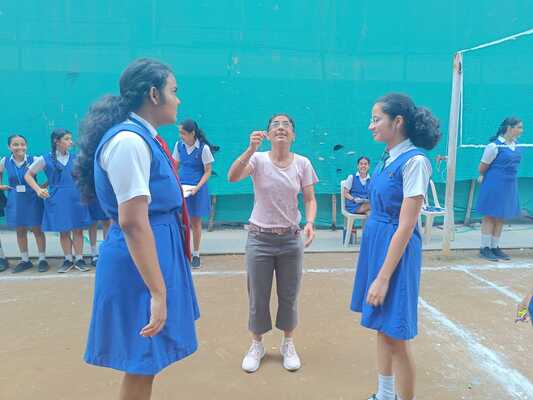
For many years, in fact, all the way until we finished school, my mother sewed our uniforms on that trusted sewing machine. There is something quietly extraordinary about that, though I did not think so at the time. Our uniforms were simple: the kind you would not look at twice, but to us, they were the best.
From kindergarten to class ten, everyone wore the same uniform. The only difference lay in the collar. The younger children had rounded collars, soft and almost decorative, while the older students graduated to proper shirt collars. It was a small shift, but it carried meaning. You could tell where someone stood just by that detail.
Our uniforms were not bought off racks or altered by tailors we barely knew. They were measured, cut, and assembled at home. Every pleat, every hem, every slightly uneven stitch carried the imprint of her hands.
Beyond uniforms, her stitching entered our school life in other ways, too.
My school placed a surprising emphasis on extracurricular activities, and stitching was one of them. It never felt unusual to us then, though I suspect it might now. There were projects to be completed, small assignments that required patience more than talent, and this was where my mother stepped in again.
She would sit with us, guiding without taking over. Showing us how to hold the fabric, how to keep the line straight, how not to rush through something that required care. There was no formal teaching in the way she did it. Just a quiet correction, repetition, and the expectation that we would learn by doing.
Because of that, both my sister and I picked up the basics almost without realising it.
Even now, that knowledge stays.
I can do simple mending. Fix a loose hem. Stitch something back into place before it becomes unusable. Small things, easily overlooked, but quietly useful. The kind of skills that do not announce themselves but make life just a little more manageable.
And somewhere along the way, I began to feel that this is something everyone should know. Not as a hobby, not as nostalgia, but as a basic life skill. The ability to repair, to make, and to extend the life of something with your own hands. It is a small form of independence and a quiet act of care.

Beyond this, she experimented. Skirts, tops, dresses, and nightwear. Sometimes following patterns, sometimes improvising. Occasionally, something would not turn out quite right, but that never seemed to matter. The act of making itself had its own dignity.
Looking back now, I realise that what she created was not just clothing. She created a kind of quiet abundance. Not the abundance of excess, but of self-sufficiency. Of knowing that what you needed could, with patience and effort, be made.
Of course, like most things, this too changed.
There came a point when we wanted more “stylish” clothes. Trends began to matter. What others were wearing began to matter. And slowly, without any formal decision, the home-stitched wardrobe receded. Shops replaced patterns. Ready-made replaced hand-cut.
But the skill did not disappear.
My mother continued to sew her saree blouses, each one fitted not just to her body but to her comfort. She continued with small stitching projects. Repairs, adjustments, quiet fixes that extended the life of things. The sewing machine did not fall silent. It simply spoke less often.
What stays with me, more than the clothes themselves, is the shape of that period. A woman who did not choose the obvious path but still chose to learn. A skill that entered the home and stayed. A rhythm of making that sat alongside the rhythms of everyday life. And a childhood that, without realising it, was surrounded by acts of creation.

It is easy, in hindsight, to romanticise such things. To turn them into symbols of simplicity or “old ways.” But that would miss something important. This was not nostalgia. This was work. Repetition. Discipline. A willingness to sit with something long enough to become good at it.
And yet, there was also something else. A quiet kind of pride. Not announced, not displayed, but present. In a well-fitted uniform. In a neatly finished hem. In the simple fact that something had been made, and made well.
Even now, when I see a sewing machine, I do not just see a tool. I hear that steady rhythm. I see that small balcony corner. I see my mother, bent slightly forward, focused, patient, building something one line at a time. And I realise that long before I began writing, before I understood the satisfaction of shaping words into something whole, I had already witnessed what it means to make.

