In My Hands Today…

Truck de India!: A Hitchhiker’s Guide to Hindustan – Rajat Ubhaykar

“The share auto I squeeze into next seems unusually vulnerable after a night in the truck – too compact, too low down. Perhaps, these are the usual side effects of prolonged riding with the king of the road, I think to myself. But it is only when I fill in ‘truck’ as my mode of transportation in the hotel ledger at Udaipur does the utter ludicrousness of my endeavour truly hit home”

Think truck drivers, and movie scenes of them drunkenly crushing inconvenient people to their gravelly deaths come to mind. But what are their lives on the road actually like?

In Truck De India!, journalist Rajat Ubhaykar embarks on a 10,000 km-long, 100% unplanned trip, hitchhiking with truckers all across India. On the way, he makes unexpected friendships; listens to highway ghost stories; discovers the near-fatal consequences of overloading trucks; documents the fascinating tradition of truck art in Punjab; travels alongside nomadic shepherds in Kashmir; encounters endemic corruption repeatedly; survives NH39, the insurgent-ridden highway through Nagaland and Manipur; and is unfailingly greeted by the unconditional kindness of perfect strangers.

Imbued with humour, empathy, and a keen sense of history, Truck De India! is a travelogue like no other you’ve read. It is the story of India, and Indians, on the road.

A VUCA World and how it impacts us

The past few years have shown us in no uncertain words how volatile our world is. Every week brings new changes and most of us are unable to make any plans because we don’t know what next week will bring us.

This is encapsulated very well in the acronym VUCA which stands for Volatile, Uncertain, Complex and Ambiguous which stands for what our world is today. First used in 1987, the acronym draws on the leadership theories of Warren Bennis and Burt Nanus, to describe or to reflect on the volatility, uncertainty, complexity and ambiguity of general conditions and situations. The U.S. Army War College introduced the concept of VUCA to describe the more volatile, uncertain, complex and ambiguous multilateral world perceived as resulting from the end of the Cold War and more frequent use and discussion of the term VUCA began from 2002. It has subsequently taken root in emerging ideas in strategic leadership that apply in a wide range of organizations, from for-profit corporations to education.

The deeper meaning of each element of VUCA serves to enhance the strategic significance of the VUCA foresight and insight as well as the behaviour of groups and individuals in organisations. It discusses systemic failures and behavioural failures, which are characteristic of organisational failure.

V stands for Volatility which is the nature and dynamics of change, and the nature and speed of change forces and change catalysts. It refers to the speed of change in an industry, market or the world in general. It is associated with fluctuations in demand, turbulence and short time to markets and it is well-documented in the literature on industry dynamism. The more volatile the world is, the more and faster things change.

U is Uncertainty or the lack of predictability, the prospects for surprise, and the sense of awareness and understanding of issues and events. Uncertainty refers to the extent to which we can confidently predict the future. Part of the uncertainty is perceived and associated with people’s inability to understand what is going on. Uncertainty, though, is also a more objective characteristic of an environment. Truly uncertain environments are those that don’t allow any prediction, also not on a statistical basis. The more uncertain the world is, the harder it is to predict.

C means Complexity which is the multiplex of forces, the confounding of issues, no cause-and-effect chain and confusion that surrounds organisations. It refers to the number of factors that we need to take into account, their variety and the relationships between them. The more factors, the greater their variety and the more they are interconnected, the more complex an environment is. Under high complexity, it is impossible to fully analyse the environment and come to rational conclusions. The more complex the world is, the harder it is to analyse.

And lastly, A stands for Ambiguity which encompasses the haziness of reality, the potential for misreads, and the mixed meanings of conditions and the cause-and-effect confusion. These elements present the context in which organizations view their current and future state, present boundaries for planning and policy management and come together in ways that either confound decisions or sharpen the capacity to look, plan and move ahead. It points to a lack of clarity about how to interpret something. A situation is ambiguous, for example, when information is incomplete, contradicting or too inaccurate to draw clear conclusions. More generally it refers to fuzziness and vagueness in ideas and terminology. The more ambiguous the world is, the harder it is to interpret.

The particular meaning and relevance of VUCA often relate to how people view the conditions under which they make decisions, plan forward, manage risks, foster change and solve problems. In general, the premises of VUCA tend to shape an organisation’s capacity to anticipate the issues that shape, understand the consequences of issues and actions, appreciate the interdependence of variables, prepare for alternative realities and challenges and interpret and address relevant opportunities. For most organisations, VUCA is a practical code for awareness and readiness.

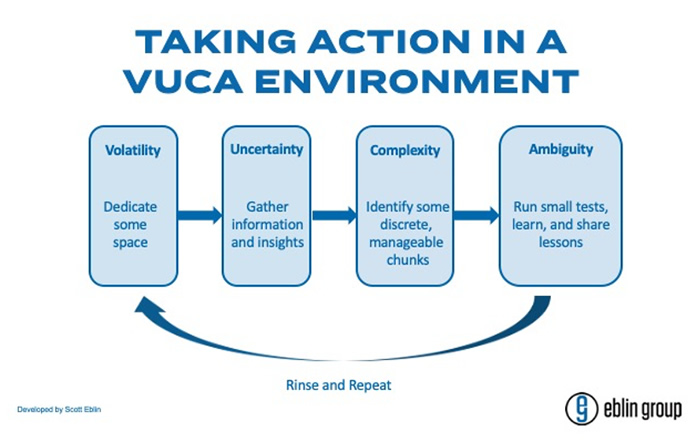
So how can we try and navigate a VUCA World? Though it may seem inescapable in certain situations and industries, one can use it to advantage. The key to managing is to break VUCA down into its parts and to identify volatile, uncertain, complex, or ambiguous situations. Each type of situation has its causes and resolutions, so one should aim to deal with one at a time.

  • Counter volatility with vision. Accept and embrace change as a constant and don’t resist it.
  • Create a strong, compelling statement of objectives and values, and develop a clear, shared vision of the future. Have flexible goals which can be amended quickly.
  • Meet uncertainty with understanding which can help understand and develop new ways of thinking and acting in response to VUCA’s elements.
  • Make investing in, analysing and interpreting business and competitive intelligence a priority, so that one doesn’t fall behind. Stay up to date with industry news, and listen carefully to find out what others want.
  • Review and evaluate performance. Consider what one did well, what came as a surprise, and what one could do differently next time.
  • Simulate and experiment with situations, so that one can explore how they might play out, and how one might react to them in the future. Aim to anticipate possible future threats and devise likely responses. Gaming, scenario planning, crisis planning and role-playing are useful tools for generating foresight and preparing responses.
  • Communicate clearly because in complex situations, clearly expressed communication help to understand direction.
  • Develop and promote collaboration. VUCA situations are often too complicated for one person to handle, so strong teams that can work effectively in a fast-paced, unpredictable environment is essential.
  • Fight ambiguity with agility by promoting flexibility, adaptability and agility. Plan, but build in contingency time and be prepared to alter plans as events unfold.
  • Hire, develop and promote people who thrive in VUCA environments as these people are likely to be collaborative, comfortable with ambiguity and change, and have complex thinking skills.
  • Encourage people to think and work outside of their usual functional areas, to increase their knowledge and experience. Job rotation and cross-training can be excellent ways to improve agility.
  • Lead teams, but don’t dictate to or control them, instead develop collaborative environments and work hard to build a consensus. Encourage debate, dissent and participation from everyone.
  • Embrace an ideas culture. Reward team members who demonstrate vision, understanding, clarity, and agility.

When one is affected by VUCA, one has a choice. Either one allows VUCA to manage, overload and overwhelm them, or they accept and manage it so that they can mitigate its effects. When one decides to accept VUCA, they choose to make themselves and others less vulnerable and empower everyone to deal with uncontrollable, unpredictable forces.

In My Hands Today…

Marley and Me: Life and Love With the World’s Worst Dog – John Grogan

John and Jenny were just beginning their life together. They were young and in love, with a perfect little house and not a care in the world. Then they brought home Marley, a wiggly yellow furball of a puppy. Life would never be the same.

Marley quickly grew into a barreling, ninety-seven-pound streamroller of a Labrador retriever, a dog like no other. He crashed through screen doors, gouged through drywall, flung drool on guests, stole women’s undergarments, and ate nearly everything he could get his mouth around, including couches and fine jewelry. Obedience school did no good—Marley was expelled. Neither did the tranquilizers the veterinarian prescribed for him with the admonishment, “Don’t hesitate to use these.”

And yet Marley’s heart was pure. Just as he joyfully refused any limits on his behavior, his love and loyalty were boundless, too. Marley shared the couple’s joy at their first pregnancy, and their heartbreak over the miscarriage. He was there when babies finally arrived and when the screams of a seventeen-year-old stabbing victim pierced the night. Marley shut down a public beach and managed to land a role in a feature-length movie, always winning hearts as he made a mess of things. Through it all, he remained steadfast, a model of devotion, even when his family was at its wit’s end. Unconditional love, they would learn, comes in many forms.

Festivals of India: Vasant Panchami

Spring is in the air and over the weekend, the festival of Vasant Panchami, which marks the arrival of spring was celebrated last Saturday. Also known as Saraswati Puja in honour of the Goddess of learning, Goddess Saraswati, the festival is celebrated across the Indian subcontinent in various ways depending on the region. Vasant Panchami also marks the start of preparation for Holika and Holi, which take place forty days later. The Vasant Utsava or festival on Panchami is celebrated forty days before spring, because any season’s transition period is 40 days, and after that, the season comes into full bloom.

Vasant Panchami is celebrated every year on the fifth day of the bright half of the Hindu lunisolar calendar month of Magha, which typically falls in late January or early February. It is generally winter-like in northern India, and more spring-like in central and western parts of India on Vasant Panchami, which gives credence to the idea that spring is actually in full bloom 40 days after the Vasant Panchami day.

Not just observed by the Hindus, Vasant Panchami has been a historical tradition of the Sikhs as well and is known as Sri Panchami in the southern states. On the island of Bali and among the Hindus of Indonesia, it is known as Hari Raya Saraswati and marks the beginning of the 210-day long Balinese Pawukon calendar.

Vasant Panchami is dedicated to the Goddess Saraswati who is the Goddess of knowledge, language, music and all arts. She symbolizes creative energy and power in all its forms, including longing and love. The season and festival also celebrate the agricultural fields’ ripening with yellow flowers of mustard crop, which Hindus associate with Goddess Saraswati’s favourite colour with people dresssing in yellow saris or shirts and accessories, sharing yellow-coloured snacks and sweets. Some add saffron to their rice and then eat yellow cooked rice as a part of an elaborate feast.

The main reason for yellow being the dominant colour during Vasant Basant Panchami is because at this time, bright yellow flowers of ripe mustard plants can be spotted in the fields of rural North India as well as many seasonal flowers are yellow, including marigold and daffodils which are offered to the Goddess. Though Goddess Saraswati is seen wearing a white saree with white flowers and pearls, it is said that yellow is her favourite colour which is why the Goddess is decorated with yellow flowers and sarees of the same colour, though people also sometimes use white symbolising purity and wisdom. Another reason behind using yellow is said that on this festival the sun starts moving northwards or on its Uttarayan path and the yellow colour symbolises and teaches everyone to become serious and sharp like the sun.

Many families mark this day by sitting with babies and young children, encouraging their children to write their first words with their fingers, and some study or create music together. On the day before Vasant Panchami, Goddess Saraswati’s temples are filled with food so that she can join the celebrants in the traditional feasting the next morning. In temples and educational institutions, statues of the goddess are dressed in yellow and worshipped with many educational institutions arranging for special prayers in the morning to seek the blessing of the Goddess. Poetic and musical gatherings are held in some communities in reverence for Goddess Saraswati.

In Nepal, Bihar and the eastern states of India such as West Bengal including the north-eastern states like Tripura and Assam, people visit temples dedicated to the Goddess and worship her by performing the Saraswati Puja with most schools arranging special Saraswati pujas for their students on their premises. In Bangladesh, all major educational institutes and universities observe it with a holiday and a special puja. In Odisha, the festival is celebrated as Basanta Panchami, Sri Panchami or Saraswati Puja with prayers performed in schools and colleges across the state. Children aged four and five years old start learning on this day in a unique ceremony named Khadi-Chuan or Vidya-Arambha. In southern states such as Andhra Pradesh, the same day is called Sri Panchami where Sri refers to her as another aspect of the one Goddess Devi. In Tamil Nadu, Goddess Saraswati is celebrated on the penultimate day of the ten-day Dusshera festival. On this day, books belonging to all members of the family are kept in front of a photograph or statue of the Goddess and prayed. The next day, every one of the books are opened and a few lines from each read. Children starting school also have a Vidya Arambam ceremony where parents help them trace a word on rice. GG & BB also had this ceremony when they were about two, just before they started pre-school.

The festival is associated with the emotions of love and emotional anticipation in Kutch in Gujarat and is celebrated by preparing a bouquet and garlands of flowers set with mango leaves, as a gift. People dress in saffron, pink or yellow and visit each other with songs about Lord Krishna’s pranks with Goddess Radha, considered to mirror Kama-Rati sung which also symbolises Lord Kamadeva and his wife Rati. In Maharashtra, Madhya Pradesh, Chhattisgarh and Uttar Pradesh, after bathing in the morning, people worship Shiva and Parvati and make offerings of mango flowers and the ears of wheat. In the Punjab region, Basant is celebrated as a seasonal festival by all faiths and is known as the Basant Festival of Kites. Children buy dor or thread and guddi or patang or kites for the sport. The people of Punjab wear yellow clothes and eat yellow rice to emulate the yellow mustard or sarson flower fields, or play by flying kites.

Namdhari Sikhs have historically celebrated Basant Panchami to mark the beginning of spring and other Sikhs treat it as a spring festival, joyfully celebrating it by wearing yellow-coloured clothes, emulating the bright yellow mustard flowers in the fields. Maharaja Ranjit Singh, the founder of the Sikh Empire, encouraged the celebration of Basant Panchami as a social event in the Gurdwaras. In 1825 he gave 2,000 rupees to the Harmandir Sahib Gurdwara in Amritsar to distribute food and held an annual Basant fair and sponsored kite flying as a regular feature of the fairs. Maharaja Ranjit Singh and his queen Moran would dress in yellow and fly kites on Basant Panchami and also hold a darbar or court in Lahore on this day which lasted ten days when soldiers would dress in yellow and show their military prowess. In the Malwa region, the festival of Basant Panchami is celebrated with wearing of yellow dress and kite flying. In Kapurthala and Hoshiarpur, a Basant Panchami fair is held where people attend wearing yellow clothes, turbans or accessories. Sikhs also remember the martyrdom of the child Haqiqat Rai on Basant Panchmi, who was arrested by the Muslim ruler Khan Zakariya Khan after being falsely accused of insulting Islam. Rai was given the choice of converting to Islam or death and, having refused conversion, was executed on the Basant Panchami of 1741 in Lahore, Pakistan. Nihangs go to Patiala on Basant Panchami and dress in Pink and Yellow on the month of Vaisakh and not only on the day of Basant Panchami.

In Bali and among Indonesian Hindus, Hari Raya Saraswati which is the festival’s local name, is celebrated with prayers in family compounds, educational institutions, and public venues from morning to noon. Teachers and students wear brightly coloured clothes instead of their usual uniforms, and children bring traditional cakes and fruit to school for offerings in a temple.

In Pakistan, kite flying in Lahore goes back centuries and evolved into a highly competitive sport after partition and the creation of Pakistan, not limited to spring only. Given the shared history and culture in the Indian subcontinent, the Punjabi Muslims in and around Lahore also celebrate kite flying as a sport in Pakistan from home rooftops during the Basant season.

Another legend behind Vasant Panchami is based on the Hindu god of love called Kama. Pradyumna is Kamadev personified in Krishna’s Book. Thus Vasant Panchami is also known as Madana Panchami with Pradyumna the son of Rukmini and Lord Krishna who awakens the passions of the earth and its people and so the world blooms anew. It is remembered as the day when the Rishis or sages approached Lord Kama to wake up Lord Shiva from his yogic meditation. They support Goddess Parvati who is doing penance to get Lord Shiva as a husband and seek Kama’s help to bring Lord Shiva back from his meditation to worldly desires. Lord Kama agrees and shoots arrows, made of flowers and bees, at Shiva from his heavenly bow of sugarcane to arouse him to pay attention to Goddess Parvati. Lord Shiva awakens from his meditation, but when his third eye opens, a fireball is directed to Lord Kama who is burnt to ashes. Vasant Panchami is hence remembered not only as the day Kamadeva was asked to stir Lord Shiva’s desire for Goddess Parvati but also as the time of year Kamadeva stimulates the passions of both the earth and its people, as the lands come alive with new blossoms.

In My Hands Today…

Indistractable: How to Control Your Attention and Choose Your Life – Nir Eyal and Julie Li

You sit down at your desk to work on an important project, but a notification on your phone interrupts your morning. Later, as you’re about to get back to work, a colleague taps you on the shoulder to chat. At home, screens get in the way of quality time with your family. Another day goes by, and once again, your most important personal and professional goals are put on hold.

What would be possible if you followed through on your best intentions? What could you accomplish if you could stay focused and overcome distractions? What if you had the power to become “indistractable”?

International best-selling author, former Stanford lecturer, and behavioral design expert, Nir Eyal, wrote Silicon Valley’s handbook for making technology habit-forming. Five years after publishing Hooked, Eyal reveals distraction’s Achilles’ heel in his groundbreaking new book.

In Indistractable, Eyal reveals the hidden psychology driving us to distraction. He describes why solving the problem is not as simple as swearing off our devices: Abstinence is impractical and often makes us want more.

Eyal lays bare the secret of finally doing what you say you will do with a four-step, research-backed model. Indistractable reveals the key to getting the best out of technology, without letting it get the best of us.

Inside, Eyal overturns conventional wisdom and reveals:

Why distraction at work is a symptom of a dysfunctional company culture – and how to fix it
What really drives human behavior and why “time management is pain management”
Why your relationships (and your sex life) depend on you becoming indistractable
How to raise indistractable children in an increasingly distracting world
Empowering and optimistic, Indistractable provides practical, novel techniques to control your time and attention – helping you live the life you really want.