Bhadrakali Devi Mandir, Nashik, Maharashtra
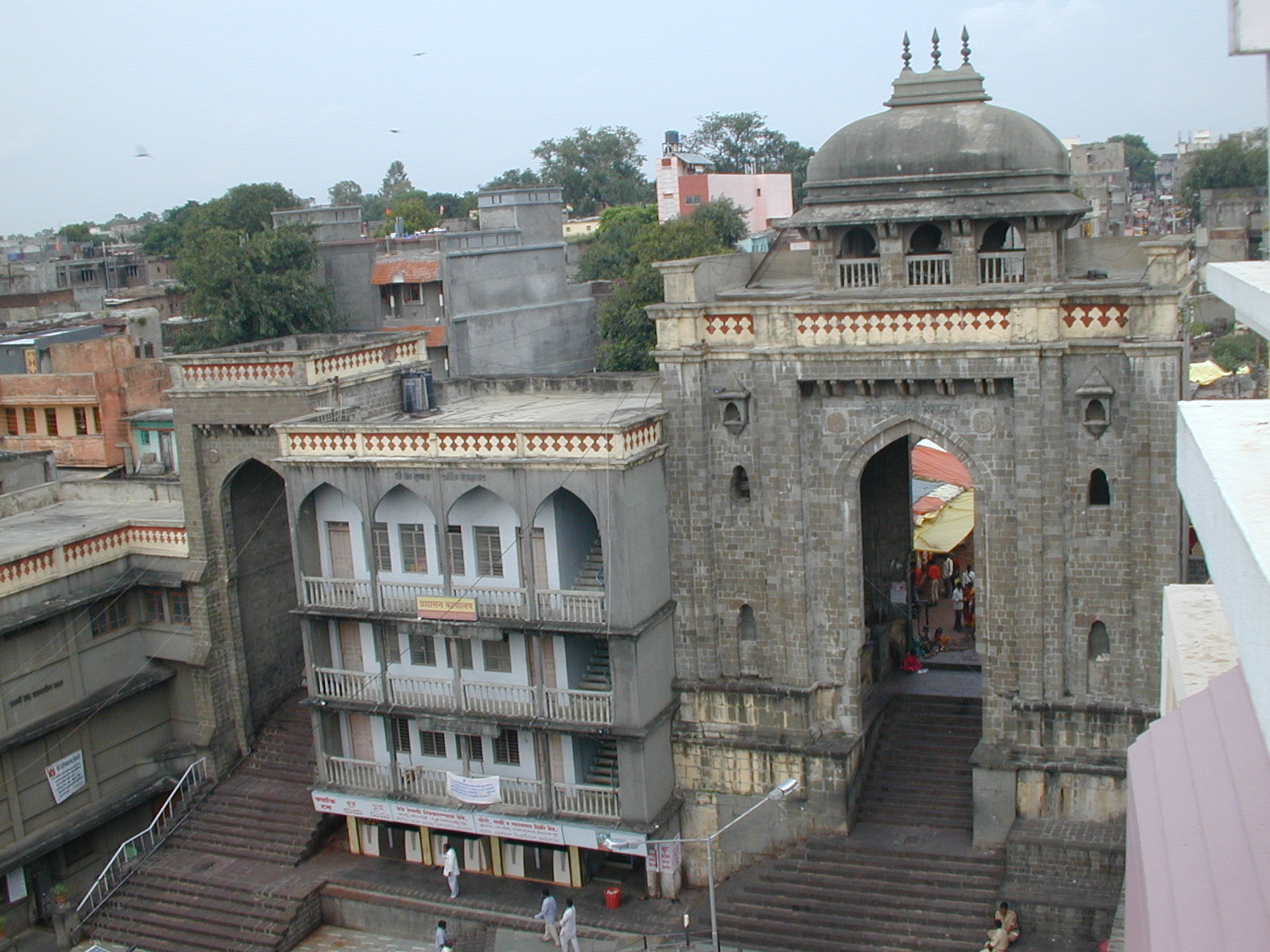
Dedicated to Goddess Bhadrakali, the temple in the ancient city of Nashik has its history intertwined with the city. According to historical records, the present structure of the temple was completed in 1790. The construction was undertaken by Mr. Patvardhan and Mr. Dixit, who built the temple in response to a request from local villagers. This request came during the Islamic regime when many deity statues were being desecrated. The villagers sought a place to worship the remnants of these statues, leading to the establishment of the current temple. The city of Nashik used to be also known as Nasikha or Chibak in ancient times is believed to have been a city spread across nine hills, with a history dating back to the 11th century.
According to tradition, it is believed that the chin or chibak of Goddess Sati fell at this sacred spot. The name Bhadrakali is significant, meaning the one who does good or the auspicious one. In Sanskrit, Bhadra means welfare or auspiciousness, and Kali refers to the goddess who is the embodiment of time and change. The bhairava associated with the temple isVikritaksheshwar.
The temple is a spacious two-story building, reflecting the architectural styles of the late 18th century. The temple houses remnants of ancient deity statues that were rescued during times of religious persecution. Despite its location in the bustling old part of Nashik, the temple maintains a captivating blend of spirituality and ancient architecture.
Sacred texts are read daily from 8 to 9:30 am, organised by the temple trust, Nyasa. Women gather daily in the afternoon to sing devotional songs. Every evening, there is a recitation of the Devi Purana, followed by storytelling and kirtana. Puja is performed in the morning, with aarti conducted both in the morning and evening. The nine-day festival of Navratri is celebrated with great fervour. Daily mantras are recited by learned Brahmins, and women perform havan on Ashtami. the eighth day. The temple celebrates the Ganesh festival and organises a yagna or fire ritual. A seven-day Guru Charitra Parayana is conducted on Datta Jayanti.
The name Nashik is believed to be derived from the Sanskrit word Nasikha, which later evolved into Nasik. The city’s history is closely tied to the legend of Lord Rama’s exile, as mentioned in the epic Ramayana. The goddess Bhadrakali is revered for her protective and nurturing qualities. She is often depicted as a fierce form of the goddess Kali, known for her strength and ability to vanquish evil. During times of religious persecution, when many deity statues were being desecrated, the local villagers managed to rescue some of these sacred images. These rescued statues became the focal point of worship in the new temple, symbolizing the resilience of faith in the face of adversity.
The Bhadrakali Devi Mandir’s significance extends beyond its religious importance. The trust managing the temple, Nyasa, organises various educational and cultural activities, including felicitating high-achieving students of Sanskrit and providing scholarships.
Tuljabhavani Temple, Tuljapur, Maharashtra
Constructed probably sometime in the 12th century, the Tulja Bhavani Temple in the town Tuljapur in Maharastra’s Osmanabad district is dedicated to Goddess Tulja Bhavani. The temple’s history is closely intertwined with the legends of the Maratha Empire. One well-known tale states that Goddess Bhavani presented Shivaji Maharaj with a sword, which he used as a protective talisman for his kingdom and subjects. The Bhonsle dynasty, including Chhatrapati Shivaji Maharaj, were frequent visitors to this temple.
The Shakti worshipped in the temple is Tuljabhavani Devi while the bhairava is Bhairava. Bhavani is a form of the goddess Durga who is worshipped in Maharashtra, Gujarat, Rajasthan, Telangana, Northern Karnataka, and Nepal, Andhra Pradesh. Bhavani translates to giver of life, meaning the power of nature or the source of creative energy. She is considered to be a mother who provides to her devotees and also plays the role of dispensing justice by killing Asuras. The Goddess is said to be swayambhu or self emanated and is the kuldevi or clan goddess for many Maratha clans of Maharashtra.
The deity is worshipped in the form of a three-foot-tall granite statue. She has eight arms, each holding a weapon, and the head of the demon Mahishasura. The temple has two main entrances, Raje Shahaji Mahadwar and Rajamata Jijau Mahadwar. The temple’s architecture reflects a blend of various styles, including Hemadpanti from the Yadava dynasty, Maratha, and Deccan influences. Unlike most temples, the installation of the goddess idol is dynamic. The idol is taken out from the Sriyantra thrice a year for Pradakshina. The goddess idol is believed to be a Swayambhu murti or a self-manifested idol made of Shaligram, a non-perishable stone.
Priests offer a daily ritual bath, change of clothes, and food to the deity four times a day. The day begins with the loud playing of a large drum at 5 am to call devotees for prayers. At 5:30 am, the Mahant performs the morning prayer. The current Mahant is Tukoji Bua. The Charantirtha Puja is performed in the presence of the Karvir Princely state. In the evening, the deity is ceremoniously put to rest.
During Navaratri, the entire temple premise is washed, cleaned, and decorated with a special Toran made of mango leaves and coconut puddles. Strict rituals are performed, including the worshipping of Kumarikas or virgins and younger girls, Saptashadi Path, Bhavani Shankar Abhishek, and Navagruha Japa. Celebrated twice a year, the Tulja Bhavani festival is a four-day festival that includes rituals like Sasthi and Bhavani Ashtami. On Bhavani Ashtami, devotees fast until they offer flowers to the deity. Gudi Padwa, which falls in the month of Chaitra, or in April, is of special significance at the temple. Other festivals celebrated in the temple include Shriral Sashti, Lalita Panchami, Makar Sankranti, Ratha Saptami, and Dussehra. The image of Shri Tulja Bhawani Mata is taken every Tuesday with Shukla Paksha Chaturdashi, Shukla Paksha Poornima, and Krishna Paksha Pratipada.
According to Sri Skanda Purana, there was a sage named Kardam and his consort Anubhuti. After Kardam’s death, Anubhuti performed penance for Goddess Bhavani on the banks of the Mandakini River to care for her infant. A demon named Kukur tortured her, but Goddess Bhavani killed the demon and rescued Anubhuti. At Anubhuti’s request, the goddess settled on the hill of Bala Ghat, becoming known as Bhavani of Tuljapur or Tulja Bhavani. Tulja Bhavani Goddess is believed to appear in the Trigunatmak position, embodying the three gunas: Tamo, represented by Maha Kali in Kolkata, Rajo, represented by Maha Lakshmi in Kolhapur, and Sattva, represented by Maha Saraswati in Mahur.
In Treta Yuga, it is said that Shri Bhagwati appeared to Lord Rama during his exile period, blessing him that his wife Sita would be found soon after his penance. Another legend says that Goddess Durga came to Yamunachala Hills to rest after killing the demon Mahishasur in Chamundi Hills.
With its blend of myth, history, and living faith, the Tuljapur Bhavani Temple occupies a special place in the hearts of the people of Maharashtra, especially those for whom she is the kuldevi.
Mahalakshmi Temple, Kolhapur, Maharashtra
Also known as the Ambabai Temple, the Mahalakshmi Temple in Kolhapur is dedicated to Goddess Mahalakshmi, the consort of Lord Vishnu. It is a unique confluence of Shaivite and Vaishnavite traditions and is also recognised as one of the 51 Shakti Peethas.
The Mahalakshmi Temple dates back to the 7th century, during the reign of the Chalukya dynasty. It was constructed by King Karnadeva of the Chalukyan Empire around 634. The temple’s architectural style reflects the grandeur of Chalukyan craftsmanship, with intricate carvings and black stone construction. The temple gained prominence during the rule of the Shilahara dynasty who ruled between the 10th and 12th centuries, who made Kolhapur their capital and adopted Goddess Mahalakshmi as their patron deity. King Gandaraditya of this dynasty expanded and embellished the temple in the 11th century. Over time, rulers from other dynasties like the Yadavas of Devagiri and Marathas contributed to its development.
During Muslim invasions in medieval India, the idol of Mahalakshmi was hidden to protect it from destruction. It was reinstalled in 1715 by Chhatrapati Sambhaji Maharaj, who also donated a large bell captured during his Goa campaign. The bell still bears a Portuguese inscription: Ave Maria Gratia Dominus Tecum IHS or Hail Mary full of grace! The Lord is with thee. The temple underwent further renovations under Queen Tarabai and later rulers of Kolhapur, making it a vibrant centre for worship and cultural activities.
According to tradition, it is believed that Sati’s left eye fell at this location. At this Shakti Peetha, Goddess Mahalakshmi is worshipped as Karveer Nivasini Ambabai, meaning the goddess who resides in Karveer, the ancient name for Kolhapur. The temple is unique because it represents both Shakti, the feminine energy, and Vishnu’s consort Lakshmi, associated with wealth and prosperity, blending Shaivite and Vaishnavite traditions seamlessly. At the Mahalakshmi Temple, Lord Shiva is worshipped as Kshetrapal Bhairava, meaning the guardian deity of this sacred land. His shrine is located within the temple complex and is an integral part of rituals performed here. Interestingly, there is also a hidden shrine dedicated to Lord Shiva within the dome of the temple. This shrine was believed to have been installed to balance the immense energy emitted by Goddess Mahalakshmi’s sanctum. However, it is no longer accessible to devotees.
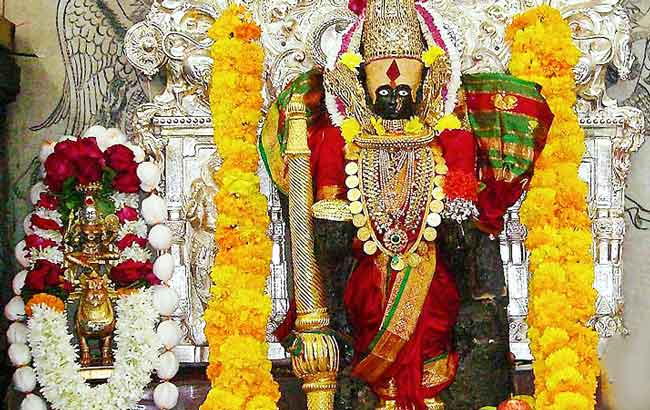
The temple follows Chalukyan architectural principles with intricate carvings on its walls and pillars. The main sanctum houses a two-foot-tall black stone idol of Goddess Mahalakshmi adorned with gold jewellery. The goddess holds a mace, shield, panapatra or drinking bowl, and Matulinga fruit in her four hands. Behind her idol stands a lion, her mount, symbolising strength. A sacred geometric diagram called the Shri Yantra is carved on one wall inside the temple. This yantra represents cosmic energy and is considered highly auspicious.
Twice a year—on January 31st and November 9th—the first rays of the sun fall directly on the feet of Goddess Mahalakshmi’s idol at sunrise. Over subsequent days, they move upward toward her face. This astronomical alignment showcases ancient Indian expertise in architecture and astronomy and is celebrated as Kirnotsav or the festival of the sun’s rays. A large stone pillar called Garuda Sthambha stands outside the temple. It is believed that anyone who prays here with devotion will have their wishes fulfilled.
The temple complex includes shrines dedicated to Goddess Saraswati, Goddess Mahakali, Lord Vishnu as Sheshashayi Vishnu, Siddhivinayak Ganapati, Kalbhairav, Tulja Bhavani, Annapurna Devi, Radhakrishna, and others. The five domes atop the temple represent different deities: one for Goddess Mahalakshmi at the centre and others for Goddesses Saraswati, Mahakali, Lord Ganapati, and Lord Vishnu at cardinal directions. A large bell captured by Chhatrapati Sambhaji from Goa bears inscriptions in Portuguese and serves as a historical artifact within the temple complex.
The daily worship begins with Mangala Aarti at dawn. Multiple pujas are performed throughout the day using flowers, lamps, incense sticks, and offerings like coconuts and sweets.The evening aarti marks the conclusion of daily rituals. During the festival of Kirnotsav, in January and November each year, thousands gather to witness sunlight illuminating the goddess’s idol—a divine spectacle symbolising cosmic harmony. Navratri is celebrated with grandeur at this temple. Special decorations adorn the sanctum sanctorum while devotees perform Garba dances outside. On Dussehra or Vijayadashami day, special rituals are conducted to mark victory over evil forces. During Diwali festivities, devotees flock to seek blessings for wealth and prosperity from Goddess Mahalakshmi. Ritual bathing ceremonies are performed for both Goddess Mahalakshmi and Kshetrapal Bhairava using milk, honey, curd, ghee, sugarcane juice, and holy water.
One popular legend explains why Goddess Lakshmi resides in Kolhapur instead of Vaikuntha with Lord Vishnu. According to this tale, Sage Bhrigu once visited Vaikuntha but felt insulted by Vishnu’s indifference toward him. In anger, he kicked Vishnu on his chest—the place where Lakshmi resides. To appease Bhrigu’s anger, Vishnu apologized humbly by massaging his feet instead of retaliating against him. This act enraged Lakshmi as she felt disrespected by Vishnu’s subservience to Bhrigu. In anger, she left Vaikuntha and settled in Kolhapur as Karveer Nivasini Ambabai.
Another story recounts how Adi Shankaracharya visited Kolhapur during his travels across India to revive Sanatana Dharma or Hinduism. He installed a Shri Yantra inside the temple to channel divine energy effectively toward devotees seeking blessings from Mahalakshmi. Chhatrapati Sambhaji Maharaj brought back a giant bell from Goa after defeating Portuguese forces in 1683 CE during his military campaign there. This bell was offered to Goddess Mahalakshmi as a token of gratitude for her blessings during his victory.
The Mahalakshmi Temple in Kolhapur stands as an eternal symbol of devotion and architectural brilliance while embodying centuries-old traditions that continue to inspire millions worldwide who seek blessings from Karveer Nivasini Ambabai!
Nartiang Durga Temple, Nartiang, Meghalaya
Dedicated to Goddess Durga, the Nartiang Durga Temple is located in the West Jaintia Hills district. This ancient shrine has drawn pilgrims for over 600 years with its origins going back to the 15th century and closely tied to the Jaintia Kingdom. Historical records indicate that King Dhan Manik, who ruled around 600 years ago, made Nartiang the summer capital of the Jaintia Kingdom. The temple’s founding is steeped in legend, with stories telling of the goddess appearing to the king in a dream, revealing the significance of the location and instructing him to build a temple in her honour.
The temple’s construction marks a significant point in the region’s religious history. It is believed that the introduction of Hinduism to the Jaintia royalty came through the marriage of King Jaso Manik (1606–1641) to Lakshmi Narayana, daughter of the Hindu Koch king Nara Narayana. This union led to the embrace of Hindu practices alongside the existing tribal traditions, creating a unique blend of cultural and religious practices that continue to this day.
According to tradition, it is believed that the left thigh of Goddess Sati fell at this sacred spot. The Shakti Peetha here is known as Jayanti, and the temple is often referred to as the Jayanti Shaktipeeth or Jainteshwari Mandir. The name Jainteshwari itself is derived from the belief that the goddess’s left thigh fell in the Jaintia Hills. At the Nartiang Durga Temple, the Bhairava is known as Kamadishwar.
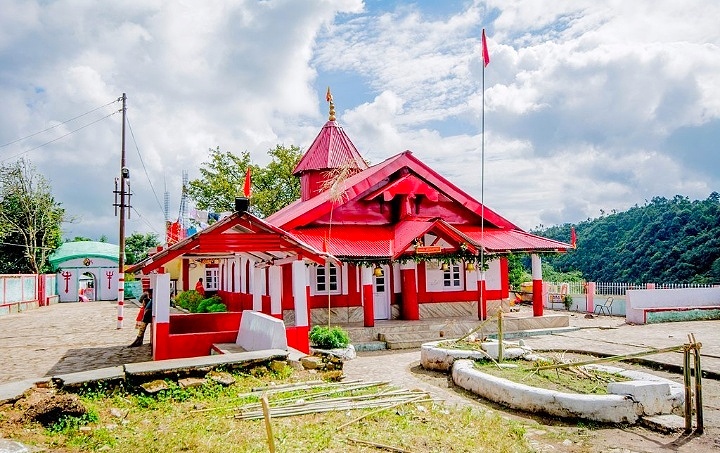
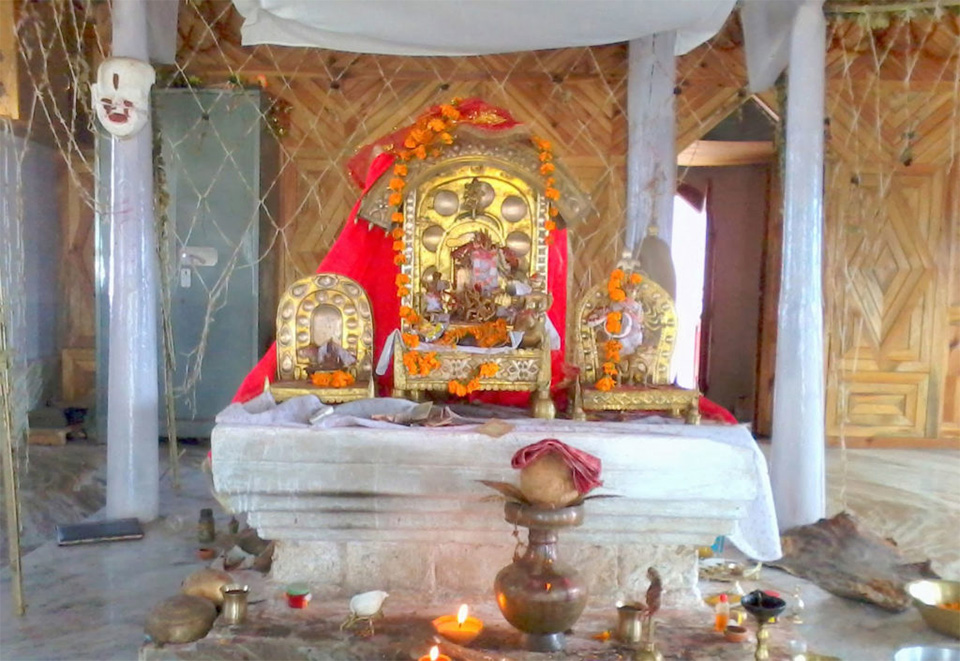
The temple’s structure reflects a fascinating blend of Hindu and Khasi architectural styles, symbolising the cultural fusion that characterises the region. The temple’s position and the presence of cannons nearby suggest that it was once part of a fort of the Jaintia Kings. Inside the temple, a single platform houses three idols: an old stone idol of the Devi, a metal idol of Durga with eight arms crushing Mahishasur, and another deity. The temple complex includes a nearby Shiva temple where one can see the remains of ancient cannons. Unlike many Hindu temples that use traditional idols, during Durga Puja, a banana plant is dressed up and worshipped as the Goddess, reflecting a unique local tradition. The local chieftain, known as the Syiem, is considered the chief patron of the temple.
Durga Puja is the most significant festival celebrated at the temple. The four-day festivities include unique rituals such as dressing up a banana plant as the Goddess and worshipping i, sacrificing goats, ducks, and hens in honour of the goddess, immersing the dressed banana plant in the Myntdu River at the end of the festival, and offering a gun salute to the Goddess, a practice that reflects the temple’s historical connection to the Jaintia royalty.
It is said that the goddess appeared to King Dhan Manik in a dream, revealing the significance of the Nartiang location and instructing him to build a temple in her honour. When King Jaso Manik needed a priest for the new Durga temple, no Brahmin was willing to take the job due to the practice of human sacrifice. As a result, the king brought a Maratha Kshatriya to serve as the priest, as Kshatriyas were allowed to perform both priestly duties and sacrificial rites. The introduction of Hinduism to the Jaintia Kingdom is attributed to Lakshmi Narayana, the Hindu wife of King Jaso Manik. Her devotion to Shakti is said to have influenced the royal family to embrace Hindu practices. In recent times, the temple has gained attention for contributing soil and water for the Bhoomi Puja at Ayodhya, highlighting its significance in the broader context of Hindu spirituality.
The Nartiang Durga Temple, with its blend of Hindu and Khasi traditions, with its unique practices sets it apart from other Shakti Peethas. These rituals reflect the seamless integration of local tribal customs with Hindu traditions, creating a distinctive form of worship that is both ancient and ever-evolving.








 Memories and Such