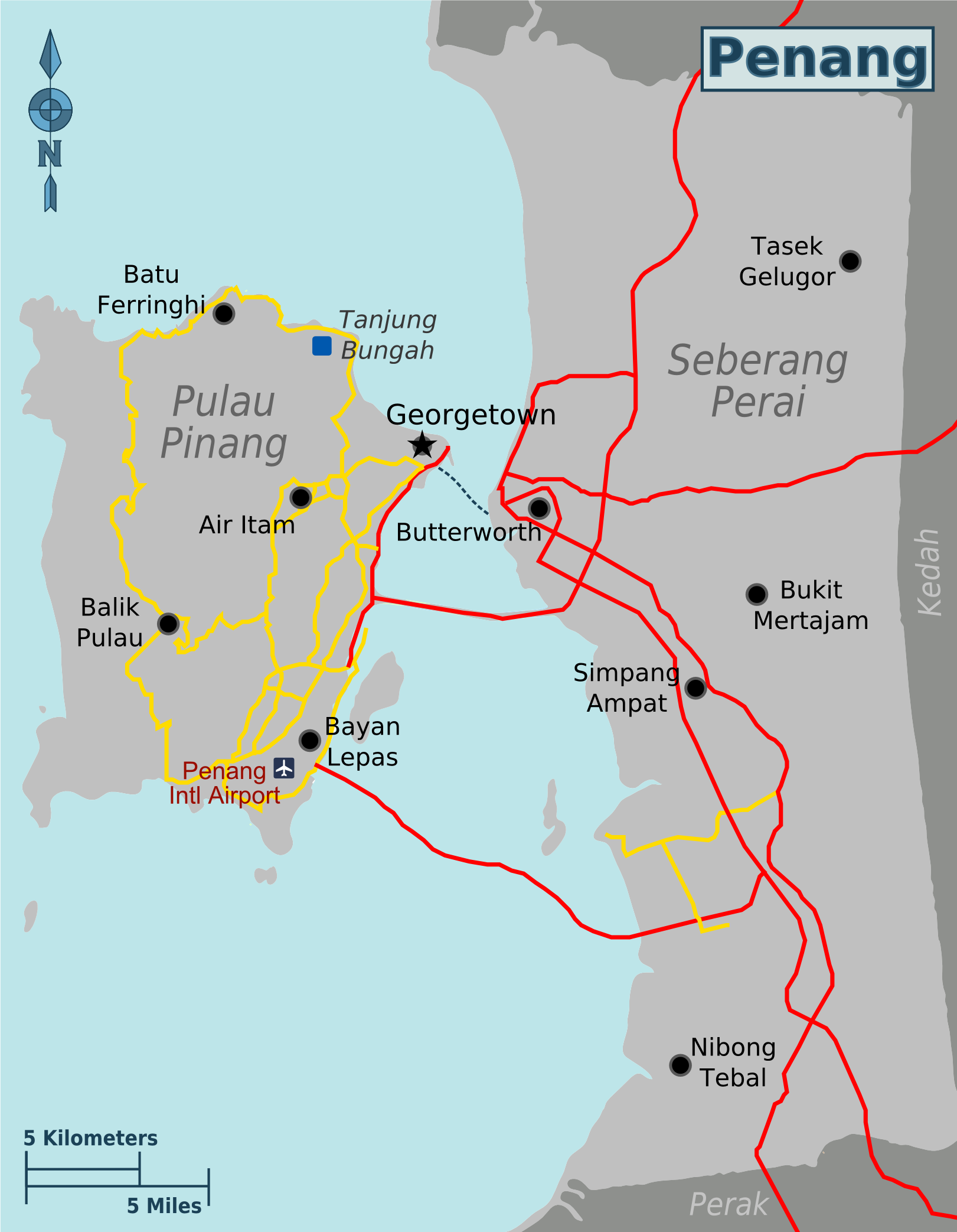
Located on the northwest coast of Peninsular Malaysia, by the Malacca Strait, the state of Penang is divided into two parts: Penang Island, where the capital city, George Town, is located, and Seberang Perai on the Malay Peninsula. These two halves are physically connected by the Penang Bridge and the Second Penang Bridge. The state shares borders with Kedah to the north and east, and Perak to the south. Penang is the second-smallest state in Malaysia by size after Perlis, located on the northwestern coastline of Peninsular Malaysia. The Seberang Peraihinterland across the Malacca Strait on the Malay Peninsula shares land borders with Kedah to the north and east and Perak to the south. Penang Island is surrounded by several islets, both natural and man-made. Some of these islets include Jerejak, Betong, Kendi, Rimau and the Andaman Islands. The capital city of George Town encompasses the entirety of Penang Island and a few surrounding islets. On the other hand, the city of Seberang Perai covers the whole mainland half of Penang.
Penang is one of Malaysia’s most densely populated and urbanised states, with Seberang Perai being Malaysia’s third-largest city by population. The state is culturally diverse, with a population that includes Chinese, Malays, Indians, Eurasians, Siamese and expatriates.
Penang’s economy shifted from entrepot trade to electronics manufacturing and the tertiary sector in the late 20th century. Today, it is one of the country’s most developed economic powerhouses, with the second-highest GDP per capita among Malaysian states and the third-highest Human Development Index after Kuala Lumpur and Selangor. Penang is also Malaysia’s leading exporter, with nearly RM 451 billion in exports in 2022, primarily through the Penang International Airport, the nation’s third busiest airport.
The name Penang comes from the modern Malay name Pulau Pinang, which means areca nut island. The State of Penang is also colloquially referred to as the Pearl of the Orient, the Island of Pearls or Pulau Mutiara.
Established by Francis Light in 1786, Penang became part of the Straits Settlements, a British crown colony also comprising Malacca and Singapore. During World War II, Japan occupied Penang, but the British regained control in 1945. Penang was later merged with the Federation of Malaya, which, upon independence, became Malaysia in 1957.
Over the course of history, Penang Island has been known by different names by seafarers from various regions. The locals named it Pulo Ka Satu, meaning The First Island, as it was the largest island on the maritime route between Lingga and Kedah. The Siamese, who were the overlords of Kedah, called it Ko Mak. Maritime explorers also took note of the island’s abundance of areca nut. During the 15th century, Admiral Zheng He of Ming China referred to the island as Bīngláng Yǔ or areca nut island in his navigational charts. In the description of Malacca, Portuguese cartographer Manuel Godinho de Erédia named it Pulo Pinaom.
Artifacts found in Seberang Perai indicate that Penang was inhabited by nomadic Melanesians around 5,000 to 6,000 years ago during the Neolithic era. The Cherok Tok Kun megalith, uncovered at Bukit Mertajam in 1845, features Pali inscriptions that suggest the Hindu-Buddhist Bujang Valley civilisation, which was based in present-day Kedah, had established its authority over certain parts of Seberang Perai by the 6th century. The entirety of Penang later formed part of Kedah, which came under Siamese suzerainty by the late 18th century.
Penang’s modern history began in 1786, when Francis Light, a representative of the British East India Company (EIC), obtained Penang Island from Sultan Abdullah Mukarram Shah of Kedah in exchange for military aid. Light had been sent to the Malay Peninsula by the EIC to build trade relations in the region, where he saw the strategic potential of Penang Island as a convenient magazine for trade that could enable the British to check Dutch and French territorial ambitions in Southeast Asia. After negotiating an agreement with the Sultan, Light and his entourage landed on Penang Island on 17 July that year and took formal possession of the island in the name of King George III of England on 11 August. The island was renamed Prince of Wales Island after the heir to the British throne and the new settlement of George Town was established in honour of King George III. Unbeknownst to Sultan Abdullah, Light had acted without the authority or the consent of his superiors in India. When Light reneged on his promise of military protection, the Sultan launched an attempt to recapture the Prince of Wales Island in 1791. However, the attempt was defeated by EIC forces and the Sultan sued for peace. An annual payment of 6000 Spanish dollars was agreed in exchange for British sovereignty over the island.
In 1800, Lieutenant-Governor George Leith secured a strip of hinterland across the Penang Strait, which was subsequently named Province Wellesley, and is known as Seberang Perai today. The new treaty for the acquisition of Province Wellesley superseded Light’s earlier agreement and gave the British permanent sovereignty over both Prince of Wales Island and the newly ceded mainland territory. The annual payment to the Sultan of Kedah was increased to 10,000 Spanish dollars. The British authorities and its successor, the Malaysian federal government, maintained the sum of annual payments to Kedah until 2018 when the federal government increased the amount by RM10 million yearly.
George Town grew rapidly as a free port and a centre of spice production, taking maritime trade from Dutch posts in the region. In 1805, Penang became a separate presidency of British India, sharing a similar status with Bombay and Madras. By 1808, a local government for George Town was in place, whilst the establishment of the Supreme Court of Penang marked the birth of Malaysia’s modern judiciary. In 1826, Penang, Singapore and Malacca were incorporated into the Straits Settlements, with George Town as the capital. However, Singapore soon supplanted George Town as Southeast Asia’s premier entrepôt. In 1832, Singapore replaced George Town as the capital of the Straits Settlements.
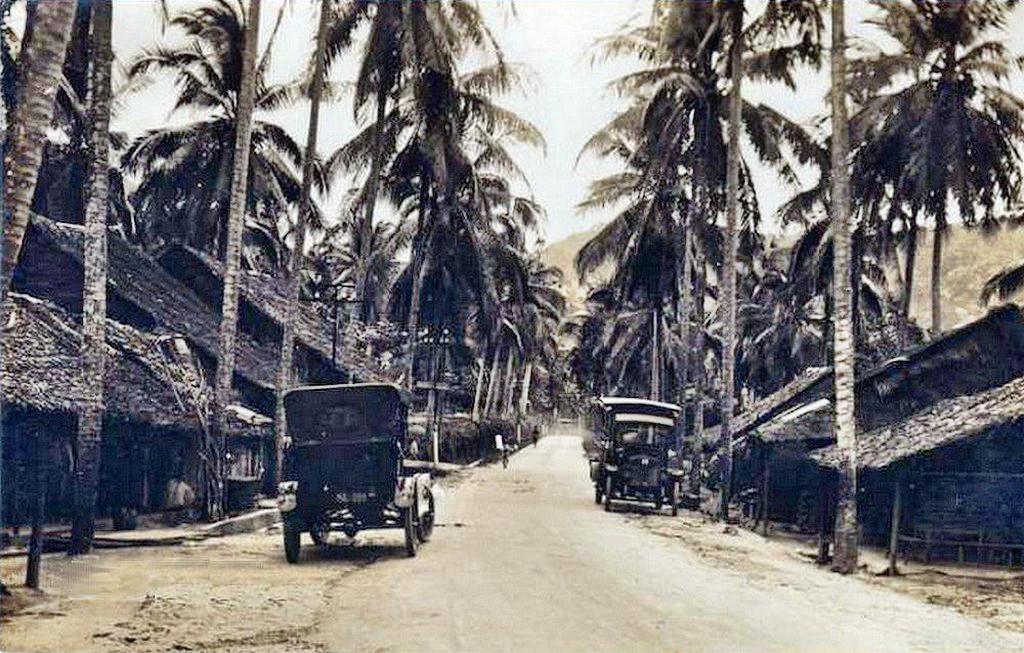
The Port of Penang still retained its importance as a vital British entrepôt. Towards the end of the 19th century, George Town became a major tin exporter and Malaya’s primary financial centre. Penang’s prosperity attracted a cosmopolitan population and led to the development of until then rural areas such as Butterworth and Bukit Mertajam. The population growth also created social problems, such as inadequate sanitation and health facilities, as well as rampant crime, with the latter culminating in the Penang Riots of 1867. In the same year, the Straits Settlements became a British crown colony, leading to improved law enforcement, and investments in health care and public transportation in Penang under direct British rule. Owing to enhanced access to education, active participation of residents in municipal affairs and substantial press freedom, George Town was perceived as being more intellectually receptive than Singapore. Penang emerged from World War I relatively unscathed, apart from the Battle of Penang that saw the Imperial German Navy cruiser SMS Emden sinking two Allied warships off George Town.
On the other hand, World War II led to unparalleled social and political upheaval. Although Penang Island had been designated as a fortress, Penang fell without struggle to the Imperial Japanese Army on 19 December 1941, after suffering devastating aerial attacks. The British covertly evacuated Penang’s European populace; historians have since contended that “the moral collapse of British rule in Southeast Asia came not at Singapore, but at Penang”.
Penang Island was subsequently renamed Tojo-to after Prime Minister Hideki Tojo. The Japanese occupiers notoriously massacred Chinese residents under the Sook Ching policy and forced women into sexual slavery. The Port of Penang was put to use as a major submarine base by the Axis Powers. Between 1944 and 1945, Allied bombers from India targeted naval and administrative buildings in George Town, damaging and destroying several colonial buildings in the process. The Penang Strait was mined to restrict Japanese shipping. After Japan’s surrender, the British marines launched Operation Jurist on 3 September 1945 to retake Penang Island, making George Town the first settlement in Malaya to be liberated from the Japanese.
Penang was placed under British military administration until 1946, after which the Straits Settlements were abolished. The British sought to consolidate the various political entities in British Malaya under a single polity known as the Malayan Union. Consequently, the Crown Colony of Penang was merged into the Malayan Union and its successor, the Federation of Malaya. Initially, the impending annexation of Penang into the vast Malay heartland proved unpopular among Penangites. The Penang Secessionist Committee was formed in 1948 due to economic and ethnic concerns, but their attempt to avert Penang’s merger with Malaya was unsuccessful due to British disapproval.
To allay concerns, the British government guaranteed George Town’s free port status and reintroduced municipal elections in 1951. George Town became the first fully-elected municipality in Malaya by 1956 and was granted city status by Queen Elizabeth II in the following year. This made George Town the first city within the Federation of Malaya, and by extension, Malaysia. George Town’s free port status was rescinded by the Malaysian federal government in 1969, leading to a loss of maritime trade, and causing massive unemployment and brain drain.
To revive the economy, the Bayan Lepas Free Industrial Zone was created. Regarded by many as the Silicon Valley of the East, the zone proved instrumental in reversing Penang’s economic slump and led to the state’s rapid economic growth until the late 1990s. During this time, the Penang Bridge, the first road link between Penang Island and the Malay Peninsula, was also built. Persistent brain drain, exacerbated by federal policies that favoured the development of Kuala Lumpur, meant that Penang was no longer at the forefront of the country’s economy by the 2000s. This, coupled with the deteriorating state of affairs in general led to simmering discontent within Penang’s society. In response, George Town’s non-governmental organisations and the national press galvanised public support and formed partnerships to restore the city to its former glory. The widespread resentment also resulted in the then-opposition Pakatan Rakyat bloc (now Pakatan Harapan) wresting power from the incumbent Barisan Nasional (BN) administration in the 2008 state election. Meanwhile, efforts to conserve George Town’s heritage architecture paid off when in 2008, the city’s historical core was inscribed as a UNESCO World Heritage Site.
The 2004 Indian Ocean tsunami hit the western and northern coasts of Penang Island, claiming 52 lives, out of 68 in Malaysia.
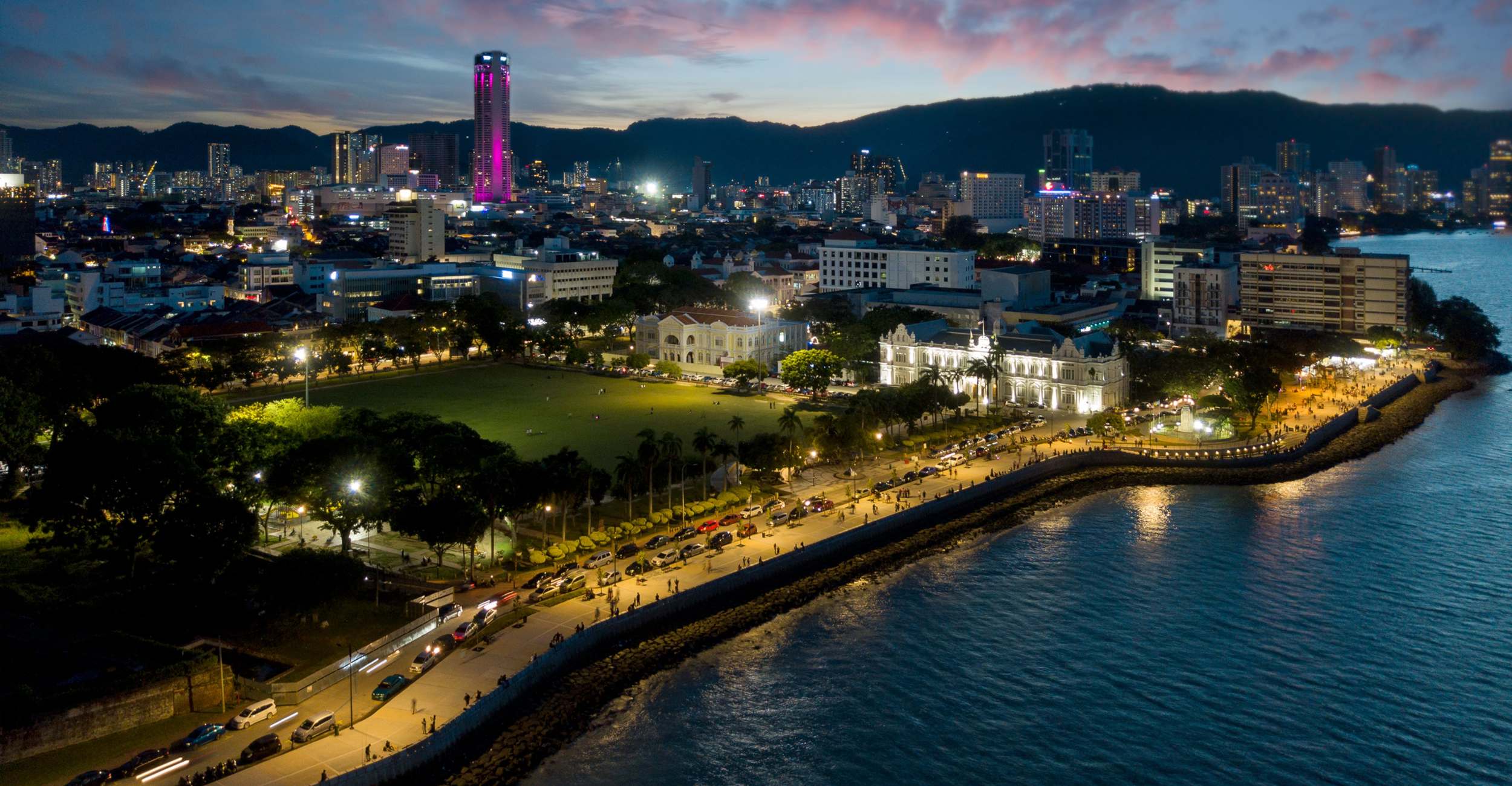
Penang Island is irregularly shaped, with a hilly and mostly forested interior. The island’s coastal plains are narrow, with the most extensive plain located at the northeastern cape. George Town, which started as a small settlement at the northeastern tip of the island, has expanded over the centuries to encompass the entire island, although the marshy western coast remains relatively underdeveloped. The highest point within Penang is Penang Hill, which stands at a height of 833 m at the centre of the island. Seberang Perai, on the other hand, has a mostly flat topography, save for a few hills such as at Bukit Mertajam. Due to land scarcity, land reclamation projects have been undertaken in high-demand areas. In 2023, a massive reclamation project commenced off George Town’s southern coast to build the 920 ha Silicon Island, envisioned as a new hub for high-tech manufacturing and commerce. Following years of reclamation works, the shoreline off Gurney Drive is also being transformed into Gurney Bay, intended as a new iconic waterfront destination for Penang.








 Memories and Such