In My Hands Today…

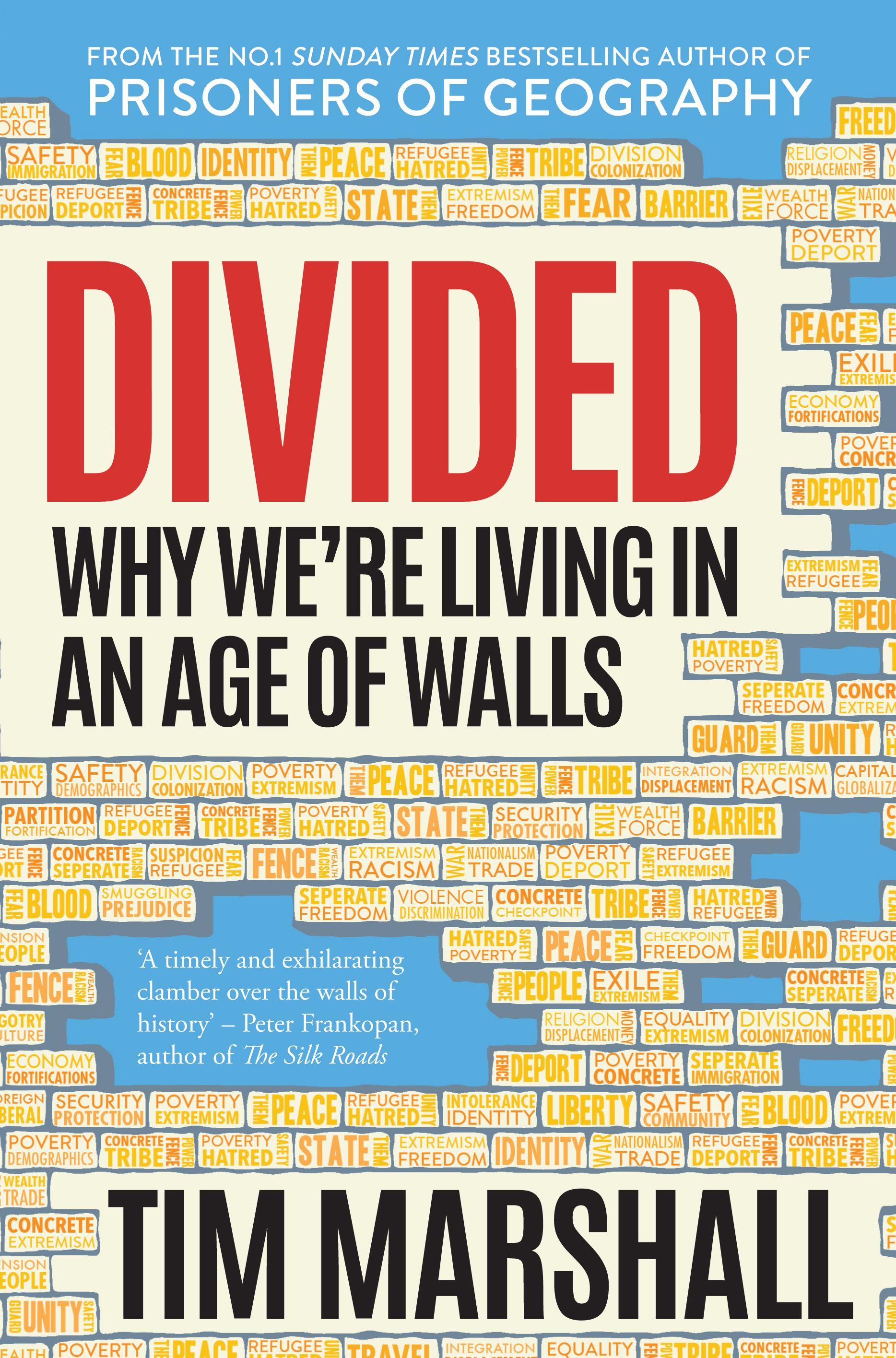
Divided: Why We’re Living in an Age of Walls – Tim Marshall

We feel more divided than ever.
This riveting analysis tells you why.

Walls are going up. Nationalism and identity politics are on the rise once more. Thousands of miles of fences and barriers have been erected in the past ten years, and they are redefining our political landscape.

There are many reasons why we erect walls, because we are divided in many ways: wealth, race, religion, politics. In Europe the ruptures of the past decade threaten not only European unity, but in some countries liberal democracy itself. In China, the Party’s need to contain the divisions wrought by capitalism will define the nation’s future. In the USA the rationale for the Mexican border wall taps into the fear that the USA will no longer be a white majority country in the course of this century.

Understanding what has divided us, past and present, is essential to understanding much of what’s going on in the world today. Covering China; the USA; Israel and Palestine; the Middle East; the Indian Subcontinent; Africa; Europe and the UK, bestselling author Tim Marshall presents a gripping and unflinching analysis of the fault lines that will shape our world for years to come.

Are We Becoming Too Busy to Be Kind?

Some questions sound simple until we sit with them. Are we becoming too busy to be kind? At first glance, the answer seems obvious. Yes, of course we are. Look around. Everyone is rushing. Everyone is tired. Everyone has deadlines, bills, errands, worries, children, ageing parents, work messages, health issues, school matters, and a phone that never really lets them rest.

But the question is not only whether we are busy. Most of us are. The real question is what that busyness is doing to us.

Is it making us less patient? Less thoughtful? Less willing to pause? Less likely to notice someone else’s discomfort? Less able to help unless it is convenient, scheduled, and does not interfere with our own carefully planned lives?

There was a time when, if something happened in public, the instinct might have been to run towards the person who needed help. Today, too often, the instinct seems to be to take out a phone. A fall, an argument, an accident, an uncomfortable scene, all of it becomes content before it becomes concern. There is something deeply unsettling about that. The urge to record has begun to compete with the urge to assist. In some cases, it has replaced it.

Of course, not everyone behaves this way. People still help. Strangers still step forward. Quiet goodness still exists all around us. But there is also a growing hesitation. Why get involved? What if I get blamed? What if this becomes complicated? What if someone records me? What if it is not my problem?

And so we look away.

Perhaps people have not become less kind. Perhaps they have become more tired, more afraid, and more overwhelmed. Kindness may still exist, but it is buried under stress, deadlines, financial worries, caregiving responsibilities, commuting fatigue, and the mental load of modern life. The heart may still be soft, but the day is hard. And when the day is hard for too long, softness begins to feel like a luxury.

To me, kindness is not about grand gestures. It is not about public charity, dramatic declarations, or social media posts about how compassionate one is. Kindness is far simpler and far more difficult. It is being a decent human being. It is helping when one can. It is being thoughtful. It is treating everyone around us with the same basic dignity, regardless of their social or financial status.

That last part matters.

Because very often, the measure of our kindness is not how we treat those above us, or those we want to impress. It is how we treat those who have no power over us. Service staff. Cleaners. Domestic helpers. Delivery riders. Security guards. Receptionists. Cashiers. The person clearing our tray. The person answering our call. The person who cannot talk back because their job depends on remaining polite.

It is easy to be charming to someone important. It takes character to be respectful to someone who is tired, underpaid, and invisible to most people.

And yet, this is where unkindness often shows itself. A sharp tone. A dismissive gesture. No eye contact. No thank you. An assumption that because someone is serving us, they are somehow beneath us. It is as if social or economic hierarchy gives people permission to forget basic decency.

It does not. Kindness is not kindness if it is selective. If we reserve courtesy only for those we consider our equals, then what we are practising is not kindness. It is social calculation.

I first moved to Singapore many years ago, and some of my earliest memories of public life here are complicated ones. I remember older Chinese passengers not sitting next to me on the bus or train, even when there was space. I remember people tapping the seat after I vacated it, as though removing my traces. These were small moments. Nobody shouted. Nobody said anything directly. But small unkindnesses can stay with us precisely because they are small. They make us question whether we imagined them. They leave a faint bruise.

At work too, unkindness often arrives in quiet forms. A message ignored, a reply delayed without explanation, someone pretending not to see your contribution, or a person in authority using silence as a weapon. No single incident may seem large enough to complain about, but together they create an atmosphere. Busy workplaces can become unkind workplaces, not always because people are cruel, but because pressure makes everyone transactional.

Kindness at work is not about being sweet all the time. It is about clear communication. It is about not dumping urgent work unnecessarily. It is about giving credit. Respecting people’s time. Saying thank you. Not weaponising hierarchy. Assuming good intent until proven otherwise. These are not soft things. They are the foundation of a healthy workplace.

But we do not always value them. Today’s culture praises productivity, ambition, speed, confidence, hustle, excellence, leadership, success, and resilience. These are not bad qualities. But where does kindness sit among them? Is it praised? Rewarded? Promoted? Or is it seen as soft, weak, inefficient, naive, not strategic enough?

Too often, kind people are taken advantage of. They are expected to absorb more, forgive more, stretch more, and understand more. Their kindness becomes part of the system’s convenience. This is why kindness also needs boundaries. Being kind does not mean becoming a doormat. It does not mean tolerating disrespect. It does not mean saying yes when every part of you is exhausted. True kindness includes honesty. It includes respect for oneself too.

That may be the hardest form of kindness for many of us.

We speak often about being kind to others, but what about being kind to ourselves? Many of us are far harsher inwardly than we would ever be to another person. I know I am guilty of this. When things do not go my way, I can very quickly slip into self-blame. I think of all the things I did wrong, all the ways I could have done better, all the moments where I was not perfect enough. It is exhausting, this private courtroom we carry within us.

And perhaps that is part of the problem. People who are constantly unkind to themselves may have very little softness left for others. If our inner voice is always impatient, critical, and unforgiving, it becomes harder to speak gently outwardly. The tone leaks. The pressure spills.

Still, this cannot become an excuse. “I am stressed” may explain unkindness, but it does not erase its effect.

We all know this because we have all done it. I try to be conscious about how I treat people, but I am sure there have been times when I have been inadvertently unkind. And if I am honest, I am probably most unkind to those closest to me: S, then my children, then my helper. I have also been unkind to my parents and my sister. I apologise when I realise it, and I try to walk back. But the truth remains. We are often least guarded with the people who love us most.

Perhaps because we know they will forgive us. Perhaps because we assume they will understand. Perhaps because home is where the mask comes off, and unfortunately, sometimes the manners come off with it.

This is a painful thing to admit, but an important one. Any essay on kindness that only points outward becomes too easy. The rude stranger, the impatient commuter, the harsh boss, the ungrateful customer, they are all convenient examples. But the real test of kindness is not only how I behave when I am rested, admired, and in public. It is how I behave when I am tired, disappointed, anxious, and at home.

Motherhood has taught me this in unexpected ways. I became more patient as a mother, so much so that my father once noticed it with surprise. I suppose having twins does that to you. When there are two babies, two sets of needs, two cries, two schedules, two small humans depending on you at once, something in you either hardens or expands. For me, it expanded my patience.

I have often been more patient with BB and GG than with many others in my life. And now that my parents are older, I find myself more patient with them too. Age reverses many roles quietly. The people who once waited for us now need us to wait for them.

Kindness is harder when one is tired. There is no point pretending otherwise. But I also believe that if someone is intrinsically kind, that quality remains, even under pressure. It may wobble. It may fray at the edges. But it does not disappear. Real kindness is not a mood. It is a muscle. It is also, perhaps, like a bank account. The more we deposit into it, the more it grows. A small act here, a patient response there, a thoughtful pause, a decision not to snap, a decision to help, all of it adds up.

What would happen if everyone around us became just ten percent kinder? Not saintly. Not self-sacrificing. Just ten percent more patient. Ten percent more thoughtful. Ten percent less likely to assume the worst. Ten percent more willing to say, “Take your time.” Would we not live in a better society?

Singapore is an interesting place to think about this question because it is such an efficient society. Things work, trains arrive, queues move and systems are clear. Time is respected. There is much to admire in this. But efficiency can sometimes look like coldness, even when it is not intended that way. When everyone is moving fast, softness can seem like delay. Pausing can feel like obstruction. The person who needs extra time becomes an inconvenience.

Singaporeans are often kind in practical ways. There are people who give up seats on buses and trains, neighbours who help without fuss, colleagues who cover for one another quietly, strangers who step in when needed. But perhaps, as a society, there can be impatience in emotional spaces. A discomfort with messiness. A preference for order over tenderness. A tendency to move quickly past anything that slows the system down.

India, at least the India I grew up in, offered a different model. Not necessarily better in every way, but different. Growing up, it was common to go into a neighbour’s house to drink water or wait if one’s parents were not home. My parents could travel and leave my sister and me alone, secure in the knowledge that neighbours would help, feed us, and be there in an emergency. I remember a neighbour picking me up from the station when my parents could not.

That kind of neighbourliness was ordinary then. Not heroic. Not worthy of an announcement. Just what people did.

I do not know if that India exists in the same way today. Cities have changed. Lives have changed. Trust has changed. People are busier, more guarded, more private, perhaps with reason. The old neighbourhood could be kind, but it could also be intrusive. Warmth came with unsolicited advice. Help came with commentary. Everyone knew your business, sometimes before you did. Still, there was a human net. Imperfect, nosy, sometimes annoying, but real.

Today, in many cities across the world, that net has thinned. We may live closer together physically, but further apart emotionally. We know the delivery rider’s location on an app, but not our neighbour’s name. We can track parcels, flights, investments, and calories, but still fail to notice when someone near us is struggling.

Online life has complicated this further. Social media has made people more visible, but not necessarily more compassionate. It has made it easier to perform concern and harder to practise it quietly. Outrage is instant. Judgment is instant. Cancelling is instant. Mockery is instant. People assume the worst with remarkable speed. Anonymity gives courage to cruelty. And the desire to go viral can turn someone else’s pain into opportunity.

Perhaps social media has not made people unkind. Perhaps it has simply made visible what people always thought privately. But visibility changes behaviour. When every act can become content, kindness itself can become performative. The public declaration begins to matter more than the private action.

This is why I respect small private kindness most. The kindness no one sees. The colleague who covers for someone without announcing it. The neighbour who helps without keeping score. The stranger who gives up a seat. The person who replies gently when they could have been sharp. The one who treats the cleaner and the CEO with the same courtesy. The friend who remembers a detail. The family member who notices tiredness before it becomes collapse.

Everyday decency matters more to me than grand gestures. Consistency matters more than spectacle. Action matters more than words, though words too can heal when they are sincere.

Who taught me kindness? Many people. My family. My neighbours. Books. The world I grew up in, where values like Athithi Devo Bhava, the guest is God, were part of the cultural fabric. At its best, this idea is rooted in generosity and hospitality. It teaches us to make space for another person. To feed, welcome, and care. Of course, like all traditions, it can also become performative or burdensome, especially for the women expected to do all the feeding and welcoming. But at its heart lies something beautiful: the idea that another person’s comfort matters.

Maybe that is what kindness really is. The belief that another person’s experience matters.

It does not always require a lot of time. Sometimes kindness happens in a second. Holding the lift. Letting someone go ahead. Saying thank you. Not honking. Smiling at someone who looks nervous. Replying to a message with care. Giving someone the benefit of the doubt.

But deeper kindness does require attention. And attention is what busyness steals first.

When we are too busy, we stop noticing. We stop noticing the helper who looks tired. The parent who is repeating a story because they want connection, not because they have forgotten they told us before. The child who is quieter than usual. The spouse who has done ten invisible things before breakfast. The colleague who is overwhelmed. The cashier who has dealt with rude customers all day. The cleaner whose work makes our comfort possible.

The opposite of kindness is not always cruelty. Sometimes it is simply not noticing.

And this is where busyness becomes dangerous. Not because having a full life is wrong. Most of us cannot opt out of responsibility. We have to work, care, plan, earn, cook, commute, manage, and keep going. But if we are so busy that we no longer have time to be decent, then something has gone wrong. If our schedules leave no room for patience, our ambition no room for gentleness, our efficiency no room for humanity, then we have built lives that may function well but feel emotionally poor.

The world does not need more performative kindness. It needs more ordinary kindness. The unglamorous kind. The kind that does not photograph well. The kind that does not need applause. The kind that shows up in tone, timing, patience, respect, and restraint.

It means helping when we can. Not recording when someone needs assistance. Not turning away simply because “it is not our problem.” Not using “I’m busy” as a blanket excuse to avoid care, courtesy, or responsibility. Yes, genuine overwhelm is real. There are seasons when people are stretched beyond capacity. But the line between genuine overwhelm and careless self-importance is thin, and we cross it more easily than we admit.

Maybe the question is not only whether we are too busy to be kind.

Maybe the question is whether we are willing to become less busy in the ways that matter. Less busy judging. Less busy proving ourselves. Less busy performing goodness. Less busy chasing productivity at the cost of tenderness. Less busy assuming that our urgency is more important than someone else’s dignity.

A kinder life does not require grand transformation. It may begin with a pause. A breath before replying. A thank you. An apology. A decision to help. A decision not to humiliate. A decision to treat the person serving us as a person, not a function. A decision to be gentler with those at home, because love should not have to survive our worst tone simply because it can.

Kindness matters because it makes the world a better place. That sounds almost too simple, but simple truths often are. A kinder world is not built only by policies, institutions, or public campaigns, though those matter too. It is built in kitchens, trains, offices, hospital corridors, school gates, WhatsApp messages, hawker centres, lifts, and living rooms.

It is built when we notice.

Perhaps we are not becoming too busy to be kind. Not yet. But we are busy enough that kindness now requires more intention than before. It has to be chosen. Practised. Protected. Passed on.

And maybe that is where we begin. Not by trying to become saints. That would be unbearable for everyone involved. But by becoming ten percent kinder. Ten percent slower to judge. Ten percent quicker to help. Ten percent more aware of the people around us.

It may not change the whole world at once.

But it will change the world immediately around us. And that is not a small thing.

Aging with Identity: Rethinking Erikson’s Final Stage of Life

Ageing is not just about bodies wearing down. It is also about identity, memory, and meaning. Erik Erikson, the psychoanalyst famous for his theory of psychosocial development, believed that later life is a stage of deep reckoning. His model, especially the last stage of “ego integrity vs. despair,” still shapes how academics, doctors, and ordinary people think about ageing. But the theory deserves scrutiny. It has both strengths and limits. It offers a helpful lens, but not the only one. To understand its truth, we must question it, push against it, and see where it holds up or falls apart.

Erikson built his work on Freud but expanded it. Instead of focusing on childhood alone, he saw development as lifelong. He listed eight stages, each defined by a conflict. Trust vs mistrust in infancy. Autonomy vs. shame in toddlers. Identity vs. role confusion in adolescence. Each stage asked a question about the self and others. How we answered shaped our growth.

For older adults, the last stage is the struggle between ego integrity and despair. Integrity means accepting your life as it was, with both failures and wins, and finding peace in it. Despair means regret, bitterness, and fear, especially fear of death. In short, Erikson asked, when old age knocks, do you face it with acceptance or anger?

Erikson’s last stage resonates because it feels true. Many older people speak about their need to “make peace” with their lives. Hospice workers observe patients reflecting on choices, wishing they had spent more time with family, or expressing gratitude for simple joys. The struggle between meaning and regret is visible in end-of-life interviews. Philosophers like Viktor Frankl, with his focus on meaning, echo this. Spiritual traditions, too, stress the importance of reconciliation before death.

The model also gives caregivers, families, and health workers a language to understand older people’s emotions. It recognises that ageing is not just physical decline but also psychological conflict. That alone is valuable.

But the stage is not universal. Not every person over 65, or 85, moves neatly into such a conflict. Many never stop working or see themselves as “old.” Others live with dementia, where reflection may no longer be accessible. If meaning-making defines ageing, what about those whose memory fails? Does that mean their experience is somehow incomplete? Erikson did not account for this.

The binary of integrity or despair also feels too stark. Human emotions are often mixed. An 80-year-old may feel proud of raising children, but at the same time regret a career choice. They may find comfort in faith but still fear death. To label them as sitting on one side or the other feels simplistic.

Class, race, and gender also complicate the picture. Regret and satisfaction are shaped by social conditions. What does integrity look like for someone who spent their life in poverty or discrimination? How does systemic injustice affect the ability to look back with acceptance? Erikson’s neat framing risks sounding blind to power.

Erikson built his model largely within a Western, individualist framework. Acceptance, in his sense, often means judging life as a personal project. But in other cultures, ageing takes different forms. In many Asian or African traditions, elders gain meaning by being part of the community, not by private self-reflection. Their identity is tied to family continuity, ancestral lines, or collective memory.

For example, Confucian ideas of filial piety emphasise not ego integrity but the role of the elder as custodian of wisdom and moral guidance. Wholeness comes not through self-acceptance alone but through leaving a legacy for others. In such contexts, Erikson’s last stage may misinterpret how ageing is experienced.

Other psychologists have offered different models. Robert Peck expanded on Erikson, suggesting that older adults face shifts beyond integrity and despair, like moving from valuing physical strength to valuing wisdom, or from focusing on personal goals to considering broader community roles. This seems less dualistic and closer to what people actually experience.

Modern gerontology often rejects “stages” altogether. Life is seen less as a set path and more as a fluid adaptation to change. Baltes’ theory of Selective Optimisation with Compensation explains ageing as a process of choosing what to focus on, maintaining what you can, and adapting where you must. This avoids the all-or-nothing of Erikson’s model and fits diverse experiences better.

Still, Erikson’s insight, that later life sharply raises questions of meaning, seems hard to deny. Even if the categories are rigid, his focus on reflection, reconciliation, and acceptance points to a central truth: ageing forces us to look back. Mortality makes the life lived matter in a way midlife rarely does. Almost every elder interviewed in ethnographic studies returns to this: how they made sense of what happened.

Critics often shy away from Erikson’s idea of despair because it sounds bleak. But maybe he was right to stress it. Ageing does involve loss: of health, vitality, loved ones, and opportunities. Pretending despair is avoidable may be dishonest. Perhaps what matters is not erasing despair but learning to live with both acceptance and regret. Integrity may not be a victory so much as a fragile balance.

This reframing also makes sense of why many older adults cycle between peace and sadness. Losses trigger reflection, good memories return, and the two coexist. The task is not choosing one “side” but holding both without collapse.

So why is this important now? Debates on ageing are not abstract. As populations age worldwide, societies must rethink how we support elders. If we frame ageing only as decline, we risk dismissing older adults as past their use. If we follow Erikson too literally, we may falsely assume the elderly are either serene sages or bitter failures. Both miss the complexity.

Public policies often overlook the psychological dimensions of later life. Loneliness, depression, and the search for meaning affect health as much as physical ailments. Understanding that ageing involves a struggle for coherence can shape better care. It reminds us that listening, storytelling, and honouring people’s lives matter.

The appeal of Erikson’s theory is its clarity: a neat final battle. But human lives rarely end neatly. Integrity is rarely full; despair never vanishes. The truth is likely messier: older adults juggle pride and regret, joy and sorrow, and courage and fear. Instead of treating Erikson as a strict stage, perhaps it is better used as a metaphor, a reminder of the questions that emerge when death comes close.

If we reject stages, though, we must ask: what does healthy ageing look like? Maybe it is less about resolving contradictions than about sustaining relationships, telling stories, and leaving something for others. Maybe ageing well is not inner peace but connection. Maybe it is not a judgment of a life but participation in life until the end.

Erikson’s theory forces the young to ask: when I look back one day, what will I see? His model is not just about old age but about what makes a life worth living. The danger is assuming a single answer applies to everyone. But the gift is remembering that reflection awaits us all.

Unshackling the Human Spirit: Envisioning a World Without Societal Expectations

From the moment we take our first breath, we are enveloped in a web of societal expectations. These unwritten rules and norms dictate how we should think, behave, and live our lives, often without us even realising it. They shape our choices, our aspirations, and our very identities. But what if we could break free from these invisible chains? What if we could live in a world where societal expectations didn’t exist? Imagine the possibilities that would unfold, the boundless potential that could be unleashed, and the profound impact it could have on our individual and collective well-being.

In our current reality, societal expectations permeate every aspect of our lives. From the careers we choose to the relationships we pursue, from the way we dress to the hobbies we enjoy, we are constantly bombarded with messages about what is “normal” or “acceptable.” These expectations are often rooted in outdated traditions, cultural biases, and societal norms that may no longer serve us in the modern world.

The pressure to conform can be overwhelming, leading many individuals to suppress their true selves, stifle their passions, and settle for lives that feel inauthentic and unfulfilling. This burden of conformity not only stifles personal growth and self-expression but also perpetuates systemic inequalities and limits the diversity of human experiences.

In a world without societal expectations, the shackles that bind us would be broken, and the human spirit would be free to soar. Imagine the vast array of talents, passions, and perspectives that could flourish when individuals are liberated from the constraints of societal norms.

Artists could create without fear of judgment or censorship, allowing their unique visions to take shape and challenge the boundaries of what is considered “art.” Scientists and researchers could pursue their curiosities without the limitations imposed by funding priorities or societal biases, potentially unlocking groundbreaking discoveries that could benefit humanity. Entrepreneurs and innovators could dream without limits, unencumbered by the expectations of what a “successful” business should look like.

In this world, individuals would be free to explore their identities, embrace their authentic selves, and forge their paths without the weight of societal expectations holding them back. The diversity of human experiences would be celebrated, and the richness of our collective tapestry would be woven with vibrant threads of individuality and self-expression.

One of the most profound impacts of a world without societal expectations would be the redefinition of success and fulfilment. In our current society, these concepts are often narrowly defined by external markers such as wealth, status, and material possessions. However, in a world free from societal expectations, success and fulfilment could take on entirely new meanings.

Success might be measured by the depth of one’s personal growth, the positive impact one has on their community, or the sense of inner peace and contentment one cultivates. Fulfilment could be found in the pursuit of passions, the cultivation of meaningful relationships, or the simple joy of living an authentic life.

Without the pressure to conform to societal norms, individuals would be free to define their paths to happiness and self-actualisation. The traditional markers of success, such as prestigious careers or lavish lifestyles, would hold no more weight than the unconventional choices of those who prioritize simplicity, creativity, or spiritual growth.

In a world without societal expectations, the barriers that divide us based on gender, race, sexuality, or any other aspect of our identities would crumble. The biases and prejudices that stem from societal norms would have no place in this liberated reality.

Imagine a world where individuals are celebrated for their unique perspectives and experiences, rather than being judged or marginalised for their differences. A world where gender roles and stereotypes no longer dictate the opportunities available to individuals, and where everyone is free to pursue their dreams without the constraints of societal expectations.

In this world, diversity would be embraced as a strength, and inclusion would be the norm. Communities would thrive on the richness of different cultures, beliefs, and ways of life, fostering a deeper understanding and appreciation for the tapestry of human experience.

Without the weight of societal expectations, individuals would be free to walk in each other’s shoes, cultivating a deeper sense of empathy and compassion. When we are no longer bound by the need to conform, we can truly see and appreciate the unique journeys and perspectives of those around us.

Imagine a world where we could openly share our struggles, our fears, and our vulnerabilities without fear of judgment or rejection. A world where we could truly listen to one another’s stories and experiences, without the filter of societal expectations clouding our understanding.

In this world, compassion would flourish, as we would be able to connect on a deeper level, recognizing our shared humanity and the universal desire for acceptance and belonging. Empathy would become the foundation upon which we build our relationships, our communities, and our societies, fostering a more inclusive and understanding world.

Perhaps the most profound impact of a world without societal expectations would be the opportunity for true self-discovery and authenticity. Without the pressure to conform, individuals would be free to explore their identities, their passions, and their unique paths in life.

Imagine a world where children are encouraged to follow their curiosities and passions from a young age, without the limitations imposed by societal expectations or predetermined career paths. A world where individuals can embrace their true selves without fear of judgment or rejection, and where self-expression is celebrated as a fundamental aspect of the human experience.

In this world, authenticity would be the norm, and self-discovery would be a lifelong journey of growth and exploration. Individuals would be free to reinvent themselves, to change course, and to embrace new passions and perspectives without the weight of societal expectations holding them back.

While the prospect of a world without societal expectations may seem idyllic, it is important to acknowledge the potential challenges and considerations that would arise in such a reality.

One concern might be the potential for chaos or a lack of structure in society. Without the guiding principles and norms that societal expectations provide, there could be a risk of social fragmentation or a breakdown in the systems and institutions that govern our daily lives.

However, it is important to recognize that societal expectations are not inherently necessary for the functioning of society. In a world without these expectations, new frameworks and systems could emerge, rooted in principles of individual autonomy, mutual respect, and collective well-being.

Another consideration is the potential for individuals to feel adrift or overwhelmed by the sheer breadth of choices and possibilities available to them. Without the familiar boundaries and expectations of society, some may struggle to navigate the vast expanse of self-discovery and self-expression.

However, this challenge could also be seen as an opportunity for personal growth and the development of self-awareness and self-determination. In a world without societal expectations, individuals would have the freedom to explore their identities and passions at their own pace, with the support of communities built on empathy and understanding.

Ultimately, envisioning a world without societal expectations requires us to embrace the unknown and let go of the familiar structures and norms that have shaped our lives for generations. It is a bold and audacious vision, one that challenges us to reimagine the very fabric of our societies and the way we relate to one another.

Yet, in this unknown lies the potential for profound transformation and the unleashing of the human spirit in ways we can scarcely imagine. It is a world where individuality is celebrated, where authenticity is the norm, and where the boundaries that once confined us are shattered, allowing us to soar to new heights of self-expression, creativity, and personal fulfillment.

While the path to such a world may be uncertain and fraught with challenges, the rewards of living in a society free from the shackles of societal expectations are immeasurable. It is a world where we can truly embrace our authentic selves, where our dreams and passions are limited only by the boundaries of our own imagination, and where the richness of human diversity is celebrated and cherished.

So, let us dare to dream of a world without societal expectations, a world where the human spirit is unshackled and free to soar. Let us embrace the unknown and the boundless possibilities that await us, for in doing so, we may just unlock the key to a more authentic, fulfilling, and compassionate existence for all.

In My Hands Today…

South vs North: India’s Great Divide – Nilakantan RS

Compare two children—one born in north India, the other in the south.

The child from south India is far less likely to die in the first year of her life or lose her mother during childbirth. She will also receive better nutrition, go to school, and stay in school longer; she is more likely to attend college and secure employment that pays her more. This child will also go on to have fewer children, who in turn will be healthier and more educated than her. In a nutshell, the average child born in south India will live a healthier, wealthier, and more secure life than one born in north India.

Why is south India doing so much better than the north? And what does that mean?

In this superbly argued book, data scientist Nilakantan RS shows us how and why the southern states are outperforming the rest of the country and its consequences in an increasingly centralized India. He reveals how south India deals with a particularly tough set of issues: its triumphs in areas of health, education, and economic growth are met with a policy regime that penalizes it; its success in population control will be met with a possible loss of political representation. How will the region manage such an assault? Hard-hitting, troubling, and full of fascinating data points, South vs. North is an essential book about one of the biggest challenges that India faces today.