In My Hands Today…

Cobalt Red: How the Blood of the Congo Powers Our Lives – Siddharth Kara

Cobalt Red is the searing, first-ever exposé of the immense toll taken on the people and environment of the Democratic Republic of the Congo by cobalt mining, as told through the testimonies of the Congolese people themselves. Activist and researcher Siddharth Kara has traveled deep into cobalt territory to document the testimonies of the people living, working, and dying for cobalt. To uncover the truth about brutal mining practices, Kara investigated militia-controlled mining areas, traced the supply chain of child-mined cobalt from toxic pit to consumer-facing tech giants, and gathered shocking testimonies of people who endure immense suffering and even die mining cobalt.

Cobalt is an essential component to every lithium-ion rechargeable battery made today, the batteries that power our smartphones, tablets, laptops, and electric vehicles. Roughly 75 percent of the world’s supply of cobalt is mined in the Congo, often by peasants and children in sub-human conditions. Billions of people in the world cannot conduct their daily lives without participating in a human rights and environmental catastrophe in the Congo. In this stark and crucial book, Kara argues that we must all care about what is happening in the Congo ― because we are all implicated.

In My Hands Today…

Eve: How the Female Body Drove 200 Million Years of Human Evolution – Cat Bohannon

How did the female body drive 200 million years of human evolution?

  • Why do women live longer than men?
  • Why are women more likely to get Alzheimer’s?
  • Why do girls score better at every academic subject than boys until puberty, when suddenly their scores plummet?
  • Is sexism useful for evolution?
  • And why, seriously why, do women have to sweat through our sheets every night when we hit menopause?

These questions are producing some truly exciting science—and in Eve, with boundless curiosity and sharp wit, Cat Bohannon covers the past 200 million years to explain the specific science behind the development of the female sex: “We need a kind of user’s manual for the female mammal. A no-nonsense, hard-hitting, seriously researched (but readable) account of what we are. How female bodies evolved, how they work, what it really means to biologically be a woman. Something that would rewrite the story of womanhood. This book is that story. We have to put the female body in the picture. If we don’t, it’s not just feminism that’s compromised. Modern medicine, neurobiology, paleoanthropology, even evolutionary biology all take a hit when we ignore the fact that half of us have breasts. So it’s time we talk about breasts. Breasts, and blood, and fat, and vaginas, and wombs—all of it. How they came to be and how we live with them now, no matter how weird or hilarious the truth is.”

Eve is not only a sweeping revision of human history, it’s an urgent and necessary corrective for a world that has focused primarily on the male body for far too long. Picking up where Sapiens left off, Eve will completely change what you think you know about evolution and why Homo sapiens has become such a successful and dominant species.

In My Hands Today…

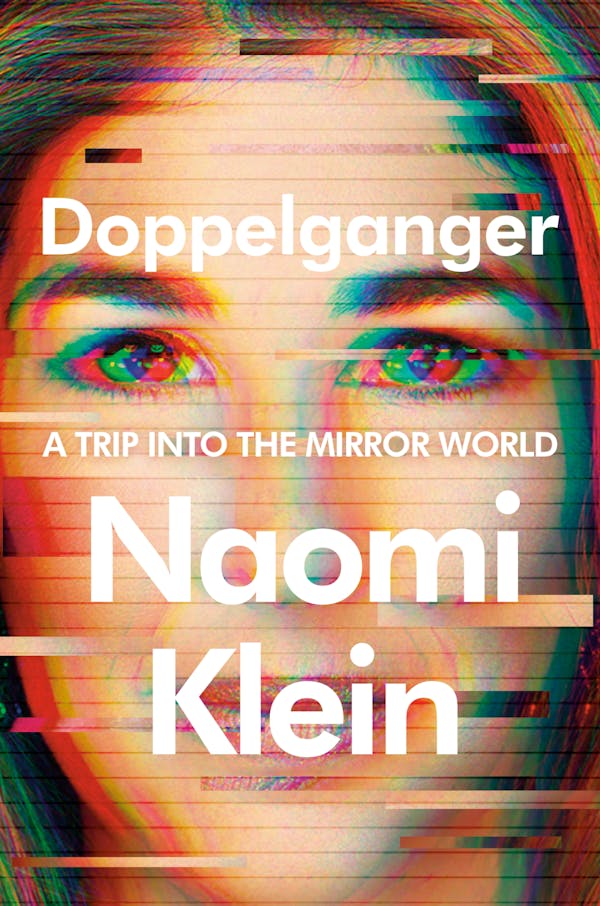
Doppelganger: A Trip into the Mirror World – Naomi Klein

What if you woke up one morning and found you’d acquired another self―a double who was almost you and yet not you at all? What if that double shared many of your preoccupations but, in a twisted, upside-down way, furthered the very causes you’d devoted your life to fighting against?

Not long ago, the celebrated activist and public intellectual Naomi Klein had just such an experience―she was confronted with a doppelganger whose views she found abhorrent but whose name and public persona were sufficiently similar to her own that many people got confused about who was who. Destabilized, she lost her bearings, until she began to understand the experience as one manifestation of a strangeness many of us have come to know but struggle to define: AI-generated text is blurring the line between genuine and spurious communication; New Age wellness entrepreneurs turned anti-vaxxers are scrambling familiar political allegiances of left and right; and liberal democracies are teetering on the edge of absurdist authoritarianism, even as the oceans rise. Under such conditions, reality itself seems to have become unmoored. Is there a cure for our moment of collective vertigo?

Naomi Klein is one of our most trenchant and influential social critics, an essential analyst of what branding, austerity, and climate profiteering have done to our societies and souls. Here she turns her gaze inward to our psychic landscapes, and outward to the possibilities for building hope amid intersecting economic, medical, and political crises. With the assistance of Sigmund Freud, Jordan Peele, Alfred Hitchcock, and bell hooks, among other accomplices, Klein uses wry humor and a keen sense of the ridiculous to face the strange doubles that haunt us―and that have come to feel as intimate and proximate as a warped reflection in the mirror.

Combining comic memoir with chilling reportage and cobweb-clearing analysis, Klein seeks to smash that mirror and chart a path beyond despair. Doppelganger What do we neglect as we polish and perfect our digital reflections? Is it possible to dispose of our doubles and overcome the pathologies of a culture of multiplication? Can we create a politics of collective care and undertake a true reckoning with historical crimes? The result is a revelatory treatment of the way many of us think and feel now―and an intellectual adventure story for our times.

In My Hands Today…

Ultra-Processed People: The Science Behind Food That Isn’t Food – Chris van Tulleken

It’s not you; it’s the food.

We have entered a new age of eating. For the first time in human history, most of our calories come from an entirely novel set of substances called Ultra-Processed Food. There’s a long, formal scientific definition, but it can be boiled down to this: if it’s wrapped in plastic and has at least one ingredient that you wouldn’t find in your kitchen, it’s UPF.

These products are specifically engineered to behave as addictive substances, driving excess consumption. They are now linked to the leading cause of early death globally and the number one cause of environmental destruction. Yet almost all our staple foods are ultra-processed. UPF is our food culture and for many people, it is the only available and affordable food.

In this book, Chris van Tulleken, father, scientist, doctor, and award-winning BBC broadcaster, marshals the latest evidence to show how governments, scientists, and doctors have allowed transnational food companies to create a pandemic of diet-related disease. The solutions don’t lie in willpower, personal responsibility, or exercise. You’ll find no diet plan in this book, but join Chris as he undertakes a powerful self-experiment that made headlines around the world: under the supervision of colleagues at University College London, he spent a month eating a diet of 80 percent UPF, typical for many children and adults in the United States. While his body became the subject of scientific scrutiny, he spoke to the world’s leading experts from academia, agriculture, and, most importantly, the food industry itself. But more than teaching him about the experience of the food, the diet switched off Chris’s own addiction to UPF.

In a fast-paced and eye-opening narrative, he explores the origins, science, and economics of UPF to reveal its catastrophic impact on our bodies and the planet. And he proposes real solutions for doctors, for policy makers, and for all of us who have to eat. A book that won’t only upend the way you shop and eat, Ultra-Processed People will open your eyes to the need for action on a global scale.

In My Hands Today…

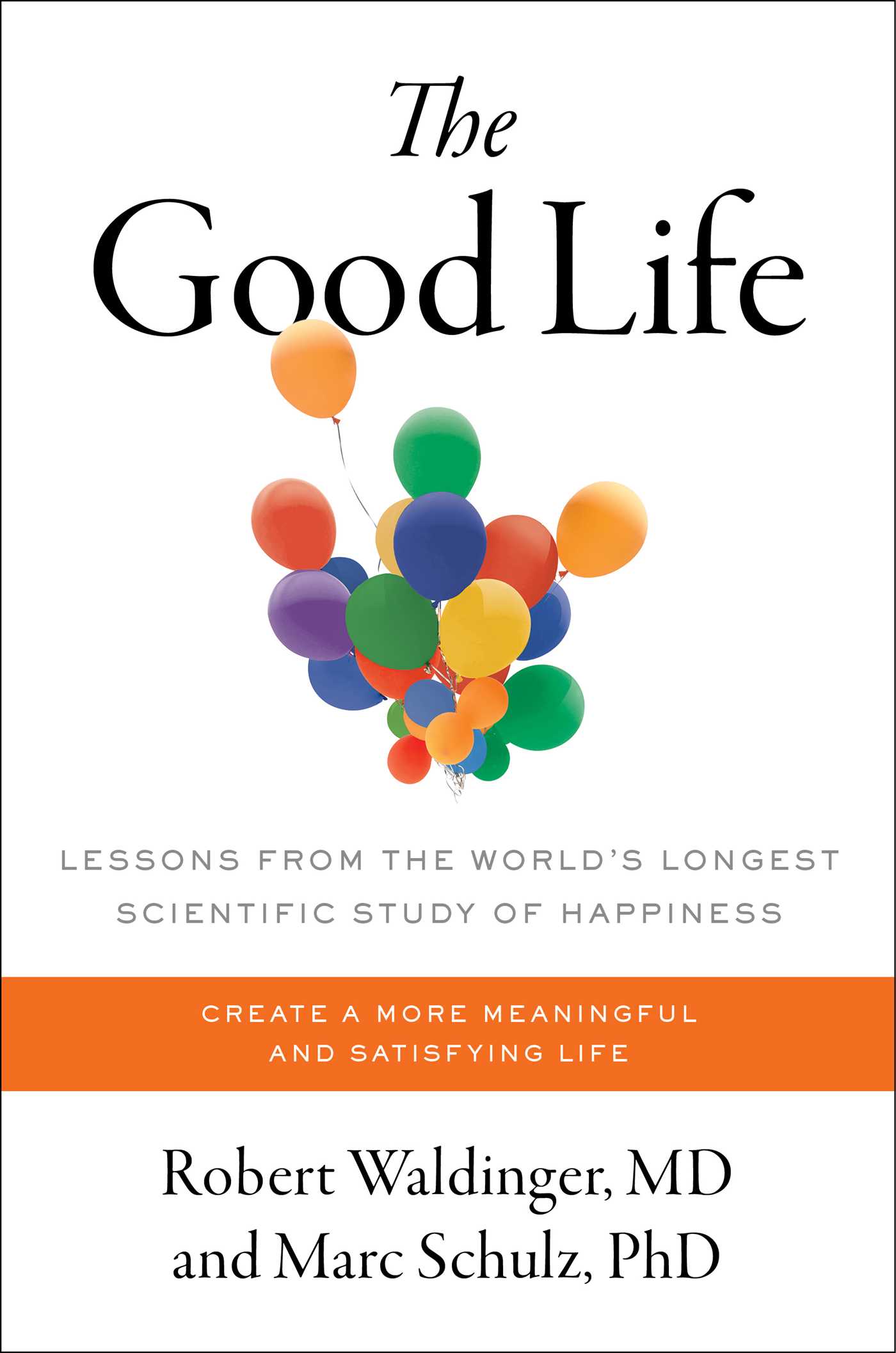
The Good Life: Lessons from the World’s Longest Scientific Study of Happiness – Robert Waldinger, Marc Schulz

What makes for a happy life, a fulfilling life? A good life? In their “captivating” ( The Wall Street Journal) book, the directors of the Harvard Study of Adult Development, the longest scientific study of happiness ever conducted, show that the answer to these questions may be closer than you realize.

What makes a life fulfilling and meaningful? The simple but surprising answer relationships. The stronger our relationships, the more likely we are to live happy, satisfying, and healthier lives. In fact, the Harvard Study of Adult Development reveals that the strength of our connections with others can predict the health of both our bodies and our brains as we go through life.

The invaluable insights in this book emerge from the revealing personal stories of hundreds of participants in the Harvard Study as they were followed year after year for their entire adult lives, and this wisdom was bolstered by research findings from many other studies. Relationships in all their forms—friendships, romantic partnerships, families, coworkers, tennis partners, book club members, Bible study groups—all contribute to a happier, healthier life. And as The Good Life shows us, it’s never too late to strengthen the relationships you already have, and never too late to build new ones. The Good Life provides examples of how to do this.

Dr. Waldinger’s TED Talk about the Harvard Study, “What Makes a Good Life,” has been viewed more than 42 million times and is one of the ten most-watched TED talks ever.