Travel Bucket List – India: Goa Part 3

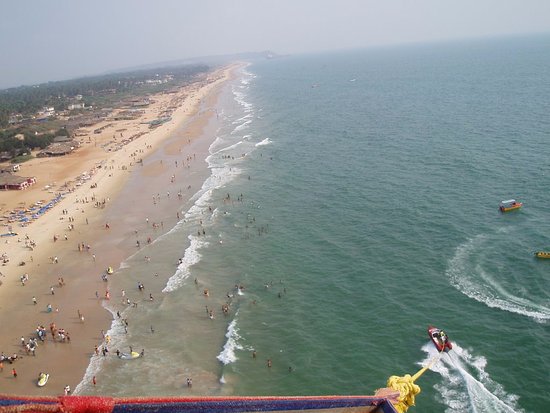
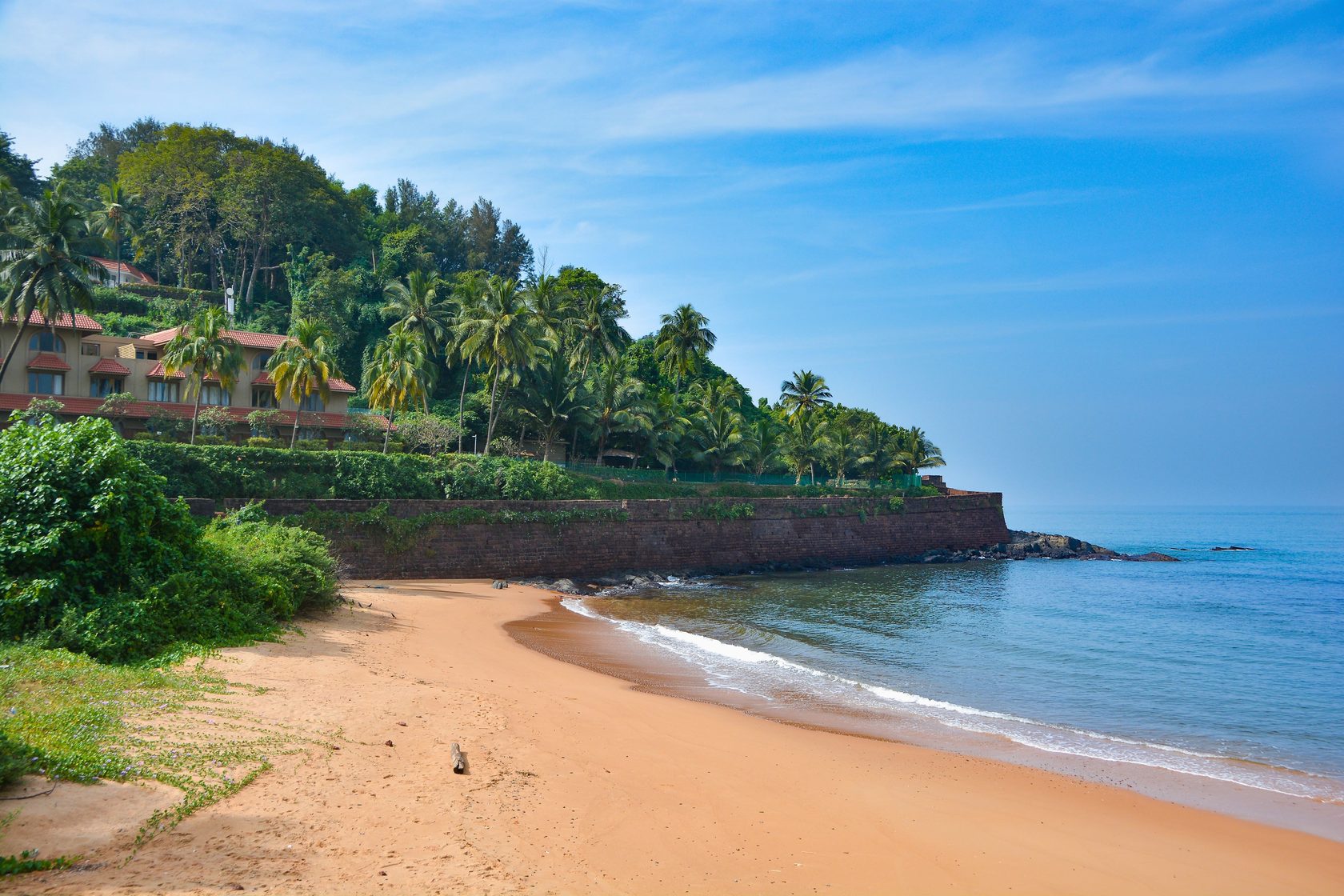
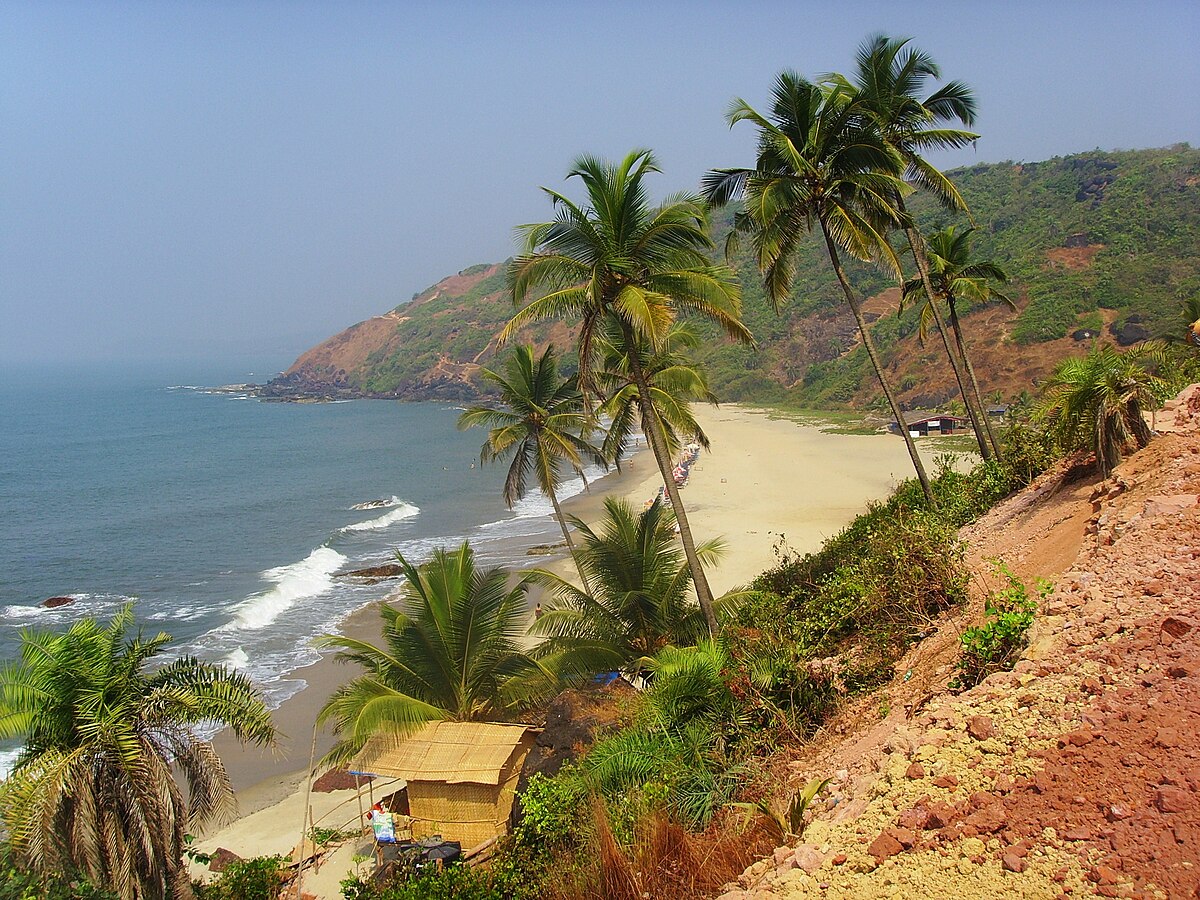
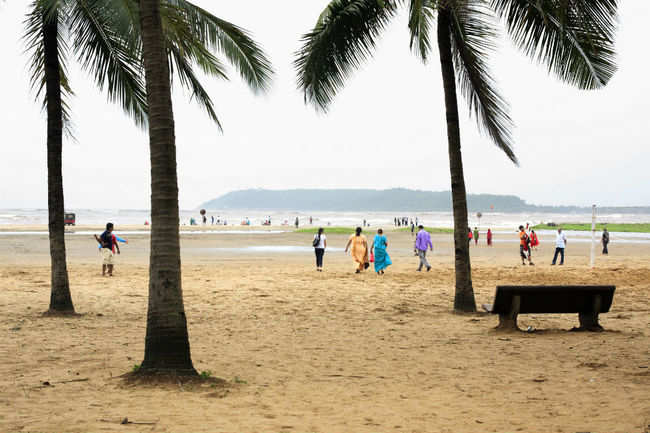
If there was one word to describe South Goa, it would be ‘Laid-back’. The unhurried pace of life, exotic beaches and heritage villages beckon solitude seeking travellers. The pace is unhurried with a soulful and serene vibe as well as great beaches, temples and churches. While North Goa is all about its nightlife, liveliness and crowd of tourists and shoppers, South Goa is known for its clean and isolated beaches, shrines, scenic drives and tranquil environment. So let’s start exploring what South Goa has in store for us.
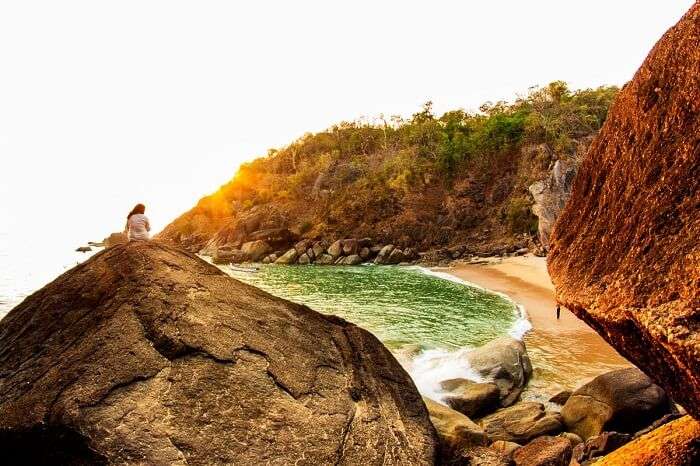
Butterfly Beach
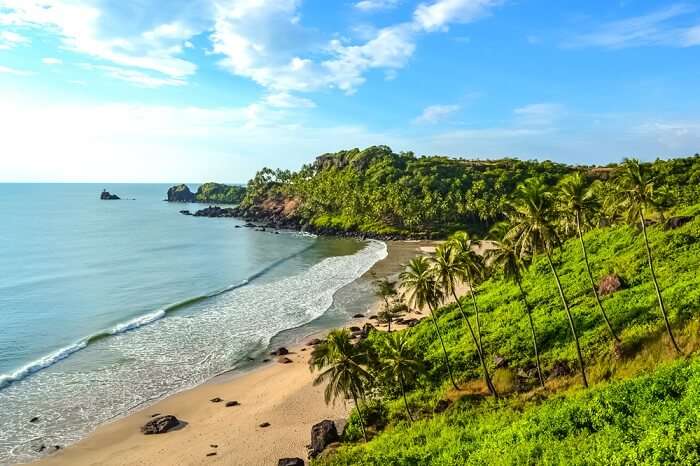
Butterfly Beach is a hidden gem in South Goa. The most astounding feature of Butterfly Beach is that you can spot millions of butterflies flying over the hilltop blossoms. The golden sands against the turquoise water creates a postcard perfect location with palm trees and scores of butterflies. This spectacular beach is a well known site to spot some playful dolphins, crabs and goldfish. You will have to take a boat ride to reach this beach as the land route demands you to undergo a challenging hike through the forest.

Betalbatim Beach
Popularly known as the Sunset Beach of Goa, this place is your destination for witnessing the most enchanting sunset you will ever see. The clean sands and beautiful surroundings make an immaculate landscape worth visiting. Contrasting with most beaches in Goa surrounded by palm trees, Betalbatim Beach is has a number of pine trees along the shoreline. Due to a number of lovebirds flocking here, it has also earned the nomenclature of being called Lover’s Beach. The beach is a preferred picnic spot among families and doesn’t have a lot of commercial activity going on contributing to the relaxed ambience. Betalbatim Beach, is located between Majorda and Colva beaches and is around 32 km from the capital Panaji.
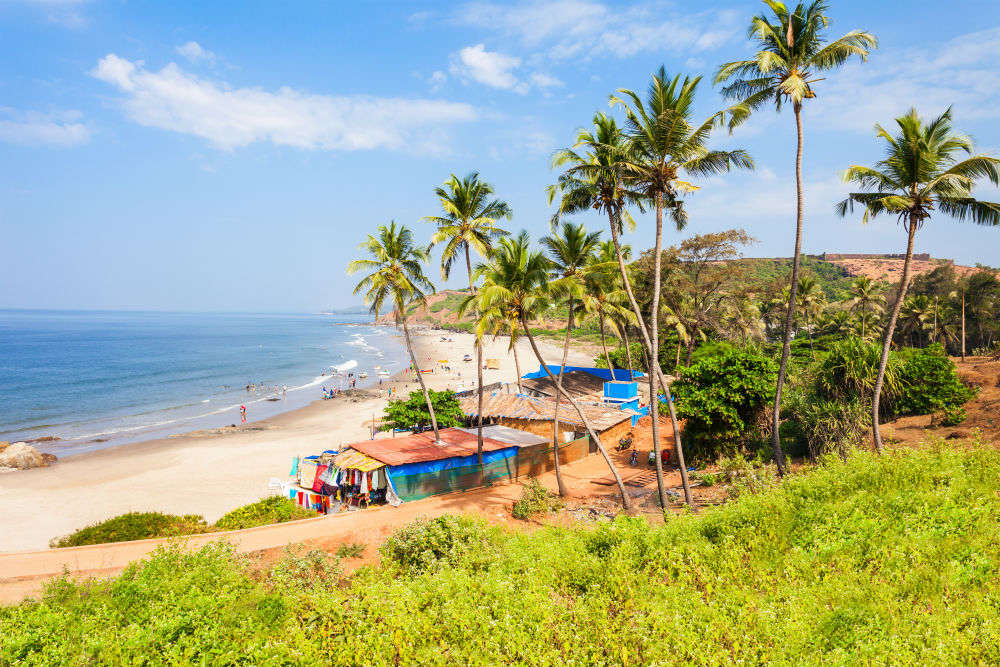
Agonda Beach
Agonda Beach in Goa is ideal for individuals searching for an energizing time in the water. The cool wind and warm summer sun help the tension and stress from life just melt away. This shoreline is long and desolate, bordered with palms and casuarinas and overwhelmed by an expansive slope toward the south. Located far south Agonda beach is at a distance of 70 km from Panjim.
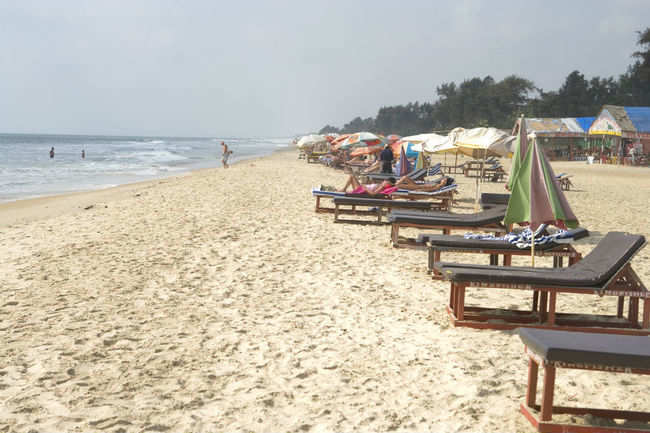
Mobor Beach
Mobor Beach is vibrant with tourists and always bustling with parties and activities that go one here perpetually. The beach is beautified with natural creations with blooming lilies in ponds, sandy dunes and coconut palms which adorn the landscape. The beach is around 55 km from Panjim.

Hollant Beach
This beach is particularly known for its serenity and landscape and not to be missed when in Goa. Hollant Beach offers wonderful perspectives including the popular southern shorelines of Goa, alongside the foothills of the Western Ghats and is known for its brilliant sunrises. The shoreline looks much all the more enchanting amid the high tide, when the ocean water ascends to converge into the crisp waters of an adjacent stream. It is not too far from Panjim and is at a distance of 27 km from the capital city.
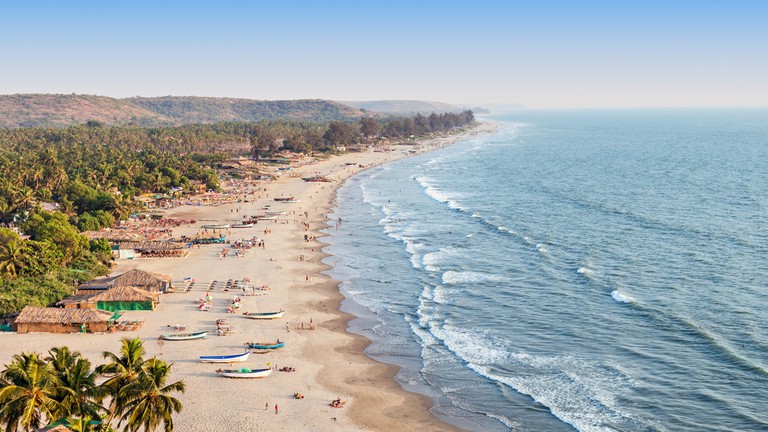
Palolem Beach
Palolem Beach is probably one of the most gorgeous beaches of South Goa. The beach remains packed with shacks, hawkers, restaurants, and eating outlets occupying the one mile long shore in crescent shape. Dolphins are also sighted here, so just keep your fingers crossed to witness this spectacular mammal playing amidst the blue waves of Arabian Sea. Located closer to Karnataka than Panjim, it is at a distance of 70 kilometers from the city of Panaji.
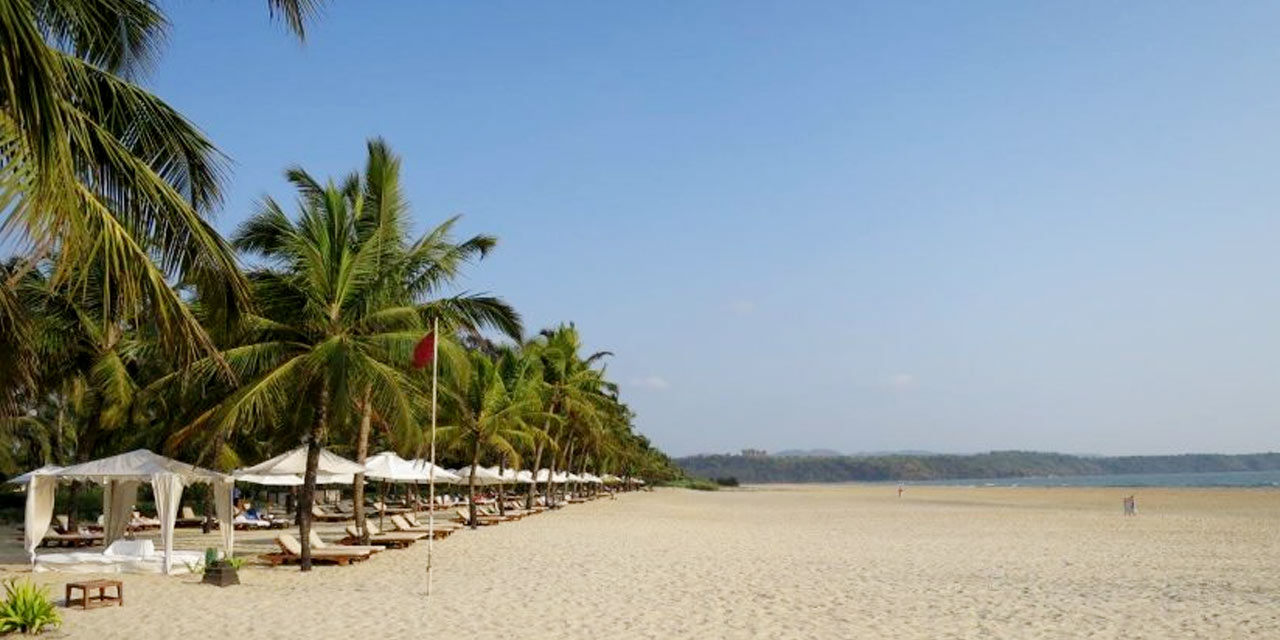
Cansaulim Beach
Unwind here on oceanside early morning and night to appreciate the excellent picturesque beauty that is Cansaulim beach. The shoreline is amazingly spotless and clean with brilliant gold sands. It is less swarmed and not an exceptionally prominent beach in Goa.
Distance from Panaji: It is located at a distance of 26.6 km from Panaji.
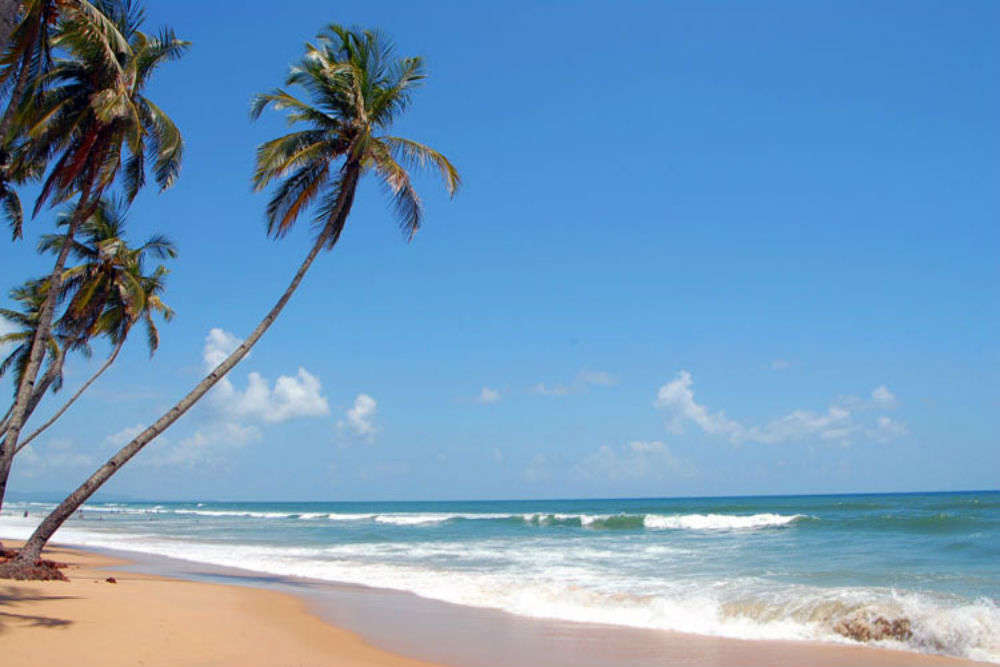
Colva Beach
Often addressed as the pride of Salcete, Colva at a distance of about 6kms from Margaon and is one of the most popular beaches in South Goa and attracts a lot of Indian visitors. The beach is an ideal destination to enjoy a range of activities from sunbathing, water sports to other leisure activities. The Colva Beach is also a famous shopping destination where you can explore some colorful clothes, jewelry and other fashion accessories.
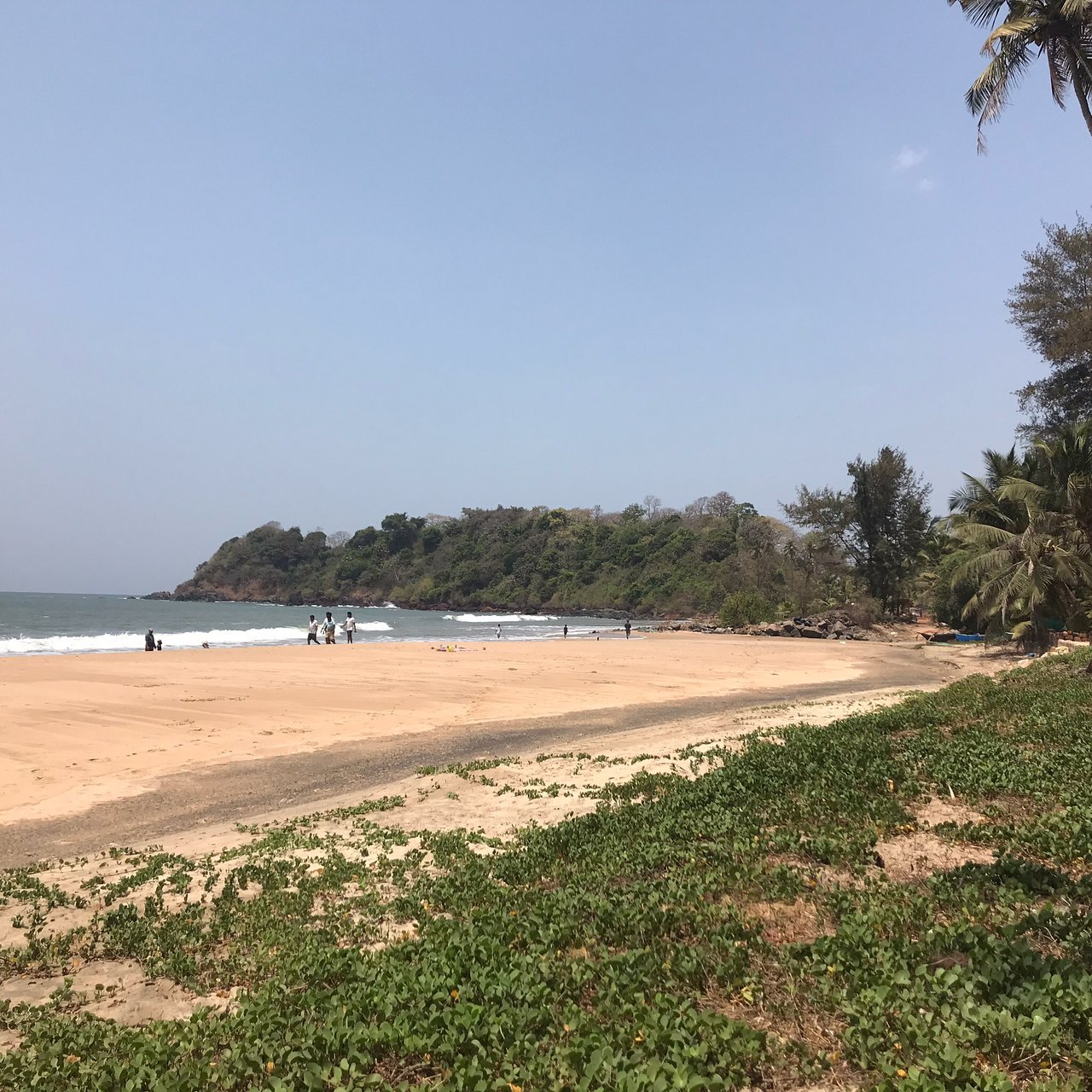
Talpona Beach
This beach is popular among tourists looking for an isolated and quiet location to enjoy the beautiful coastline against the magnificent Arabian Sea. The beach of Talpona is covered with pure sand of a golden color and framed with palm trees and pine groves. The sea is relatively calm and quiet here and one can easily enjoy a day with their thoughts. The Talpona beach has small sand dunes and is not visited much by tourists. The peaceful beach is also a resting ground of many birds.

Kakolem Beach
Also called the Tiger Beach, Kakolem Beach is one of the most remote and truly natural beaches in whole Goa. One of the least crowded beaches of Goa where you can relax completely. It is often claimed that this beach is a secret place to shoot tigers but in reality no one can say that they have ever really spotted the King of the jungle here. The beach is mostly lonely and deserted and there isn’t much activity going around. Kakolem Beach is located at a distance of 60 kilometers from the city of Panaji. There is no proper road and only a small path off the main road leads to the beach. There are no buses that travel to this beach. One can reach this beach only by private transport.

Benaulim Beach
A poupluar tourist spot, Benaulim Beach has everything ideal from captivating shorelines, extravagant gleaming sands, superb convenience, to nightlife and late night vibrant parties. Only 5 km from Margaon, this place is popular in south Goa for its delicious seafood.

Our Lady of Remedios Church
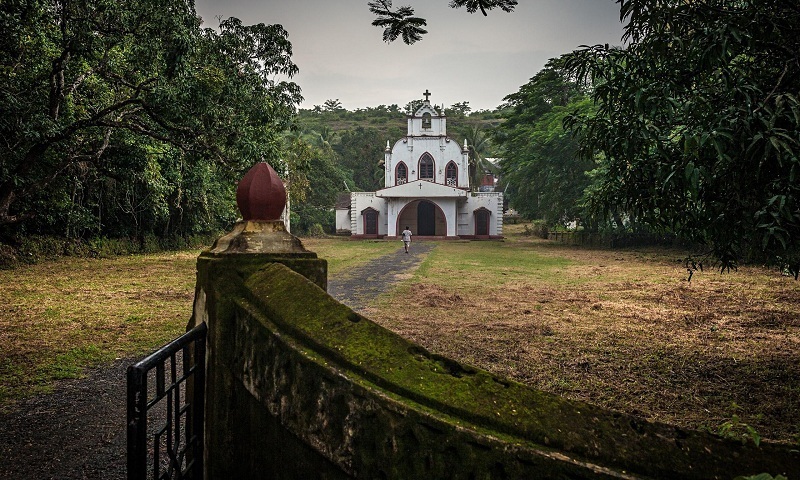
Marked with splendid architecture and a serene ambiance, Our Lady of Remedios Church at Betalbatim is an ancient place of worship that traces its origins back to 1630. Surrounded by green lawns, the white exterior of the church offers a soothing sight during the day. During the night, the church looks magnificent as the whole area is illuminated. The church is located in Fatona, Betalbatim and is open from 6 am to 5 pm daily.

Saviour of the World Church
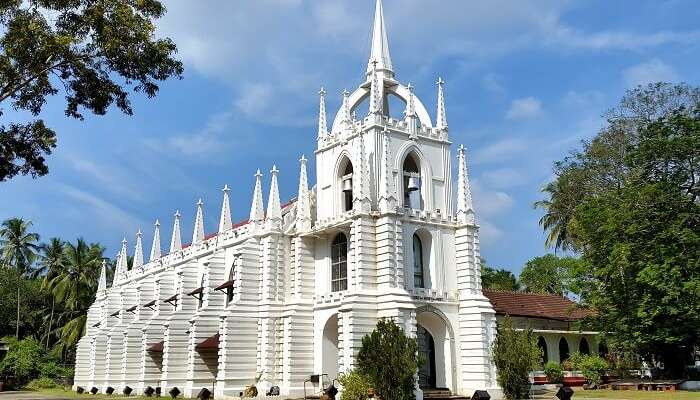
Built in 1586, the Saviour of the World Church is a sight to behold even today. The majestic shrine boasts of being one of Goa’s most gorgeous churches built in the Mannerist Neo-Roman style of architecture. Located in Salcette, Loutolim at a distance of around 10 km from Margao, the church is open every day between 6 am and 7 pm.
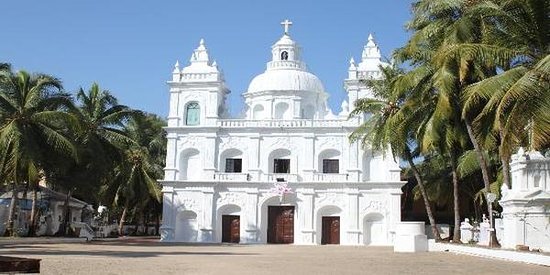
St. Alex Church
Built in the year 1597 on the banks of Angoddi Tollem Lake in Curtorim, St. Alex Church is among the oldest chapel churches in the region. An interesting fact about the church is that it was constructed on the site of an ancient Hindu temple, called Ravalnath Temple. If you walk around the church, you can still see the ruins of the temple here. The church is around 6 km from Margao and is open daily from 9 am to 8:30 pm.

Shantadurga Temple
This temple is devoted to goddess “Shantadurga” who is worshiped as the “Goddess of Peace”, and as a mediator between Lord Shiva and Lord Vishnu. The divine shrine was initially situated at, Cavelossim but during the demolition period of the Portuguese in the mid 15th century, the celestial being was relocated to Kavlem. This ancient temple with its vibrant combination of the maroon, white and peach exemplifies the Indo-Portuguese architectural style giving the temple an enchanting old-charm look. Apart from these, the Nayan Manohar Deepstambh, a five-story lamp tower, is another point of attraction which is beautifully lit during the festivals. The temple is located in Ponda and is open from 5 am to 10 am every day.

Tambdi Surla Mahadev Temple
Built in the 12th century, the temple is is a Shaivite temple dedicated to Lord Shiva, built in the Jain style of architecture. It is considered the only specimen of Kadamba-Yadava architectural style in preserved basalt stone in Goa. The temple has a Shiv Ling which is mounted on a pedestal and, has four withstanding pillars embellished with excellent carvings of elephants. Also, there are finely carved sacred lotus flowers and, intricate carvings designed by skilled craftsmen which add up to the charm of the stone ceiling and, the building. The temple is located near the Bhagwan Mahaveer Wildlife Sanctuary and is open daily from 7 am till 5:30 pm.

Chandreshwar Bhoothnath Temple
This temple is another one dedicated to Lord Shiva who is worshipped here as the Lord of the Moon. This ancient temple stands atop the Chandranath Hill. If you happen to visit the temple on a full moon night, you can see the Shiva Linga inside the shrine looking resplendent under the moonlight. There’s also the Boothnath Temple nearby which is worth a visit. This temple is also dedicated to Lord Shiva where the deity is worshiped as the Lord of the ghosts. Open from 5:30 am till 8:30 pm daily, this temple is located in Paroda in the Quepem taluka.

Naval Aviation Museum
A popular place to visit with children, the museum has a huge exhibition of large machines and artifacts related to the evolution of naval aviation in the country. Here, one can see real Helicopters, Aircraft, Fighter Jets and learn about their history. The museum is a made up of two parts; one is the outdoor large park which has 13 aircraft in total namely, Sea Harrier, HAL Chetak, Westland Sea King and many more such decommissioned aircraft, exhibiting the evolution of the Indian Naval Air Arms and another is the double-storey indoor gallery where you can learn many interesting things about flying, like the aircraft ejection system and life-rafts. The place also has a café (called Cockpit Café) where you can enjoy a tea, a souvenir shop, and a mini theatre where you can catch short movies and documentaries on naval aviation. The Naval Aviation Museum is the only of its kind in Asia. The museum is in Vasco de Gama, near the airport and is open from 9:30 am to 5 pm, on all das except Mondays when it is closed. The entry fee is Rs. 30 per adult and Rs. 10 per child.

Goa Chitra Museum
Go on a journey through the cultural and historical past of Goa through the 4000 plus exhbits at the Goa Chitra Museum. These artifacts map out the lifestyle of the people of Goa in the past and how it changed over time, owing to many historical and cultural factors. The museum is a treasure trove of all sorts of artifacts, ranging from agricultural tools to musical instruments, and even staple food. Needless to say, it is one of the must-visit museums in Goa where you can get a glimpse into the region’s rich and interesting past. Located in Benaulim and open from 9 am to 6 pm daily, you can go to the museum with an entry fee of Rs. 300 per person.
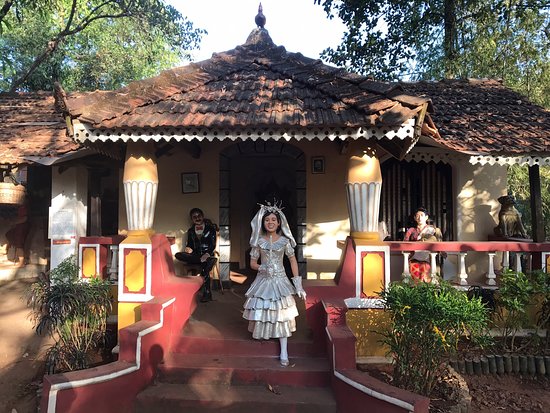
Big Foot Museum
This museum is an off-beat museum established and run privately by an artist named Maendra Alvares. It is an open-air museum that recreates a miniature Goan village of the bygone days. Some of the key highlights of the museum include miniature houses that depict traditional Goan life and culture, a handicraft center that sells Goan artifacts, a bird habitat, a restaurant, rubber plantations, a spice yard, and lot more. The 14-meter high Sant Mirabai sculpture, which apparently is the largest laterite sculpture in the country, is another key attraction of the museum. Located in Loutolim at a distance of about 9 km from Margao, the museum is open from 9 am to 6 pm every day and the entrance fee is Rs 50 for adults and Rs 30 for children.

The Grande Island
Also known as Ilha Grande, this island is a treasure trove of palm trees, jaw-dropping marine life experiences, and extraordinary sunsets. One can indulge in sight-seeing, snorkeling, sea walk, swimming, and many more aqua activities at the island. You can also go dolphin sighting from here which is an amazing experience.

Pequeno Island
Commonly called the Bat Island, this serene island with several picturesque views, is located just a kilometer away from the Baina Beach in Vasco da Gama. The crystal clear water with its marine life attracts the masses. The perfect place to view the stars and have a camfire, this island is the bliss for those seeking solitude.

Bhagwan Mahaveer Wildlife Sanctuary
Lying the westeen ghats, sprawling over an area of 240 km, this wildlife sanctuary came into existence in the year 1999 under the Wildlife Act. The sanctuary has rich flora and fauna which attracts the tourists. One can witness bewitching scenic views and come across numerous varieties of animals like pythons, cobras, slender toris, jungle cats, elephants, avian birds, and many more rare species. One can even hire a jeep to explore every nook and corner of the diverse sanctuary. Located off the national highway 4A at Caranzol, the wildlife sanctuary is open from 8 am to 5:30 pm. The entry fee is Rs. 20 per person for adults; Rs. 10 per person for children; Rs 30 per camera and Rs 150 per video camera.

Netravali Wildlife Sanctuary
Seated in the south-eastern part of Goa, the Netravali Wildlife Sanctuary lies in Verlem, around 46 km from Margao, near a tributary of the Zuari river. Nestled with dense forests which remain evergreen throughout the year, this sanctuary is renowned for varieties of animals like Gaur, Ratufa indica, Tetracerus quadricornis, and leopard. Its famous birds are Malayan night heron, Nilgiri wood pigeon, pied hornbill, grey-headed bulbul, white-bellied treepie and a rufous babbler. The best time to visit this place is from October to March and at this time one can easily spot the rare species of flora and fauna like Black Panther, four horned antelope, and colorful butterflies. Entry to this sanctuary is free and it is open from 8:30 am to 4:30 pm

Cotigao Wildlife Sanctuary
Located in Canacona, at a distance of around 58 km from Margao, the Cortigao Wildlife Sanctuary entices you to a world of exotic flora and fauna. It boasts of varied wildlife species, including slender loris, mouse deer, Indian pangolin, Malabar trogon, Malayan bittern, golden-back gliding snake, and many more. One of the prime attractions of the sanctuary is a treetop watchtower overlooking a watering hole. If you climb up the watchtower during dawn or dusk, you can watch many animals visiting the watering hole to quench their thirst. And now, that’s a sight you wouldn’t want to miss in a lifetime. The sanctuary is open from 7 am to 5:30 pm daily and the entry fees are Rs. 5 per adult and Rs. 2 per child.

Dudhsagar Falls
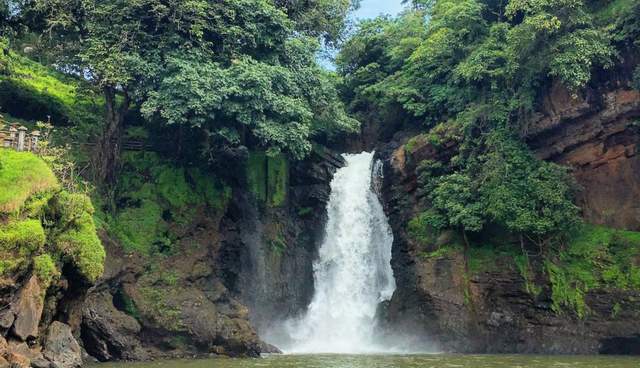
Located in the Bhagwan Mahaveer Sanctuary and Mollem National Park, this picturesque falls surrounded by lush green forests and falling from a height of 1,000 feet or 310 meters, forms the border between Goa and Karnataka. The literal meaning of Dudhsagae is “Sea of Milk”, which is what this waterfall looks like when it is in full glory. The gushing water sprawling down through the tropical forest gives captivating views. If you are an adventure enthusiast then you can even trek to the waterfalls and explore the bewildering paths which lead to it. You can even stay near the waterfall, at the forest guesthouse that is taken care of by the Karnataka Tourism Development Corporation. The falls are open from 9 am to 6 pm and the entry fee is Rs. 20 per person. You can also pay Rs. 400 per person for a jeep drive from Castle Rock to Dudhsagar Falls. At the falls you need to pay Rs. 300 for a normal camera and Rs. 5000 for a professional camera permit.

Bamanbudo Waterfalls
Untouched and unexploited are the words which perfectly describe the Bamanbudo Waterfall. This waterfall flows in the backdrop of serene Amba Ghat. The waterfall is undoubtedly the picture-perfect spot, with water falling down through the lush green hillock. The sound of the water, freshness in the air and, everything beautiful contributes to the significance of the place. This waterfall is located on the main road and one cannot trek to this splendid destination. It is located in
Gordongram and is open 24 hours.
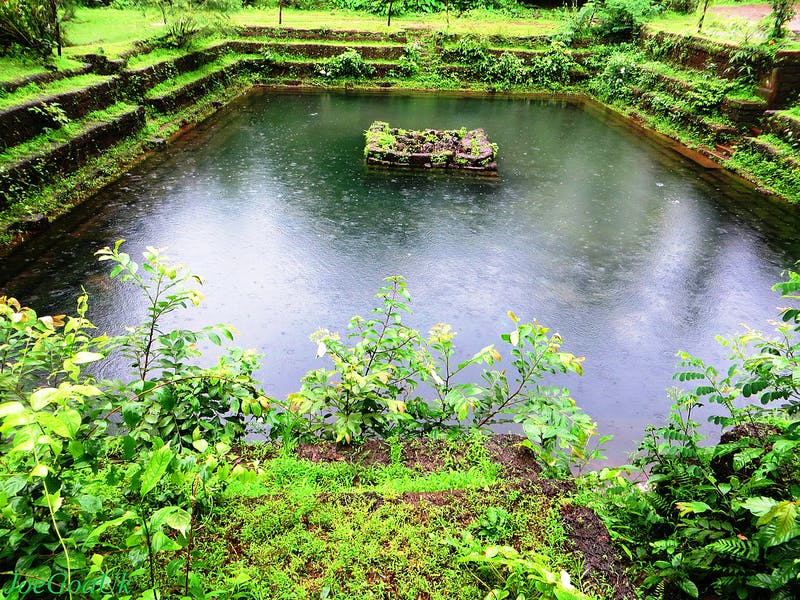
Netravali Bubbling Lake
The sacred water reservoir, Netravati Bubbling Lake is a part of the Gopinath Temple. The astonishing fact about the lake is that it has clean water which keeps on bubbling at different points and bubbles even more if someone starts clapping. The priest who resides there believes that it will create the same bubbling effect if you start enchanting “Om” however, these are just mythological stories and the real fact is it bubbles due to the presence of limestone, carbon dioxide or methane in water. The massive temple of which this lake is a part of, has a huge pedestal in the center of the lake and is frequented by the devotees of Shiva. It exhibits an intrinsic style of pillars carved by the Kadamba-Shilahara craftsmen. This lake is located in Netravali in Vichudrem and is open from 8 am to 6 pm.

Cabo de Rama Fort
This decrypted structure with towers and rustic cannons is counted amongst the oldest forts in Goa. It used to be a well-equipped fort with 21 guns, several military barracks and a chapel but, when the Portuguese left India, the place was abandoned and, later used as the government prison. Now, the fort is housed only by the ruins but is a popular tourist place. A popular legend in the area states that Lord Rama and his wife Sita had stayed at this fort during their exile from Ayodhya. It is said that the fort was named to honor Lord Rama. The Fort also has a church of Santo Antonio which is in great condition and still visited by his followers. The mystical atmosphere, steep cliffs, and majestic views make it a frequently visited place. It is a perfect place for you whether you are an adventure buff, photo fanatic or a nature lover. The fort is in Canacona and is open from 9:30 am to 5:30 pm daily.

Chandor
On the banks of the river Kushavati, Chandor is a sleepy town in South Goa. This destination has made its mark as a significant stop for its collection of Portuguese architecture. Between 6th and 11th century, this village was called Chandrapur and was reckoned as the most spectacular city of the Konkan Coast. Today, Chandor is a small village with important relics dating back to the Portuguese era and a Hindu temple and headless Nandi Bull built in the 11th century. The best way to reach Chandor is by a cab from Margao and the best time to visit is between October to April.
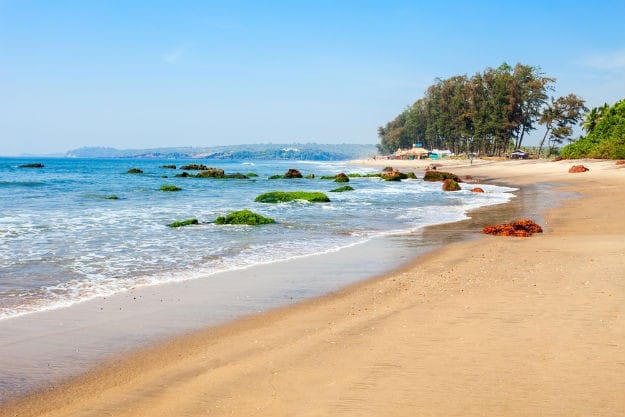
Travel Bucket List – India: Goa Part 2

Now that we have an introduction to Goa, in the next two posts, I will take you in detail through the districts of North Goa and South Goa.

North Goa is one of the two districts that make up the state of Goa. The district is bounded by Sindhudurg district of Maharashtra state to the north and by Belgaum district of Karnataka to the east, by South Goa District to the south, and by the Arabian Sea to the west. Much of today’s North Goa was under the Kingdom of Sawantwadi. Hence these areas were seen as a safe haven for the Hindus who were living under continuous fear of the Portuguese Inquisition. These areas were conquered by Portuguese as part of New Conquest in the late 18th century and then remained with the Portuguese till 1961 when it was annexed by India.

Beaches
North Goa is seen is the more happening and party place of Goa as compared to South Goa. The beaches here are very beautiful and crowded during peak times. Some of the best North Goa beaches include

Source

Vagator Beach which is a a crescent shape beach offering myriad watersport activities. The stunning red cliffs and cracked rocks surrounding the beach is an Instagram hotspot as are sunsets from this beach. The three day Sunburn Music festival which will take place in 2020 in December is an annual electronic dance music festival. Since its inception, Sunburn has grown to become one of Asia’s largest music events. The beach is bifurcated into two parts; one where you will find the flea market and lots of shacks to eat. Vagator Beach is about 20 kms from Panaji. Ozran Beach is an extension of Vagator Beach, and this secluded beach is a standout amongst the most picturesque Goan beaches. This beach boasts of a postcard perfect view of the coastline. The rocky beach is an ideal spot for picnics where you can enjoy the scenic beauty under the shade of palm trees. Here you can enjoy the sunsets as the sky turns golden from the sundecks outside the beach shacks. One of the attractions on this beach is the rock sculpture which people popularly call the Shiva Face which was carved by one of the tourists.

Nesting between the Aravalli hills, Anjuna beach is among the cleanest beaches in Goa. The hippies were the first people to come here in the 1950s and since then Anjuna Beach is a hotspot in Goa for local and international tourists. Anjuna Beach grows on you as you take a stroll along the glowing white sands and enjoy the sight of gently swaying palms in front of you. This beach is also famous for its Wednesday Flea Markets where you can shop for souvenirs, knick-knacks, funcky jewellery, beachwear, sarongs, traditional handicrafts etc. The market is located in the southern end of the beach where there are also several food stalls, body piercing centers, live music, and other entertainment activities in and around the market. The market is open only from October to May, from 8 am to 8 pm, so plan your visit accordingly if you want to enjoy the market. The beach is around 22 km north of Panaji and lies between Vagator and Calangute beaches.

Source

Named the ‘Queen of Beaches’, the sandy Calangute Beach is the perfect blend of adventure and beauty. The beach ticks all the boxes for a fun day, be it shopping, soaking in the picturequese sights or taking part in adventure water sports. This beach is often crowded with people swelling towards the sea, lazing around, taking sunbath and children making sand castles. Another spectacular features of Calangute Beach is its sunsets and sunrise. Calangute beach is about 16 km north of Panjim.

The scintillating Sinquerim Beach is an excellent shoreline that has a fabulous extend of sand. It is situated at the north of the well known shorelines like Baga, Calangute and Candolim. It is a perfect place for swimming and one ought not to miss going to this shoreline when vacationing in Goa to enjoy the beach activities. The beach offers the best opportunities to try water sports in Goa like scuba diving, water-skiing, windsurfing and much more. This beach also has some amazing night clubs and restuarants and is located about 14 km north of Panaji.

A calm and peaceful beach, Candolim Beach has no shops, restaurants or any commercial activity. Scrubs covered dunes at the back is the major attraction. Tranquil ambiance, thrilling water sports, and an enchanting nightlife make Candolim the perfect spot for honeymooners. Don’t forget to try a dolphin sighting trip and see if you spot this elusive yet friendly creature.

Another secluded beach known for its beauty and tranquillity, Arambol Beach , also known locally as Harmal Beach, is a rocky and sandy beach giving out a bohemian vibe. This beach is counted among the less-crowded beaches in Goa, which makes it ideal for you to spend some romantic moments with your special someone and indulge in some amazing water-based activities. You can even shop for knick-knacks and junk jewelry from the small shops lining the beach or have a drink or two at one of the shacks surrounding the beach. The beach is 35 km north of Panaji, close to the Maharashtra-Goa border.

Well known for it’s white sands, clear water and lines of palm trees that line the shoreline, Mandrem Beach is one of the less well known North Goa beaches. Visit this place during the high tides because that is when its beauty is at its peak. This beach is snuggled between Ashvem and Arambol beaches and lies around 20 km north of Panjim.

Morjim Beach is located in what is locally known as Little Russia, so expect to see many Russians expats here. This beach is the nesting and hatching habitat of the Olive Ridley Sea Turtle, so is an amazing place to just chill, relax and unwind as this beach is a protected area. If you want to see the turtles come here to nest and return to the ocean, come between September to April, but do take note of the exact dates as environmentalists say the nesting season has become later in the last few years.

Miramar Beach is famed for its alluring palm trees and lies close to the confluence point of the Mandovi river and the Arabian Sea. This beach is just 3 km south of Panjim city centre and lies between Panaji and Dona Paula.

Also known as Shiridon, the coarse sand Siridao Beach is famed as the “Shell Collectors Beach” and lies at the mouth of the Zuari river. Shell collectors can find the most unique shells and a wide range of oysters and pearl shells as well as some mysterious caves nearby.

Temples
When you think of Goa, temples are not what comes to your mind, but there are many temples in Goa with rich history and culture. Some of the best temples in Goa are:

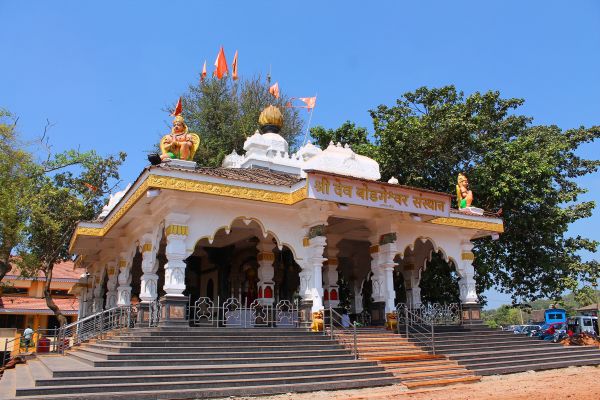
One of the important temples of North Goa, the Temple of Bogdeshwara is an exquisite structure and is a masterpiece in its own right. Located in the verdant greenery, the temple is dedicated to Kanakeshwar Baba or Bodgeshwar, also known as Bongini. In complete contrast to the hip and happening façade of North Goa, this small shrine exudes tranquility and is an ideal place to spend a few hours soaking in the serene vibes. This temple is famous for fulfilling the desires of its devotees and evry year, thousands of people visit this temple to get their prayers heard. The annual fair called ‘Zatra’ is held at the temple during the month of December or January. The temple is located in Mapusa, on the Calangute-Mapusa road, about 12 kms from Panaji. The temple is open from 6 am to 8 pm daily.

Located in Mangeshi village, about 22 km from Panjam, the 450-year old Mangeshi Temple, dedicated to Lord Shiva, is one of the largest and most frequently visited temples in Goa. The temple is built in the Goan temple architecture style consisting of several domes, pilasters and balustrades. There is a prominent Nandi Bull and the temple has a unquie Deepastambha which is a seven storey octagonal lamp tower, painted white with golden arches inside the temple complex. When the deepstambha is illuminated at night, the sight is simple awe inspiring. The temple also has a magnificent water tank, which is believed to be the oldest part of the temple. The temple is open from 6 am to 10 pm.

The village of Bandode or Bandivade is the location of a number of temples among which is the large and beautiful temple of Goddess Mahalaxmi. The temple of Goddess Mahalaxmi has been in existence since at least the year 1413, when information about the rituals of the temple is found on stone plaques carved during the reign of Nanjan Gosavi Pratihast over Goa. As is the case with most Hindu deities in Goa, the idol of Mahalaxmi from this temple was also smuggled away in the middle of the night to avoid persecution by the Portuguese in the sixteenth century. Adorned with a pillared hall and a silver arched doorway, the temple features an idol of Goddess Lakshmi crafted out of black stone. Adding to the beauty of the temple are twenty-four wooden panels displaying scenes from the Bhagavata Purana. The temple is open from 6:30 am to 8:30 pm every day.

Forts
Because of the more than four centuries of Portuguese rule in Goa, there are many interesting and architecturally forts which have stood as sentinels over the centuries.

One of the most famous of Goa forts, Fort Aguada is located at the mouth of the river Mandovi. The fort offers gorgeous views of the Arabian Sea. This beautiful fortress constructed in 1612, also boasts of a four-storeyed Portuguese lighthouse, the oldest one of its kind in Asia, which has beautiful sweeping views of the sea and the nearby Aguada beach from a height. Don’t miss the series of prison cells in the fort. Fort Aguada is so large it sweeps along the entire peninsula of the southern tip of Bardez. It is one of the best places to visit in north Goa during the monsoons. The fort is free to enter and is open from 10 am to 5:30 pm.

Dating back to 1717, the Chapora Fort overlooks the dazzling Vagator Beach, Morjim Beach, Ozran Beach and the mouth of the Chapora river. The Portuguese built this fort with the purpose of keeping a check over the Hindu raiders. This place, which is partly in ruins is a nice photography spot due to the sweeping views it offers. There are also two tunnels that Portuguese constructed to escape in case of an emergency in the fort. The fort is open from 9:30 am to 5:30 pm daily.

The most well-preserved of forts In Goa and standing on a hilltop, the Reis Magos Fort was constructed by Afonso de Noronha, a Portuguese Viceroy between 1551 and 1554. The fort is located on the hill onlooking the magnificent Reis Magos Church, at the merging point of the Mandovi river. From serving as a residence for viceroys and other significant personalities to being a prison and then lying as an abandoned fort, Reis Magos Fort has seen many chapters of history unfold within its walls. Today, the fort serves as a cultural center and draws in a large number of tourists. The fort is located in Bardez and is open from 9:30 am to 5 pm on all days except Mondays when it is closed.

Chuches and Basilicas
The Portugese occupation of Goa means that there are many churches in the state, some of which are very famous and are on every tourist’s itinerary.

The Basilica of Bom Jesus needs no introduction as it is one of the most photographed places in Goa. A UNESCO World Heritage Site, the Basilica, dating back over four centuries, is characterized by baroque architecture and fine detailing, carved from basalt embellishments, it is one of the richest facades in Goa. The Basilica of Bom Jesus is most famous for holding the mortal remains of St. Francis Xavier. The basilica also has a collection of paintings related to the life of the St. Xavier and relics of other saints such as Jesuit Rudolf Acquaviva and Antoni Francisci. The church is open from 9 am to 6:30 pm Mondays to Saturdays and from 10 am to 6:30 pm on Sundays.

Marked by its spectacular double flight of steps zigzagging its way upward, the Church of Our Lady of Immaculate Conception which is located on a hillside, overlooking the city of Panjim, boasts of a majestic structure. It houses the ancient bell that was once a part of the Church of Our Lady of Grace. It is said to be the second largest bell of its kind in Goa. The church is open everyday between 9 am to 12:30 pm and from 3:30 to 7:30 pm.

The Chapel of St. Catherine exhibits a simple renaissance style architecture, but it has immense historical significance. This edifice owes its origin to the Portuguese general Afonso de Albuquerque, who commissioned its construction in 1510 to commemorate his victorious march into the city. Located in Taleigao, the chapel is open daily from 6 am to 6 pm.

Housing the the miraculous statue of Mae de Deus which brought the church back to life post its ruin state, the Church of Mae De Deus is a bright white building with neo-gothic architecture is so peaceful, you will not feel the time time spent here. With imposing interiors and carved ornamentation on ceiling and walls, the church is a nice place to spend an afternoon peacefully. It is located in Saligao and is openevery day from 9 am to 12:30 pm and then again from 3 to 5 pm.

Museums, Casinos and Islands
Goa is much more than beaches, temples, forts and churches. Below are some of the other interesting activities you can do in North Goa.

The Goa State Museum is a treasure trove of more than 8000 artifacts and antiques depicting the glorious past of Goa. Of all museums in Goa, this one exhibits items pertaining to religious expression, history of printing in the state, lottery printing, cultural anthropology, contemporary and Christian art, furniture, sculptures as well as information on Goa’s struggle for freedom. There are also screenings of short videos of various cultural, heritage and anthropological facts about Goa. The museum is open from 10 am to 6 pm, Monday to Friday.

If you are fascinated by the architectural beauty of Goa, you must visit the Houses of Goa Museum. Unlike other museums in Goa, this museum offers a peek into the evolution of houses in Goa and its surrounding areas. Interestingly, the museum itself is shaped like a ship and stands right in the middle of the road. The museum is located in Torda, Salvador Do Mundo and is open from 10 am to 7:30 pm. It is closed on Mondays. The entry fee is Rs 100 for adults and Rs. 25 for children.


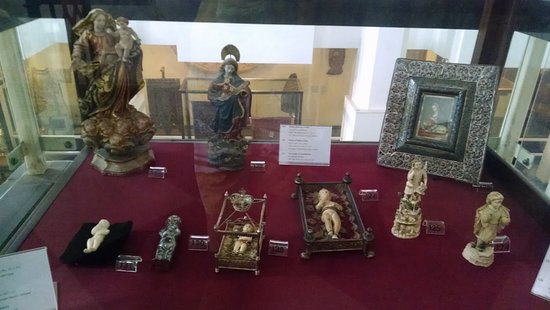
Christianity has played an undeniable role in the history and culture of Goa and the Museum of Christian Art is where you can get a glimpse into this rich history. The museum showcases many relics that are as old as the Portuguese invasion of the region. From statues and furniture to ivory, paintings, and precious metals, you will find a wide range of interesting exhibits here. Located in old Goa or Velha Goa, the museum is closed on Sundays and open from 9:30 am to 5 pm. Entry fee is Rs 30 per person.

Located in Calangute beach, Casino Palms is the most famous casino in Goa. Try your luck playing roulette and other games. The casino is open 24 hours daily. There is also a bar and plush lounges inside the casino to enjoy the nightlife.

Chorao Island’s name is is from Sanskrit which means ‘Stunning Precious Stone’. The largest island in Goa, it is located just three km from Panaji and has grown from a settlement for Portuguese noblemen to a quaint island with churches and old villas.

Cascading from the height of 50 m or 24 feet, the Harvalem Waterfalls is one of the those places where you can have a relaxing picnic. These falls make a plunge pool at the bottom where one can swim in and relax with cold waters. A temple dedicated to Lord Shiva is nearby along with a well-maintained park where one can just sit and observe the deep beauty it possesses. If you plan to visit this waterfalls, try to reach right after the monsoon as the water gushes in the highest amount during the time making it beautiful more than ever. The falls are located about 8 km from the town of Bicholim, which is around 25 km from Panjim and is open daily between 9 am and 6 pm.

This was all about North Goa. In the next blog post, we will go down south and see what South Goa has to offer.

Travel Bucket List – India: Goa Part 1

Located just south of my home state of Mahashtra, the state of Goa is the smallest Indian state by area and the fourth smallest by population. Goa has the highest GDP per capita among all Indian states – two and a half times that of the country. It was ranked the best-placed state by the Eleventh Finance Commission for its infrastructure and ranked on top for the best quality of life in India by the National Commission on Population based on the 12 Indicators

Rock art engravings found in Goa exhibit the earliest traces of human life in India. In the 3rd century BC, Goa was part of the Maurya Empire, ruled by the Buddhist emperor, Ashoka of Magadha. Between the 2nd century BC and the 6th century AD, Goa was ruled by the Bhojas of Goa. The rule later passed to the Chalukyas of Badami, who controlled it between 578 and 753, and later the Rashtrakutas of Malkhed from 753 to 963. From 765 to 1015, the Southern Silharas of Konkan ruled Goa as the feudatories of the Chalukyas and the Rashtrakutas. Over the next few centuries, Goa was successively ruled by the Kadambas as the feudatories of the Chalukyas of Kalyani. In 1312, Goa came under the governance of the Delhi Sultanate. The kingdom’s grip on the region was weak, and by 1370 it was forced to surrender it to Harihara I of the Vijayanagara empire. The Vijayanagara monarchs held on to the territory until 1469, when it was appropriated by the Bahmani sultans of Gulbarga. After that dynasty crumbled, the area fell into the hands of the Adil Shahis of Bijapur, who established as their auxiliary capital the city known under the Portuguese as Velha Goa (or Old Goa). In 1510, the Portuguese defeated the ruling Bijapur sultan Yusuf Adil Shah with the help of a local ally, Timayya. They set up a permanent settlement in Velha Goa. This was the beginning of Portuguese colonial rule in Goa that would last for four and a half centuries, until its annexation in 1961. In 1843 the Portuguese moved the capital to Panaji from Velha Goa. By the mid-18th century, Portuguese Goa had expanded to most of the present-day state limits. Simultaneously the Portuguese lost other possessions in India until their borders stabilised and formed the Estado da Índia Portuguesa or State of Portuguese India. After India gained independence from the British in 1947, India requested that Portuguese territories on the Indian subcontinent be ceded to India. Portugal refused to negotiate on the sovereignty of its Indian enclaves. On 19 December 1961, the Indian Army invaded with Operation Vijay resulting in the annexation of Goa, and of Daman and Diu islands into the Indian union. Goa, along with Daman and Diu, was organised as a centrally administered union territory of India. On 30 May 1987, the union territory was split, and Goa was made India’s twenty-fifth state, with Daman and Diu remaining a union territory.

Goa features a tropical monsoon climate and being in the tropical zone and near the Arabian Sea, has a hot and humid climate for most of the year. The month of May is usually the hottest, seeing daytime temperatures of over 35 °C coupled with high humidity. The state’s three seasons are: Southwest monsoon period (June – September), post-monsoon period (October – January) and fair weather period (February – May). Over 90% of the average annual rainfall is received during the monsoon season.

The state is divided into two main regions – North Goa and South Goa. Panaji, which is the capital of the state is also the district headquarters of North Goa. The headquarters for South Goa is the city of Margao, which is the second largest city as well as the commercial and cultural capital of the state.

Goa is a state with highest proportion of urban population with 62.17% of the population living in urban areas. Even though the state was under Portugese occupation for more than four centuries, Hindus dominate the state. They are around two thirds the population in the state, while Christians account for a quarter of the population. Of the balance population, Muslims account for about 8.5% and the balance 0.5% are the Sikhs, Jains and other communities.

Tourism is the the biggest industry in the state, which accounts for around 12% of all foreign tourist arrivals in India. There are also scores of domestic tourists who love visiting Goa, especially for it’s beaches and nightlife. You generally see western or foreign tourists come to Goa in the winter months while domestic tourists visit Goa during the summer. One of the biggest tourist attractions in Goa is water sports. Beaches like Baga and Calangute offer jet-skiing, parasailing, banana boat rides, water scooter rides, and more. Over 450 years of Portuguese rule and the influence of the Portuguese culture presents to visitors to Goa a cultural environment that is not found elsewhere in India. Goa is often described as a fusion between Eastern and Western culture with Portuguese culture having a dominant position in the state be it in its architectural, cultural or social settings. The state of Goa is famous for its excellent beaches, churches, and temples.[61] The Bom Jesus Cathedral, Fort Aguada and a new wax museum on Indian history, culture and heritage in Old Goa are other tourism destinations.

Rice with fish curry (xit koddi in Konkani) is the staple diet in Goa. Goan cuisine is famous for its rich variety of fish dishes cooked with elaborate recipes. Coconut and coconut oil are widely used in Goan cooking along with chili peppers, spices, and vinegar is used in the Catholic cuisine, giving the food a unique flavour. The Goan cuisine is heavily influenced by Portuguese cuisine. Goan food may be divided into Goan Catholic and Goan Hindu cuisine with each showing very distinct tastes, characteristics, and cooking styles. Pork dishes such as Vindalho, Xacuti, chouriço, and Sorpotel are cooked for major occasions among the Goan Catholics. An exotic Goan vegetable stew, known as Khatkhate, is a very popular dish during the celebrations of festivals, Hindu and Christian alike. A rich egg-based, multi-layered sweet dish known as bebinca is a favourite at Christmas. Ros omelette is one of the most popular snacks and street foods in Goa, it is traditionally sold on food carts on streets. The most popular alcoholic beverage in Goa is feni; cashew feni is made from the fermentation of the fruit of the cashew tree, while coconut feni is made from the sap of toddy palms. In fact the bar culture is one of the unique aspects of the Goan villages where a local bar serves as a meeting point for villagers to unwind. Goa also has a rich wine culture, as a nod to its Portugese and Catholic heritage.

Travel Bucket List – India: Tamil Nadu Part 6

After visiting the temple towns, let’s check out some beach and coastal towns plus some other interesting places in the state. This is the last part in this series.

Mahabalipuram
Mahabalipuram, also called Mamallapuram is famous for its shore temples built in 7th century. This UNESCO World Heritage Site was the second capital of the Pallava kings of Kanchipuram. It is an ancient historic town and was a bustling seaport during Pallava kings in 7th Century AD. According to the legend, it has been named after the demon king Mahabali who was renowned for his generosity. Some maintain that it has been named Mamallapuram after the Pallava King Narasimha Varman I, a great wrestler with the title Mamallan.

It is known for its historical monuments, sculptures, scenic beauty, culture and tradition. Mahabalipuram art can be divided into four categories: open air bas-relief, structured temples, man-made caves and rathas or chariot temples. The famous Arjuna’s Penance and the Krishna Mandapa adorn massive rocks near the centre of the village. The beautiful Shore Temple towers over the waves, behind a protective breakwater. Sixteen man-made caves in different stages of completion are also seen, scattered through the area. The striking feature is that all the sculptures here are monolithic – giant structures carved from single rocks.

The temples of Mamallapuram, built largely during the reigns of Narasimha Varman and his successor Rajasimha Varman, showcase the movement from rock-cut architecture to structural buildings. The mandapas and the rathas shaped as temple chariots are made from the granite rock face, while the famed Shore Temple, erected half a century later, is built as a structured temple with huge blocks of rocks following wonderful architecture. Thirukadalmallai temple, Cholamadal Artist’s Village, Mahabalipuram Beach, Tiger Cave and Crocodile Bank serve as popular picnic spots for people here.

One of the prominent festivals celebrated here is the Mamallapuram Dance Festival, which is organized by the Department of Tourism every year during December – January. As part of the festival, various dance forms are showcased including Bharatanatyam, Kuchipudi, Kathakali and Odissi.

The best time to visit Mahabalipuram is from October to March while the peak season is from November to February. Usually it takes one full day to visit Mahabalipuram.

Kanyakumari
Located at the southernmost tip of the Indian Peninsula, Kanyakumari is also called Cape Comorin. Kanyakumari has been a great centre for art and religion for centuries. It was also an area of great trade and commerce. It was ruled by Cholas, Pandyas and Nayaks. Later on, Kanyakumari came under the rule of the Venad dynasty and its capital was located at Padmanabhapuram. In spite of the troubles encountered in the southern border of Venad, Marthanda Varma expanded the kingdom northwards to Aluva and established the kingdom of Travancore. In 1745, the capital was shifted from Padmanabhapuram to Thiruvananthapuram. Kanyakumari was ruled by the kings of Travancore, under the authority of the British, till India’s independence in 1947, after that it became a part of the independent Indian Union.

The city gets its name from the Hindu goddess Kanyakumari who was also known as Kumari Amman. Swami Vivekananda is said to have been lived here for a while and meditated. It is situated at the confluence of Bay of Bengal, Arabian Sea and Indian Ocean. This place offers marvelous views of both the sunrise as well as the sunsets. It is the only place in India where one can enjoy the unique spectacle of a sunset and the moonrise simultaneously on full moon days.

One of the main attractions in Kanyakumari is the Kumari Amman or Bhagavaty Amman Temple. Considered as one of the Shakti Peethas, this 3000-year-old temple, dedicated to the Goddess Kumari Amman attracts large number of devotees every year. The temple is the first Durga temple created by Lord Parasurama and one of the 108 Shakthi Peethas. This temple is situated at the shore of the Laccadive Sea. The Kumari temple has been mentioned in Ramayana, Mahabharata and Purananooru.

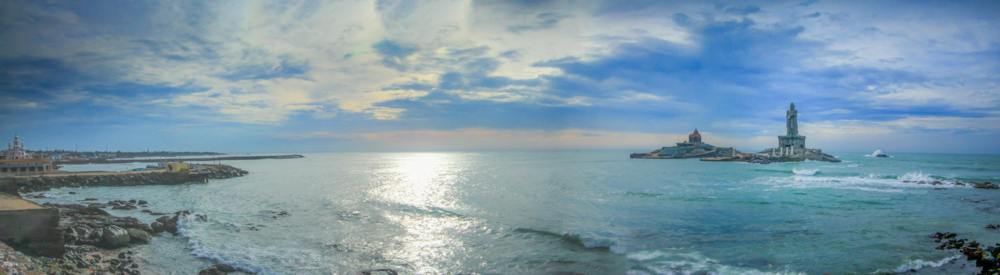
The Thiruvalluvar Statue has a height of 95 feet and stands upon a 38-foot rock that represents the 38 chapters of “virtue” in the Thirukkural. The statue standing on the rock represents “wealth” and “pleasures”, signifying that wealth and love be earned and enjoyed on the foundation of solid virtue. The combined height of the statue and pedestal is 133 feet, denoting the 133 chapters in the Thirukkural. The statue, with its slight bend around the waist, is reminiscent of a dancing pose of the ancient Indian deities like Nataraja. Vivekananda Rock Memorial

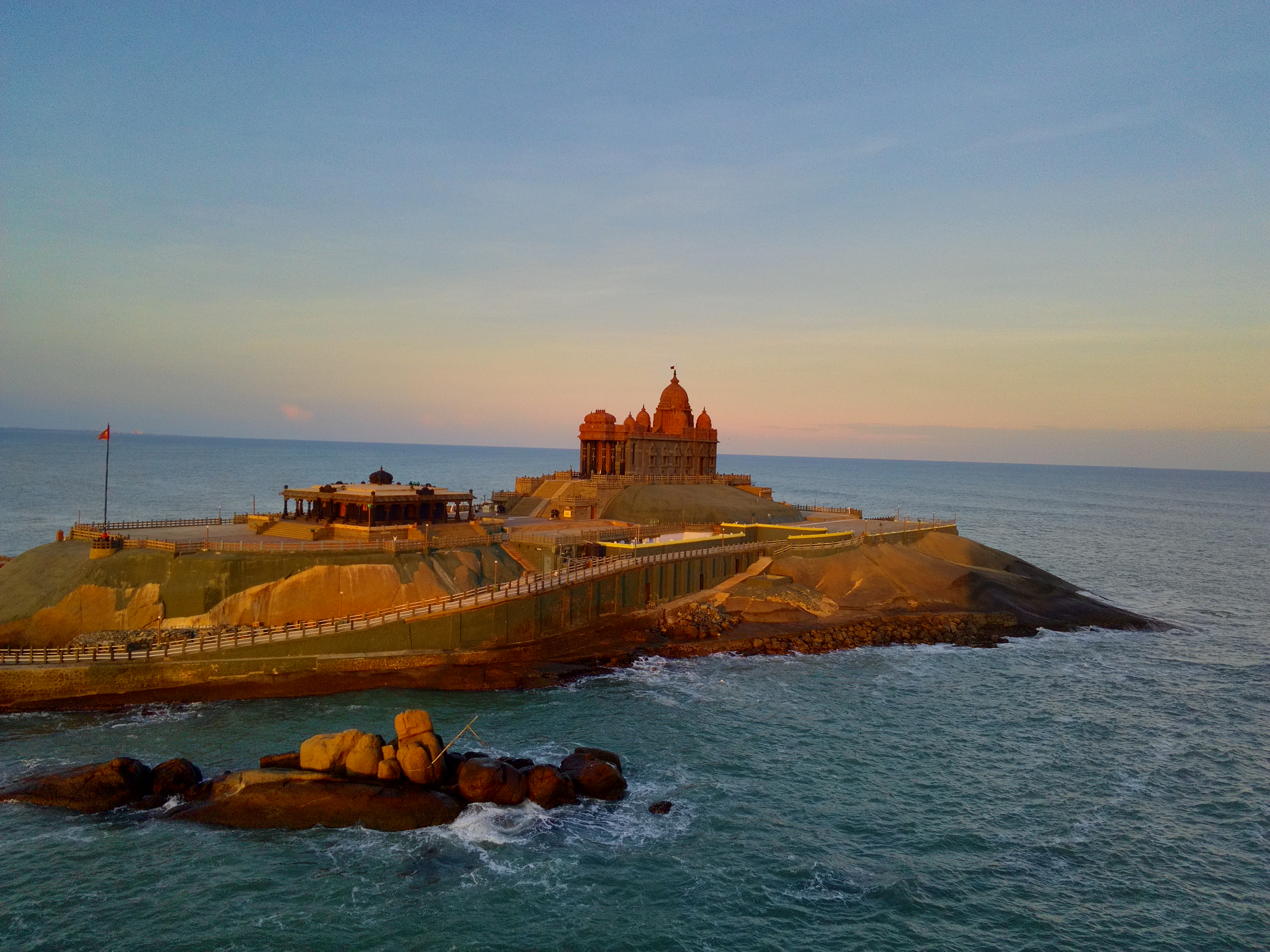
The Vivekananda Rock Memorial is a popular tourist monument in Kanyakumari. The memorial stands on one of two rocks located about 500 metres east of the mainland of Vavathurai. It was built in 1970 in honour of Swami Vivekananda who is said to have attained enlightenment on the rock. According to local legends, it was on this rock that Goddess Kumari performed austerity. A meditation hall (Dhyana Mandapam) is also attached to the memorial for visitors to meditate. The design of the mandapa incorporates different styles of temple architecture from all over India. The rocks are surrounded by the Laccadive Sea. The memorial consists of two main structures, the Vivekananda Mandapam and the Shripada Mandapam.

The Gandhi Memorial Mandapam has been built on the spot where the urn containing the Mahatma’s ashes was kept for public viewing before immersion. Resembling central Indian Hindu temples in form, the memorial was designed in a way that on Gandhi’s birthday, 2 October, the first rays of the sun fall on the exact place where his ashes were kept.

Near Kanyakumari’s southern shore stands a monument, called the Tsunami Memorial Park to the memory of those who died in the 2004 Indian Ocean earthquake and tsunami, an underwater megathrust earthquake that claimed around 280 000 lives in many countries, including India, Sri Lanka, Somalia, Thailand, Maldives and Indonesia.

Padmanabhapuram Palace, Suchindram, Pechiparai Reservoir, Vattakottai Fort, St Xavier’s Church and Udayagiri Fort are some of the other places to see in Kanyakumari. Some of the popular beaches near Kanyakumari are Thengapattinam Beach, Sanguthurai Beach and Chothavilai Beach.

The Chaitra Poornima Festival, Navratri, and the Holy Annual Festival of the Catholic Church are some of the major festivals celebrated in Kanyakumari.

The best time to visit Kanyakumari is from October to March while the peak season is from November to February.

Mudumalai Wildlife Sanctuary
At a distance of 37 km from Ooty, the Mudumalai Wildlife Sanctuary or Mudumalai National Park is located at the foothills of the Nilgiri hills in the state of Tamil Nadu. It is one of the finest and most attractive wildlife sanctuaries in India. The protected area is home to several endangered and vulnerable species including Indian elephant, Bengal tiger, gaur and Indian leopard. There are at least 266 species of birds in the sanctuary, including critically endangered Indian white-rumped vulture and long-billed vulture.

Mudumalai is the first sanctuary in South India set up in 1940 and was declared as a National Park in 1990. In April 2007, the Tamil Nadu state government declared Mudumalai to be a tiger reserve. Mudumalai is a part of Niligiri Biosphere Reserve which includes the Bandipur National Park, Rajiv Gandhi National Park (Nagarhole) in Karnataka, and Wayanad Wildlife Sanctuary in Kerala.

By sharing its boundaries with the states of Karnataka and Kerala, the sanctuary is divided into 5 ranges – Masinagudi, Theppakadu, Mudumalai, Kargudi and Nellakota. There is a high diversity of animal life in the park with about 50 species of fishes, 21 species of amphibians, 34 species of reptiles, 200 species of birds and 50 species of mammals. The park is ideal home to several endangered and vulnerable species including Elephant, Tiger, Gaur, Leopard, Deer, Wild dog etc. There are about 200 species of birds in the park, including White rumped vulture, long billed vulture, Red crest, Mynas, Parakeets, and Owls etc.

Theppakadu is the entry point to the Sanctuary which has an Information Centre. The forest department organizes Elephant Safari into the park and also Elephant Interaction Camp. Trekking is not permitted in Mudumalai. Also, no jeep safaris are available here and private vehicles are only allowed on the outer peripheral roads in the park. The Forest Department runs mini-bus safaris into the Park starting from Theppakadu. The safari bus stops at Moyar Watchtower which offers spectacular views of Moyar Gorge & Waterfalls. Mornings are the best time for safari to spot the wildlife. The safari takes visitors to jungle home campus, which is situated 10 km into the deep jungle.

The Forest Department has accommodation in Forest Rest Houses at Theppakadu, Kargudi, Abayaranyam and Masinagudi. The forest department has cottages in various locations within the forests available on a first-come, first-served basis, and there are various private resorts and guest houses that visitors can stay in.

The best time to visit the Mudumalai National Park is from December to June.

The one hour Vehicle Safari starts from 6-9 am and then again from 3-6 pm. The 40-minute Elephant Safari starts from 7:30 – 10:30 am and then again from 2:30 PM – 5:30 pm.

The entry fee to the sanctuary is Rs 135 with other fees for photography, videography and Rs. 1500 for jeeps to enter the sanctuary.

Hogenakkal Falls
Hogenakkal is a waterfall where the Kaveri river splits into multiple streams of waterfalls and where there is water throughout the year.

Also known at Marikottayam, Hoge actually means smoke and Kal means rock. Sometimes referred to as the “Niagara Falls of India,” it is known for bathing areas and hide boat rides, projecting itself as a major tourist attraction. Carbonatite rocks in this site are considered to be the oldest of its kind in South Asia and one of the oldest in the world.

The word Hogenakal is formed of two Kannada words hoge and kal. When the water falls on the rocks it appears as if hoge (smoke) is emanating from the top of the kal (rock) because of the force of the water, hence Hogenakkal (smoking rocks). It is also called as Marikottayam by the people of Tamil Nadu.

Other than the Hogenakkal Falls, Mettur Dam, Melagiri Hills and Pennagram Villages are other places in the vicinity which are worth visiting.

Kutralam Falls
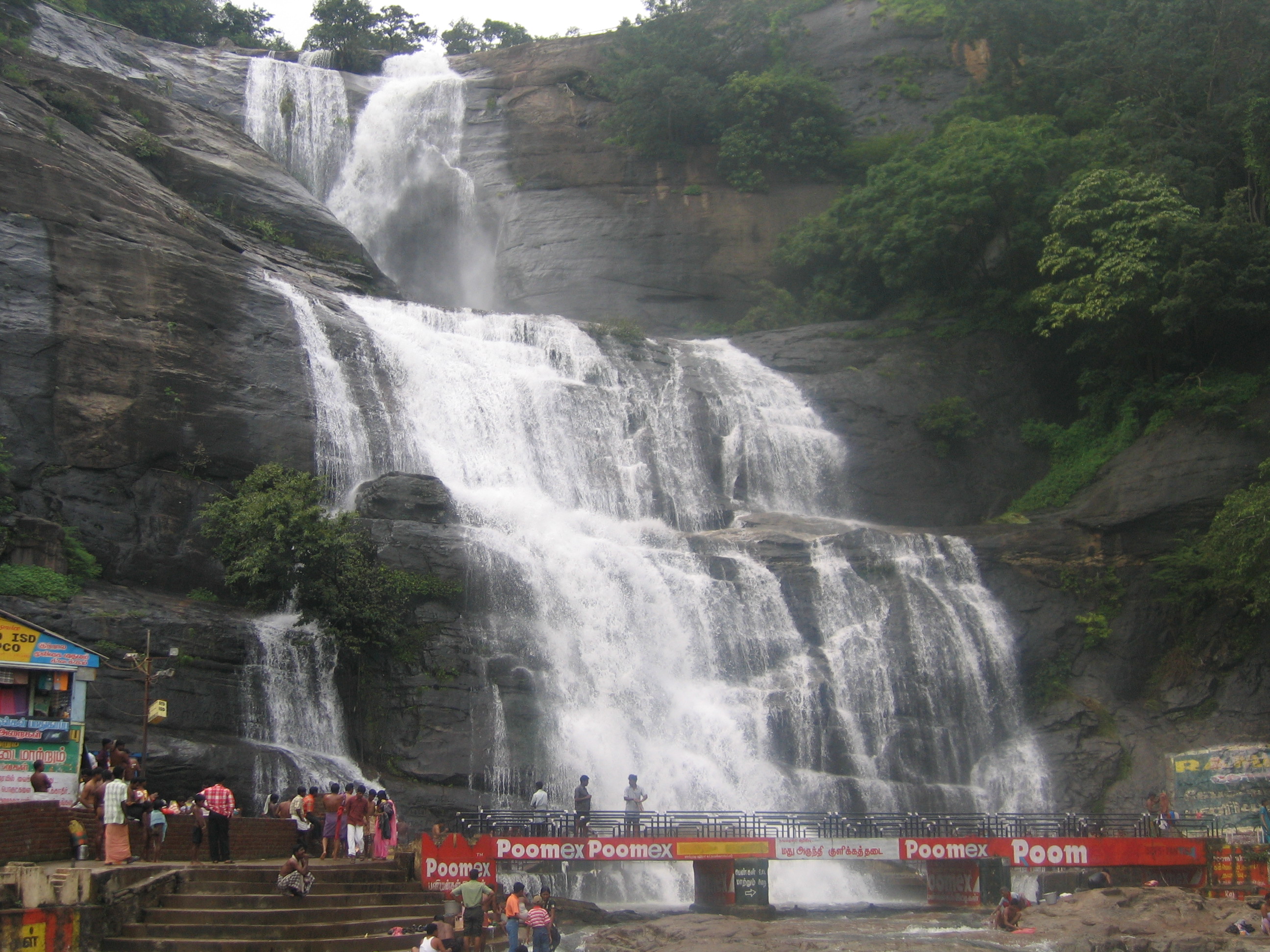
Kutralam or Courtallam, is a small town bordering Kollam District, famous for its waterfalls on the Western Ghats. With captivating panoramic vistas, the township is popularly renowned as ‘Spa of South’. It has nine waterfalls in the region that add a charm to its exotic beauty. One will also find Kutrallam adorned with ancient temples reflecting the age-old legends attached to them. The town itself like many other cities of India narrates mythological folklores adding to its mystique.

One of the prime attractions of all the nine waterfalls, Main Falls also known as Peraruvi is situated in the town center. It falls from an altitude of 60m and serves as the biggest of all the falls in the area. In fact, the water stream besides being a major sightseeing spot, is also place of worship for locals. However, take care of the time you travel as between November and January, the stream dries up. But at the same time during the peak season, it displays a sight of sheer beauty. Two temples dedicated to Goddess Kuzhalvaimozhi Amman and Sri Thirukutralanthar (Lord Shiva) are also big attention seekers situated in the vicinity.

A sight of pure brilliance, Five Falls is one of the most sought after destination in Kutrallam, situated around 4 km from the main town. Visitors are absolutely awe inspired by the sight it presents with falls splitting into five parts before rushing down at the Aranvankadu Pass. These five falls are regarded as the five heads of the cobras by the locals. However, three falls out of five can be accessed by men whereas only two falls are open for women. There are two temples also lying in the vicinity of waterfalls namely Swami Ayyappa Temple and Vinayaka Temple attracting lot of devotees.

Shenbaga Falls is one of those places which apart from being a famous tourists spot is also a major place of worship for locals. Also known as Chembakadevi, this place can be reached easily from Main Falls via trekking trail. The distance between the two is almost 3 kms. This fall derives its name from village Shenbaga Devi situated in the proximity that houses a temple dedicated to Goddess Shenbaga Devi, an incarnation of Goddess Durga. Owing to its religious importance, the place is flocked by the devotees in large number. They pay the homage to goddess with Shenbaga flowers which can be bought on the way to the temple from various shops.
Situated 4 km from the Main Falls, Honey Falls or Thenaruvi are quite famous among the locals as well as tourists. The stream derived its name from the beehives that are formed here during the dry season on the face of the rock. The view of the falls is very enchanting formed in the shape of horseshoe. The falls comprises of three streams that falls down to form a small lake right amid a rainforest. Situated about a 2 hour trek from Main Falls, this falls do not have the provision of bathing.

Palaruvi Falls, cascading downstream from the height of 300 ft, is one of the prime attractions in Kutrallam. The name Palaruvi means ‘Stream of Milk’ in the regional language. Ironically it seems to be a glittering stream of milk as it flows down. The roaring sounds of the fall stand in stark contrast to the silence of the forests and mist-kissed mountains around it. Situated in the Thenmala ranges, Palaruvi falls are surrounded by lush green forests, the Kallada River and some minor waterfalls. The enchanting place is perfect for savouring nature’s beauty. The fall not only does have an alluring beauty but also is considered sacred by the locals. The milk-like water is worshipped by people who believe it to be a religious spot. Also, Palaruvi waterfalls are among those seasonal waterfalls which ace their mightiness during the shower season and almost dry up in the midst of hot summers. The heavy downpour of water creates a splashing pool beneath for the people to enjoy the freshness of its water.

This brings us to the end of a visit around Tamil Nadu. I hope you had as much fun reading these posts as I had writing them. There are many on this list which I mean to visit the next time I go visit my ancestral state.

Travel Bucket List – India: Tamil Nadu Part 5

Please see the first part published on Wednesday before reading this post.

Kumbakonam
Kumbakonam is known as a “temple city” due to the prevalence of a number of temples here and is noted for its Mahamaham festival which attracts people from all over the country.

Kumbakonam dates back to the Sangam period and was ruled by the Early Cholas, Pallavas, Medieval Cholas, Later Cholas, Pandyas, the Vijayanagara Empire, Madurai Nayaks, Thanjavur Nayaks and the Thanjavur Marathas. It rose to be a prominent town between the 7th and 9th centuries AD, when it served as a capital of the Medieval Cholas. The town reached the zenith of its prosperity during the British Raj when it was a prominent centre of European education and Hindu culture; and it acquired the cultural name, the “Cambridge of South India”.

The name “Kumbakonam”, roughly translated in English as the “Pot’s Corner”, is believed to be an allusion to the mythical pot (kumbha) of the Hindu god Brahma that contained the seed of all living beings on earth. The kumbha is believed to have been displaced by a pralaya (dissolution of the universe) and ultimately came to rest at the spot where the town of Kumbakonam now stands. This event is now commemorated in the Mahamaham festival held every 12 years. Kumbakonam is also known as Baskarashetram[2] and Kumbam[3] from time immemorial and as Kudanthai in ancient times.

Kumbakonam is known for its temples and mathas (monasteries). There are around 188 Hindu temples within the municipal limits of Kumbakonam. Apart from these, there several thousand temples around the town thereby giving the town the sobriquets “Temple Town” and “City of temples”.

Adi Kumbeswarar Temple is considered to be the oldest Shaiva (the sect of the god Shiva) shrine in the town, believed to be constructed by the Cholas in the 7th century. The Nageswaraswamy Temple has a separate shrine for the Sun god Surya who is believed to have worshipped Shiva at this place. Adi Kumbeswarar temple, Nageswaraswamy temple and Kasi Viswanathar temple are Shiva temples in the town revered in the Tevaram, a Tamil Shaiva canonical work of the 7th–8th century. Kumbakonam has one of the few temples dedicated to the god Brahma.

Sarangapani temple is the largest Vaishnava (the sect of the god Vishnu) shrine present in Kumbakonam. The present structure of the temple having a twelve storey high tower was constructed by Nayak kings in the 15th century. It is one of the “Divya Desams”, the 108 temples of Vishnu revered by the 12 Alvar saint-poets. The Ramaswamy temple, which has scenes from the Hindu epic Ramayana depicted on its walls, was constructed by Govinda Dikshitar, the minister of successive Nayak rulers, Achuthappa Nayak (1560–1614) and Raghunatha Nayak (1600–34). He added a commercial corridor between the temple and the older Chakrapani temple, which in modern times is called Chinna Kadai Veethi, a commercial street in the town. Pilgrims from all parts of India take a holy dip once every 12 years during the Mahamaham festival, also known as the Southern Kumbh Mela in the Mahamaham tank.

You can also do the Navagraha temple pilgrimage, for the nine planets, keeping Kumbakonam as your base as all the temples are located quite close to each other and Kumbakonam. These Navagraha temples are located in the Cauvery delta region of Kumbakonam – Thanjavur. Traditionally these are Shiva temples with a shrine for one of the planets. It is believed that the planetary deities were cursed by Brahma to dwell in Vellurukku Vanam, the white wild flower jungle and were blessed by Shiva to make it their abode to devotees. The temples have six daily rituals at various times from 5:30 a.m. to 9 p.m., and two yearly festivals on its calendar.

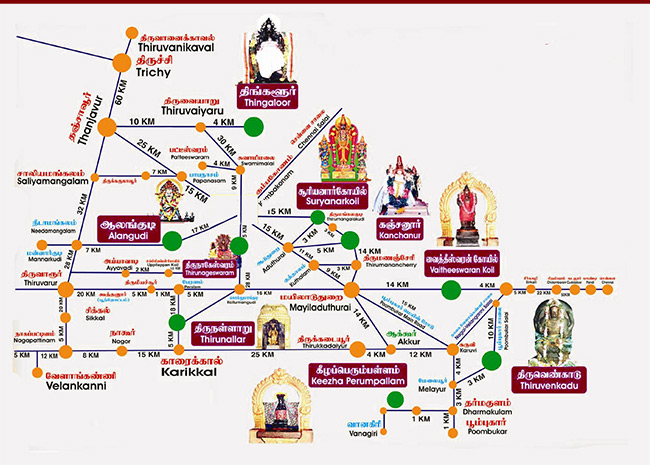
Suryanar Kovil or the temple dedicated to the Sun Lord is located to the East of Kumbakonam, 2 km from Aduthurai. Kanjanoor, the temple for Sukran or the temple for Venus, is located 3 km from Suryanar Kovil in the Aduthurai – Kuthalam road. The Thingalur temple dedicated to the Moon God or Chandran is located 35 km to the west of Kumbakonam in the Kumbakonam – Tiruvvayyaru Road. Vaitheeswaran Kovil which is the temple for Mars is located 50.5 km away from Kumbakonam on the Kumbakonam – Sirkazhi Road and 14.5 km away from Mayiladuthurai. Swetharanyeswarar Temple dedicated to Mercury is located 24 km from Mayiladuthurai and 13 km to the East of Vaitheeswaran Kovil. Ketu Stalam or the temple for the south node of the eclipse of the sun and the moon is located close to Poompuhar, 23 km to the South West of Vaitheeswarn Kovil. Alangudi is located 18 km to the South of Kumbakonam on the Kumbakonam – Mannargudi road. Rahu Stalam or the north node is located 6 km to the West of Kumbakonam on the Kumbakonam – Karaikal road and Saniswarar temple dedicated to Saturn is located 46 km further on the same road. Out of the nine temples, six are located on the northern bank of river Kaveri, while the remaining three in the southern bank.
Source

Thanjavur
Thanjavur, formerly known as Tanjore, is an important center of South Indian religion, art, and architecture. Most of the Great Living Chola Temples, which are UNESCO World Heritage Monuments, are located in and around Thanjavur. The foremost among these, the Brihadeeswara Temple, is located in the centre of the city. Thanjavur is also home to Tanjore painting, a painting style unique to the region.

The city is an important agricultural centre located in the Cauvery Delta and is known as the Rice bowl of Tamil Nadu. The city first rose to prominence during the reign of Cholas when it served as the capital of the empire. After the fall of Cholas, the city was ruled by various dynasties like Pandyas, Vijayanagar Empire, Madurai Nayaks, Thanjavur Nayaks, Thanjavur Marathas and British Empire. It has been a part of independent India since 1947. Carnatic music was codified in Thanjavur and the art flourished during the Nayak rule in the 16th century. Bharathanatyam, a classical dance form of South India, had its major styles developed in Thanjavur.

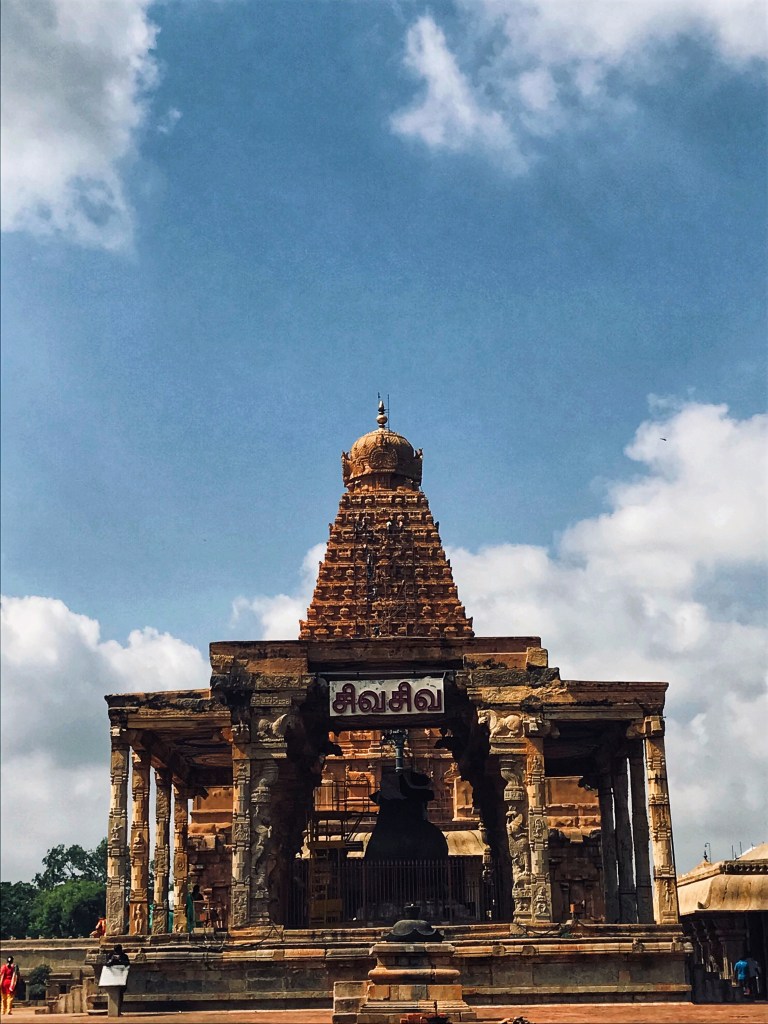
The most visited monument in Thanjavur is the Brihadeeswarar Temple, whose construction, the historian Percy Brown described as “a landmark in the evolution of building art in South India”. Built in the 11th century by the Chola king Raja Raja Chola I (985–1014), the temple is dedicated to the Hindu god Shiva. The walls of the sanctum are covered with wall paintings from the Chola and Nayak periods. The temple was designated a UNESCO World Heritage Site in 1987. It is replicated in the Gangaikonda Cholesvarar Temple constructed by Raja Raja’s son Rajendra Chola I (1012–44).

The Thanjavur Maratha palace was the official residence of the Bhonsle family who ruled over the Thanjavur region from 1674 to 1855. It was originally constructed by the rulers of the Thanjavur Nayak kingdom and after their fall, it served as the official residence of the Thanjavur Marathas. When most of the Thanjavur Maratha kingdom was annexed by the British Empire in 1799, the Thanjavur Marathas continued to hold sway over the palace and the surrounding fort. The southern side of the third quadrangle of the palace has a 190 ft (58 m) tower-like building, called the Goodagopuram.

The Saraswathi Mahal Library, established around 1700 and located in the premises of the palace, contains over 30,000 Indian and European manuscripts written on palm leaf and paper. Over eighty per cent of its manuscripts are in Sanskrit and many of them are on palm leaves. The Tamil works include treatises on medicine, and commentaries on Sangam literature. The Rajaraja Chola art gallery is located inside the palace – it has a large collection of stone and bronze images from the ninth to 12th centuries. Most of the idols present in the gallery were collected from various temples in the Thanjavur district.

The Sivaganga Park is situated to the east of the Brihadeeswarar Temple and encompasses the Sivaganga Tank believed to have been built by the king Raja Raja Chola. It was created as a people’s park by the Tanjore municipality in 1871–72. It has a collection of plants, animals and birds and serves as a zoo for children within the city.

Sathaya Thiruvizha is the annual birthday festival of Raja Raja Chola held during October every year. Thanjavur is the base for the Tyagaraja Aradhana, a Carnatic music festival held annually during January – February at Thiruvaiyaru, located 13 km away from the city. Thanjavur painting is a major form of classical South Indian painting from Thanjavur. It dates back to about the 1600s, the period of Nayakas of Thanjavur, who encouraged art, classical dance and music literature, both in Telugu and Tamil. The art is usually a combination of raised and painted surfaces, with the Hindu god Krishna being the most popular image depicted. In modern times, these paintings have become souvenirs of festive occasions in South India, wall decors, and collectors’ items for art lovers.

Source

Swamimalai
Swamimalai lies on the banks of river Kaveri and is one of the six abodes of the Lord Muruga.

The town has one of the six abodes of Karthikeya and the temple is fourth among the Padai Veedugal. According to Hindu mythology, Karthikeya explains the meaning of pranavam to His father Lord Shiva at Swamimalai. Hence, one can see the Karthikeya depicted as Guru (teacher) and Shiva listening as shishya (disciple) in the gopuram of the temple complex. The God is given by the name Swaminathan and Thagapan Swami (literally Father of God).

Swamimalai Bronze Icons refers to bronze idols and statues manufactured in Swamimalai. It has been recognized as a Geographical indication by the Government of India in 2008-09. During the reign of Chola empire, Raja Raja I commissioned a group of sculptors for the construction of the Brihadeeswarar Temple at Thanjavur. The sculptors helped sculpt statues for Airavatesvara Temple and later settled at Swamimalai.

Rameshwaram
Rameshwaram lies on Pamban Island which is separated from mainland India by the Pamban channel and is about 40 kilometres from Mannar Island, Sri Lanka. It is in the Gulf of Mannar, at the tip of the Indian peninsula. Pamban Island, also known as Rameswaram Island, is connected to mainland India by the Pamban Bridge.

Rameswaram is the closest point from which to reach Sri Lanka from India, and geological evidence suggests that the Rama Sethu or Adam’s Bridge was a former land connection between India and Sri Lanka.

Rameswaram is significant for many Hindus as a pilgrimage to Varanasi is considered to be incomplete without a pilgrimage to Rameswaram. The town along with the Ramanathaswamy temple is one of the holiest Hindu Char Dham (four divine sites) sites comprising Badrinath, Puri and Dwarka.

Gandhamathan Parvatham, a hillock situated 3 km to the north of the temple is the highest point in the island. There is a two storeyed hall, where Rama’s feet is found as an imprint on a chakra or wheel. The Ramarpatham Temple is located on the hillock.

The Ramanathaswamy Temple is the most notable historic landmark of the town. Located in the centre of town, the Ramanathaswamy Temple is a famous Hindu temple dedicated to the God Shiva. The temple is one of the 12 Jyotirlinga shrines, where Shiva is worshipped in the form of a Jyotirlinga meaning “pillar of light”. It is also one of the 275 Paadal Petra Sthalam temples and is glorified in hymns by the three of the most revered Nayanar saints (7th century Saivite saints), Appar, Sundarar and Tirugnana Sambandar. The temple in its current structure was built during the 12th century by the Pandya Dynasty. The temple has the longest corridor among all Hindu temples in India. The breadth of these columned corridors varies from 17 to 21 feet with a height of 25 feet. Each pillar is sculpted in the Nayak style as in Madurai Meenakshi Amman Temple. The contribution of the kings of the Sethupathy dynasty (17th century) to the temple was considerable. Large amounts of money was spent during the tenure of Pradani Muthirulappa Pillai towards the restoration of the pagodas which were falling into ruins – the Chockattan Mantapam or the cloistered precincts of the temple was reconstructed by him.

There are sixty-four Tīrthas or Theerthams (holy water bodies) in and around Rameswaram. According to the Skanda Purana, twenty-four of them are important. Of the 24, 14 are in the form of tanks and wells within the precincts of the temple. Bathing in these tanks is a major aspect of the pilgrimage to Rameswaram and is considered equivalent to penance. Twenty-two of the tanks are within the Ramanathaswamy Temple. The foremost one is called Agni Theertham, the sea (Bay of Bengal). Jatayu, King of the Birds, who fought in vain with the demon-king Ravana to save Sita, is said to have fallen down at Jadayu Theertham as his wings were severed. Villoondi Theertham literally translates to ‘buried bow’, is located around 7 kilometres from the main temple on the way to Pamban. It is believed to be the place where Rama quenched the thirst of Sita by dipping the bow into the sea water. Other major holy bodies are Hanuman Theertham, Sugreeva Theertham and Lakshmana Theertham.

Dhanushkodi is the southernmost tip of the island and houses the Kothandaramaswamy Temple dedicated to Lord Rama. Though Dhanushkodi was washed away during the 1964 cyclone, the temple alone remained intact. It is 18 km way from the centre of the town and can be reached by road. A popular belief is that, Dhanushkodi is where Vibishana, a brother of Ravana surrendered before Rama in the the Hindu mythological epic Ramayana.

Ramanathapuram, Tirupullani, Uthirakosamangai, Sethu are the nearby attractions to Island of Rameshwaram. Beautiful beaches at Olaikuda, Danushkodi and Pamban are other attractions apart from the religious point of view. Scuba diving and migratory birds watching during winter are the activities here.

The best time to visit Rameshwaram is July to August & November to March while the peak season is July to August & February to March.

Source

Madurai
Situated on the banks of the River Vaigai, Madurai is also referred to as Athens of the East and Temple Town. Madhurai is the oldest continually inhabited city in the Indian peninsula, with a history dating all the way back to the Sangam period of the pre-Christian era. It has been inhabited since at least the 3rd century BCE, the third largest city in the state and is considered as the cultural capital of Tamil Nadu.

Madurai is closely associated with the Tamil language, and the third Tamil Sangam, a major congregation of Tamil scholars said to have been held in the city. The recorded history of the city goes back to the 3rd century BCE, being mentioned by Megasthenes, the Greek ambassador to the Maurya empire, and Kautilya, a minister of the Mauryan emperor Chandragupta Maurya.

Madurai was the seat of power of the Pandyan Empire. It was built by the Pandyan king Kulasekhara and was the capital city of the great Pandya kings of South India. It was later ruled by Cholas, Later Pandyas, Madurai Sultanate, Vijayanagara, Madurai Nayaks and finally British. Pandyas and Nayaks contributed enormously to the development of Meenakshi Amman Temple and Madurai city.

Madurai is an important industrial and educational hub in South Tamil Nadu. The city is home to various automobile, rubber, chemical and granite manufacturing industries. The city has a number of historical monuments, with the Meenakshi Amman Temple, Koodal Alagar Temple and the Tirumalai Nayak Palace being the most prominent.

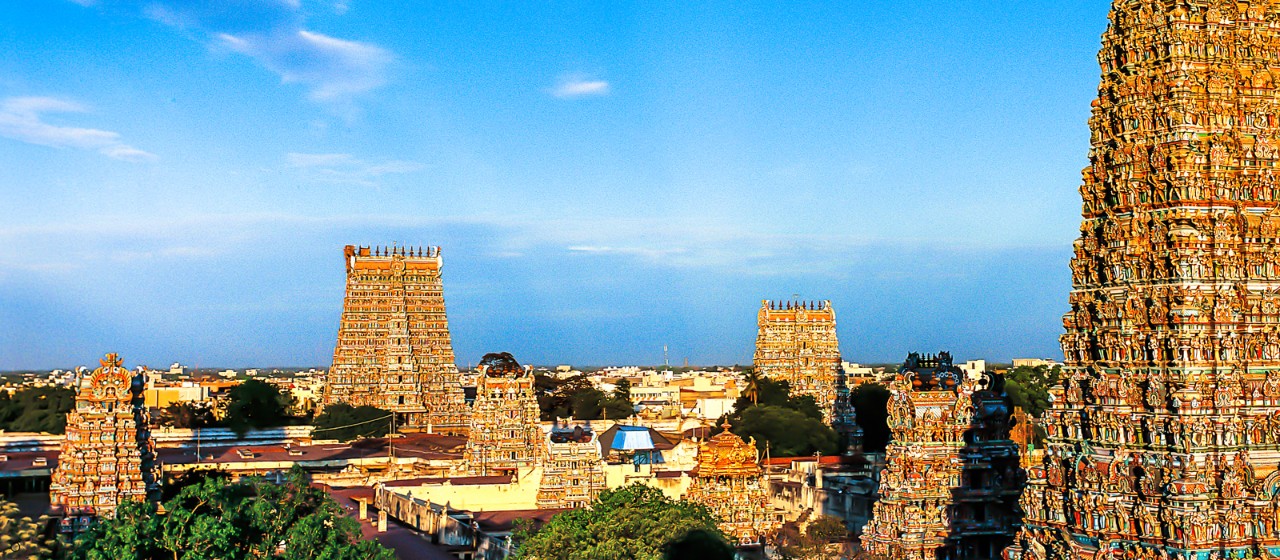
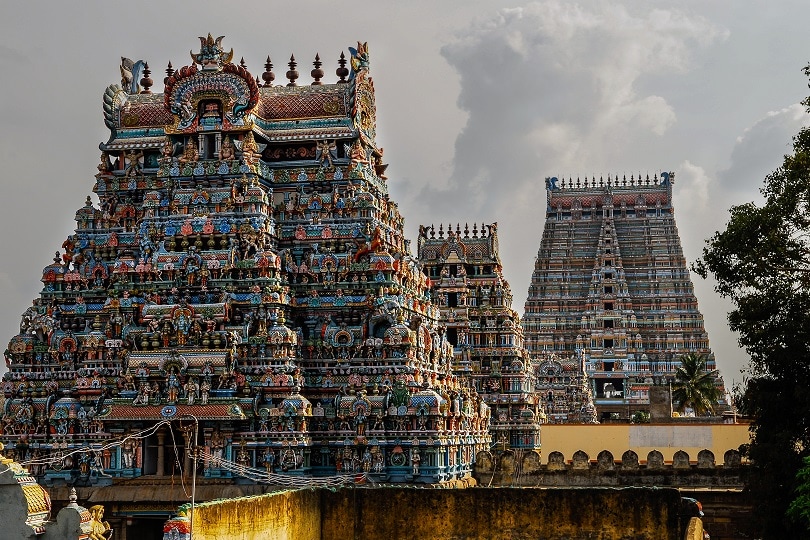
Meenakshi Amman Temple, known as Madurai Meenakshi is the biggest landmark of Madurai. It is one of the largest temples in India. The temple has a stunning architecture and a significant testimony for Vishwakarma Brahmins for their master architecture in sculpting this temple. The core city of Madurai is built parallel to the streets of Madhurai Temple. The temple is dedicated to Meenakshi and her consort, Sundareswarar. The complex houses 14 gopurams or gateway towers and two golden sculptured shrines over the sanctum of the main deities. The temple is a significant symbol for Tamils and has been mentioned since antiquity in Tamil literature, though the present structure was built between 1623 and 1655 CE.

The Sangam period poet Nakkeerar is associated with some of the Tiruvilayaadal episodes of Sundareswarar – that are enacted as a part of temple festival traditions even today.

The Koodal Azhagar Temple is a Vishnu temple located in the city. It has idols of the Navagraha (nine planet deities), which are otherwise found only in Shiva temples. The deity, Kallazhagar, is believed to be the brother of Meenakshi, the presiding deity at the Meenakshi temple and the festival calendars of these two temples overlap during the Meenakshi Thirukalyanam festival.

Tirupparankunram is a hill 8 kilometres away from Madurai where the Hindu god Murugan is said to have married Deivanai. The temple is the first among the Six Abodes of Murugan and is one of the most visited tourist spots in Madurai, next only to the Meenakshi Amman Temple.

The people of Madurai celebrate numerous festivals, including Meenakshi Tirukkalyanam, the Chittirai Festival and the Car Festival. The annual 10-day Meenakshi Tirukalyanam festival, also called Chittirai festival, is celebrated during April–May every year and attracts one million visitors. Legend has it that the Hindu god Vishnu, as Alagar, rode on a golden horse to Madurai to attend the celestial wedding of Meenakshi (Parvati) and Sundareswarar (Shiva). Before Alagar reaches the wedding, the marriage will be completed and he does not cross the vaigai river. During this day there will be huge crowd will be present near the river too see Lord Alagar in the river. During the Cradle festival, the festive idols of Meenakshi and Sundareswarar are taken in procession to a mirror chamber and set on a rocking swing for nine days. Avanimoolam festival is celebrated during September when the 64 sacred games of Shiva, thiruvilayadal, are recited. The Thepporchavam festival, or float festival, is celebrated on the full moon day of the Tamil month Thai, which falls around January – February, to celebrate the birth anniversary of King Thirumalai Nayak. The decorated icons of Meenakshi and her consort are taken out in a procession from the Meenakshi Temple to the Mariamman Teppakulam. The icons are floated in the tank on a raft decked with flowers and flickering lamps.

There are probably more temple towns in the state, but if I start to list more, I could go on and on as this state brims with temples and other religious places of worship.