Thiruthangal Temple, Thiruthangal, Tamil Nadu Thiruthangal, located near Sivakasi in Tamil Nadu, is one of those Divya Desams where the story is not about movement but about choosing to remain. The presiding deity here is Ninra Narayana Perumal, and the goddess is Sengamalavalli Thayar. The name itself reflects the central image. Ninra means “standing,” and this is the Lord who stands, not in passing, but with intention. The temple sits on a small hill, and that elevation adds a quiet sense of separation from the everyday world below. Yet the feeling is not of distance. It is of steadiness.
The mythology of Thiruthangal is connected with a gentle but telling story involving the goddess. According to tradition, Lakshmi and Bhudevi once sought to determine who held a more significant place beside Vishnu. What began as a comparison grew into a moment of tension, not out of anger, but out of the desire to be seen. Lakshmi chose this place to perform penance, seeking clarity and affirmation. Vishnu appeared before her here and resolved the tension, not through argument, but through presence. Because the goddess stayed here and the Lord stood with her, the place came to be known as Thiruthangal. The story does not end in conflict. It settles into understanding.
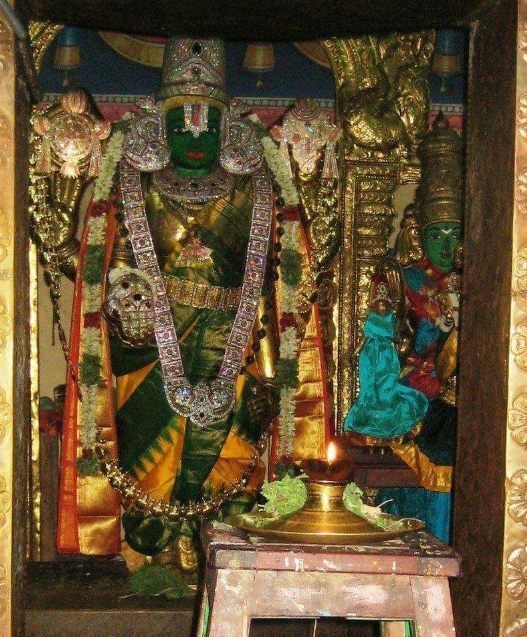
Inside the sanctum, this sense of resolution becomes visible. Ninra Narayana Perumal stands in a composed posture, holding the conch and discus, calm and unhurried. The standing form carries a certain clarity. It does not suggest movement or rest, but readiness that has already found its place. Sengamalavalli Thayar’s shrine adds warmth to the space, grounding the stillness of the Lord with compassion. Together, they create an atmosphere that feels balanced.
The temple’s location on a hill shapes the experience quietly. The climb is not long, but it is enough to slow the body and shift the mind. By the time you reach the top, the rhythm has changed. The surroundings open up, and the space feels less crowded, even when there are other visitors. The hill does not isolate the temple. It gives it a clearer presence.
Historically, Thiruthangal reflects the continuity of temple culture in southern Tamil Nadu, with roots that extend through the Pandya period and later contributions from local patrons. The structure has been maintained across centuries, not through large expansions, but through steady care. This continuity is visible in the layout and in the ongoing practice of worship. The temple has remained active, carrying its story forward without interruption.
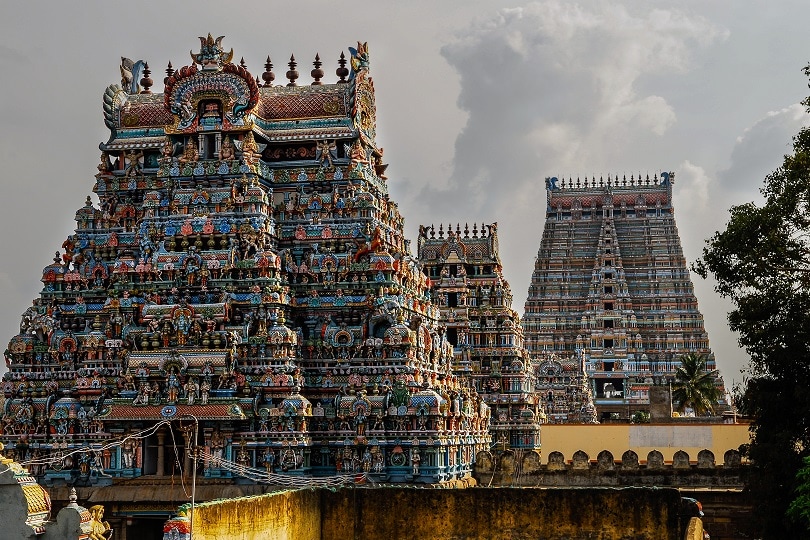
Architecturally, the temple follows the Dravidian style, with a gopuram marking the entrance and prakarams guiding the movement inward. The scale is modest compared to some larger temples, but the proportions feel balanced. The sanctum remains the focal point, drawing attention to the standing form of the Lord. The surrounding structures support the experience without distraction. The hill itself becomes part of the architecture, shaping how the temple is approached and understood.
The daily rituals follow the Vaishnavite tradition, with regular pujas conducted throughout the day. Festivals such as Vaikunta Ekadasi and Brahmotsavam bring larger gatherings, but the temple does not lose its steady tone. The standing form of the deity continues to anchor the space, even during moments of activity.
For pilgrims, the experience of Thiruthangal often comes with a sense of quiet clarity. After visiting temples associated with action, movement, or transformation, arriving here introduces a different emphasis. The Lord does not act. He stands. That posture begins to carry meaning. It suggests that some things do not need to be changed or moved. They need to be held in place.
Culturally, the temple holds its place within the Divya Desam tradition through the hymns of the Alvars, who recognised its significance. Over time, it has come to represent themes of balance, resolution, and steadiness. Devotees come here not only with requests but with the need for clarity. The temple does not provide answers in obvious ways. It offers a space where things settle.
In modern times, Thiruthangal continues to function as an active place of worship, maintained through regular rituals and community care. It remains part of a living tradition, drawing pilgrims who seek both devotion and quiet reflection.
Thiruthangal ultimately represents the strength of staying. Ninra Narayana Perumal does not move through the world here. He stands within it. In the larger Divya Desam journey, this temple offers a simple but steady insight. Not every moment calls for action. Some call for presence.
Thirukkoodal Temple, Madurai, Tamil Nadu Madurai is a city that rarely pauses. It moves through history, ritual, and everyday life all at once, and in the middle of that movement stands Thirukkoodal, the temple of Koodal Azhagar Perumal, with Madhuravalli Thayar as the goddess. The name Koodal itself suggests coming together, a meeting point, a place where things gather. That meaning fits the temple well. It sits within a city known for convergence, where people, traditions, and rhythms overlap, and yet inside the temple, the experience becomes more focused, more contained.
The mythology of Thirukkoodal is not built around a single dramatic episode. Instead, it is shaped by presence across different states. The most striking aspect of the temple is that the Lord is worshipped in three distinct forms within the same space. In the sanctum, Koodal Azhagar stands in a composed posture, holding the conch and discus. Above, in another tier, he is seen seated, and in yet another, he reclines. These are not separate temples. They are layers within one structure. The arrangement itself becomes the message. The divine is not limited to one state. It stands, sits, and rests, all within the same presence.
This idea carries a quiet significance. In many temples, one encounters a single form and builds meaning around it. Here, the experience is expanded. The Lord is not fixed. He moves across states without losing identity. For the devotee, this creates a different kind of engagement. You do not see the divine in one moment. You see it as continuity across different conditions.
Inside the temple, this layered presence shapes the experience. The standing form of Koodal Azhagar holds the immediate attention. It feels grounded and direct. The seated and reclining forms above introduce a shift, inviting the mind to move beyond what is seen first. Madhuravalli Thayar’s shrine adds warmth to the space, grounding the experience in grace. Together, they create an atmosphere that feels complete, not because it is large, but because it holds multiple states at once.
Historically, Thirukkoodal has been an important temple in Madurai, with roots that extend through the Pandya period and later contributions from other dynasties. The temple has stood through centuries of change in the city, maintaining its identity even as the surroundings evolved. It is not as widely known as the Meenakshi Amman Temple nearby, but it holds its own place within the sacred geography of Madurai.
Architecturally, the temple reflects the Dravidian style, with a gopuram marking the entrance and prakarams guiding movement inward. The most distinctive feature is the vertical arrangement of the three forms of the deity. This structure creates a sense of movement within the temple without requiring physical distance. The experience shifts as one looks upward, moving from one state to another.
The daily rituals follow the Vaishnavite tradition, with regular pujas conducted throughout the day. Festivals such as Vaikunta Ekadasi and Brahmotsavam bring larger gatherings, but the temple does not lose its inward focus. Even during these times, the layered presence of the deity remains the central experience.
For pilgrims, Thirukkoodal often feels like a pause within the larger movement of Madurai. After navigating the busy streets and the intensity of the city, stepping into the temple creates a shift. The mind begins to settle, not into stillness alone, but into a recognition of different states coexisting.
Culturally, the temple holds its place within the Divya Desam tradition through the hymns of the Alvars, who recognised its significance. Over time, it has come to represent a broader idea. Life itself does not remain in one state. It moves through action, rest and reflection. Thirukkoodal reflects that movement without separating it into different spaces.
In modern times, the temple continues to function as an active place of worship, drawing devotees from within the city and beyond. It remains part of a living tradition, even as it stands alongside larger and more prominent temples.
Thirukkoodal ultimately represents presence across change. Koodal Azhagar Perumal does not remain in one posture. He stands, sits, and rests, all within the same space. In the larger Divya Desam journey, this temple offers a simple but steady insight. The divine is not limited to one state, and neither are we.
Kumbakonam Kumbakonam is known as a “temple city” due to the prevalence of a number of temples here and is noted for its Mahamaham festival which attracts people from all over the country.
Kumbakonam dates back to the Sangam period and was ruled by the Early Cholas, Pallavas, Medieval Cholas, Later Cholas, Pandyas, the Vijayanagara Empire, Madurai Nayaks, Thanjavur Nayaks and the Thanjavur Marathas. It rose to be a prominent town between the 7th and 9th centuries AD, when it served as a capital of the Medieval Cholas. The town reached the zenith of its prosperity during the British Raj when it was a prominent centre of European education and Hindu culture; and it acquired the cultural name, the “Cambridge of South India”.
The name “Kumbakonam”, roughly translated in English as the “Pot’s Corner”, is believed to be an allusion to the mythical pot (kumbha) of the Hindu god Brahma that contained the seed of all living beings on earth. The kumbha is believed to have been displaced by a pralaya (dissolution of the universe) and ultimately came to rest at the spot where the town of Kumbakonam now stands. This event is now commemorated in the Mahamaham festival held every 12 years. Kumbakonam is also known as Baskarashetram[2] and Kumbam[3] from time immemorial and as Kudanthai in ancient times.
Kumbakonam is known for its temples and mathas (monasteries). There are around 188 Hindu temples within the municipal limits of Kumbakonam. Apart from these, there several thousand temples around the town thereby giving the town the sobriquets “Temple Town” and “City of temples”.
Adi Kumbeswarar Temple is considered to be the oldest Shaiva (the sect of the god Shiva) shrine in the town, believed to be constructed by the Cholas in the 7th century. The Nageswaraswamy Temple has a separate shrine for the Sun god Surya who is believed to have worshipped Shiva at this place. Adi Kumbeswarar temple, Nageswaraswamy temple and Kasi Viswanathar temple are Shiva temples in the town revered in the Tevaram, a Tamil Shaiva canonical work of the 7th–8th century. Kumbakonam has one of the few temples dedicated to the god Brahma.
Sarangapani temple is the largest Vaishnava (the sect of the god Vishnu) shrine present in Kumbakonam. The present structure of the temple having a twelve storey high tower was constructed by Nayak kings in the 15th century. It is one of the “Divya Desams”, the 108 temples of Vishnu revered by the 12 Alvar saint-poets. The Ramaswamy temple, which has scenes from the Hindu epic Ramayana depicted on its walls, was constructed by Govinda Dikshitar, the minister of successive Nayak rulers, Achuthappa Nayak (1560–1614) and Raghunatha Nayak (1600–34). He added a commercial corridor between the temple and the older Chakrapani temple, which in modern times is called Chinna Kadai Veethi, a commercial street in the town. Pilgrims from all parts of India take a holy dip once every 12 years during the Mahamaham festival, also known as the Southern Kumbh Mela in the Mahamaham tank.
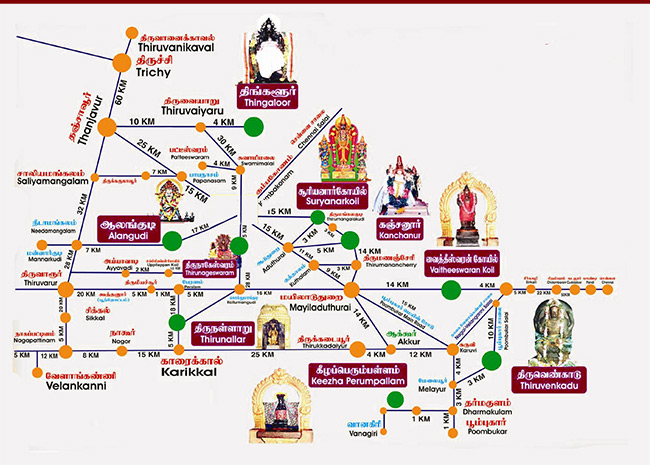
You can also do the Navagraha temple pilgrimage, for the nine planets, keeping Kumbakonam as your base as all the temples are located quite close to each other and Kumbakonam. These Navagraha temples are located in the Cauvery delta region of Kumbakonam – Thanjavur. Traditionally these are Shiva temples with a shrine for one of the planets. It is believed that the planetary deities were cursed by Brahma to dwell in Vellurukku Vanam, the white wild flower jungle and were blessed by Shiva to make it their abode to devotees. The temples have six daily rituals at various times from 5:30 a.m. to 9 p.m., and two yearly festivals on its calendar.
Suryanar Kovil or the temple dedicated to the Sun Lord is located to the East of Kumbakonam, 2 km from Aduthurai. Kanjanoor, the temple for Sukran or the temple for Venus, is located 3 km from Suryanar Kovil in the Aduthurai – Kuthalam road. The Thingalur temple dedicated to the Moon God or Chandran is located 35 km to the west of Kumbakonam in the Kumbakonam – Tiruvvayyaru Road. Vaitheeswaran Kovil which is the temple for Mars is located 50.5 km away from Kumbakonam on the Kumbakonam – Sirkazhi Road and 14.5 km away from Mayiladuthurai. Swetharanyeswarar Temple dedicated to Mercury is located 24 km from Mayiladuthurai and 13 km to the East of Vaitheeswaran Kovil. Ketu Stalam or the temple for the south node of the eclipse of the sun and the moon is located close to Poompuhar, 23 km to the South West of Vaitheeswarn Kovil. Alangudi is located 18 km to the South of Kumbakonam on the Kumbakonam – Mannargudi road. Rahu Stalam or the north node is located 6 km to the West of Kumbakonam on the Kumbakonam – Karaikal road and Saniswarar temple dedicated to Saturn is located 46 km further on the same road. Out of the nine temples, six are located on the northern bank of river Kaveri, while the remaining three in the southern bank.
Thanjavur Thanjavur, formerly known as Tanjore, is an important center of South Indian religion, art, and architecture. Most of the Great Living Chola Temples, which are UNESCO World Heritage Monuments, are located in and around Thanjavur. The foremost among these, the Brihadeeswara Temple, is located in the centre of the city. Thanjavur is also home to Tanjore painting, a painting style unique to the region.
The city is an important agricultural centre located in the Cauvery Delta and is known as the Rice bowl of Tamil Nadu. The city first rose to prominence during the reign of Cholas when it served as the capital of the empire. After the fall of Cholas, the city was ruled by various dynasties like Pandyas, Vijayanagar Empire, Madurai Nayaks, Thanjavur Nayaks, Thanjavur Marathas and British Empire. It has been a part of independent India since 1947. Carnatic music was codified in Thanjavur and the art flourished during the Nayak rule in the 16th century. Bharathanatyam, a classical dance form of South India, had its major styles developed in Thanjavur.
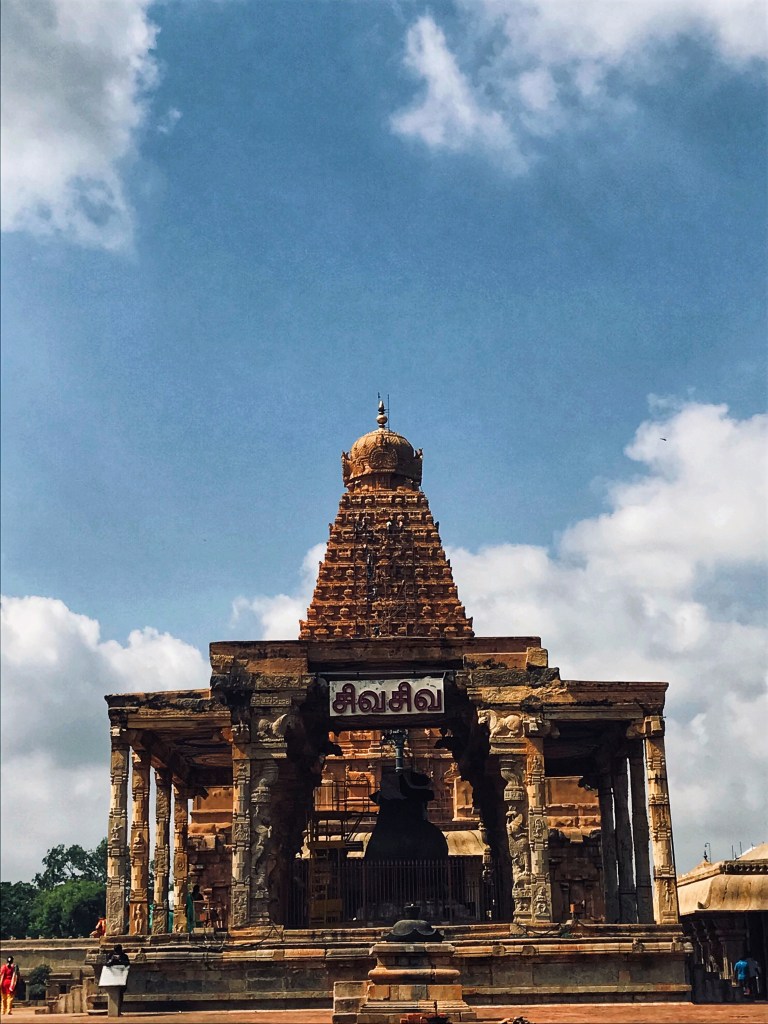
The most visited monument in Thanjavur is the Brihadeeswarar Temple, whose construction, the historian Percy Brown described as “a landmark in the evolution of building art in South India”. Built in the 11th century by the Chola king Raja Raja Chola I (985–1014), the temple is dedicated to the Hindu god Shiva. The walls of the sanctum are covered with wall paintings from the Chola and Nayak periods. The temple was designated a UNESCO World Heritage Site in 1987. It is replicated in the Gangaikonda Cholesvarar Temple constructed by Raja Raja’s son Rajendra Chola I (1012–44).
The Thanjavur Maratha palace was the official residence of the Bhonsle family who ruled over the Thanjavur region from 1674 to 1855. It was originally constructed by the rulers of the Thanjavur Nayak kingdom and after their fall, it served as the official residence of the Thanjavur Marathas. When most of the Thanjavur Maratha kingdom was annexed by the British Empire in 1799, the Thanjavur Marathas continued to hold sway over the palace and the surrounding fort. The southern side of the third quadrangle of the palace has a 190 ft (58 m) tower-like building, called the Goodagopuram.
The Saraswathi Mahal Library, established around 1700 and located in the premises of the palace, contains over 30,000 Indian and European manuscripts written on palm leaf and paper. Over eighty per cent of its manuscripts are in Sanskrit and many of them are on palm leaves. The Tamil works include treatises on medicine, and commentaries on Sangam literature. The Rajaraja Chola art gallery is located inside the palace – it has a large collection of stone and bronze images from the ninth to 12th centuries. Most of the idols present in the gallery were collected from various temples in the Thanjavur district.
The Sivaganga Park is situated to the east of the Brihadeeswarar Temple and encompasses the Sivaganga Tank believed to have been built by the king Raja Raja Chola. It was created as a people’s park by the Tanjore municipality in 1871–72. It has a collection of plants, animals and birds and serves as a zoo for children within the city.
Sathaya Thiruvizha is the annual birthday festival of Raja Raja Chola held during October every year. Thanjavur is the base for the Tyagaraja Aradhana, a Carnatic music festival held annually during January – February at Thiruvaiyaru, located 13 km away from the city. Thanjavur painting is a major form of classical South Indian painting from Thanjavur. It dates back to about the 1600s, the period of Nayakas of Thanjavur, who encouraged art, classical dance and music literature, both in Telugu and Tamil. The art is usually a combination of raised and painted surfaces, with the Hindu god Krishna being the most popular image depicted. In modern times, these paintings have become souvenirs of festive occasions in South India, wall decors, and collectors’ items for art lovers.
Swamimalai Swamimalai lies on the banks of river Kaveri and is one of the six abodes of the Lord Muruga.
The town has one of the six abodes of Karthikeya and the temple is fourth among the Padai Veedugal. According to Hindu mythology, Karthikeya explains the meaning of pranavam to His father Lord Shiva at Swamimalai. Hence, one can see the Karthikeya depicted as Guru (teacher) and Shiva listening as shishya (disciple) in the gopuram of the temple complex. The God is given by the name Swaminathan and Thagapan Swami (literally Father of God).
Swamimalai Bronze Icons refers to bronze idols and statues manufactured in Swamimalai. It has been recognized as a Geographical indication by the Government of India in 2008-09. During the reign of Chola empire, Raja Raja I commissioned a group of sculptors for the construction of the Brihadeeswarar Temple at Thanjavur. The sculptors helped sculpt statues for Airavatesvara Temple and later settled at Swamimalai.
Rameshwaram Rameshwaram lies on Pamban Island which is separated from mainland India by the Pamban channel and is about 40 kilometres from Mannar Island, Sri Lanka. It is in the Gulf of Mannar, at the tip of the Indian peninsula. Pamban Island, also known as Rameswaram Island, is connected to mainland India by the Pamban Bridge.
Rameswaram is the closest point from which to reach Sri Lanka from India, and geological evidence suggests that the Rama Sethu or Adam’s Bridge was a former land connection between India and Sri Lanka.
Rameswaram is significant for many Hindus as a pilgrimage to Varanasi is considered to be incomplete without a pilgrimage to Rameswaram. The town along with the Ramanathaswamy temple is one of the holiest Hindu Char Dham (four divine sites) sites comprising Badrinath, Puri and Dwarka.
Gandhamathan Parvatham, a hillock situated 3 km to the north of the temple is the highest point in the island. There is a two storeyed hall, where Rama’s feet is found as an imprint on a chakra or wheel. The Ramarpatham Temple is located on the hillock.
The Ramanathaswamy Temple is the most notable historic landmark of the town. Located in the centre of town, the Ramanathaswamy Temple is a famous Hindu temple dedicated to the God Shiva. The temple is one of the 12 Jyotirlinga shrines, where Shiva is worshipped in the form of a Jyotirlinga meaning “pillar of light”. It is also one of the 275 Paadal Petra Sthalam temples and is glorified in hymns by the three of the most revered Nayanar saints (7th century Saivite saints), Appar, Sundarar and Tirugnana Sambandar. The temple in its current structure was built during the 12th century by the Pandya Dynasty. The temple has the longest corridor among all Hindu temples in India. The breadth of these columned corridors varies from 17 to 21 feet with a height of 25 feet. Each pillar is sculpted in the Nayak style as in Madurai Meenakshi Amman Temple. The contribution of the kings of the Sethupathy dynasty (17th century) to the temple was considerable. Large amounts of money was spent during the tenure of Pradani Muthirulappa Pillai towards the restoration of the pagodas which were falling into ruins – the Chockattan Mantapam or the cloistered precincts of the temple was reconstructed by him.
There are sixty-four Tīrthas or Theerthams (holy water bodies) in and around Rameswaram. According to the Skanda Purana, twenty-four of them are important. Of the 24, 14 are in the form of tanks and wells within the precincts of the temple. Bathing in these tanks is a major aspect of the pilgrimage to Rameswaram and is considered equivalent to penance. Twenty-two of the tanks are within the Ramanathaswamy Temple. The foremost one is called Agni Theertham, the sea (Bay of Bengal). Jatayu, King of the Birds, who fought in vain with the demon-king Ravana to save Sita, is said to have fallen down at Jadayu Theertham as his wings were severed. Villoondi Theertham literally translates to ‘buried bow’, is located around 7 kilometres from the main temple on the way to Pamban. It is believed to be the place where Rama quenched the thirst of Sita by dipping the bow into the sea water. Other major holy bodies are Hanuman Theertham, Sugreeva Theertham and Lakshmana Theertham.
Dhanushkodi is the southernmost tip of the island and houses the Kothandaramaswamy Temple dedicated to Lord Rama. Though Dhanushkodi was washed away during the 1964 cyclone, the temple alone remained intact. It is 18 km way from the centre of the town and can be reached by road. A popular belief is that, Dhanushkodi is where Vibishana, a brother of Ravana surrendered before Rama in the the Hindu mythological epic Ramayana.
Ramanathapuram, Tirupullani, Uthirakosamangai, Sethu are the nearby attractions to Island of Rameshwaram. Beautiful beaches at Olaikuda, Danushkodi and Pamban are other attractions apart from the religious point of view. Scuba diving and migratory birds watching during winter are the activities here.
The best time to visit Rameshwaram is July to August & November to March while the peak season is July to August & February to March.
Madurai Situated on the banks of the River Vaigai, Madurai is also referred to as Athens of the East and Temple Town. Madhurai is the oldest continually inhabited city in the Indian peninsula, with a history dating all the way back to the Sangam period of the pre-Christian era. It has been inhabited since at least the 3rd century BCE, the third largest city in the state and is considered as the cultural capital of Tamil Nadu.
Madurai is closely associated with the Tamil language, and the third Tamil Sangam, a major congregation of Tamil scholars said to have been held in the city. The recorded history of the city goes back to the 3rd century BCE, being mentioned by Megasthenes, the Greek ambassador to the Maurya empire, and Kautilya, a minister of the Mauryan emperor Chandragupta Maurya.
Madurai was the seat of power of the Pandyan Empire. It was built by the Pandyan king Kulasekhara and was the capital city of the great Pandya kings of South India. It was later ruled by Cholas, Later Pandyas, Madurai Sultanate, Vijayanagara, Madurai Nayaks and finally British. Pandyas and Nayaks contributed enormously to the development of Meenakshi Amman Temple and Madurai city.
Madurai is an important industrial and educational hub in South Tamil Nadu. The city is home to various automobile, rubber, chemical and granite manufacturing industries. The city has a number of historical monuments, with the Meenakshi Amman Temple, Koodal Alagar Temple and the Tirumalai Nayak Palace being the most prominent.
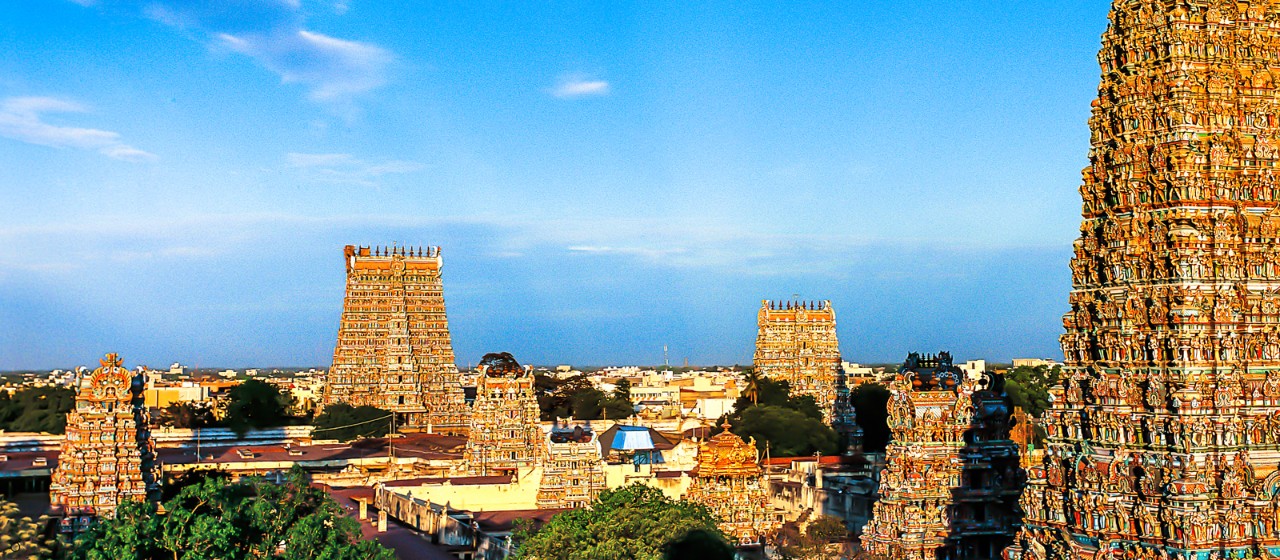
Meenakshi Amman Temple, known as Madurai Meenakshi is the biggest landmark of Madurai. It is one of the largest temples in India. The temple has a stunning architecture and a significant testimony for Vishwakarma Brahmins for their master architecture in sculpting this temple. The core city of Madurai is built parallel to the streets of Madhurai Temple. The temple is dedicated to Meenakshi and her consort, Sundareswarar. The complex houses 14 gopurams or gateway towers and two golden sculptured shrines over the sanctum of the main deities. The temple is a significant symbol for Tamils and has been mentioned since antiquity in Tamil literature, though the present structure was built between 1623 and 1655 CE.
The Sangam period poet Nakkeerar is associated with some of the Tiruvilayaadal episodes of Sundareswarar – that are enacted as a part of temple festival traditions even today.
The Koodal Azhagar Temple is a Vishnu temple located in the city. It has idols of the Navagraha (nine planet deities), which are otherwise found only in Shiva temples. The deity, Kallazhagar, is believed to be the brother of Meenakshi, the presiding deity at the Meenakshi temple and the festival calendars of these two temples overlap during the Meenakshi Thirukalyanam festival.
Tirupparankunram is a hill 8 kilometres away from Madurai where the Hindu god Murugan is said to have married Deivanai. The temple is the first among the Six Abodes of Murugan and is one of the most visited tourist spots in Madurai, next only to the Meenakshi Amman Temple.
The people of Madurai celebrate numerous festivals, including Meenakshi Tirukkalyanam, the Chittirai Festival and the Car Festival. The annual 10-day Meenakshi Tirukalyanam festival, also called Chittirai festival, is celebrated during April–May every year and attracts one million visitors. Legend has it that the Hindu god Vishnu, as Alagar, rode on a golden horse to Madurai to attend the celestial wedding of Meenakshi (Parvati) and Sundareswarar (Shiva). Before Alagar reaches the wedding, the marriage will be completed and he does not cross the vaigai river. During this day there will be huge crowd will be present near the river too see Lord Alagar in the river. During the Cradle festival, the festive idols of Meenakshi and Sundareswarar are taken in procession to a mirror chamber and set on a rocking swing for nine days. Avanimoolam festival is celebrated during September when the 64 sacred games of Shiva, thiruvilayadal, are recited. The Thepporchavam festival, or float festival, is celebrated on the full moon day of the Tamil month Thai, which falls around January – February, to celebrate the birth anniversary of King Thirumalai Nayak. The decorated icons of Meenakshi and her consort are taken out in a procession from the Meenakshi Temple to the Mariamman Teppakulam. The icons are floated in the tank on a raft decked with flowers and flickering lamps.
There are probably more temple towns in the state, but if I start to list more, I could go on and on as this state brims with temples and other religious places of worship.