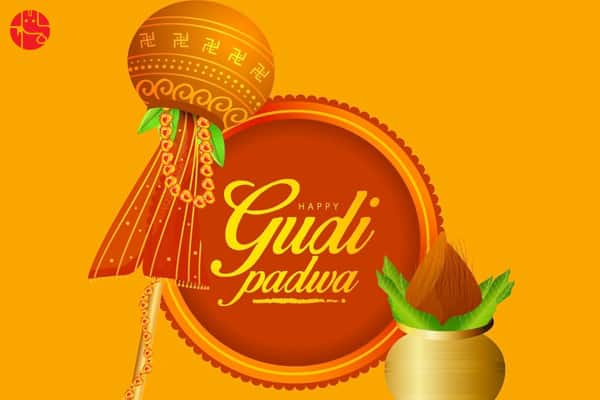
Festivals of India: Gudi Padwa

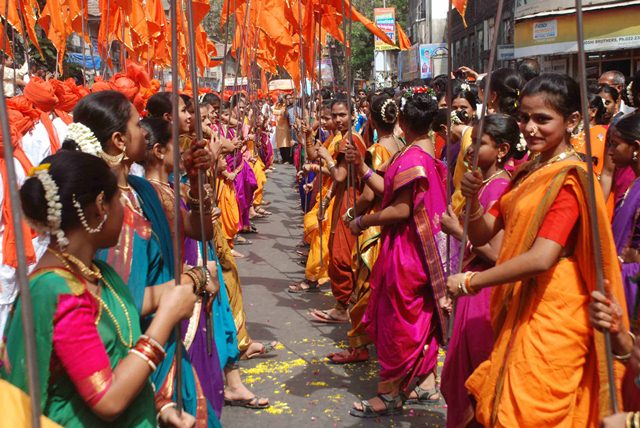
Spring is in the air and this means that various Indian communities will start celebrating their new year. The first is usually Gudi Padwa, a spring-time festival that marks the traditional new year for Marathi and Konkani Hindus. It is celebrated in and near Maharashtra and Goa on the first day of the Chaitra month to mark the beginning of the New year according to the lunisolar Hindu calendar. The word Padwa comes from the Sanskrit word Pratipada, which refers to the first day of a lunar fortnight. The festival is observed with colorful floor decorations or rangoli, a special Gudi flag which is garlanded with flowers, mango and neem leaves and topped with an upturned silver or copper vessel, street processions, dancing and festive foods.

Gudi Padwa marks end of one harvest season and beginning of a new one for farmers and so is also celebrated as a harvest festival in the region. On this day the position of the Sun is above the point of intersection of the equator, which according to the Hindu calendar marks the commencement of the Spring Season.
In India, this day which is the first day of the bright phase of the moon is called Gudi Padwa in Marathi, Ugadi in Telugu, and Yugadi in Kannada. The Sindhi community celebrates this day as Cheti Chand as the new year and observed as the emergence day of Lord Jhulelaal. Prayers are offered to Lord Jhulelaal and the festival is celebrated by making delicacies. However, this is not the universal new year for all Hindus. For some, such as those in and near Gujarat, the new year festivities coincide with the five day Diwali festival. For many others, the new year falls on Vaisakhi between 13 and 15 April, according to the solar cycle part of the Hindu lunisolar calendar, and this is by far the most popular not only among Hindus of the Indian subcontinent but also among Buddhists and Hindus in many parts of southeast Asia.

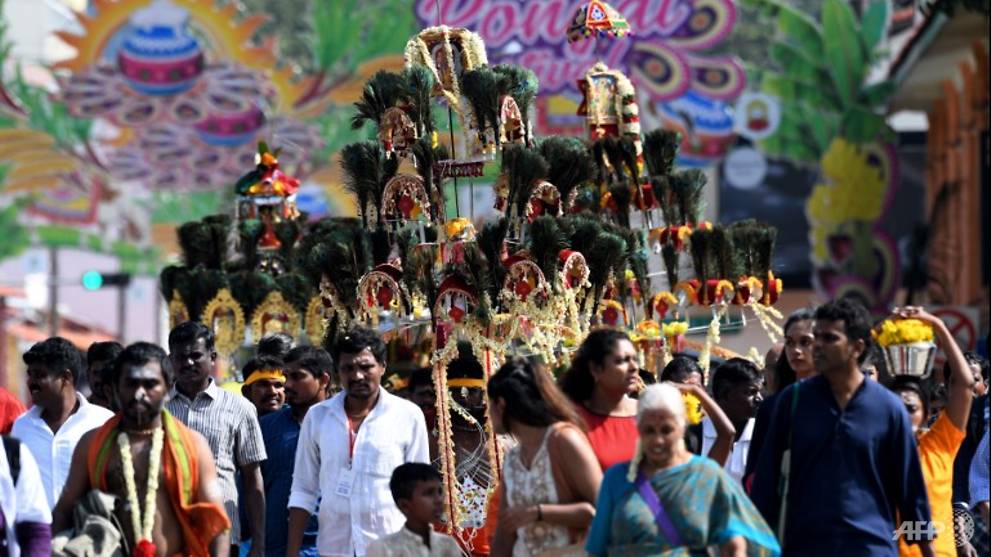
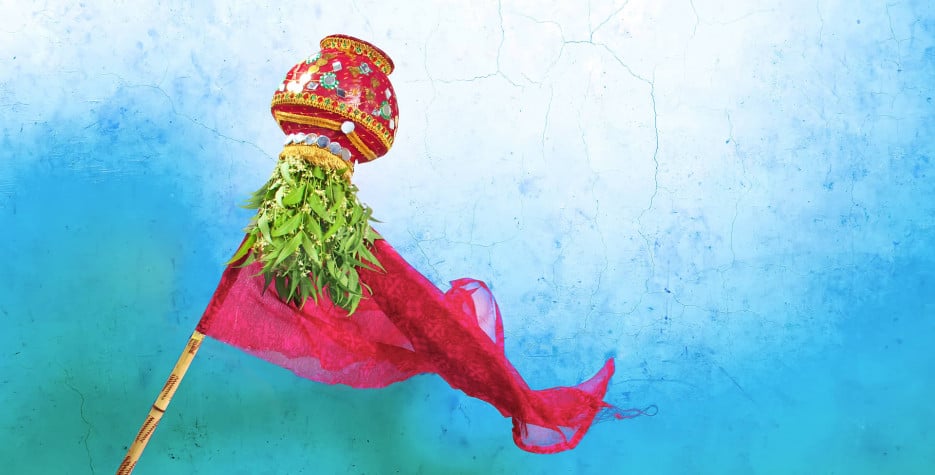
It’s really fascinating on the day of Gudi Padwa to see many Gudis arrangements in the windows and doors of Maharashtrian and Konkani households. The Gudi is a bright colorful silk scarf-like cloth tied to the top of a long bamboo pole. On the top of the pole, one or more boughs of neem leaves and mango leaves are attached along with a garland of flowers. This arrangement is capped with a silver, bronze or copper pot called handi or kalash in Marathi signifying victory or achievement. The whole arrangement is hoisted outside each household, typically to the right and is visible to everybody. Villages or neighborhoods also come together and host a community Gudi Kavad, which they carry together to the local Shiva temple. Some temples are located on the top of hills, and groups work together to help reach the kavad to the top.

There are many historical legends and beliefs associated with this festival. One of these comes from the Brahma Purana which states that Lord Brahma recreated the world after a raging deluge in which all time had stopped and all the people of the world, destroyed. On Gudi Padva, time restarted and from this day on, the era of truth and justice, known as Satyug began. Therefore, Lord Brahma is worshipped on this day and the Gudi symbolises the Brahmadhvaj.
Another popular legend about the origin of this festival revolves around the return of Lord Rama to Ayodhya along with his wife Sita and his brother Laxman from exile. The ‘Brahmadhvaj’ is hoisted in memory of the coronation of Lord Rama. The Gudi is hoisted at the entrance of the household in commemoration of the Gudi that was hoisted in Ayodhya as a victory flag. It is also believed that Lord Rama was victorious over King Bali on this day, marking this occasion.

For the people of Mahrashtra, there is an added significance to this festival. It is believed that Chhattrapati Shivaji Maharaj, celebrated leader of the Maratha clan, led the troops to victory and attained freedom for the kingdom from the dominion of the Mughals in that area. The Gudi then is a symbol of victory and prosperity.

It also symbolizes the victory of King Shalivahana and was hoisted by his people when he returned to Paithan (near current day Aurangabad).

The Gudi is believed to ward off evil, invite prosperity and good luck into the house. Many businessmen inaugurate their ventures on this day as it is considered an auspicious day.

On this day, courtyards in village houses will be swept clean and plastered with fresh cow-dung. Even in urban areas, even if they don’t do it everyday, on this day people take the time out to do some spring cleaning and women work on intricate rangoli designs on their doorsteps, the vibrant colours mirroring the burst of colour associated with spring. Everyone dresses up in new clothes and it is a time for family gatherings. Traditionally, families prepare a special dish that mixes various flavors, particularly the bitter leaves of the neem tree and sweet jaggery. Additional ingredients include sour tamarind and astringent dhane seeds. Most communities prepare something similar which is a reminder of life’s sweet and bitter experiences, as well as a belief that the neem-based mixture has health benefits.

Here’s wishing all those celebrating Gudi Padwa, Ugadi, Cheti Chand and Yugadi a very happy new year and to enjoy your celebrations and the yummy food that follows!
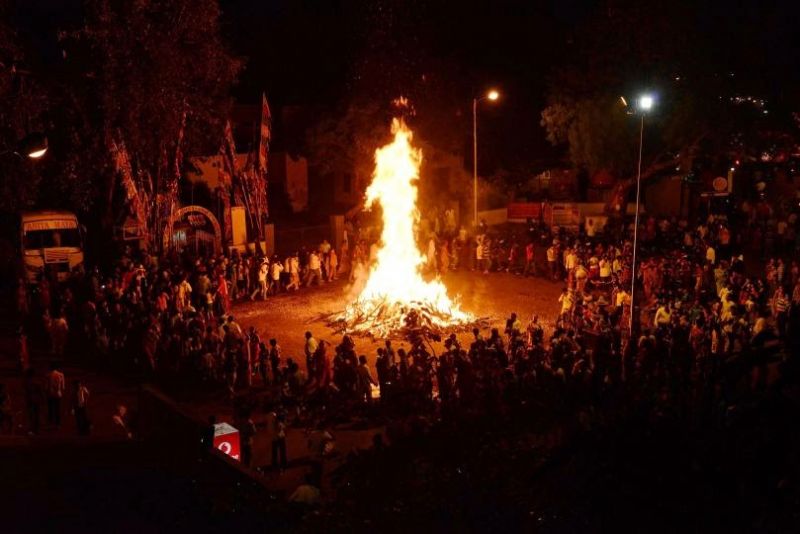
Festivals of India: Holi

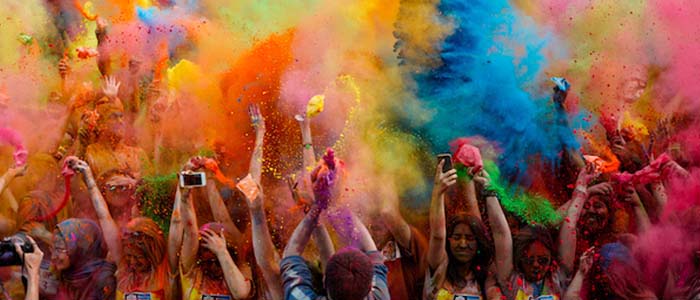
Literally the most colourful of all festivals and the one I am personally not a big fan of, the festival of Holi hearlds the arrival of spring, the end of winter, the blossoming of love, and for many, a festive day to meet others, play and laugh, forget and forgive, and repair broken relationships. The festival also celebrates the beginning of a good spring harvest season. This year, the Holi festivities, which is usually celebrated for a night plus the next day, started yesterday night and today India and especially northern India will be awash in colours.

The first evening is known as Holika Dahan (burning of demon holika) or Chhoti Holi (aka small Holi) and the following day as Holi or Rangwali Holi (aka colourful Holi). This festival is an ancient Hindu religious festival which has become popular with non-Hindus as well in many parts of South Asia, as well as people of other communities outside Asia.

Holi celebrations start on the night before Holi with a Holika Dahan where people gather, perform religious rituals in front of the bonfire, and pray that their internal evil be destroyed the way Holika, the sister of the demon king Hiranyakashipu, was killed in the fire. The next morning is celebrated as Rangwali Holi – a free-for-all festival of colours, where people smear each other with colours and drench each other. Water guns and water-filled balloons are also used to play and colour each other. Anyone and everyone is fair game, friend or stranger, rich or poor, man or woman, children, and elders. The frolic and fight with colours occurs in the open streets, open parks, outside temples and buildings. Groups carry drums and other musical instruments, go from place to place, sing and dance. People visit family, friends and foes to throw coloured powders on each other, laugh and gossip, then share Holi delicacies, food and drinks. Some customary drinks include bhang (made from cannabis), which is intoxicating. In the evening, after sobering up, people dress up and visit friends and family.

There is a symbolic legend to explain why Holi is celebrated as a festival of triumph of good over evil in the honour of Hindu god Vishnu and his follower Prahlada. King Hiranyakashipu, according to a legend found in chapter 7 of Bhagavata Purana, was the king of demonic Asuras, and had earned a boon that gave him five special powers: he could be killed by neither a human being nor an animal, neither indoors nor outdoors, neither at day nor at night, neither by astra (projectile weapons) nor by any shastra (handheld weapons), and neither on land nor in water or air. Hiranyakashipu grew arrogant, thought he was God, and demanded that everyone worship only him. However, Hiranyakashipu’s own son, Prahlada, however, disagreed and was and remained devoted to Lord Vishnu. This infuriated Hiranyakashipu who subjected Prahlada to cruel punishments, none of which affected the boy or his resolve to do what he thought was right. Finally, Holika, Prahlada’s evil aunt, tricked him into sitting on a pyre with her. Holika was wearing a cloak that made her immune to injury from fire, while Prahlada was not. As the fire roared, the cloak flew from Holika and encased Prahlada, who survived while Holika burned. Vishnu, the god who appears as an avatar to restore Dharma in Hindu beliefs, took the form of Narasimha – half human and half lion (which is neither a human nor an animal), at dusk (when it was neither day nor night), took Hiranyakashyapu at a doorstep (which was neither indoors nor outdoors), placed him on his lap (which was neither land, water nor air), and then eviscerated and killed the king with his lion claws (which were neither a handheld weapon nor a launched weapon). The Holika bonfire and Holi signifies the celebration of the symbolic victory of good over evil, of Prahlada over Hiranyakashipu, and of the fire that burned Holika.

In the Braj region of India (Mathura and Agra in the current state of Uttar Pradesh), where the Lord Krishna grew up, the festival is celebrated until Rang Panchmi (which happens around 5-6 days after Holi) in commemoration of the divine love of Radha for Krishna. The festivities officially usher in spring, with Holi celebrated as a festival of love. There is a symbolic myth behind commemorating Krishna as well. As a baby, Krishna developed his characteristic dark skin colour because the she-demon Putana poisoned him with her breast milk. In his youth, Krishna despaired whether the fair-skinned Radha would like him because of his dark skin colour. His mother, tired of his desperation, asks him to approach Radha and ask her to colour his face in any colour she wanted. This she did, and Radha and Krishna became a couple. Ever since, the playful colouring of Radha and Krishna’s face has been commemorated as Holi.

The festival of Holi is celebrated at a time when people are pretty much tired of the gloomy winters and thus have a tendency to feel sleepy and lazy. It’s natural for the body to experience some sluginess due to the changes in temperature. To counteract this, people sing loudly or even speak loudly. Their movements are brisk and their music is loud. All of this helps to rejuvenate the system of the human body. Also, colours when sprayed on the body have a great impact on it. Biologists believe the liquid dye or Abeer penetrates the body and enters into the pores. It has the effect of strengthening the ions in the body and adds health and beauty to it. Of course this is only true for natural colours and not the synthetic colours used today. Another scientific reason for celebrating Holi relates to the tradition of Holika Dahan. The mutation period of winter and spring, induces the growth of bacteria in the atmosphere as well as in the body. When Holika is burnt, temperature rises very high at the bonfire. So when people perform Parikrima (the circumambulation or going around the bonfire) around the fire, the heat from the fire kills the bacteria in the body thus, cleansing it. In the south where winters are not as severe, Holi is rarely celebrated or celebrated in a different way. The day after the burning of Holika people put ash or Vibhuti on their forehead and they would mix sandalwood paste with the young leaves and flowers of the mango tree and consume it to promote good health. Some also believe that play with colours help to promote good health as colours are said to have great impact on our body and our health. Doctors believe that for a healthy body, colours too have an important place besides the other vital elements. Deficiency of a particular colour in our body causes ailment, which can be cured only after supplementing the body with that particular colour.

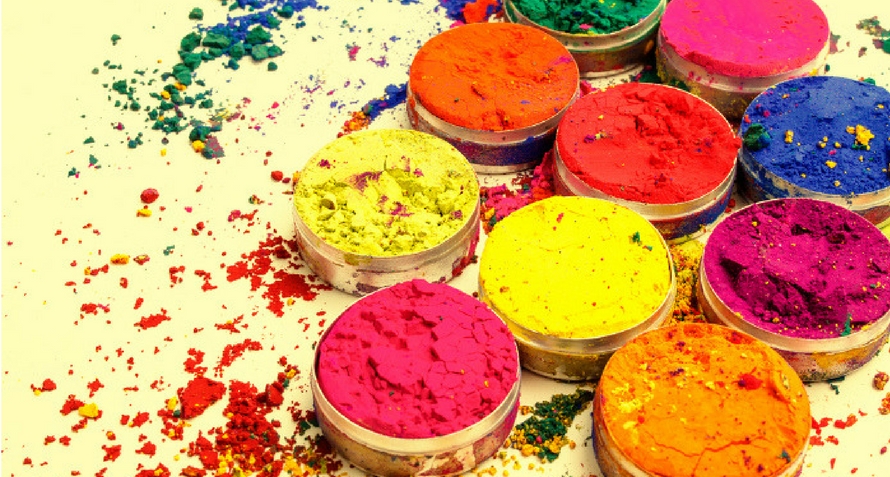
Traditionally Holi used to be played with colours found in nature. Traditional colours, called ‘Gulal’ are known to have medicinal properties since they were usually made of neem, kumkum, turmeric, bilva and other medicinal herbs. The flowers of the palash or flame of the forest trees provide the bright red and orange colours. Powdered fragrant red sandalwood, dried hibiscus flowers, madder tree, radish, and pomegranate are alternate sources and shades of red. Mixing lime with turmeric powder creates an alternate source of orange powder, as does boiling saffron in water. Henna and the dried leaves of gulmohur tree offer a source of green colour. In some areas, the leaves of spring crops and herbs have been used as a source of green pigment. Turmeric powder is the typical source of yellow colour. Sometimes this is mixed with gram or other flour to get the right shade. Bael fruit, amaltas, species of chrysanthemums, and species of marigold are alternate sources of yellow. Indigo plant, Indian berries, species of grapes, blue hibiscus, and jacaranda flowers are traditional sources of blue colour while beetroot is the traditional source of magenta and purple colour. Often these are directly boiled in water to prepare coloured water. Dried tea leaves offer a source of brown coloured water. Certain clays are alternate source of brown while some types of grapes, gooseberry and charcoal offer gray to black colours.

These days however, natural powders are becoming rare and chemically produced industrial dyes have been used to take their place in almost all of urban India. Due to the commercial availability of attractive pigments, slowly the natural colours are replaced by synthetic colours. These colours which more often than not contain questionable chemicals cause mild to severe symptoms of skin irritation and inflammation. Lack of control over the quality and content of these colours is a problem, as they are frequently sold by vendors who do not know their source. I remember friends coming to school, college and work in varying hues, some of which are not found anywhere in nature. Another gripe I have with the synthetic colours is the very weird smell that comes from them which really puts me off. And then let’s talk about the water bombs that contain a mixture of water and these colours which people throw from their homes, balconies and rooftops during this time period. I remember growing up, I used to hate getting out of the house during this time and in Mumbai, this period would typically be examination time, which meant actually getting out more to tuition classes and study sessions. We used to rarely walk alone, preferring to go out in groups so we can look all around us, especially when walking by medium to high rise buildings and preferring to walk in the middle of the road, even if that was not the safest place to walk. So you can see why in the beginning of this post, I said this is not a festival I particularly enjoy.

Happy Holi folks!

Festivals of India: Thaipusam

Last Saturday, Tamils all over the world celebrated the festival of Thaipusam. This festival is celebrated on the full moon in the Tamil month of Thai which starts in in mid-January, usually coinciding with Pushya star, known as Poosam in Tamil. It is mainly observed in countries where there is a significant presence of Tamil community. It is quite a big celebration

It is a national holiday in countries like Malaysia, Sri Lanka and Mauritius. In certain states of Malaysia and in the nations of Sri Lanka and Mauritius it is a government and a bank holiday.In Singapore, it was previously a national holiday but was removed from the official list of national holidays.

The word Thaipusam is a combination of the name of the month, Thai, and the name of a star, Pusam. This particular star is at its highest point during the festival. The festival commemorates the occasion when Parvati gave Murugan a Vel “spear” so he could vanquish the evil demon Soorapadman. It is commonly believed that Thaipusam marks Murugan’s birthday.

This festival was, according to one tradition, said to have been supposedly created during one of the battles between the Asuras (or to be more specific Soorapadman) and the Devas. At one point, the latter were defeated several times by the former. The Devas were unable to resist the onslaught of the Asura forces. In despair, they approached Shiva and entreated to give them an able leader under whose heroic leadership they might obtain victory over the Asuras. They surrendered themselves completely and prayed to Shiva. Shiva granted their request by creating the mighty warrior, Skanda, out of his own power or Achintya Shakti. He at once assumed leadership of the celestial forces, inspired them and defeated the Asura forces and to recognise that day the people created the festival, Thaipusam.

According to Skanda Puranam, the legend of Murugan, and Thirupugal which are divine verses on Murugan, adhere to Shaivam principles. Murugan is the embodiment of Shiva’s light and wisdom and devotees pray to him to overcome the obstacles they face, as He is the divine vanquisher of evil. The motive of Thaipusam festival is to pray to God to receive his grace so that bad traits are destroyed.

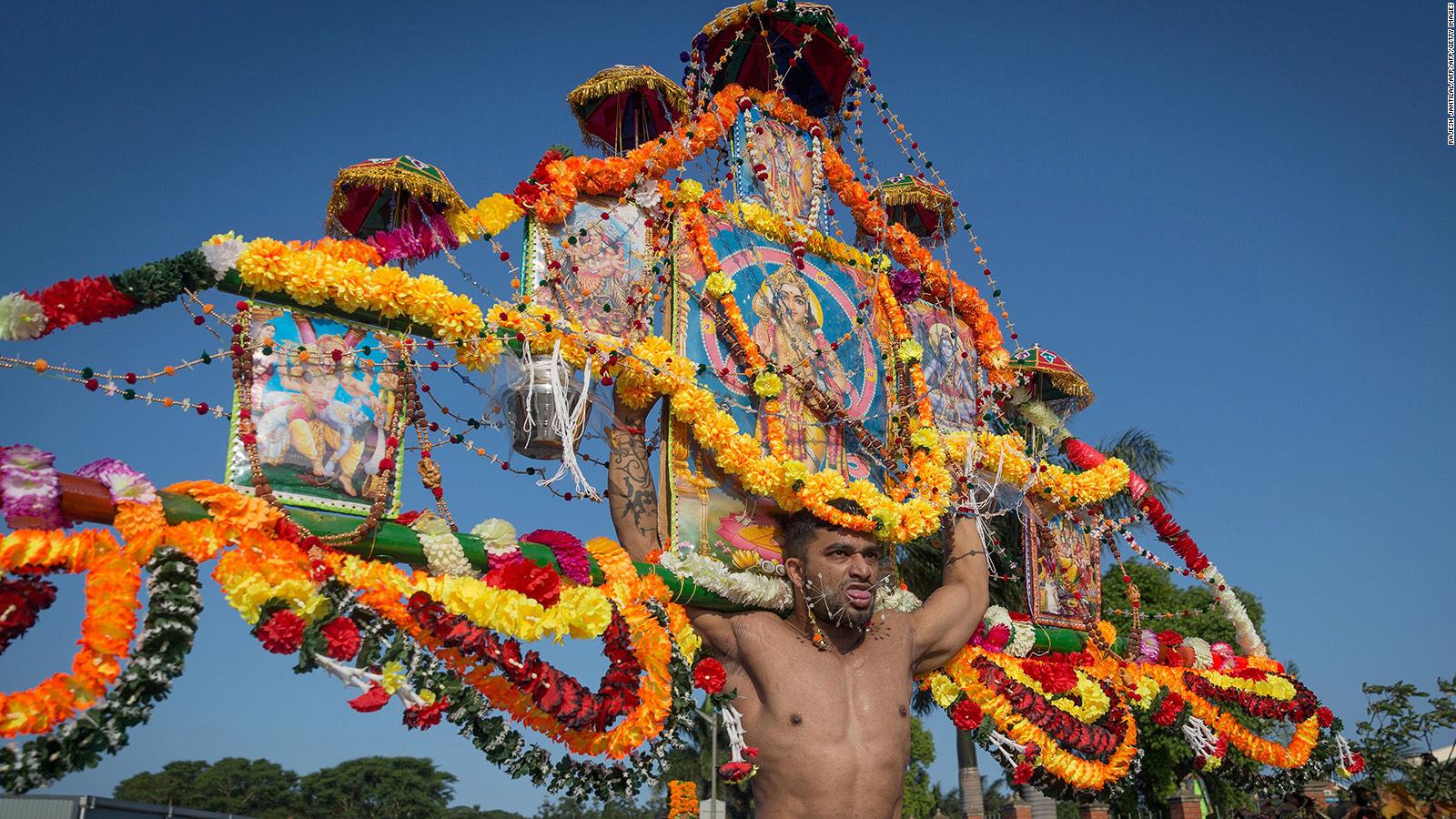
The Kavadi Attam (“kavadi dance”) is a ceremonial act of devotional sacrifice through dance, food offerings, and bodily self-mortification. It is often performed by devotees during the festival of Thaipusam in honor of Murugan. The kavadi is a heavy semicircular, decorated canopy or shrine supported by a wooden rod that the pilgrim carries on their shoulders to the temple and attached to the devotee with shrap skewers. They symbolize the burdens carried. The largest of the burdens, known as the vel kavadi, requires the person carrying it to be pierced by 108 small spears or vels! Other worshipers carry pots of milk, fruit, or grains as offerings to Lord Murgan, symbolising abundance and fertility.

The worshipers who pierce their tongues, cheeks, and faces with sharp objects hardly bleed and report feeling very little pain! Many claim that their wounds heal nearly immediately and don’t produce scars. Before being pierced, devotees are worked into a trance-like state with chanting and drums. Once entranced, the crowd helps to take care of them as they are led through the procession. Tongues are often pierced and pinned through the cheeks as a symbolic gesture of the volunteer giving up the gift of speech.

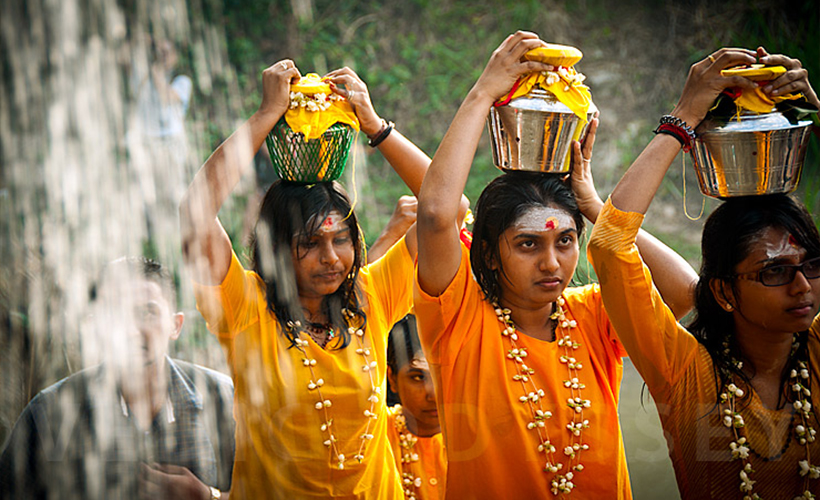
The devotee makes the pilgrimage (the nadai payanam) with bare feet, dressed in bright orange and yellow — Lord Murugan’s favorite colors — while they chant and walk to the temple. bearing food offerings on the kavadi. Depending on the location of the temple, this walk to the temple can take more than a week. The temple of Murugan in Palani is a popular destination, as it is one among the arupadai veedu (“six houses” – the sites sacred to Murugan). The Palani Murugan temple also has a reputation as a place of healing. Bogar (an ancient siddhar and devotee of Murugan) made the statue of Murugan in Palani, with the mixture of several sidhha medicines.

Devotees prepare for the celebration by keeping their body always clean, doing regular prayers, following a vegetarian diet and fasting before the Thaipusam. Kavadi-bearers have to perform elaborate ceremonies at the time of assuming the kavadi and at the time of offering it to Murugan. The kavadi-bearer observes celibacy and consumes only certain types of foods known as satvik food, once a day, while continuously thinking of God. On the day of the festival, devotees shave their heads and undertake a pilgrimage along a set route, while engaging in various acts of devotion, notably carrying the various types of kavadi. The devotees believe that worshiping lord Murugan every year in this way makes them physically and mentally healthy, and helps clear them of karmic debts they may have incurred. It is believed that only when the mind is free of material worth and the body free from physical pleasures can a devotee undertake the sacred task without feeling any pain.

At its simplest, the pilgrimage may entail walking the route carrying a pot of milk, but mortification of the flesh by piercing the skin, tongue or cheeks with vel skewers is also common. In addition, some pierce their tongues or cheeks, all the way through, with a small spear. similar practice is performed by the Nagarathar community in Pazhani, India. This is known as the Nagarathar Kavadi.

Harry Potter

I first read Harry Potter nearly twenty years back when the books first came out. I remember buying a bootlegged copy (Mumbai is quite famous for these kinds of books) and remember quickly getting hooked on to the series. I read the first three books before I moved to Singapore and remember when book number 5, The Order of the Phoenix, was released, I was pregnant with GG & BB. I was ordered bed rest by my doctor around my eighth month and it was around this time, I got hold of the book. It was a heafty book and I remember thinking it will be a good companion to my week-long bed rest. I finished the book in less than two days!

Around the time BB & GG were 8-9 years old, I started selling the series to them, but faced a lot of resistance, especially when they saw the size of the books. After about a couple of years, during one holiday, I decided to bribe them at the airport. I forced them to buy the first two books of the series and told them to try and read it. If they didn’t like the series after reading the two books, I will give up trying to force them to read. GG got hooked almost immediately and finished both books by the time we were back in Singapore. BB took longer to get involved in the books. I had to compell him to read at least 50 pages each day and by the time we were back in Singapore, he was also hooked in the series, not as much as GG, but enough to fight with her to read a new book first.

Source

GG is a true Potterhead and knows so much more about the world that J.K. Rowlings created than i could ever hope to know! She has a Potterworld account and has been sorted into Ravenclaw. She knows all the trivia and facts and corrects me on more than one occasion. She wants to go to the UK and visit the places where the books have been set, including doing the studio tour, visiting platform 9 3/4 at Kings Cross station and visiting Alnwick Castle which was used to film Hogwarts in the movies.

Both GG & BB have moved on to other book series now, but I suspect that the Harry Potter series retains a special place in their hearts.

Are you a fan of Harry Potter? I would love to hear which is your favourite book in the series.

Positive Self-Affirmations: Your Psychological Immune System

Source

Sometime last week, I randomly had a thought of putting together all the affirmations I had collected and written down in different places into one document. I truly didn’t know why I did what I did and decided to find out more about affirmations and see whether they have any impact on our lives and if they are beneficial in any way. I have used positive affirmations previously and also have read the book, The Secret, but to be honest, the affirmations did not work for me previously. So I decided to find out more about affirmations and maybe this time, I will be able to successfully use affirmations.

So let’s start at the very beginning – what exactly are positive affirmations? Affirmations which are a New Age terminology are said to be “the practice of positive thinking and self-empowerment—fostering a belief that “a positive mental attitude supported by affirmations will achieve success in anything.” More specifically, an affirmation is a carefully formatted statement that should be repeated to one’s self and written down frequently. For affirmations to be effective, it is said that they need to be present tense, positive, personal and specific.

These ideas grew in popularity after books like Rhonda Bryrne’s The Secret, Napoleon Hill’s Think and Grow Rich and Wallace D. Wattles’ 1910 book The Science of Getting Rich became popular in their times. Affirmations are also referred to in Neurolinguistic Programming (NLP), Neuro Associative Conditioning “NAC” as popularized by Anthony Robbins, and hypnosis.

What it means is that when we think positively and have positive thoughts relating to a specific event or thing we want, we manage to turn things in our tide using the power of our mind and that specific event happens or we get hold of exactly what we want. In other words, they are positive phrases or statements used to challenge negative or unhelpful thoughts.

A 2009 study found that positive affirmation had a small, positive effect on people with high self-esteem, but a detrimental effect on those with low self-esteem. Individuals with low self-esteem who made positive affirmations felt worse than individuals who made positive statements but were allowed to consider ways in which the statements were false. There have also been some studies which show that when self-affirmation statements which involve writing about one’s core values rather than repeating a positive self-statement can improve performance under stress.

It is said that affirmations are not only for manifesting a specific goal, but they are also meant to encourage a life filled with positivity and gratitude.

We do speak with ourselves in different times during the day, something pepping us up and at other times cursing ourselves when we make a blunder. I tend to be more on the negative side as opposed to the positive side. Daily affirmations are like a psychological immune system. When you get bogged down or thinking negatively, your affirmations will allow you to pick you up and get you back on track.

While researching for this post, I read up a few articles on positive affirmations and saw that, in spite of my scepticism, there are benefits to this practice.

You perform better under stress – positive self-affirmations allow you to release your stress and help you perform better, whether at home, in school or at work.

You are better off psychologically – When someone uses positive affirmations regularly, they tend to feel happier, more optimistic, more hopeful, healthier, less sad and less angry.

Healthy habits – You can also use positive affirmations to change habits. Reminding yourself periodically can help promote a healthier way of living. Apparently a recent study showed that optimistic people have healthier hearts.

Self-Awareness – When you think, speak or write certain thoughts on a daily basis, you become more aware of them and then consciously work to reduce negativity in your life. This allows you to become a more positive person both inward and outwards.

Gratitude – Daily affirmations keep you in a constant state of gratitude. When you remember the small things that make you happy, you become aware of the little things in life that are important. This is especially true today when we live a fast paced life, one that is constantly on our smart phones.

Motivation – Affirmations allow you to motivate yourself into doing positive actions. When you tell yourself you will be successful in a particular activity, then the chances are that you will focus all your attention in making sure you do your best in this activity and be the best you are. Your thoughts point to the direction of your life’s actions.

So how do we go about making positive self-affirmations? You can think about them, repeat a sentence like a mantra while you practice meditation (in fact, I remember reading that meditating over a self-affirmation is a great way to do it), write it down some place or even whisper it under your breath at periodic points in your day. You could do one, more or even all of these during your day to affirm your thought for the day. There is no hard and fast rules about the timing or frequency when it comes to practicing positive self-affirmations.

According to psychotherapist Ronald Alexander of the Open Mind Training Institute, affirmations can be repeated up to three to five times daily to reinforce the positive belief. He suggests that writing your affirmations down in a journal and practicing them in the mirror is a good method for making them more powerful and effective.

You can create your own affirmation phrase which is generic like, “I am a successful person” or “I am confident and capable at what I do” or focus on a specific area of your life like, “I choose only to think good thoughts” or “I choose to eat healthily for all meals.

You can also create your own positive affirmation cards on small credit card sized paper where you write your chosen affirmation and pop it into your bag to read throughout the day. I prefer using an online diary like Google Docs and writing down my affirmations and I can view them while I am working or even during my commute as I whip out my phone and read it on the go.

There are loads of resouces online which have many affirmations you can use or you can create your own affirmations. What works for someone may not be the best affirmation for you, so you need to work around and see what works best for you. I personally feel this is more of a trial and error method.

Positive self-affirmations can be a refreshing way to use positive self-talk capable of reversing negative internal messages and motivating ourselves. Do you have your own affirmations you’d like to share? Or, even better, how do you come up with your own affirmations? Share in the comments, I’d love to hear them!