Festivals of India: Rama Navami

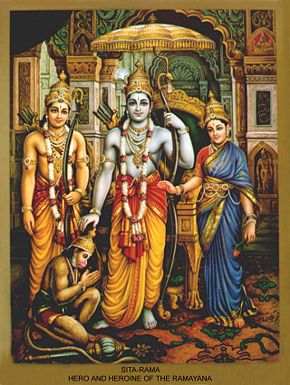
Tomorrow is Ram Navami, the festival which celebrates the birth of Lord Rama, the seventh avatar of Lord Vishnu, the oldest son of King Dasharatha and Queen Kaushalya and the protagonist of the Hindu epic The Ramayana.

The day is traditionally celebrated on Shukla Paksha on the Navami, or ninth day of the month of Chaitra in the Hindu calendar. This day also marks the end of the Chaitra Navratri or Vasant Navratri which is celebrated mostly in Northern India.

Lord Rama, one of the oldest know Gods having a human form, is known as the perfect man and ‘Maryada Purushottam’ which translates to an ideal, righteous and perfect human being. In this avatar or manifestation of Lord Vishnu, as Lord Rama, he destroys the demon king of Lanka (present day Sri Lanka) King Ravana.
In his Sanskrit text Ramayana, Valmiki, describes the birth chart of Lord Rama as

“On completion of the ritual six seasons have passed by and then in the twelfth month, on the ninth day of Chaitra month [March–April], when the presiding deity of ruling star of the day is Aditi, where the ruling star of day is Punarvasu (Nakshatra),  the asterism is in the ascendant, and when five of the nine planets viz., Sun, Mars, Jupiter, Saturn, and Venus are at their highest position, when Jupiter with Moon is ascendant in Cancer, and when day is advancing, then Queen Kausalya gave birth to a son with all the divine attributes like lotus-red eyes, lengthy arms, roseate lips, voice like drumbeat, and who took birth to delight the Ikshwaku dynasty, who is adored by all the worlds, and who is the greatly blessed epitome of Vishnu, namely Rama.”

Book I: Bala Kanda, Ramayana by Valmiki, Chapter (Sarga) 18, verses 8, 9, 10 and 11

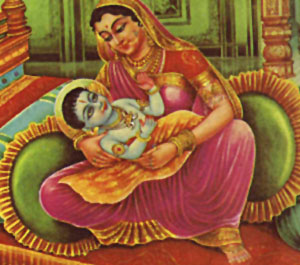
Temples celebrate his birth at noon, with cradles and small image of Lord Rama in it as he is traditionally supposed to be born then. Many people may fast with the temple offerings being their main meal of the day.

In South India, the day is also celebrated by performing a Kalyanosatvam (marriage celebration) of Rama and Sita and then temples have processions (which is dwindling these days).

A sweet drink called Panakam, made using jiggery, lemon, cardamom and pepper is made and offered to the Lord on this day as prasadam along with a cooling yoghurt drink called Neer Mor and a lentil payasam.

Although an important festival in the Hindu calendar, this is not a festival, I remember celebrating much. I do remember drinking panakam made by my mother and that is the extent of our festivities. I don’t have any memories of any special dishes made for this festival. This year, I will most likely make the drink, offer it to the Lord and then share it with my family.
Festivals of India: Karadiya Noombu


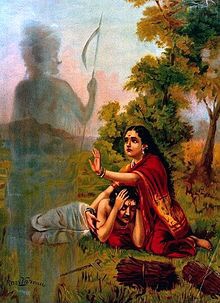
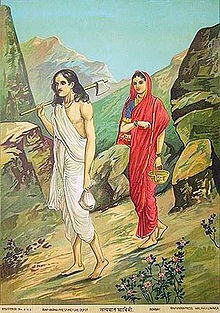
Savitri following Satyavan to the forest (Image from Wikipedia)

Women in Tamil Nadu will celebrate Karadaiya Noombu or Savitri Vartham on Sunday early morning. One of the more obscure festivals celebrated in Tamil Nadu, this can be compared to the more popular and ubiquitous Karwa Chauth that women in North India celebrate. In both, women fast for the well-being and long-life of their husbands. Here, women and girls will tie a yellow thread (noombu) at the exact moment when the Tamil month of Maasi ends and the the month of Panguni starts. In Karadaiya Noombu, girls also tie the yellow thread, although they won’t fast, unlike Karva Chauth.


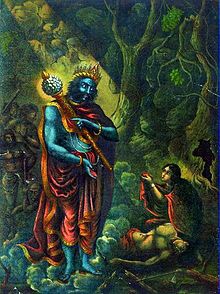
Savitri begging Lord Yama not to tak e away her husband’s life (Image from Wikipedia)

A special offering to God called Noombu Adai is prepared to offer to the Lord and then eaten by the women fasting/praying.


Savitri fighting for Satyavan’s life (Image from Wikipedia)

It is believed that on this day, aeons ago, in mythology, the princess Savitri sweet-talked the Lord Yama and got her husband Satyavan back from the dead. The story of Satyavan and Savitri was first found in the Mahabharata and is actually a very sweet story. Read more here (http://en.wikipedia.org/wiki/Savitri_and_Satyavan)

The fast for Karadaiya Noombu is observed from sunrise on the transition day when the Sun God, Lord Surya transitions from Kumbha (Capricorn) raashi to Meena (Pieces) raashi. 


I am really curious to know if other cultures have something similar….

Chinese New Year

Gong Xi Fa Cai, Xin Nian Quai Le

With these words, the Chinese diaspora across the world welcomed the Year of the Sheep yesterday. This is also called the Spring Festival in China and is traditionally celebrated for 15 days. The Chinese New Year is also called the Lunar New Year.

The Lunar New Year is a time to honour both deities and ancestors and is celebrated not only in China, but also in countries with significant  Chinese populations like Singapore, Malaysia, Hong Kong, Macau, Taiwan, Indonesia, Thailand, Philippines etc.

Regional differences ensure differing customs across the diaspora, but cleaning the homes thoroughly before the new year, buying new clothes for everyone in the family, putting up auspicious sayings and calligraphy in the home, giving away ‘luck-money’ in the form of angpows or red packets and having a reunion dinner on the eve of the new year are common across different dialect groups.

According to tales and legends, the beginning of the Chinese New Year started with a mythical beast called the Nian. Nian would come on the first day of New Year to eat livestock, crops, and even villagers, especially children. To protect themselves, the villagers would put food in front of their doors at the beginning of every year. It was believed that after the Nian ate the food they prepared, it wouldn’t attack any more people. One day a villager decided to get revenge of the Nian. A god visited him and told him to put red paper on his house and to place firecrackers. The villagers then understood that the Nian was afraid of the color red. When the New Year was about to come, the villagers would hang red lanterns and red spring scrolls on windows and doors. People also used firecrackers to frighten away the Nian. From then on, Nian never came to the village again. The Nian was eventually captured by Hongjun Laozu, an ancient Taoist monk. The Nian became Hongjun Laozu’s mount. (source Wikipedia)

The first two days of the Chinese New Year is a public holiday in many countries, including Singapore and when it comes at the beginning or end of a work week, like this year, it means a long weekend!

Many workplaces will have a special Chinese New Year lunch and lio-hei or yusheng for their employees. Lo Hei or the Prosperity toss is something which is pretty unique to Singapore and Malaysia and maybe other parts of ASEAN. The lo hei usually has fish served with white radish, carrots, capsicum, turnips, red pickled ginger, sun-dried oranges, daun limau nipis (key lime leaves), Chinese parsley, chilli, jellyfish, chopped peanuts, toasted sesame seeds, Chinese shrimp crackers (or fried dried shrimp), five spice powder and other ingredients, laced with a sauce using plum sauce, rice vinegar, kumquat paste and sesame oil, for a total of 27 ingredients. While putting each ingredient, auspicious couplets are said, each with a special meaning, to increase your prosperity in the coming year. Then everyone in the table grabs a pair of chopsticks and toss the ingredients in the air, repeating the auspicious wishes while doing so, the reasoning being, the higher you toss, the better your luck for the year. Some people believe that if the ingredients fall on your head, you will be very lucky that year!

My workplace had a lo-hei earlier this week, but I was held up and by the time I reached the place for lunch, the lo-hei was over…

Festivals of India: Maha Shivaratri

This year, I have decided to blog about all the major Hindu festivals as well as those of other faiths which are celebrated in Singapore. This will serve mainly as a repository of knowledge for GG & BB, when I am not around…

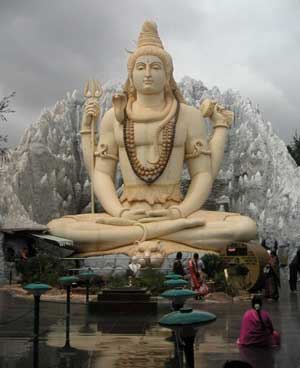
So yesterday, Hindus across the world celebrated Maha Shivratri. This is an annual festival which is celebrated in honor of one of the triumvirate of the Hindu pantheon of Gods – Lord Shiva. This day, celebrated as the convergence of Shiva and Shakti (male and female) is the day Lord Shiva married the Goddess Parvati. It is also said this is the day when Lord Shiva performed the Tandava dance, a dance which is the source of the cycle of creation, preservation and dissolution.

Devotees celebrate this festival principally by fasting all day and offering bael leaves to the Lord as well as staying up the whole night in prayer and contemplation. It is said that the planetary positions in the Northern Hemisphere on this day act as a potent catalyst to help a person raise their spiritual energy. The benefits of powerful ancient Sanskrit mantras such as Maha Mrityunjaya Mantra increase greatly on this night.

This Wikipedia link has some nice stories on this day which is a nice read.

The holiest of the Shiva temples in India are called the Jyotirlingas. There are 12 such temples, spread across the country. More information is here

Personally, though Lord Shiva is the kuladevta (or family deity) of S’s family, we don’t really do anything special on this day. There are no special prayers or dishes we make to commemorate this day.

Festivals of India: Pongal O Pongal

This week all over India, various communities will be celebrating/would have celebrated their Harvest festivals. In the southern part of India, specifically Tamil Nadu, today is the day that is celebrated as Pongal.

Not to be confused with the yummy sweet and salt Pongal dishes, the festival of Pongal is a harvest festival celebrated by Tamil people all over the world around 13-16 January each year. This is a four day festival which is according to the Gregorian calendar, unlike most Hindu festivals, which are based on the lunar calendar and marks the start of the sun’s six-month long journey northwards or Uttarayan as it’s called in Sanskrit. This is also celebrated as Makar Sankranti in other parts of India.

The word Pongal in Tamil means ‘overflowing’ and signifies abundance and prosperity. The celebrations for the four day festival start with ‘Bhogi Pongal’ with the worship of Lord Indra, the ruler of clouds and rains to thank him for a season of good rainfall and to make sure he blesses the farmer with just enough rain to ensure abundant harvest. The next day is ‘Thai Pongal’ which is the main festival day. People wake up before sunrise and bathe and get ready and at the time of sunrise, ritually boil fresh milk and let it overflow the earthern pot it is being boiled in. When the boiling happens, people shout “Pongalo Pongal” which means “Let there be prosperity and abundance everywhere”.  The third day is set aside for the animals in the household called ‘Mattu Pongal‘ to give them thanks for the work they do helping the farmer with his harvest. The farm animals, specifically the bulls and cows are scrubbed up and decorated and treated with goodies. The last day is a time for family reunions, called ‘Kaanum Pongal‘ where brothers give their married sisters special gifts and employers gift their employees. This marks the end of the Pongal festivities for the year.

Other harvest festivals celebrated in India include Bihu in Assam, Lohri in Punjab and Makar Sankranti in Gujarat, my home state of Maharashtra and other states in India

This is basically a festival meant to thank the Sun God  for a good harvest and has been celebrated for more than 1000 years, though some historians say it’s older than that.

Culture is important for a human being. You need to know where you come from, what your values are, so that, as custodians of the next generation, you are able to pass it on. This post is so BB & GG know where they come from and are able to pass it to their children and grand-children!