Adulting 101: Financial Literacy

As GG & BB turn 21 later this year (where did all the time go?), I decided to start a new series aimed at young adults. This series will have articles on what adulting is all about. So what is adulting? Adulting is simply doing things that an adult does – work, make and save money, buy or rent a home, etc. Today’s topic, the first in the series, will talk about a very important, perhaps the most important, aspect of adulting – financial literacy.

Being financially literate means having the knowledge and skills to make informed decisions about managing money effectively. This critical life skill empowers one to achieve their financial goals, build wealth, and secure their future.

What is financial literacy? Financial literacy encompasses understanding concepts like budgeting, saving, investing, credit, debt management, and risk protection through insurance. It involves being able to read and analyse financial statements, calculate interest rates, and comprehend the time value of money. Ultimately, financial literacy equips one with the ability to make sound financial choices that align with their short-term and long-term objectives.

Developing financial literacy early in one’s career is crucial for several reasons. Understanding credit, interest rates, and the consequences of overspending can help one steer clear of accumulating unmanageable debt, which can hinder their financial progress. Unexpected expenses like medical bills or job loss can derail finances. Financial literacy teaches the importance of setting aside funds for emergencies and providing a safety net. Whether it’s buying a home, funding retirement, or achieving other financial milestones, financial literacy empowers an individual to make informed decisions about saving and investing for their future goals. Lastly, being financially literate means understanding the role of insurance in protecting assets and income from potential risks, such as accidents, illness, or natural disasters.

One of the fundamental principles of financial literacy is the importance of saving. Developing the habit of saving early can have a profound impact on long-term financial well-being. Here are some reasons why saving should be a priority:

  1. Emergency fund: as mentioned earlier, an emergency fund can provide a financial cushion during unexpected events, preventing one from going into debt or depleting their long-term savings.
  • Retirement planning: compound interest is a powerful force that can help retirement savings grow exponentially over time. Starting to save for retirement early, even with small amounts, can make a significant difference in future financial security.
  • Achieving financial goals: Whether it’s buying a house, starting a business, or taking a dream vacation, saving consistently can help one achieve their financial goals more quickly.

Here are some tips for starting on a financial literacy journey:

  1. Create a budget to track income and expenses to understand where the money is going. Budgeting is the foundation of effective money management.
  • Build an emergency fund and aim to save at least three to six months’ worth of living expenses for unexpected emergencies.
  • Educate oneself by reading books, attending workshops, or taking online courses to improve one’s financial knowledge. Understanding concepts like compound interest, credit scores, and investment strategies can empower one to make better financial decisions.
  • Automate savings by setting up automatic transfers from salary and other commonly used accounts to a dedicated savings account, making saving a habit and reducing the temptation to spend.
  • Seeking professional advice by working with a financial advisor, especially for more complex financial matters like retirement planning or investment strategies. One should look for fee-only advisors who act as fiduciaries, putting one’s interests first.
  • Once an emergency fund has been established and high-interest debts have been paid off, one should consider investing in diversified portfolios like mutual funds or exchange-traded funds (ETFs) to build long-term wealth.

The key things to focus on in building emergency funds are setting realistic goals, making saving automatic and consistent, cutting expenses where possible, and taking advantage of opportunities to direct extra money towards the emergency fund. Building the habit and making it a priority from a young age will pay off tremendously. To build an emergency fund, here are some effective ways to start:

  1. Start small and set achievable goals: Begin by saving the first $1,000 (or an equivalent amount in your currency) as an initial emergency fund target. Set small, realistic goals like saving $20-$100 per month until that first $1,000 is reached. Having an achievable initial goal will help one stay motivated and build the habit of saving.
  • Set up automatic transfers: Automate savings by setting up recurring transfers from the main account to a dedicated high-yield savings account for the emergency fund. Treat these automatic transfers like a recurring bill that gets paid first before other expenses. Automating the process makes it easier to save consistently without having to think about it.
  • Cut back on unnecessary expenses: Identify and reduce discretionary spending on things like eating out, entertainment, subscriptions, etc. Cook at home, find free/low-cost hobbies, and cancel unused memberships. Redirect the money saved from cutting expenses into the emergency fund.
  • Use windfalls and pay raises: When one receives tax refunds, bonuses, gifted money or pay raises, allocate a portion towards the emergency fund. Don’t treat windfalls as extra spending money; instead, prioritise saving some of it.

Developing financial literacy is an ongoing journey, but the sooner you start, the better prepared you’ll be to navigate the financial challenges and opportunities that lie ahead. Embrace financial education, cultivate healthy money habits, and take control of your financial future from the very beginning of your career.
Financial Literacy for Teens and Young Adults

BB & GG only started getting serious pocket money from the start of this school year. Luckily for us, they don’t really spend the money they get as pocket money, instead putting it in a money box. I’ve told them that at the end of the year, we will tally the money they’ve saved and half of that will go into their bank accounts and the other half is for them to spend.

I’ve also opened a trust savings account for them, this was when they were about a month old. Into this account went all the money they’ve received till date – all birthday money and any money that their doting grandparents and other relatives would give to them on festivals and occasions. I’ve also been putting a small sum into this account every month and over the years this has added up to a good amount. The money in this account is meant for tertiary and other education for both of them and I don’t want them to have access to this account ever!

So that BB & GG learn the importance of a savings account and learn to use it responsibly, I am keen that at least by the end of this year, I open savings accounts for them, these will not be linked to the ones I have already opened for them.

So that they know how to manage their finances, I’ve also been reading up on financial literacy. I actually consider this one of the most important subjects that should be, but is not taught in schools and colleges and so I decided to read up and then go on to teach them the same.

So what exactly is financial literacy? One definition I found and which I felt was very appropriate says, “Financial literacy is the ability to use knowledge and skills to make effective and informed money management decisions”.

Income and Expenses and the relationship between them
To be able to make informed money management decisions, the first thing you need to do is to teach your child what income and expenditure are and the relationship between them. In very simple terms, income is what you earn – your monthly or weekly salary plus anything else you earn when you are not working. Expenditure is everything you spend on. The difference between this is your net profit or loss. Profit happens when income is more than expenses and loss is when the reverse happens.

All expenses need not be bad, some expenses, which you incur to obtain something which will stay with you for a while (that is what we call an asset) is probably good expenses. Examples for this can be buying a house, spending money on learning something new which helps you in your day job or paying for your passion, which in turn is turned into a source of income.

However, not everything you buy that stays with you for a long time is a good expense. Now we bring into the picture a term called Depreciation. Simply put, depreciation is the reduction in value of an asset over a period of time due to wear and tear. A good example would be a car. You pay good money for the car, add to this the various taxes and the maintenance you pay for it over a period of time. When the time comes to sell the car, you would not get even half of what you’ve paid for it, this is depreciation. Another good example is electronic items when you buy them, you pay a premium, especially for some products. Then when the next upgrade comes, your current model is sold for pennies!

Spend, Save, and Share
When you earn, it does not mean that you need to save everything except that which you need for daily expenses and necessities. You should also keep some money to spend on things that you like. However, it is always better to divide your income into two or more buckets – to save, to spend and maybe to use for the less fortunate.

By this same token, if you have multiple goals, you can have multiple accounts in your bank

Saving for long and short term goals
The long term goals will be big goals – like a house, a car etc, medium and short term goals can be holidays, electronic equipment, etc and the daily expense account should be your usual account. As soon as your salary gets credited to your account, transfer the agreed upon percentage to each of these accounts. This is called ‘Paying Yourself First’.

Make sure that your ATM card is not linked to these accounts so there is no temptation to dip into them. Make it easy to see the balance online, but difficult to access it online and through the ATM. This will reduce the temptation to use these accounts as back-ups when you find yourself short.

Since BB & GG are not earning members of society nor have any long-term goals at the moment, all their savings will be for short or medium term goals. I am going to get them to write down their short and medium goals so that they have goals to work towards.

Budgeting
This is perhaps the biggest lesson that financial literacy teaches us and one that is often relegated to the bottom when it comes to personal finance. Anyone who deals with money needs to budget it. And when you are young like BB & GG, it becomes important that they learn this when they just start learning about money so that by the time they start earning decent money, budgeting becomes as essential to them as breathing or eating!

Budgeting is a plan you make each month (or week or whenever you get your income) on how to spend your money. Budgeting is important because it allows you to have a plan for your money and also makes sure that you always have money for things that are necessary and those that are important. It also keeps you on-track for your short, medium and long-term goals in life.

When you go to purchase anything, ask yourself always if you can live without the item. If yes, then go away and do not buy. If the answer is no, then still put it back, but think about it for a week or so. If after a week, you still can’t stop thinking about it, either see if you can afford it or if no, then plan to save it for your short-term goals.
Making an initial budget is quite simple – make a list of all income on one side, and then first move money to your savings, then account for the necessities and what’s left will be your fun money or money you can use for entertainment or for yourself without feeling guilty about it.

If you have basic accounting knowledge and know how to reconcile your own accounts, it will help you in own budgeting and financial planning.

The power of Compound interest
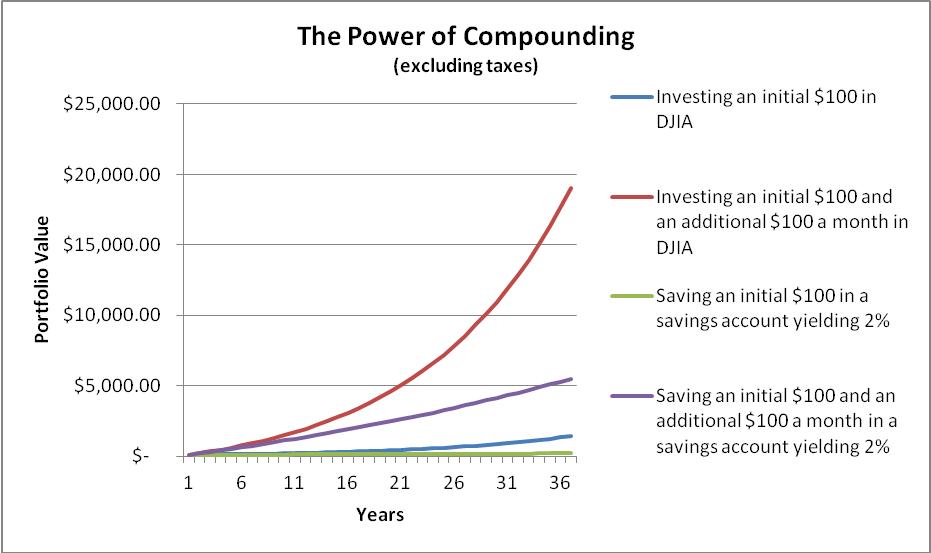
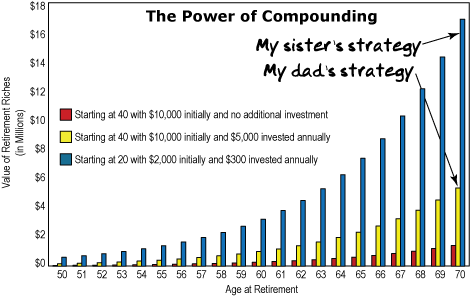
One of the biggest advantages when it comes to financial management, especially for those who start saving early on, compounding your money allows it to grow faster. Compound interest happens when the interest that is accrued to your savings account adds to the money into the account and that interest, in turn, earns more interest.

So for compound interest to be really effective, you need to start saving much earlier, rather than later. Even if you put in small sums, but at regular intervals over a period of time, starting from when you first start working (or even earlier, if possible), then with careful planning, you may even become a millionaire by the time you hit 50 years of age!

Here are some images which show you the immense power that is compounding.


As BB & GG grow older and more financially savvy, I want to introduce investing concepts to them. These are all topics for posts which will probably come later as they become more financially lierate.
Inflation