Sacred Stones, Spaces, and Stories: Ashtavinayaka Part 8

Renowned as the “Remover of Obstacles,” the Vighneshwar Temple at Ozar lies on the banks of the Kukadi River. Here, Lord Ganesha is worshipped as Vighneshwar or Vighnahar, the vanquisher of Vighnasura, the demon of obstacles, making Ozar a beacon for those seeking the removal of life’s impediments and the fulfilment of their aspirations.

Ozar is a small town in the Pune district, about 85 km from Pune city and near the famed Lenyadri caves. The temple’s riverside location, close to the Yedagaon dam, and its proximity to the Lenyadri shrine and Shivneri Fort imbue the site with a sense of history and natural beauty. The approach to the temple is marked by a fortified stone gateway, flanked by deep malas, or lamp towers, and meditation rooms.

The lore of Vighneshwar Temple is rooted in ancient scriptures such as the Mudgala Purana, Skanda Purana, and Vinayaka Purana and is central to its spiritual identity. Once, King Abhinandana performed a grand sacrifice but neglected to offer due respect to Indra, the king of gods. Feeling slighted, Indra commanded Kala (time/death) to disrupt the sacrifice. Kala assumed the form of the demon Vighnasura, “the demon of obstacles,” and not only destroyed the ritual but unleashed havoc across the universe, creating impediments in the virtuous deeds and sacrifices of sages and mortals alike.

Distressed by the chaos, the sages sought help from Brahma, or Shiva in some versions, who advised them to worship Lord Ganesha. Responding to their prayers, Ganesha confronted Vighnasura. Realising he could not defeat the divine child, Vighnasura surrendered and promised to desist from troubling those who invoked Ganesha’s name. In some retellings, Vighnasura became Ganesha’s attendant, tasked with testing the devotion of those who neglected his worship.

To commemorate this cosmic victory, the sages consecrated an idol of Ganesha as Vighneshwar at Ozar. From that day, it was decreed that obstacles, or Vighnas, would only trouble those who failed to honour Ganesha, cementing his role as the universal remover of obstacles.

The Vighneshwar Temple’s historical prominence is closely linked to the Maratha Peshwas. After the victorious Battle of Vasai or Bacaim in 1739, Chimaji Appa, the younger brother and military commander of Peshwa Baji Rao I, renovated the temple and adorned its shikhara, or spire, with gold as an offering of gratitude for his triumph. The temple underwent further restoration in 1967 under the guidance of Appa Shastri Joshi, a devoted follower of Ganesha.

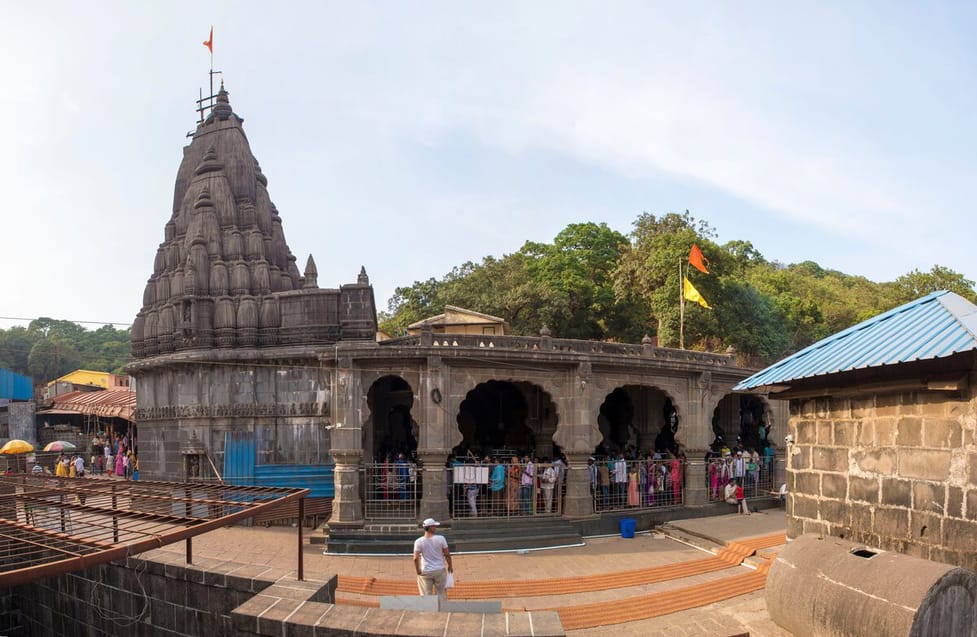
The Vighneshwar Temple exemplifies classic Hindu temple architecture, blending grandeur with spiritual symbolism. The temple faces east, welcoming the rising sun and symbolising new beginnings. It is set within a large, walled courtyard with a prominent gateway, flanked by two massive stone Dwarapalas, or gatekeepers, and adorned with bas-reliefs of musicians. Two large deepmalas, or lamp towers, stand near the entrance, and small meditation rooms on either side offer spaces for contemplation. The temple features three intricately carved entrances, with the eastern gate serving as the main access point. The first hall houses an image of Dhundiraj Ganesha, while the second contains a white marble statue of Mushika, Ganesha’s mouse vehicle. The temple walls are decorated with vibrant murals and sculptures depicting scenes from Ganesha’s legends and the Ashtavinayak pilgrimage. The sanctum’s shikhara is covered in gold foil, a legacy of Chimaji Appa’s offering.

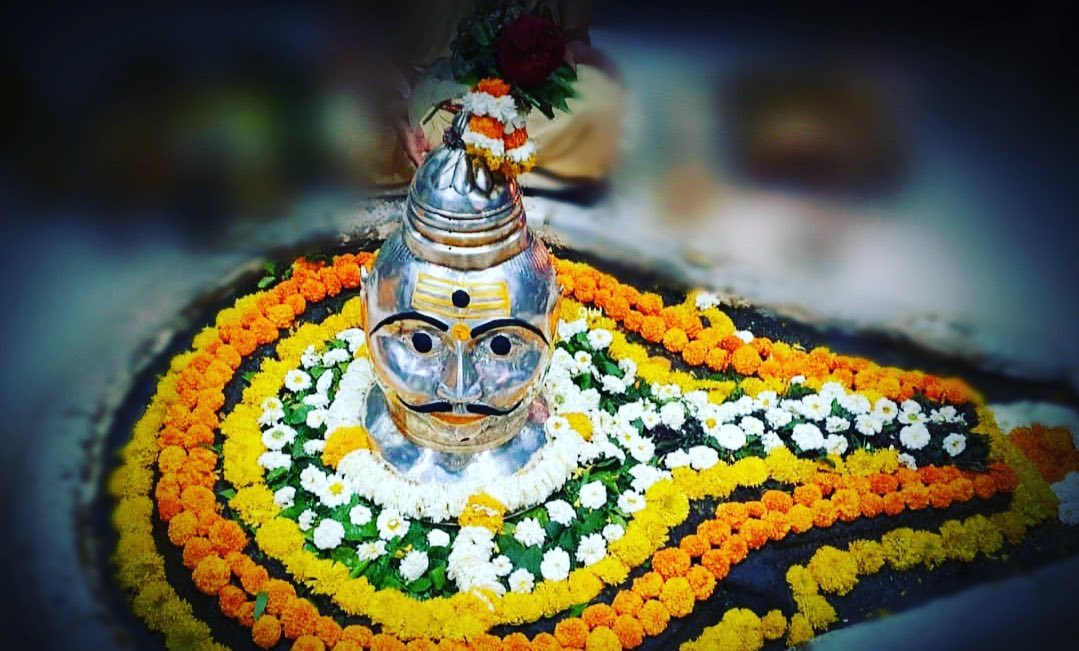
The presiding deity is a swayambhu, or self-manifested idol, naturally formed as an elephant-faced stone. The idol faces east, with its trunk turned to the left, and is covered in indoor, or vermilion. The eyes are set with emeralds, and diamonds adorn the forehead and navel. Brass images of Ganesha’s consorts, Riddhi and Siddhi, flank the main idol, symbolising prosperity and spiritual power.

The temple opens early, and devotees offer flowers, durva grass, and modaks to the deity. Ritual bathing of the idol is performed, especially on auspicious days. Morning and evening aartis are conducted with great devotion, accompanied by the ringing of bells and the chanting of hymns. Circumambulation, or pradakshina, of the sanctum is a common practice, with devotees seeking the removal of obstacles from their lives. On Sankashti Chaturthi, the fourth day after the full moon, special pujas and offerings are made, drawing large crowds of devotees.

The deepmalas are lit during festivals, creating a mesmerising spectacle of light that symbolises the victory of knowledge over ignorance. The marble statue of Mushika is also worshipped, as he is considered Ganesha’s loyal vehicle and a symbol of humility and service.

Ganesh Chaturthi or Bhadrapada Shuddha Chaturthi, is the most important festival at Ozar. The temple is adorned with flowers and lights, and thousands of devotees gather for special abhisheks, aartis, and processions. The atmosphere is charged with devotion, music, and communal harmony.

Other major festivals include Tripuri Pournima, the full moon in the month of Kartik and Magh Chaturthi in January or February, when fairs are organised and the temple becomes a hub of religious and cultural activities.

Vighneshwar’s legend is a powerful reminder that obstacles are an inevitable part of life, but with faith and devotion, they can be overcome. The temple’s rituals, architecture, and festivals all reinforce the message that invoking Ganesha brings clarity, strength, and the removal of impediments.

Ozar is traditionally the seventh temple visited on the Ashtavinayak pilgrimage, though many pilgrims visit it fifth for convenience. The temple’s association with the defeat of Vighnasura makes it a crucial stop for those seeking to complete the spiritual circuit and receive Ganesha’s blessings.

The temple stands as a radiant beacon of faith, resilience, and triumph over adversity. Its legends speak of cosmic battles and divine grace; its architecture embodies the grandeur and serenity of Hindu sacred spaces; its rituals and festivals unite communities in celebration and prayer.

In My Hands Today…

Gods, Guns and Missionaries: The Making of the Modern Hindu Identity – Manu S. Pillai

When European missionaries arrived in India in the sixteenth century, they entered a world both fascinating and bewildering. Hinduism, as they saw it, was a pagan a worship of devils and monsters by a people who burned women alive, performed outlandish rites and fed children to crocodiles. But it quickly became clear that Hindu ‘idolatry’ was far more layered and complex than European stereotypes allowed, surprisingly even sharing certain impulses with Christianity.

Nonetheless, missionaries became a threatening force as European power grew in India. Western ways of thinking gained further ascendancy during the British while interest in Hindu thought influenced Enlightenment thinkers like Voltaire in Europe, Orientalism and colonial rule pressed Hindus to reimagine their religion. In fact, in resisting foreign authority, they often adopted the missionaries’ own tools and strategies. It is this encounter, Manu S. Pillai argues, that has given Hinduism its present shape, also contributing to the birth of an aggressive Hindu nationalism.

Gods, Guns and Missionaries surveys these remarkable dynamics with an arresting cast of characters – maharajahs, poets, gun-wielding revolutionaries, politicians, polemicists, philosophers and clergymen. Lucid, ambitious, and provocative, it is at once a political history, an examination of the mutual impact of Hindu culture and Christianity upon each other, and a study of the forces that have prepared the ground for politics in India today. Turning away from simplistic ideas on religious evolution and European imperialism, the past as it appears here is more complicated – and infinitely richer – than previous narratives allow.

In My Hands Today…

Airplane Mode: An Irreverent History of Travel – Shahnaz Habib

A playful personal and cultural history of travel from a postcolonial, person-of-color perspective, Airplane Mode asks: what does it mean to be a joyous traveler when we live in the ruins of colonialism, capitalism and climate change?

For Shahnaz Habib, an Indian Muslim woman, travel has always been a complicated pleasure. Yet, journeys at home and abroad have profoundly shaped her life. In this inquiring and surprising debut, Habib traces a history of travel from pilgrimages to empires to safaris, taking on colonialist modes of thinking about travel and asking who gets to travel and who gets to write about it.

Threaded through the book are inviting and playful analyses of obvious and not-so-obvious travel artifacts: passports, carousels, bougainvilleas, guidebooks, expressways, the idea of wanderlust. Together, they tell a subversive history of travel as a Euro-American mode of consumerism—but as any traveler knows, travel is more than that. As an immigrant whose loved ones live across continents, Habib takes a deeply curious and joyful look at a troubled and beloved activity.

Sacred Stones, Spaces, and Stories: Ashtavinayaka Part 7

Perched high on the rugged hills of Junnar in Pune district, the Girijatmaj Temple at Lenyadri is a remarkable confluence of natural beauty, ancient history, and deep spiritual resonance. Unique among the eight Ashtavinayak shrines dedicated to Lord Ganesha, Girijatmaj is the only temple set atop a mountain and carved into a single monolithic rock within a complex of ancient Buddhist caves. Here, Ganesha is worshipped as the “son of Girija”, another name for Goddess Parvati, and the temple is a living testament to the power of maternal devotion, the endurance of faith, and the seamless blending of India’s Buddhist and Hindu heritages.

Lenyadri, also known as Ganesh Lena or Ganesh Pahar, is located about 95 km from Pune and 5 km from Junnar. The temple sits at the heart of a cluster of 30 rock-cut Buddhist caves, which date back to the 1st–3rd centuries AD and are scattered along a cliff face. The caves overlook the Kukadi River valley, offering breathtaking views of the surrounding green hills, especially after the monsoon when the landscape is lush and vibrant. To reach the temple, pilgrims and visitors must climb 307–315 stone steps, flanked by playful monkeys and mountain streams. The ascent is both a physical and spiritual journey, with the panoramic vistas and the cool mountain air preparing the mind for the sanctity that awaits at the summit.

The story of Girijatmaj is rooted in the deep yearning of Goddess Parvati for a child. According to the Ganesh Purana, after taking the form of Parvati, having previously been Sati, the goddess desired to have Ganesha as her son. She chose the caves of Lenyadri, then known as Jirnapur or Lekhan Parbat, as her place of penance. For twelve years, Parvati performed intense austerities and prayers inside these caves, seeking the blessing of motherhood.

Pleased by her unwavering devotion, Lord Ganesha granted her wish. On the auspicious day of Bhadrapada Shuddha Chaturthi, or Ganesh Chaturthi, Parvati scraped the dirt from her body, mixed it with oil and ointment, and fashioned an idol of Ganesha. As she worshipped this idol, it miraculously came to life, and Ganesha declared that he had incarnated as her son, as desired. Shiva later named the child Ganesh, meaning “one who keeps the three qualities: Satva, Raja, and Tama, under control.” Ganesha spent his childhood at Lenyadri, and for fifteen years, the caves were his playground and home.

The caves of Lenyadri are also the backdrop for several of Ganesha’s legendary childhood adventures. According to the Ganesh Purana, the demon king Sindhu, forewarned that his death would come at the hands of Ganesha, sent a series of demons—Krur, Balasur, Vyomasur, Kshemma, and Kushal—to kill the young deity. Ganesha, even as a child, vanquished all his adversaries and performed many playful miracles, or balleelas, in and around the caves. These stories are cherished by devotees and add to the temple’s aura of divine protection and joy.

The Lenyadri caves were originally carved as Buddhist viharas and chaityas, monastic dwellings and prayer halls, during the Hinayana phase of Buddhism, between the 1st and 3rd centuries AD. Of the approximately 30 caves, most served as monastic quarters, while a few were chapels. Cave 7, which now houses the Girijatmaj Temple, was originally a vihara, a communal hall for monks.

Over centuries, as Buddhism waned and Hinduism reasserted itself in the region, the caves were adapted for Hindu worship. The transformation of Cave 7 into a Ganesha shrine is a striking example of India’s syncretic religious history, where sacred spaces evolve and retain their spiritual significance across faiths.

The entire temple is hewn from a single rock, with no separate structural additions. This gives the temple its cool, serene ambience, regardless of the weather outside. The main hall, the sabha-mandapa, is a spacious, unpillared chamber measuring 53 feet long, 51 feet wide, and 7 feet high. It contains 20 cells of varying sizes, originally used by Buddhist monks. The central entrance is flanked by two windows, and a pillared veranda leads into the hall. The sanctum is not a separate structure but a niche in the back wall of the cave. The image of Ganesha is not a free-standing idol but a relief carved directly into the stone wall. The idol faces east, with its trunk turned to the left, and only one eye is visible. The icon is covered in indoor, or vermilion, in keeping with the tradition of Ashtavinayak temples. During the day, sunlight streams into the sanctum, bathing the idol in a celestial glow and enhancing the temple’s mystical atmosphere. The temple lacks a separate shikhara, or spire; gopuram, or gateway; or ornate carvings typical of Hindu temples, emphasising its monastic origins and simplicity.

The temple opens early in the morning and closes at sunset. Devotees offer flowers, durva grass, and modaks to the deity. The idol, being part of the rock, is not adorned with clothes or ornaments but is anointed with sindoor and sometimes oil. Ritual bathing, abhishek and aarti, and the waving of lamps are performed daily. Devotees can sponsor abhishek or aarti as a special offering. Circumambulation, or pradakshina, of the temple is performed within the main hall, as the structure is carved into the mountain. The most important festival is Ganesh Chaturthi, or Bhadrapada Shuddha Chaturthi, when thousands of pilgrims climb the steps to offer prayers. Special aartis, abhisheks, and communal feasting mark the occasion. Other festivals like Maghi Ganesh Jayanti, which is Ganesha’s birthday, and Sankashti Chaturthi, a monthly festival, are also celebrated with great devotion.

Many devotees undertake the climb of 307–315 steps barefoot as an act of penance or to fulfil vows, believing that the effort itself invokes Ganesha’s blessings. The temple’s monastic origins and serene setting make it a favoured spot for meditation and quiet contemplation. The absence of loud music or elaborate rituals preserves the cave’s tranquil atmosphere.

The name “Girijatmaj” combines “Girija,” another name for Parvati, the daughter of the mountain, and “Atmaj,” or son, emphasising Ganesha’s identity as the beloved child of Parvati. The temple thus celebrates the bond between mother and son, and by extension, the nurturing, protective aspect of the divine.

Girijatmaj is the only Ashtavinayak temple located on a mountain, symbolising the spiritual ascent a devotee must undertake to reach the divine. The physical climb is a metaphor for the inner journey of discipline, faith, and perseverance. The temple’s setting within a Buddhist vihara highlights the fluidity of India’s religious traditions. The peaceful coexistence of Buddhist and Hindu elements is a powerful reminder of the region’s pluralistic heritage.

Girijatmaj is traditionally the sixth temple visited on the Ashtavinayak pilgrimage, though the order can vary. Its unique location and the legend of Ganesha’s birth make it a highlight of the yatra. Pilgrims often combine their visit with a trek through the other caves, exploring the rich tapestry of Buddhist art and architecture that surrounds the temple.

The Girijatmaj Temple at Lenyadri is a living symbol of faith, perseverance, and the enduring bond between mother and child. Its legends speak of penance rewarded, demons vanquished, and the joy of divine play. Its architecture, carved from living rock, stands as a testament to the artistry and spiritual vision of ancient India.

Sacred Stones, Spaces, and Stories: Ashtavinayaka Part 6

One of Maharashtra’s celebrated Ashtavinayak temples, the Chintamani Temple is located on the banks of the Mula-Mutha River, just 25 km from Pune, in Theur. Revered as the abode of Chintamani Ganesha, the wish-fulfilling form of the elephant-headed deity, this temple is a magnet for pilgrims seeking peace of mind, the removal of worries, and the fulfilment of heartfelt desires.

Theur is a serene village located at the confluence of the Mula, Mutha, and Bhima rivers, a site long regarded as spiritually potent. Its name is said to derive from the Sanskrit “Sthavar,” meaning “stable,” a reflection of the temple’s legendary power to bring stability to restless minds. The temple’s peaceful setting, surrounded by lush fields and the gentle flow of water, provides an ideal environment for devotion and meditation, attracting hundreds of thousands of devotees each year.

The Chintamani Temple is steeped in legends that illuminate the compassionate and wish-fulfilling nature of Lord Ganesha. According to the Mudgala Purana, King Abhijeet and Queen Gunavati, after years of penance, were blessed with a son named Gana, also called Guna or Ganasura. Gana grew into a powerful but arrogant and greedy prince. On a royal visit to the hermitage of Sage Kapila, Gana was served a magical feast, conjured by the sage’s wish-fulfilling jewel, the Chintamani.

Overcome by desire, Gana demanded the jewel, but Kapila refused. In a fit of rage, Gana seized the gem by force and left. The heartbroken sage prayed to Lord Ganesha for help. Responding to his devotee’s plea, Ganesha appeared, some accounts say in a dream, others in person, and, with the help of his power, Siddhi, created the thousand-armed warrior Laksha to defeat Gana’s army. Ganesha himself beheaded the arrogant prince and returned the jewel to Kapila.

Yet, the sage, now enlightened, realised that the presence of the Lord was more precious than any jewel. He requested Ganesha to stay at Theur, and the deity agreed, taking the name Chintamani, “the remover of worries” and “the wish-fulfiller”.

Another legend tells of Lord Brahma, the creator, who was plagued by anxiety and an unsettled mind. Seeking peace, Brahma meditated on Ganesha at Theur and found his worries dispelled. The name “Theur” thus signifies a place of stability, where even gods find solace.

A lesser-known myth recounts that Lord Indra prayed to Ganesha under a Kadamba tree at Theur to be freed from the curse of Sage Gautama. This gave rise to the name Kadambanagari for the region, further highlighting its spiritual significance.

While the exact date of the temple’s founding is lost to history, Theur has been a Ganapatya, or Ganesha-worshipping centre, since antiquity. The present structure was restored in the 16th–17th centuries by Cintāmaṇī Maharaja Deva and his descendants and later enhanced by the Maratha Peshwas, especially Madhavrao I, in the 18th century.

The temple is closely associated with the Ganapatya saint Morya Gosavi, who frequently visited Theur on his journeys between Chinchwad and Morgaon. According to tradition, Morya Gosavi performed a 42-day penance at Theur, fasting and meditating, until Ganesha appeared to him in the form of a tiger and granted him spiritual powers, or siddhi. His descendants continued to serve as the temple’s custodians, and the Chinchwad Devasthan Trust now manages the site.

The Chintamani Temple became a spiritual hub for the Peshwa rulers of the Maratha Empire, who considered Ganesha their family deity, their kuladaivat. Madhavrao I, in particular, was a devoted patron; he renovated the temple, built the wooden sabha-mandapa, or assembly hall, and installed a large European bell captured from the Portuguese at Vasai Fort. Madhavrao spent his final days at the temple, performing a continuous abhisheka, or ritual bathing of milk, in hopes of regaining his health. His wife, Ramabai, also a devout follower, performed sati after his death, and their memory is honoured annually at the temple.

The Chintamani Temple is one of the largest Ashtavinayak shrines, showcasing a harmonious blend of architectural styles. Facing north, the main entrance opens into a spacious courtyard. The Sabha Mandapam, a wooden assembly hall constructed by Madhavrao I, features intricately carved pillars and a black stone water fountain. The Garbhagriha, the sanctum sanctorum, houses the swayambhu, or self-manifested idol, of Chintamani Ganesha, oriented eastward. The idol is cross-legged, coated in sindur, vermilion, with jewel-studded eyes and a trunk turned to the left. The temple complex is home to a sacred Kadamba tree, under which Ganesha is believed to have defeated Gana. Behind the temple stands the Peshwa Wada, once the residence of Madhavrao I, now serving as the administrative hub. The complex includes smaller shrines dedicated to Lord Shiva, Lord Vishnu, and Lord Hanuman. A European bell, a war trophy from the Portuguese, still hangs in the temple, a symbol of Maratha valour and piety.

The Chintamani Temple maintains a vibrant schedule of daily worship. The temple opens at 6 am, with devotees flocking for early morning darshan. Ritual bathing of the idol, or abhisheka, with milk, water, and flowers is performed, especially on auspicious days. Morning and evening aartis are conducted with great devotion, accompanied by the ringing of bells and the chanting of hymns. Naivedya, in the form of offerings of modaks, sweet dumplings, and other delicacies, are made to the deity and later distributed as prasad to devotees.

The temple is renowned as a centre for meditation, with devotees seeking relief from mental worries and anxieties. Pilgrims perform pradakshina, or circumambulation of the temple, often while reciting Ganesha mantras. Devotees offer prayers and tie threads around the sacred Kadamba tree, seeking the removal of obstacles and the fulfilment of wishes.

Ganesh Chaturthi, in August or September, is the most celebrated festival at Theur. Over ten days, the temple is adorned with decorations, and thousands of devotees gather for special rituals, processions, and communal feasting. The air is filled with devotional music and the sound of drums, creating an atmosphere of joy and spiritual fervour.

Maghi Chaturthi, celebrated in January or February, is another major festival. The festivities begin on the fourth day, or Chaturthi, and continue until the eighth day or Ashtami, featuring special abhishekas, aartis, and processions.

Unique to Theur is the Rama-Madhav Punyotsav, held on the eighth day of the Kartik month, so in October or November, commemorating the death anniversaries of Madhavrao I and his wife Ramabai. Devotees gather to honour their memory with prayers and rituals, reflecting the temple’s deep historical ties to the Maratha dynasty.

Theur is traditionally the fifth stop on the Ashtavinayak circuit, though many pilgrims visit it second due to its proximity to Pune and Morgaon. Its association with wish-fulfilment and peace of mind makes it a particularly popular destination for those seeking relief from life’s anxieties.

The Chintamani Temple is not only a place of worship but also a centre of community life. Festivals, daily rituals, and charitable activities bring together people from all walks of life, fostering a spirit of unity and shared devotion. In the tranquil embrace of Theur, amidst the echoes of ancient myths and the blessings of the wish-fulfilling Lord, devotees discover that true chintamani, the real jewel, is the serenity and stability that faith brings to the restless heart.