Asura: Tale Of The Vanquished – Anand Neelakantan
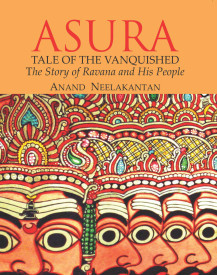 The epic tale of victory and defeat… The story of the Ramayana had been told innumerable times. The enthralling story of Rama, the incarnation of God, who slew Ravana, the evil demon of darkness, is known to every Indian. And in the pages of history, as always, it is the version told by the victors that lives on. The voice of the vanquished remains lost in silence.
But what if Ravana and his people had a different story to tell? The story of the Ravanayana has never been told. Asura is the epic tale of the vanquished Asura people, a story that has been cherished by the oppressed castes of India for 3000 years. Until now, no Asura has dared to tell the tale. But perhaps the time has come for the dead and the defeated to speak.
“For thousands of years, I have been vilified and my death is celebrated year after year in every corner of India. Why? Was it because I challenged the Gods for the sake of my daughter? Was it because I freed a race from the yoke of caste-based Deva rule? You have heard the victor’s tale, the Ramayana. Now hear the Ravanayana, for I am Ravana, the Asura, and my story is the tale of the vanquished.”
“I am a non-entity – invisible, powerless and negligible. No epics will ever be written about me. I have suffered both Ravana and Rama – the hero and the villain or the villain and the hero. When the stories of great men are told, my voice maybe too feeble to be heard. Yet, spare me a moment and hear my story, for I am Bhadra, the Asura, and my life is the tale of the loser.”
The ancient Asura empire lay shattered into many warring petty kingdoms reeling under the heel of the Devas. In desperation, the Asuras look up to a young saviour – Ravana. Believing that a better world awaits them under Ravana, common men like Bhadra decide to follow the young leader. With a will of iron and a fiery ambition to succeed, Ravana leads his people from victory to victory and carves out a vast empire from the Devas. But even when Ravana succeeds spectacularly, the poor Asuras find that nothing much has changed from them. It is then that Ravana, by one action, changes the history of the world.

 On the day he retires, Inspector Ashwin Chopra inherits two unexpected mysteries.
 An eye-opening and courageous memoir that explores what learning a new language can teach us about distant worlds and, ultimately, ourselves.
 On the eve of the monsoons, in a remote Indian village, Kavita gives birth to a baby girl. But in a culture that favours sons, the only way for Kavita to save her newborn daughter’s life is to give her away. It is a decision that will haunt her and her husband for the rest of their lives, even after the arrival of their cherished son.
 The story describes the complex transition of an adolescent mind into adulthood and the heartbreak which a youth faces. It revolves around a young man named Chandran, who resembles an Indian upper middle class youth of the pre-independence era. First, Chandran’s college life in late colonial times is described. After graduation, he falls in love with a girl, but is rejected by the bride’s parents, since his horoscope describes him as a manglik, a condition in which a manglik can only marry another manglik and if not, the non-manglik will die. Malathi, the girl with whom Chandran falls in love after graduating from college, is then married to someone else.
