Festivals of India: Varalakshmi Vratam

Last week was the Varalakshmi Vratam, also called Varalakshmi Puja, an observance to propitiate the goddess of prosperity, Goddess Lakshmi. Varalakshmi is the manifestation of Goddess Lakshmi who grants boons or varams and is the embodiment of wealth, prosperity, and auspiciousness.

It is a puja primarily performed by married Hindu women in South India, particularly in the states of Tamil Nadu, Karnataka, Andhra Pradesh, and Telangana on the Friday before the day of the full moon in the Hindu month of Shravana, which corresponds to the Gregorian months of July – August. The vratam or fast is performed by sumangalis or married women for their well-being, and to ask the Goddess to bless their husbands with health and longevity. Many believe that worshipping the aspect of Varalakshmi on this day is equivalent to worshipping the Ashtalakshmi or the eight aspects of Lakshmi, all of whom represent different forms of wealth.

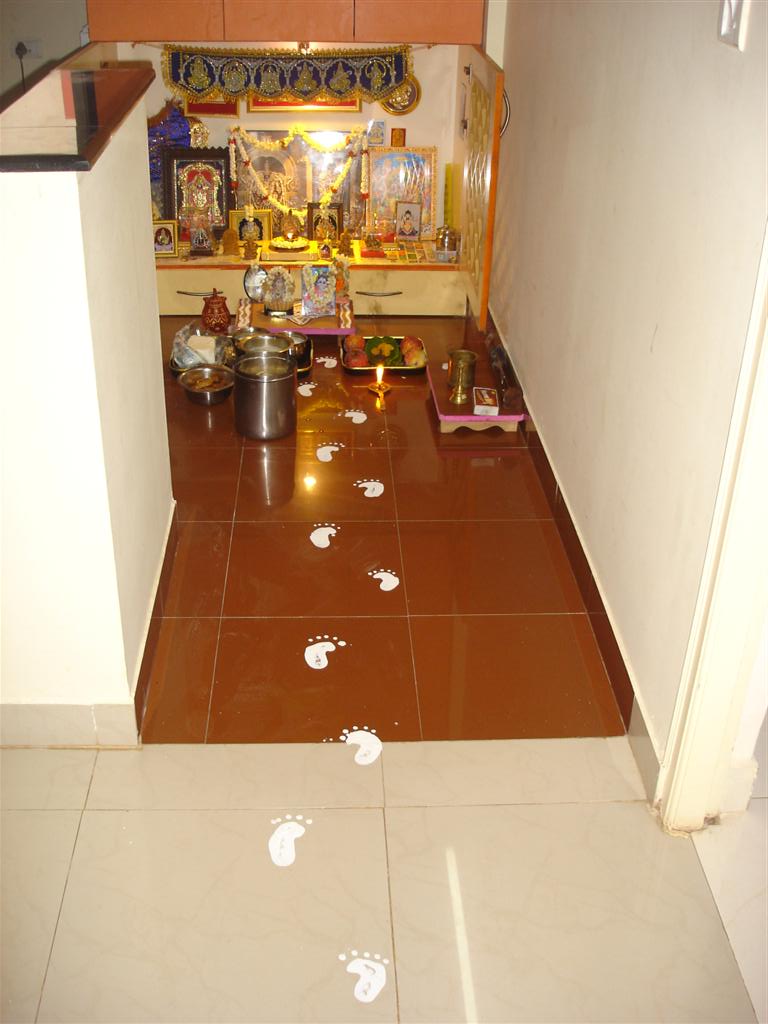
On this occasion, women worship the goddess Lakshmi by offering fruits, sweets and flowers and a kalasham which represents the deity is decorated with a sari, flowers and gold jewellery, with offerings placed in front of it. The puja begins with the formal welcome of Goddess Lakshmi into one’s house. A wooden tray or a stand is placed outside the house’s threshold. Rangoli is drawn in the puja room. A kalasham which is usually made of brass or silver is placed on the tray outside the house. The pot is decorated with mango leaves as well as flowers. Auspicious items such as rice, betel leaves, turmeric sticks, bananas, and coins are placed inside the pot. A thread dipped in turmeric is tied around the neck of the pot. A coconut scrubbed with turmeric is placed on top of it. In some traditions, the face of the goddess may be drawn on the coconut, or a brass or silver face may be kept on the pot and decorated with kumkum, turmeric, and sandalwood powder. During an auspicious hour, the women sing a song of greeting to Goddess Lakshmi and carry the tray and kalasham into the puja room. After lighting the lamp and performing the arati, shlokas, songs dedicated to the goddess are sung. The yellow thread is untied, and a piece is given to each girl or woman to tie around her right wrist. This is symbolic of the conclusion of the auspicious puja, as well as receiving the blessings of the deity. This is also worn to signify protection and piety, and several articles are given as gifts and charity in good faith.

In Tamil Nadu, as offerings, four varieties of kozhakattai, payasam, and vadai are prepared as naivedyam or offerings. The next day, the Lakshmi puja is performed. Cooked rice, chickpeas, fruit, and betel leaves are offered to all the women who participated. The face of the goddess is turned towards the west, and the kalasham with its contents is placed inside a drum of rice, symbolically keeping the goddess safely inside the house until the next year. The festivities of this occasion often end with the recitation of the vrata katha, the story of the vow that offers it its religious significance.

According to one story, a Brahmin woman named Padmavati, known to be pious and dutiful to her husband, as well as reputed to assist the sick, poor, and the needy, was observed by Goddess Lakshmi in the kingdom of Kosala. Greatly pleased, the goddess instructed her to perform the festival on the given date in the month of Shravana so that she could achieve salvation. In a similar story, a virtuous and honest woman named Charumati, devoted to her husband and in-laws, receives a dream from Lord Vishnu. The deity tells her to worship the Goddess Lakshmi every year during the month of Shravana, which would give her blessings of his consort, as well as wealth.

Some of the rituals that are performed on this occasion are regarded by some scholars to be significant. The essence of the goddess, in fact, of all females, is said to be turmeric and vermillion, and then during this festival, goddess and woman overlap, periodically, momentarily.

Varalakshmi Vrat is not just an individual observance but also a festival that fosters a sense of community and togetherness. The festival celebrates the divine feminine energy where women come together to perform the puja, share their experiences, and seek the blessings of the Goddess. It is a time when friendships are strengthened, and bonds are renewed. In a country that is diverse with multiple cultures and traditions, festivals hold a special place in the hearts of its people. And I believe that it is these festivals that keep us rooted in our traditions and as custodians of traditions, we should celebrate them so that the next generation also knows the beauty of their culture.

Festivals of India: Nag Panchami

Today is Naga Panchami. One of India’s unique festivals, Nag Panchami is a day of traditional worship of the snake or Nag or Naja or Naga, which are associated with the mythical Naga beings observed by Hindus, Jains, and Buddhists throughout India and Nepal. The worship is offered on the fifth day of the bright half of the lunar month of Shravan which is around mid-July to mid-August. Some Indian states, like Karnataka, Rajasthan and Gujarat, celebrate Naga Panchami in the dark half or Krishna Paksha of the same month. As part of the festivities, a Naga or serpent deity made of silver, stone, wood, or a painting is given a reverential bath with milk and their blessings are sought for the welfare of the family. Live snakes, especially cobras, are also worshipped on this day, especially with offerings of milk and generally with the assistance of a snake charmer.

Naga Panchami is also a day when Akharas or traditional Indian wrestling gyms, hold special celebrations to honour the mystical symbolism of the snake as a symbol of virility and kundalini energy. There are many legends in Hinduism and folklore narrated to the importance of worship of snakes. According to Hindu Puranas and the Mahabharata, Kashyapa, grandson of Lord Brahma, married two daughters of Prajapati Daksha, Kadru and Vinata. Kadru then gave birth to the race of Naga, while Vinata gave birth to Aruna, who became the charioteer of the sun god, Surya, and also gave birth to the great eagle Garuda, who became the vehicle of Lord Vishnu.

In the Mahabharata epic, the sage Astika stops King Janamejaya from sacrificing and eventually decimating the serpent race or the Sarpa Satra. This sacrifice was performed by Janamejaya to avenge the death of his father Parikshita, who was killed by Takshaka, the king of the snakes. A sacrificial fireplace had been specially erected and the fire sacrifice to kill all snakes in the world was started by a galaxy of learned Brahmin sages. The sacrifice performed in the presence of Janamejaya was so powerful that it was causing all snakes to fall into the Yagna kunda or the sacrificial fire pit. When the priests found that only Takshaka who had bitten and killed Parisksihita had escaped to the nether world of Indra seeking his protection, the sages increased the tempo of reciting the mantras to drag Takshaka and also Lord Indra to the sacrificial fire. Takshaka had coiled himself around Indra’s cot but the force of the sacrificial yagna was so powerful that even Indra along with Takshaka was dragged towards the fire. This scared the Gods who then appealed to Manasadevi to intervene and resolve the crisis. She then requested her son Astika to go to the site of the yagna and appeal to Janamejaya to stop the Sarpa Satra yagna. Astika impressed Janamejaya with his knowledge of all the Sastras or scriptures who then granted him to seek a boon. It was then that Astika requested Janamejeya to stop the Sarpa Satra. Since the king was never known to refuse a boon given to a Brahmin, he relented, despite protests by the sages performing the yagna. The yagna was then stopped and thus the life of Indra and Takshaka and the rest of the serpent race was spared. This day, according to the Hindu Calendar, happened to be Nadivardhini Panchami or the fifth day of the bright fortnight of the lunar month of Shravana during the monsoon season and since then the day is a festival day of the Naga as their life was spared on this day. Lord Indra also went to Manasadevi and worshipped her. During this sacrifice, the Mahabharata as a whole was first narrated by the sage, Vaisampayana. According to the Garuda Purana, offering prayers to snakes on this day is auspicious and will usher good tidings in one’s life. This is to be followed by feeding Brahmins.

On Naga Panchami, snakes are worshipped with milk, sweets, flowers, lamps, and even sacrifices. Deities of snakes made of silver, stone, wood, or paintings on the wall are first bathed with water and milk and then worshipped with the reciting of mantras. Fasting is observed on this day and Brahmins are fed. Fasting and praying on this day is considered a sure protection against the fear of snake bites. In many places, real snakes are worshipped and fairs are held. On this day digging the earth is taboo as it could kill or harm snakes which reside inside the earth.

In some regions, milk is offered along with crystallised sugar, and rice pudding. A special feature is the offering of a lotus flower which is placed in a silver bowl. In front of this bowl, a rangoli of a snake is created on the floor with a brush made of wood, clay, silver or gold with sandalwood or turmeric paste as the paint. The design pattern resembles a five-hooded snake. Devotees then offer worship to this image on the floor. In villages, the anthills where the snakes are thought to reside, are searched. Incense is offered to the anthill as prayer along with milk. This is a myth from folklore where snakes are fed milk so that snakes come out of the anthill. After this, milk is poured into the hole in the anthill as a libation to the snake god.

On this occasion, doorways and walls outside the house are painted with pictures of snakes, and auspicious mantras are also written on them. It is believed that such depictions will ward off poisonous snakes. The day is also observed as Bhratru Panchami when women with brothers worship snakes and where they reside, offering prayers to propitiate Naga so that their brothers are protected and do not suffer or die due to snake bites. Naga Panchami is also celebrated as Vishari Puja or Bishari Puja in some parts of the country where Bisha or Visha means poison.

Apart from the scriptural mention of snakes and Naga Panchami, there are also many folktales about the festival. One such tale is of a farmer living in a village. He had two sons and one of whom killed three snakes during ploughing operations. The mother of the snake took revenge on the same night by biting the farmer, his wife and two children and they all died. The following day the farmer’s only surviving daughter, distraught and grieving over the death of her parents and brothers, pleaded before the mother snake with an offering of a bowl of milk and requested forgiveness and asked to restore the life of her parents and brothers. Pleased with this offering the snake pardoned them and restored the farmer and his family to life.

In folklore, snakes also refer to the rainy season, the Varsha ritu in Sanskrit. They are also depicted as deities of ponds and rivers and are said to be the embodiment of water as they spring out of their holes, like a spring of water. It is believed that snakes are more powerful than humans on account of their association with Lord Shiva, the Goddesses, Lord Vishnu and Lord Subramanya or Kartikeya and because of this, a degree of fear is instilled, resulting in the deification of the cobra and its worship throughout the country by Hindus.

Snakes also have a connotation with the Moon’s nodes in Hindu astrology. The head of the snake is represented by Rahu or the Dragon’s Head and its tail by Ketu or the Dragon’s Tail. If in the astrological chart of a person, all the seven major planets are hemmed between Rahu and Ketu in the reverse order or anticlockwise, it is said to denote Kalasarpa dosha or Black Snake Defect, which forebodes ill luck and hardship in an individual’s life and is appeased by offering worship to the snakes on Naga Panchami day.

In the city of Nagpur in Maharashtra snakes have a special identity. Nagpur’s name is derived from the word Naga which means snake as the place was infested with snakes. Nagpur was the homeland of the Naga people who embraced Buddhism, supported it in its early period, and propagated it throughout India. The Nagaoba Temple in Mahal is where worship is offered on Naga Panchami day. The temple was found under the neem tree known as Nagaoba ka Vota, under a platform. Another important event held on this occasion is an arduous trekking pilgrimage known as Nagadwar Yatra to Pachmarhi. Here, food prepared as an offering to the Snake God is cooked in a kadai.

The Naga Chandreshwar in Ujjain is a sub-temple located on the third floor of the Mahakaleshwar Jyotirlinga temple. The speciality of this shrine is that it is open only one day of the year on Naga Panchami day and remains shut for the rest of the year. The idol of Nagachandreshwar is very unique with Shiva and Parvati seated on a ten-hooded snake surrounded by Nandi, Ganesha and other idols. It is believed that the great snake Taksha lives here and praying during Naga Panchami rids the devotee of various afflictions and doshas such as Naga Dosha, Sarpa Dosha and any form of Doshas.

In Kashmir, snakes have been reported to have been worshipped from historical times with places of worship reported from as far back as 700 AD. In cities such as Benares, Naga Panchami is when Akharas or venues of wrestling practice and competitions are bedecked. On this occasion, the akharas are cleaned up thoroughly and the walls are painted with images of snakes. Priests preside over the festivities and the gurus are honoured along with the sponsors. Its significance is that the wrestlers stand for virility and Naga symbolizes this scheme of virility. The Akharas are decorated with snake images showing snakes drinking milk. In Narasinghgarh Akhara in Varanasi, there is a special shrine dedicated to Naga Raja or the King of Snakes where a bowl is suspended above the image of the snake and milk is poured into it so that it trickle over the snake god as a form of an offering.

On Naga Panchami, snake charmers are everywhere in towns and villages displaying snakes in their baskets. Some snake charmers hang limp snakes around their necks with crowds gathering around them and the snakes in the basket are worshipped by devotees. In Punjab, the festival is celebrated in a different month and a different format. It is celebrated in the month of Bhadra which falls between September and October and is called Guga Nauvami or the ninth day of the lunar month during the bright half of the Moon. On this occasion, an image of a snake is made with dough and kept in a winnowing basket and taken around the village. Villagers offer flour and butter as an oblation to the image. At the end of the parade, the snake is formally buried and women worship the snake for nine days and give offerings of yogurt.

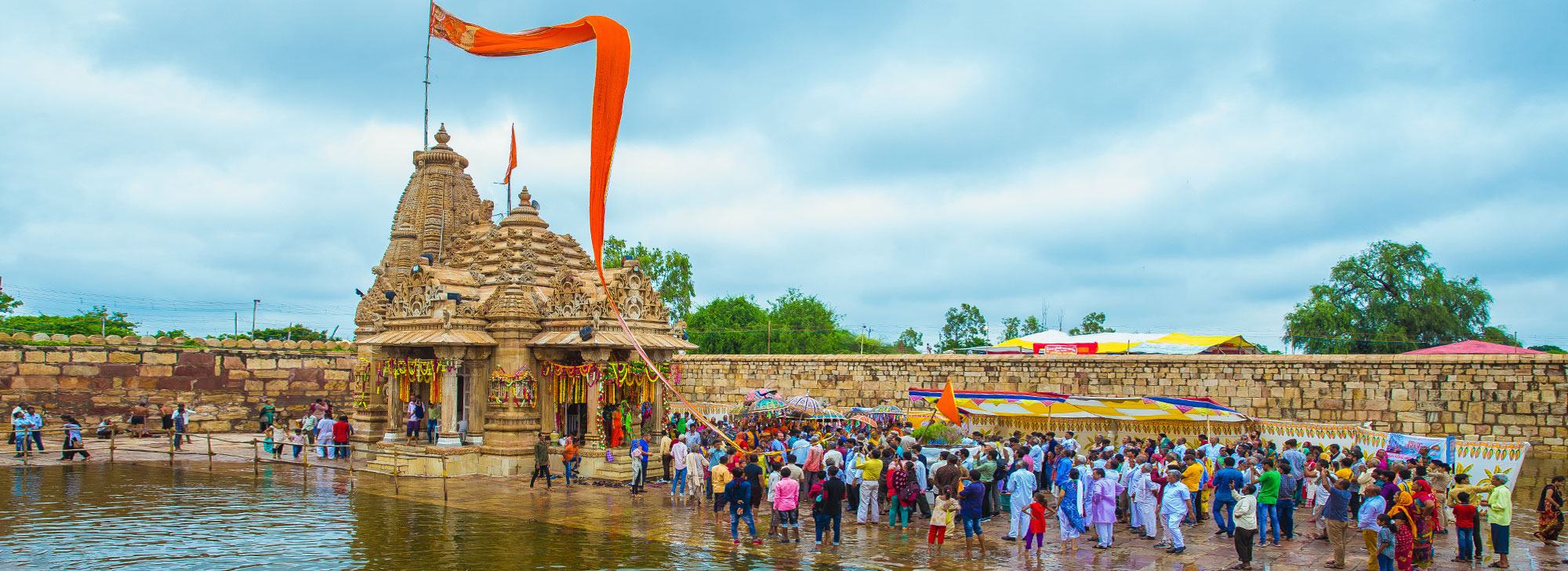
In western India, Naga Panchmi is known as the Ketarpal or Kshetrapal, meaning, a protector of his domain. In the Kutch region, the snake is named Bhujang, which is also the Sanskrit name for a snake. The name is attributed to the city of Bhuj which is located below the hill named Bhujiya, after Bhujang, as it was the abode of snakes. On top of this hill, there is a fort known as the Bhujia Fort where a temple has been built for the snake god and a second temple at the foot of the hill is known as the Nani Devi temple. Bhujia Fort was the scene of a major battle between Deshalji I, the ruler of Kutch and Sher Buland Khan, the Mughal Viceroy of Gujarat who invaded Kutch. When the army of Kutch was losing the battle, a group of Naga Bawas opened the gate of Bhujia Fort by a clever ploy of visiting the Naga temple for worship and joined the fray against Sher Buland Khan’s army. Eventually Deshalji I won the battle. Since that day Naga Bawa and their leader have a pride of place in the procession held on Naga Panchami. Within the fort, there is a small square tower dedicated to Bhujang Naga or the snake god, who in folklore is said to have been the brother of Shesh Naga. It is said Bhujang Naga came from Than in Kathiawar and freed Kutch from the oppression of demons known as Daityas and Rakshasas. The Snake Temple was also built at the time of the fortification of the hill during Deshalji I’s reign and was provided with a chhatri. Every year on Naga Panchami, a fair is held at the temple premises. In the Sindhi community, Naga Panchami is celebrated in honour of Gogro.

In the eastern and north-eastern states, the goddess is worshipped as Manasa. According to Hindu mythology, Manasa is a snake goddess who was also called Jaratkaru and the wife of a Brahmin sage also named Jaratkaru. On this occasion, a twig of the Manasa or sale plant symbolizing the goddess Manasa is fixed on the ground and worshipped, not only in the month of Shravan, as in the rest of the country, but also during the month of Bhadrapad with the festival held within the precincts of the devotee’s house.

In South India, the snake is identified with Lord Subramanya who is the commander of the celestial army and also with Lord Shiva and Lord Vishnu. In Karnataka, the preparation for the festival starts on the New Moon day of the Bhimana Amavasya, five days before the festival day of Panchami. Girls offer prayers to the images made out of white clay painted with white dots. They take a vow by tying a thread dipped in turmeric paste on their right wrist and offer prayers. An image of a snake is drawn on the floor in front of the house and milk is offered as oblation. On the previous night of the festival, they keep a complete fast or take a salt-free diet. After the prayers, a feast is held. In South India, both sculpted and live snakes are worshipped. Every village has a serpent deity who is worshipped as a single snake or nine snakes called Nava Naga but the popular form is of two snakes in the form of an Aesculapian Rod. Every worshipper in South India worships the anthill where the snakes are reported to reside. Women decorate the anthill with turmeric paste and vermillion and sugar mixed with wheat flour. They bedeck it with flowers with the help of threads tied to wooden frames. In Maharashtra, they go around the anthill in a worship mode five times singing songs in praise of snake gods.

In another form of worship practised by childless women stone statues of snakes are installed below a peepal tree and worshipped to seek blessings of the snake god to bestow them with children. This is done as it is believed snakes represent virility and have the gift of inducing fecundity curing barrenness. In Coorg in Karnataka, an ancestral platform called a noka is installed with rough stones which are believed to be the ancestral incarnation in the form of snakes but they are not necessarily worshipped on Naga Panchami day.

In Kerala, the Ezhavas and the Nairs are Serpent-worshipers. A shrine is normally established for the snake god in the southwest corner of the ancestral house, along with a temple for the para-devata. Women fast on the day before Naga Panchami. On Naga Panchami, they take a bath at dawn and pray at the Tharavad Sarpa Kavu and take home the thirtham milk. A Chembarathi or Hibiscus flower is dipped in milk and sprinkled on the brother’s back and then an aarti is done, after which a thread dipped in turmeric is tied on the right wrist of the brother. A feast is then served.

Naga Panchami is widely observed in Nepal, particularly the fight between Garuda and a great serpent. In the Changu Narayan Temple in Kathmandu, there is a statue of Garuda which is said to have been established by Garuda himself and on Naga Panchami, the image is said to sweat reminiscing his great fight with a giant snake; people collect the sweat and use it for curing leprosy. In Pakistan, the Sindhis celebrate Naga Panchami by honouring Gogro, a mythical character that protects against snake bites.

In My Hands Today…

Amritsar to Lahore: A Journey Across the India-Pakistan Border – Stephen Alter

“During the course of my journey, many of the people I met in Pakistan and India expressed a curious combination of affection, indifference, and animosity toward their neighbors across the border. . . . The border divides them but it is also a seam that joins the fabric of their cultures.”

On 15 August 1947, in what some have argued was the final, cynical act of a collapsing empire, the British left India divided. Arbitrary borders that have profoundly affected the recent history of the subcontinent were drawn upon the map of India. In the violence that accompanied Partition, it has been estimated that close to a million people were killed and more than ten million uprooted and displaced. The hatreds created by what was one of the largest mass migrations in history only exacerbated the religious tensions that originally led to Partition. Since then, India and Pakistan have fought three devastating wars, and the danger of armed conflict is constant.

A sensitive and thoughtful look at the lasting effects of Partition on everyday people, Amritsar to Lahore describes a journey across the contested border between India and Pakistan in 1997, the fiftieth anniversary of Partition. Setting out from and then returning to New Delhi, Stephen Alter crossed the border into Pakistan, retraced the legendary route of the Frontier Mail toward the Khyber Pass, and made his return by bus along the Grand Trunk Road, stopping in major cities along the way.

During this journey and another in 1998, Alter interviewed people from all classes and castes: Hindus, Muslims, and Sikhs, men and women. In candid conversation, the older generation who lived through the events of 1947 shared their memories and opinions of that pivotal moment of Partition, while youths who have inherited the fragments of that past reflected upon the meaning of national identity. In an engaging account of peoples and places, Alter documents in evocative detail his meetings with varied individuals. He recalls the Muslim taxi driver who recognizes an air of confidence with which men in Pakistan walk the streets dressed in salwar kameez; the brigadier who saved the brass insignia of the British crown from Lord Mountbatten’s Rolls Royce; gold merchants, customs officers, fellow travelers, musicians, and many others.

Alongside these diverse and vivid interviews, chance conversations, and oral histories, Alter provides informed commentary to raise questions about national and individual identity, the territorial imperatives of history, and the insidious mythology of borders. A third-generation American in India, where he has spent much of his life, Alter reflects intimately upon India’s past and present as a special observer, both insider and outsider. His meaningful encounters with people on his journey illustrate the shared culture and heritage of South Asia, as well as the hateful suspicions and intolerance that permeate throughout the India-Pakistan frontier. Also woven into the narrative are discussions of the works of South Asian novelists, poets, and filmmakers who have struggled with the issue of identity across the borderlands.

Ongoing battles in Kashmir and nuclear testing by both India and Pakistan may prove that peace in this region can be achieved only when border disputes are resolved. Offering both the perspective of hindsight and a troubling vision of the future, Amritsar to Lahore presents a compelling argument against the impenetrability of boundaries and the tragic legacy of lands divided.

In My Hands Today…

Pax Indica: India and the World of the 21st Century – Shashi Tharoor

Indian diplomacy, a veteran told Shashi Tharoor many years ago, is like the love-making of an elephant: it is conducted at a very high level, accompanied by much bellowing, and the results are not known for two years.

In this lively, informative and insightful work, the award-winning author and parliamentarian brilliantly demonstrates how Indian diplomacy has become sprightlier since then and where it needs to focus in the world of the 21st century.

Explaining why foreign policy matters to an India focused on its own domestic transformation, Tharoor surveys Indias major international relationships in detail, evokes the countrys soft power and its global responsibilities, analyses the workings of the Ministry of External Affairs, Parliament and public opinion on the shaping of policy, and offers his thoughts on a contemporary new grand strategy for the nation, arguing that India must move beyond non-alignment to multi-alignment.

His book offers a clear-eyed vision of an India now ready to assume new global responsibility in the contemporary world. Pax Indica is another substantial achievement from one of the finest Indian authors of our times.

In My Hands Today…

Tamarind City: Where Modern India Began – Bishwanath Ghosh

‘While in other big cities tradition stays mothballed in trunks, taken out only during festivals and weddings, tradition here is worn round the year.’

This is just one of the author’s many keen observations of Chennai. With mordant wit, this biography of a city spares neither half of its split-personality: from moody, magical Madras to bursting-at-the-seams, tech-savvy Chennai. And, a minute into the book, the reader knows they are inseparable-and Bishwanath Ghosh refuses to take sides.

And yet, he tells us, while Chennai is usually known as conservative and orthodox, almost every modern institution in India-from the army to the judiciary, from medicine to engineering-traces its roots to Madras’s Fort St George, which was built when Delhi had only just become the capital of the Mughal Empire, and Calcutta and Bombay weren’t even born. Today, the city once again figures prominently on the global map as ‘India’s Detroit’, a manufacturing giant, and a hub of medical tourism. There have been sweeping changes since pre-Independent India, but even as Chennai embraces change, its people hold its age-old customs and traditions close to their heart. ‘This is what makes Chennai unique,’ says Ghosh, ‘the marriage of tradition and technology’.

Bishwanath Ghosh wears a reporter’s cap and explores the city he has made his home, delving into its past, roaming its historic sites and neighbourhoods, and meeting a wide variety of people-from a top vocalist to a top sexologist, from a yoga teacher to a hip transsexual, from a yesteryear film star to his own eighty-five-year-old neighbour, from the ghosts of Clive, Wellesley, Hastings and Yale to those of Periyar and MGR, two people who redefined the political skyline of Tamil Nadu.

What emerges is an evocative portrait of this unique city, drawn without reservation-sometimes with humour, sometimes with irony-but always with love.