In My Hands Today…

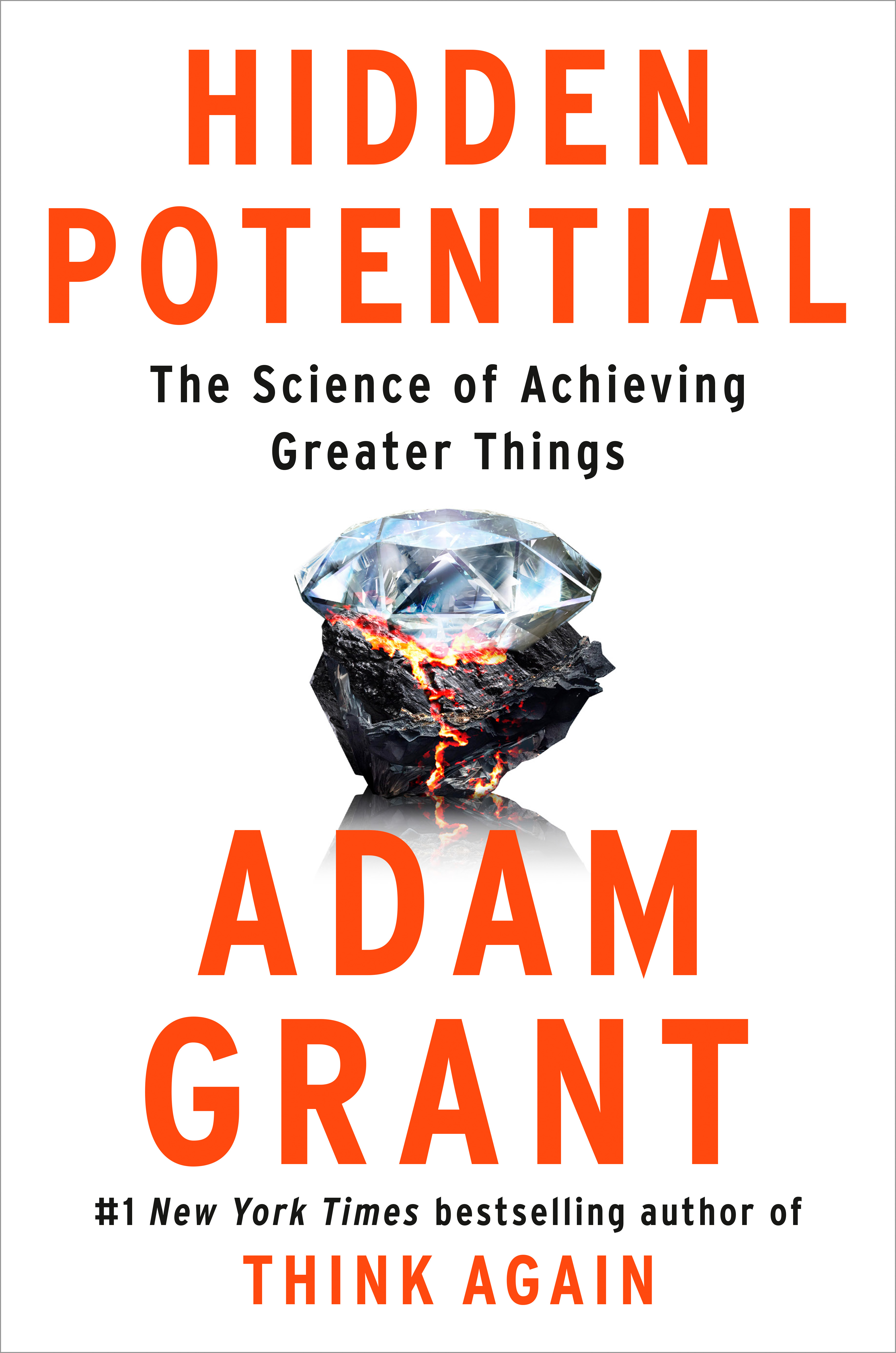
Hidden Potential: The Science of Achieving Greater Things – Adam M. Grant

We live in a world that’s obsessed with talent. We celebrate gifted students in school, natural athletes in sports, and child prodigies in music. But admiring people who start out with innate advantages leads us to overlook the distance we ourselves can travel. We underestimate the range of skills that we can learn and how good we can become. We can all improve at improving. And when opportunity doesn’t knock, there are ways to build a door.

Hidden Potential offers a new framework for raising aspirations and exceeding expectations. Adam Grant weaves together groundbreaking evidence, surprising insights, and vivid storytelling that takes us from the classroom to the boardroom, the playground to the Olympics, and underground to outer space. He shows that progress depends less on how hard you work than how well you learn. Growth is not about the genius you possess—it’s about the character you develop. Grant explores how to build the character skills and motivational structures to realize our own potential, and how to design systems that create opportunities for those who have been underrated and overlooked.

Many writers have chronicled the habits of superstars who accomplish great things. This book reveals how anyone can rise to achieve greater things. The true measure of your potential is not the height of the peak you’ve reached, but how far you’ve climbed to get there.
Genres
Nonfiction
Self Help
Psychology
Business
Audiobook
Personal Development
Leadership

In My Hands Today…

The Infinite Game – Simon Sinek

Do you know how to play the game you’re in?

In finite games, like football or chess, the players are known, the rules are fixed, and the endpoint is clear. The winners and losers are easily identified.

In infinite games, like business or politics or life itself, the players come and go, the rules are changeable, and there is no defined endpoint. There are no winners or losers in an infinite game; there is only ahead and behind.

The more I started to understand the difference between finite and infinite games, the more I began to see infinite games all around us. I started to see that many of the struggles that organizations face exist simply because their leaders were playing with a finite mindset in an infinite game. These organizations tend to lag behind in innovation, discretionary effort, morale and ultimately performance.

The leaders who embrace an infinite mindset, in stark contrast, build stronger, more innovative, more inspiring organizations. Their people trust each other and their leaders. They have the resilience to thrive in an ever-changing world, while their competitors fall by the wayside. Ultimately, they are the ones who lead the rest of us into the future.

Any worthwhile undertaking starts with Why – the purpose, cause or belief that inspires us to do what we do and inspires others to join us. Good leaders know how to build Circles of Safety that promote trust and cooperation throughout their organizations. But that’s not enough to help us chart a course through the unpredictable, often chaotic landscape of today’s marketplace.

I now believe that the ability to adopt an infinite mindset is a prerequisite for any leader who aspires to leave their organization in better shape than they found it.

In My Hands Today…

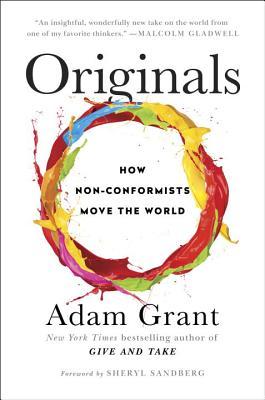
Originals: How Non-Conformists Move the World – Adam M. Grant

In Originals the author addresses the challenge of improving the world from the perspective of becoming original: choosing to champion novel ideas and values that go against the grain, battle conformity, and buck outdated traditions. How can we originate new ideas, policies, and practices without risking it all?

Using surprising studies and stories spanning business, politics, sports, and entertainment, Grant explores how to recognize a good idea, speak up without getting silenced, build a coalition of allies, choose the right time to act, and manage fear and doubt; how parents and teachers can nurture originality in children; and how leaders can build cultures that welcome dissent. Learn from an entrepreneur who pitches his start-ups by highlighting the reasons not to invest, a woman at Apple who challenged Steve Jobs from three levels below, an analyst who overturned the rule of secrecy at the CIA, a billionaire financial wizard who fires employees for failing to criticize him, and a TV executive who didn’t even work in comedy but saved Seinfeld from the cutting-room floor. The payoff is a set of groundbreaking insights about rejecting conformity and improving the status quo.

In My Hands Today…

Good Power: Leading Positive Change in Our Lives, Work, and World – Ginni Rometty

Ginni Rometty led one of the world’s most iconic companies, and in Good Power she recounts her groundbreaking path from a challenging childhood to becoming the CEO of IBM and one of the world’s most influential business leaders. With candor and depth, Rometty shares milestones from her life and career while redefining power as a way to drive meaningful change in positive ways for ourselves, our organizations, and for the many, not just the few—a concept she calls “good power.”

Rometty’s “memoir with purpose” combines the experiences that defined her life—personal hurdles, high-stakes decisions, passionate advocacy—with the actionable advice of a coaching session to highlight lessons that shape authentic leadership. Behind-the-scenes stories and practical guidance offer us a blueprint for how we can all use good power to advance our careers, inspire our teams, improve our companies, and create healthier societies.

The book begins with raw, vivid memories from Rometty’s youth and early professional years as she recalls the trauma and the role models that formed her belief that how we lead is as important as what we achieve. She learns early on that good power is a choice available to everyone, even to those without money, status, or impressive titles.

Rometty then shows us how her concept of good power evolved as she grew from a first-time manager to a transformative CEO. Stories told through the lens of five principles—be in service of others; build belief; know what must change and what must endure; steward good tech; be resilient—reveal tools that anyone can apply to achieve real change at any stage of their life and work.

Rometty also encourages us to use good power at scale to bring about urgent societal change. She shares insights from her own journey to create a more equitable world by leading the SkillsFirst movement, which connects underserved populations with family-sustaining jobs by transforming hiring, education, and training.

With heart, humility, and conviction, Good Power offers an inspiring, compelling guide to creating meaningful change in our lives.

In My Hands Today…

Principles: Life and Work – Ray Dalio

Ray Dalio, one of the world’s most successful investors and entrepreneurs, shares the unconventional principles that he’s developed, refined, and used over the past forty years to create unique results in both life and business—and which any person or organization can adopt to help achieve their goals.

In 1975, Ray Dalio founded an investment firm, Bridgewater Associates, out of his two-bedroom apartment in New York City. Forty years later, Bridgewater has made more money for its clients than any other hedge fund in history and grown into the fifth most important private company in the United States, according to Fortune magazine. Dalio himself has been named to Time magazine’s list of the 100 most influential people in the world. Along the way, Dalio discovered a set of unique principles that have led to Bridgewater’s exceptionally effective culture, which he describes as “an idea meritocracy that strives to achieve meaningful work and meaningful relationships through radical transparency.” It is these principles, and not anything special about Dalio—who grew up an ordinary kid in a middle-class Long Island neighborhood—that he believes are the reason behind his success.

In Principles, Dalio shares what he’s learned over the course of his remarkable career. He argues that life, management, economics, and investing can all be systemized into rules and understood like machines. The book’s hundreds of practical lessons, which are built around his cornerstones of “radical truth” and “radical transparency,” include Dalio laying out the most effective ways for individuals and organizations to make decisions, approach challenges, and build strong teams. He also describes the innovative tools the firm uses to bring an idea meritocracy to life, such as creating “baseball cards” for all employees that distill their strengths and weaknesses, and employing computerized decision-making systems to make believability-weighted decisions. While the book brims with novel ideas for organizations and institutions, Principles also offers a clear, straightforward approach to decision-making that Dalio believes anyone can apply, no matter what they’re seeking to achieve.