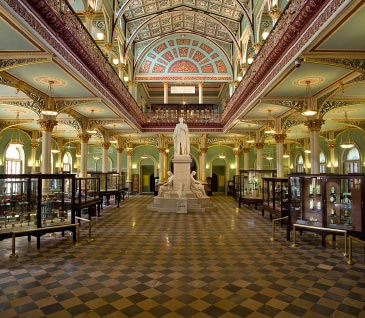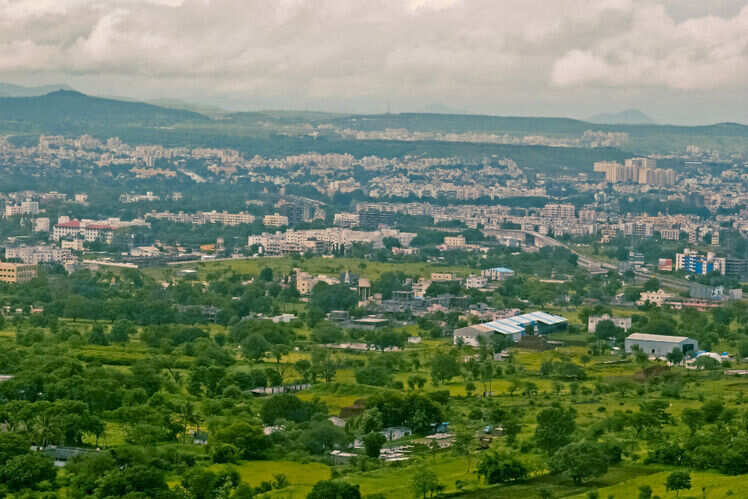
After Mumbai, lets move to Pune. The second largest city in Maharashtra and also called “Oxford of the East” due to the large number of educational institutions in the city, Pune or Poona is also considered to be the cultural capital of the state.
Copper plates dated 858 and 868 show that by the 9th century an agricultural settlement known as Punnaka existed at the location of the modern Pune which was ruled by the Rashtrakuta dynasty. Pune was part of the territory ruled by the Seuna Yadavas of Devagiri from the 9th century to 1327. In 1599, Pune became part of the fiefdom granted to Maloji Bhosale for his services to the Ahmadnagar Sultanate and was ruled by the Ahmadnagar Sultanate until it was annexed by the Mughals in the 17th century. Maloji Bhosale’s grandson, Shivaji, the founder of the Maratha Empire, was born at Shivneri, a fort not far from Pune. It changed hands several times between the Mughals and the Marathas in the period 1680 to 1705. After the destruction of the town in raids by the Adil Shahi dynasty in 1630 and again between 1636 and 1647, Dadoji Konddeo, oversaw the reconstruction of the town. He stabilised the revenue collection and administrative systems of the areas around Pune and the neighbouring Maval region. Shivaji’s mother, Jijabai is said to have commissioned the building of the Kasba Ganapati temple. The Ganesha idol consecrated at this temple has been regarded as the presiding deity (Gramadevata) of the city. From 1703 to 1705, towards the end of the 27-year-long Mughal–Maratha Wars, the town was occupied by Aurangzeb and its name was changed to Muhiyabad.
In 1720, Baji Rao I was appointed Peshwa (Prime Minister) of the Maratha Empire by Chhatrapati Shahu. He moved his base from Saswad to Pune in 1728, marking the beginning of the transformation of what was a kasbah into a large city. He also commissioned the construction of the Shaniwar Wada on the right bank of the Mutha River. The construction was completed in 1730, ushering in the era of Peshwa control of the city. The patronage of the Maratha Peshwas resulted in a great expansion of Pune, with the construction of around 250 temples and bridges in the city, including the Lakdi Pul and the temples on Parvati Hill. The building of temples led to religion being responsible for about 15% of the city’s economy during this period. The Peshwa’s influence in India declined after the defeat of Maratha forces at the Battle of Panipat but Pune remained the seat of power. In 1802 Pune was captured by Yashwantrao Holkar in the Battle of Poona, directly precipitating the Second Anglo-Maratha War of 1803–1805. The Peshwa rule ended with the defeat of Peshwa Bajirao II by the British East India Company in 1818. The city was known as Poona during British rule. Poona Municipality was established in 1858. A railway line from Bombay to the city opened in 1858, run by the Great Indian Peninsula Railway (GIPR). Poona was prominently associated with the struggle for Indian independence. In the period between 1875 and 1910, the city was a centre of agitation led by Gopal Krishna Gokhale and Bal Gangadhar Tilak. The city was also a centre for social reform led by Mahatma Jyotirao Phule, feminist Tarabai Shinde, Dhondo Keshav Karve and Pandita Ramabai. They demanded the abolition of caste prejudice, equal rights for women, harmony between the Hindu and Muslim communities, and better schools for the poor.
The must-see places to visit in this city steeped in culture are below:
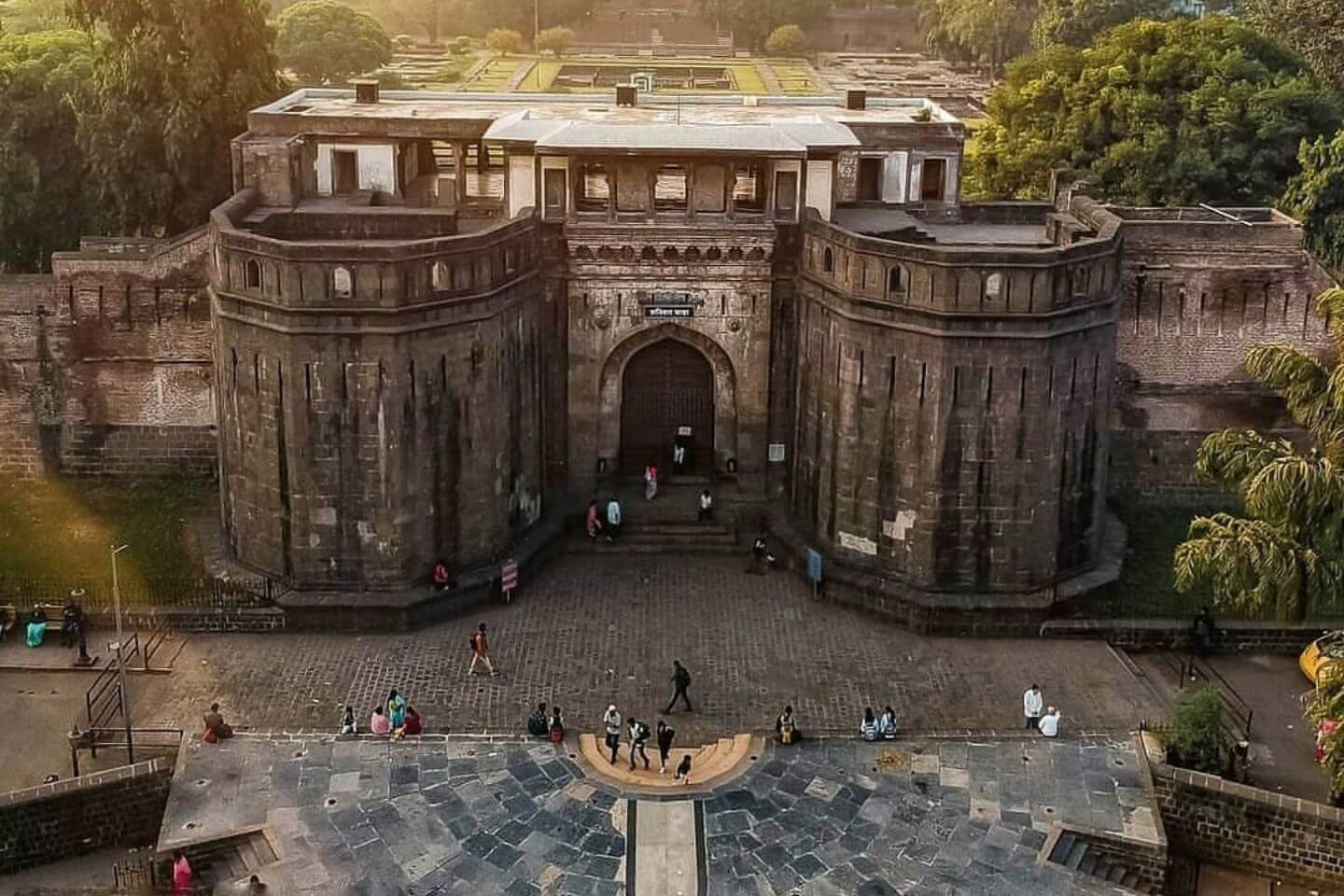
Shaniwar Wada
A prominent historical landmark in Pune is Shaniwarwada, a majestic 286 year-old fortification which was built in 1732 and which was the seat of the Peshwas of the Maratha Empire in their heydays. In 1828, the fort was destroyed by a huge fire and later the remnants were transformed to become a tourist site. Shaniwarwada was a seven-storied capital building of the Peshwas built by Peshwa Bajirai I and the Peshwas wanted the building to be made of stone alone. However, after the completion of the ground floor, the people of Satara insisted that stone monument can be sanctioned and built only by the Shahu King, not the Peshwas. With respect to it, the Peshwas were asked to continue the construction of the building by using only bricks. But when the British attacked, only the base floor survived while all the other floors were completely destroyed. The major buildings inside the fort are Thora Rayancha Diwankhana or the court reception hall of the eldest royal member, Naachacha Diwankhana which is the dance hall, Juna Arsa Mahal that is the Old Mirror Hall and so on. Since all the buildings were destroyed in the fire, only descriptions of the remaining areas are available currently. The doorways were made of teak arches with ornamental teardrop teak pillars shaped like Suru trunks. Ceilings were beautified by numerous chandeliers and the floors were filled with polished marble adorned with rich Persian rugs. The walls displayed paintings depicting the Hindu epics. The top floor of the building enacted as the residence of the Peshwa and it was called Meghadambari.
The Shaniwar Wada, although ridden with tales of treachery and deceit, is one of the last standing testimonies to the grandeur, valour, and the just rule of the Peshwas. The entire old part of the city of Pune is laid out in a chaotic yet ironically, orderly fashion all around this historical structure. It is around Shaniwar Wada that you will find the oldest markets of Pune including Laxmi Road, Tulshibaug, Ravivar Peth etc. Shaniwarwada is open all days of the week from 8 am to 6:30 pm and there is a Light & Sound show daily. Tickets for the show can be booked between 6:30 – 8:30 pm. Entry fee for Indian citizens is INR 5 while for foreigners it is INR 125. The price of the Light & Sound show is INR 25 per person.
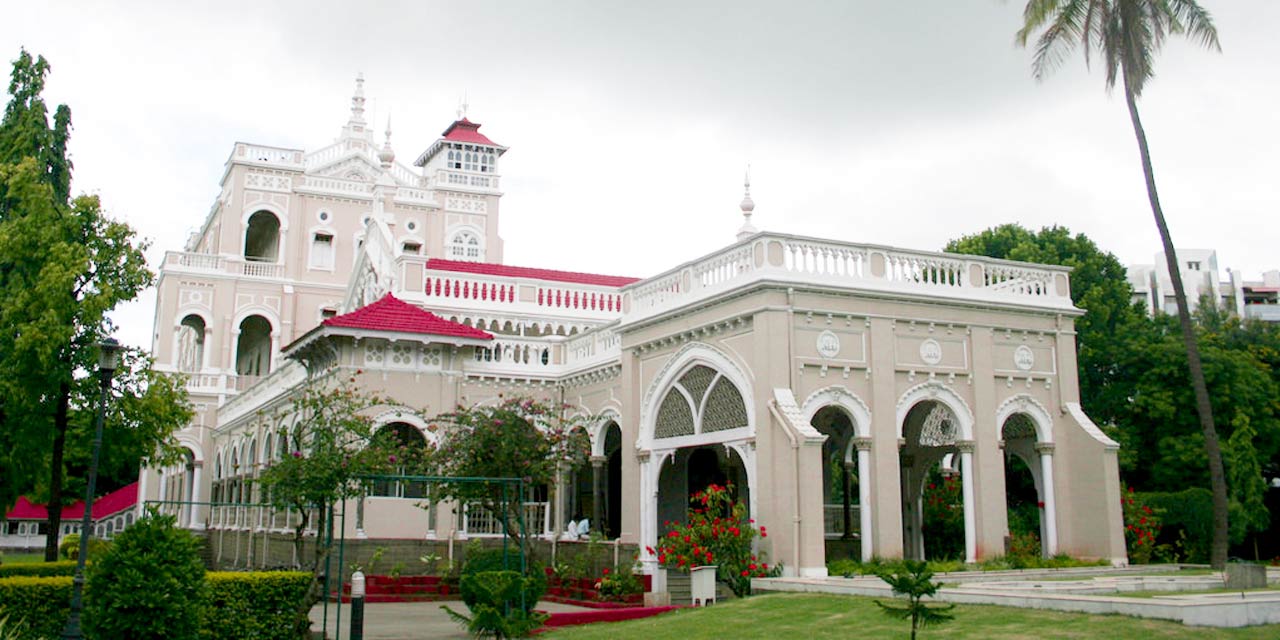
Aga Khan Palace
Built by Sultan Muhammed Shah Aga Khan III in the year 1892, the Aga Khan Palace is one of the most important landmarks in Indian history and has been instrumental in many defining moments of India’s independence. It was once the site where Mahatma Gandhi, his wife Kasturba Gandhi, as well as Sarojini Naidu and Mahadev Desai were held prisoners. Spread over a vast land of 19 acres, the palace is now the headquarters of the Gandhi National Memorial society. The Sultan built the palace to support the poor in the neighbouring areas who were hit by a famine. In the memory of Kasturba Gandhi and Mahadev Desai, architect Charles Corea had their memorials built in the premises of the palace. The palace houses a museum which holds a rich collection of pictures. There are also other items like the personal belongings of Gandhis. The Palace also has the ashes of Mahatma Gandhi buried in its ground. In 2003, the monument was declared to be of national importance by the Archaeological Survey of India. The palace is open all days of the week from 9 am to 5:50 pm and entry fee for Indians is INR 5 while that for foreigners it is INR 100.

Lal Mahal
Located near Shaniwarwada, Lal Mahal or Red Palace is a historic landmark from the 16th century. Subject to innumerable attacks and initial revival, the palace has significant stories to tell. It was first restored by Shivaji’s father Shahaji Bhosle for his family to stay in the 1630s. The original one had undergone several destructions and the current one is a reconstructed structure, built between 1984 and 1988. Shivaji’s wedding with Maharani Saibai took place in this palace. There is nothing much that this place exhibits or explains because of continuous harm to the building. Consequently, it leaves much to imagination like how big it was, how many rooms etc. The original monument was constructed with the aim of rejuvenating the city of Pune when Dadoji Kondev entered the city with Shivaji Maharaj. Pune Municipal Corporation was the one who rebuilt the current Lal Mahal and the construction was begun in 1984 and ended in 1988. The current palace displays a collection of large sized oil paintings based on the important events happened in the life of Shivaji. There is the Jijamata Garden now recognised as a recreational park for kids.The palace is open on all days between 9 am and 1 pm and then again between 4 – 8 pm. Entry fee for all is INR 3 per person.

Dagdusheth Halwai Ganpati Temple
The Shreemant Dagdusheth Halwai Ganapati temple is a famous Pune landmark which is visited by thousands of pilgrims each year. The annual ten-day Ganesh festival celebrated at the temple is the main festival at this temple. The inception of the temple took place over 125 years ago in 1893 by Shri Dagdusheth Halwai (a confectioner) and his wife, Lakshmibai. The idol of Lord Ganapati is 2.2 meters high and 1 meter wide and is adorned with almost 40 kilos of gold. The main idol is insured for a sum of INR 10 million. The temple is open daily from 6 am to 11 pm.

Parvati Hill Temple
Constructed as the personal temple of the Peshwas by Balaji Baji Rao in the 17th century, the Parvati Hill Temple rises over 2,000 feet and offers sweeping views of the city. It serves as a shrine for several Hindu Gods- God Shiva, Goddess Parvati, God Vishnu, Goddess Rukmini and God Vitthalla, and God Vinayakar. The Parvati temple, a black stone structure which lies among four other temples and the Peshwa Museum and Parvati Water Tank on the hill however, is dedicated to Goddess Parvati and Lord Shiva. The hill is accessed by climbing 103 stone steps which were originally designed to allow elephants to ascend and descend from the hill. It doesn’t take anyone longer than 10 minutes to reach the top. The hill is the highest point in Pune. The gates of the temple open at 5.00 am and 8.00 pm, while the hill is open daily from 8 am to 5 pm. Sunsets from the hill is beautiful and is favourite activity of Punekars.

Pataleshwar Cave Temple
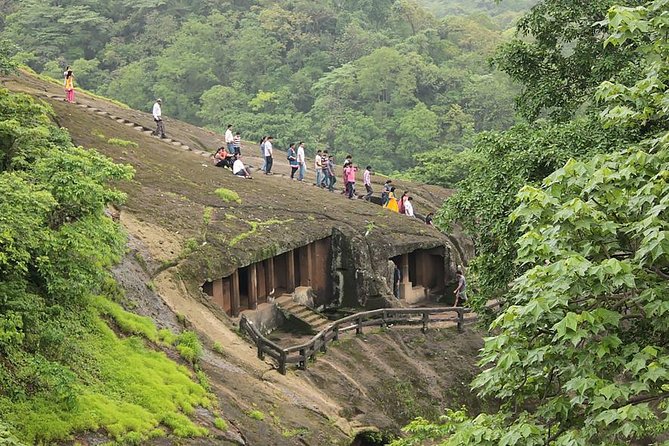
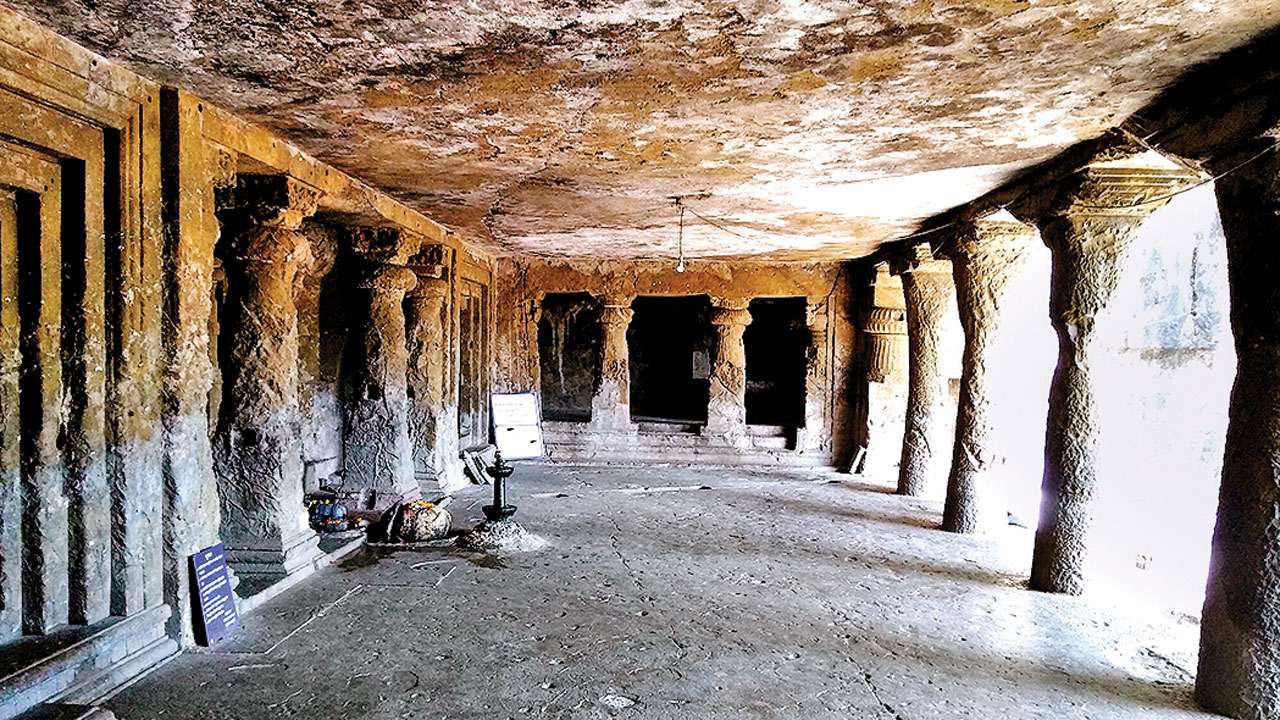
An atypical rock cut cave temple, the Pataleshwar Cave Temple is an ancient temple that dates back to the 8th century during the Rashtrakuta period. The temple is also known as Panchaleshvara or Bamburde temple. The main God in the temple is by Lord Pataleshwar, who is the God of the Underworld, a form of Lord Shiva. Carved out of a single magnanimous rock, this spellbinding monolith originally was located outside the town and when the city limits were expanded, the temple is situated now in downtown Pune. It has been declared as a protected monument by the government. The construction of the temple was inspired by the majestic Elephanta Caves but it was left incomplete. For the same reason, the temple has no real entrance; the only major entrance is next to a banyan tree in the courtyard. The temple is maintained by the Archaeological Survey of India (ASI). The temple is open from 8 am to 5:30 pm and entry is free.

Vetal Tekdi
A prominent hill in the city limits of Pune is Vetal Hill which is the highest point at an elevation of 2600 feet. Vetala temple is also located on the top of the hill and that is how the hill got its name as Vetal Hill. Adventure seekers come here in plenty to escape from the hustles and bustles of the city and it is a great morning trek location. The hill surrounds the city across a distance of almost 11 km and acts as the lungs of the city. Vetal Tekdi has a mostly dry deciduous type of vegetation and a number of bird species that are native to the region also call it home. In fact, it is not unusual to spot a peacock or two lingering on the premises early in the morning. Near the temple, there is an observation desk set up by the Indian Forest Department. Vetal Tekdi has two spurs named Fergusson College Hill and Chatturshrungi Hill. There is no particular timing to visit the hill but it is advised to trek up the hill before dawn to enjoy the beautiful sunrise and the unbeatable serenity.

Sinhagad Fort
Located in the Sahyadri Mountains, Sinhagad Fort is an ancient fortress known for its historical significance and architecture. It was once known as Kondhana and has witnessed a number of battles; a notable battle being the 1670 Battle of Sinhagad. The name, “Sinhagad”, literally means Lion’s Fort signifying its strength and brilliance. Today, the structure is a perfect landmark for trekkers as it is located at a height of over 750 metres in the Sahyadri Mountains. In fact, the fort is strategically built right in the centre of the line of Maratha forts built in the Sahyadris. Some of these citadels are the Rajgad Fort, Torna Fort and the Purandar Fort. The place is also famous among photographers and nature lovers. Sinhagad Fort and its surroundings mostly provide a good environment for a quick getaway. People living nearby often head to the attraction over the weekend. Back in the time, renowned personalities like Bal Gangadhar Tilak, Mahatma Gandhi have also visited the fort for meetings and holidays. The mountain also serves as a great location for training of the National Defence Academy Students. They hike up the hill till the fort in complete battle gear. Due to its historical and cultural significance, there are restrictions on partying, cooking/ consuming non-vegetarian food, alcohol etc. Nonetheless, one is bound to have a great time if they avoid these activities and soak in the dilapidated yet striking structure and the scenic surroundings.

Shivneri Fort
Shivneri Fort is the birthplace of the founder of the Maratha Empire, Chhatrapati Shivaji Maharaj. It was built in the 16th century and was recognised as a military fortification. The place is also famous for being the place where Chhatrapati Shivaji Maharaj was trained. Its proximity from Pune, atop a hill with Junnar at its base, makes Shivneri Fort a good picnic spot for the locals. Its sheer magnificence draws a considerable number of visitors each year. Plus, there are some more attractions nearby which can be covered along with the fort in a day. Its terrain makes it a good trekking route too. Having said that, several history lovers are also drawn to the attraction for its historical significance. An English Traveller, Fraze, who visited Shivneri Fort in the late 17th century noticed that the fort was so well managed that it has enough supplies to feed thousands of families for about 6 to 7 years. The ancient architecture and its massive built is also worth a visit to Shivneri Fort.





/GettyImages-92154218-596dbeeec412440010082443.jpg)





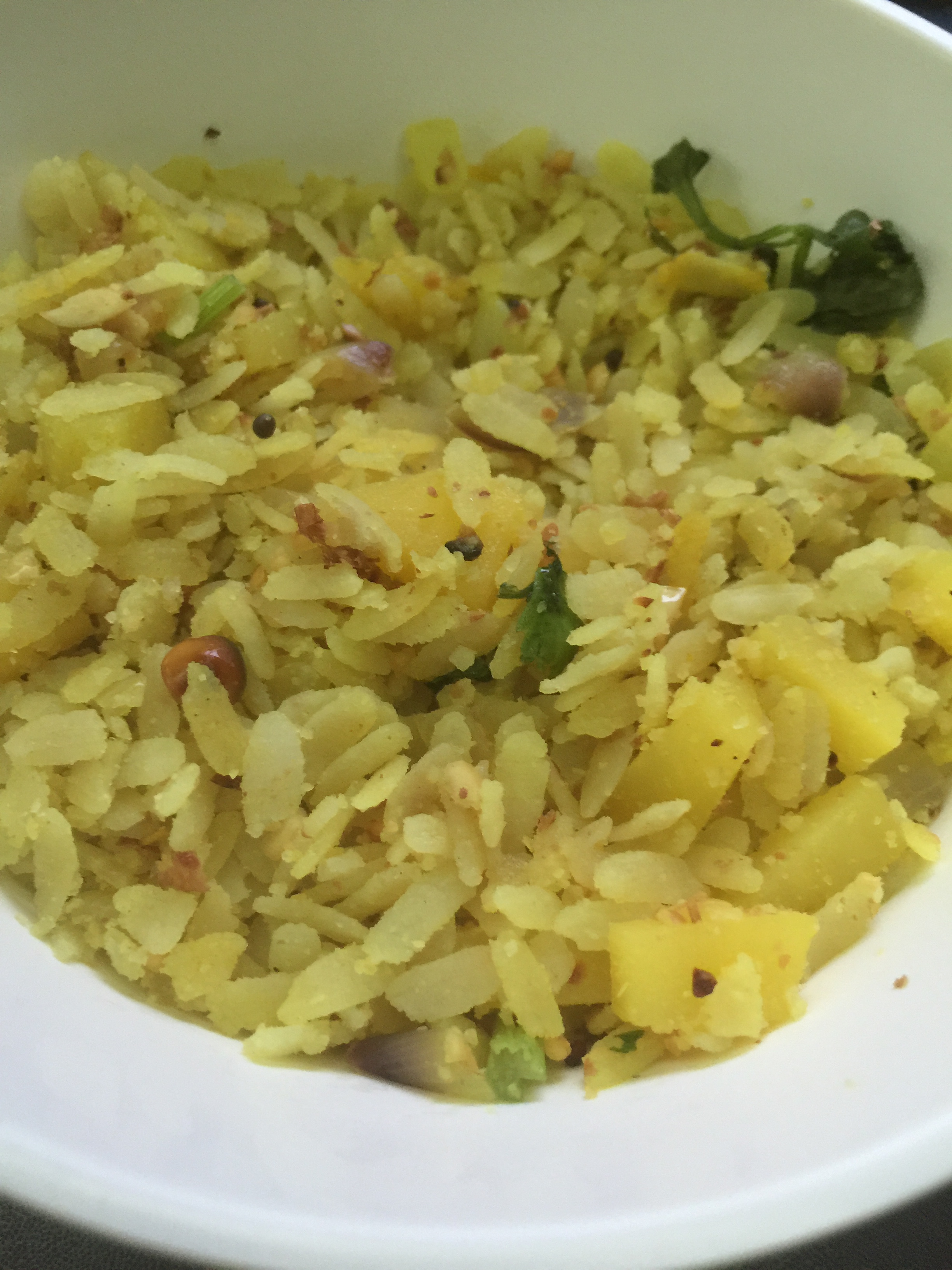
 Here’s another recipe from the heartlands of my home state of Maharashtra. This recipe is from the kitchens of the rustic, rural householder and is a staple of practically every Marathi household. I got this recipe from a book I have had for almost twenty years now, called Maharashtrian Cooking authored by Kumud Marathe.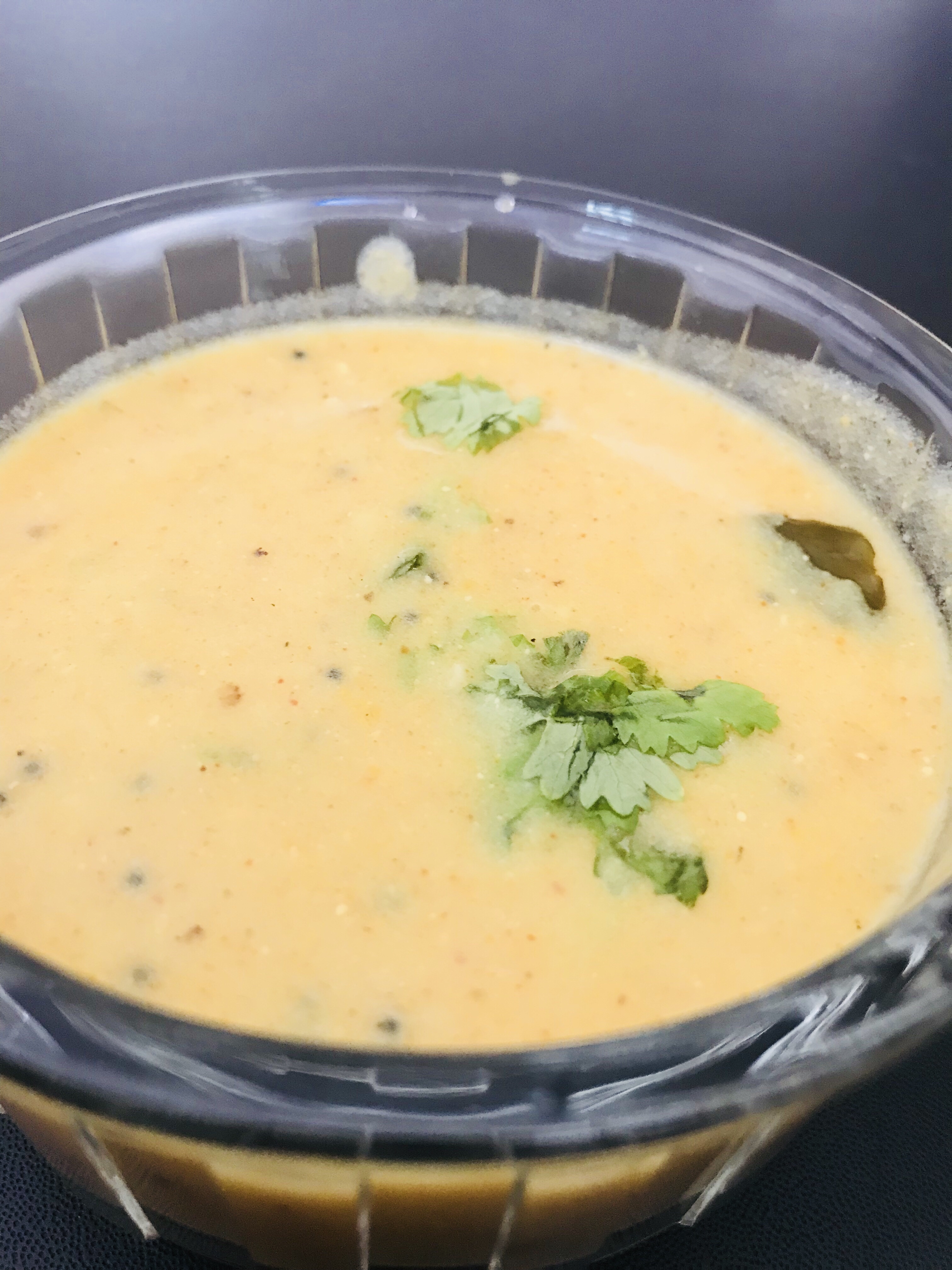



 Memories and Such