I love travel, if I could have the time and money, I’d love to travel the world! I remember one of my first conversations with S was exactly this….At some point (has to be soon lol) I will try to see as much of the world as I can…
I am a bit sad that there are so many parts of the world that are now inaccessible to me. With all the terror attacks happening around, travel these days has become something that you fear, rather than cherish. The Middle East has along with the countries to the west of India have now become unsafe to travel and so it’ll be long time before anyone can visit them. And when that happens, will the countries be as they were? Will the historical treasures, some thousands of years old, still survive?
If you read my blogs regularly, you will see I love reading books which are related to the Indian subcontinent as well as other cultures. So I’d love to actually go and visit all these different cultures myself and try and see it on an intimate level. I love going to places which I read about and if I’ve read something recently about a place I am visiting, it makes the place come even more alive to me. Also when I read about a place after I’ve visited it, most times the book becomes more real to me and instead of just reading it, it becomes my personal movie and I can actually ‘see’ the book come to life!
One country I am a bit obsessed with is Pakistan. As an Indian, born post-Independence, growing up, Pakistan was and probably still is in some people’s mind’s ‘the enemy’! Textbooks in school reinforced this and I am sure this is the same thing across the border. My wanting to visit this country may seem strange and slightly weird to any Indian who is reading this! A lot of people I know, including my dad, have memories of independence and the subsequent wars India and Pakistan have waged. I remember the Kargil War which happened when I was working in India. I remember my company going around asking people if they wanted to donate to the war efforts and most, if not all, of the people working in that place decided to donate one day’s salary to the war chest for the soldiers and their kin. My company, if I remember correctly, made a donation equal to what the employees donated. During the 1971 war between India and Pakistan, my dad was a air raid warden for our area and his responsibility was to make sure all houses had blackout paper in their windows and that when the air-raid signal went off, no one had lights shining. My neighbors in India, who are Sindhis were originally from Sindh in Pakistan and came to India as refugees post partition. But to my mind, that is politics and not the people and culture of the country and from an early age, I’ve been fascinated by that country since we share a common history for the last thousands of years, except for the last 60.
One incident comes to mind which crystallized to me just how same and at the same time different we were. I helped out in a project for a professor in a university I was working in Singapore many years back. One component was to translate Indian, specifically Hindi newspapers on specific issues. Since they could not find someone willing to do the translation, I was roped in! The study also had someone from Pakistan doing the same thing for Urdu newspapers and we both sort of translated articles relating to the same incident and the way each side portrayed the incident was a serious relevation to me! What was white on one side was shown to be black or at the very least grey in the other side and vice-versa!
Since coming to Singapore, I’ve met, interacted and befriended many Pakistanis and found them to be just as we are. The specter we always taught about may be politics and when we speak someone ‘across the border’ they are just like us, with the same language, food and clothes. I’ve realized the two things you should not speak are politics and cricket; otherwise we have loads of common things to speak about.
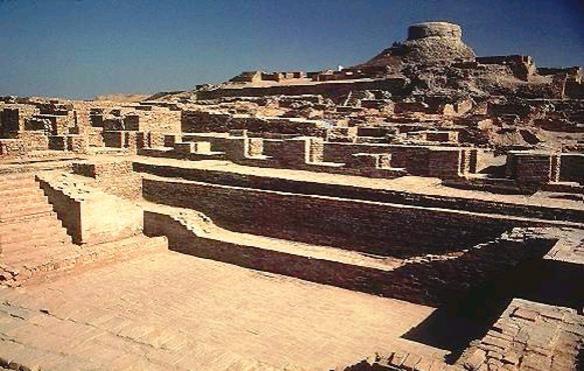
Excavation of Mohenjodaro, source Wikipedia
I know as someone born in India, to parents who are Indian, the chances of me going to Pakistan to see the country is probably as remote as going to the moon! I’d probably hitch a ride to the moon faster than visit Pakistan. I’d love to go and visit the sites of the Indus valley civilization and Mohenjodaro and Harappa and also see the towns and cities I’ve only seen in movies and television shows.
When I see ties between Singapore and Malaysia so cordial and movement between the two countries so easy, I mourn for something similar to happen between India and Pakistan. When we share so much together, why is it so difficult to visit each other? Maybe the politicians and people who govern both countries fear exactly that – that when we realise how similar we are, we won’t need all that hateful rhetoric and live in peace. I do hope one day (not too hopeful that it will happen in my lifetime), this does come true. In the meantime, I will live out my obsession with pictures, books, movies and television!
This actually turned out to be a fun post to write. I’ll do this on and off – listing places I’d love to visit, who knows this may be the key to me travelling there soon!
Is there any country you’d love to visit but can’t for a variety of reasons? I’d love to hear all about it in the comments!

 The unforgettable story of a fatherless boy growing up in a household of outspoken women, The Wish Maker is also a tale of sacrifice, betrayal, and indestructible friendship. Zaki Shirazi and his female cousin Samar Api were raised to consider themselves “part of the same litter.” Together they watched American television and memorized dialogue from Bollywood movies, attended dangerous protests, and formed secret friendships. In a household run by Zaki’s crusading political journalist mother and iron-willed grandmother, it was impossible to imagine a future that could hold anything different for either of them.

 Memories and Such