In My Hands Today…

Your Future Self: How to Make Tomorrow Better Today – Hal Hershfield

We’ve all had the desire to travel through time and see what our lives will be like later in life. But while we want the best possible future for ourselves, we often fail to make decisions that would truly make that version of the future.

Based on over a decade of groundbreaking research, Your Future Self is the “entertaining and powerful book” (Carol Dweck, author of Mindset ) that explains that in our minds, our future selves often look like strangers.

Many of us view the future as incredibly distant, making us more likely to opt for immediate gratification that disregards our health and well-being in the years to come.

People who are able to connect with their future selves, however, are better able to balance living for today and planning for tomorrow. Your Future Self describes the mental mistakes we make in thinking about the future and gives us practical advice for imagining our best future so we can make that vision a reality.

In My Hands Today…

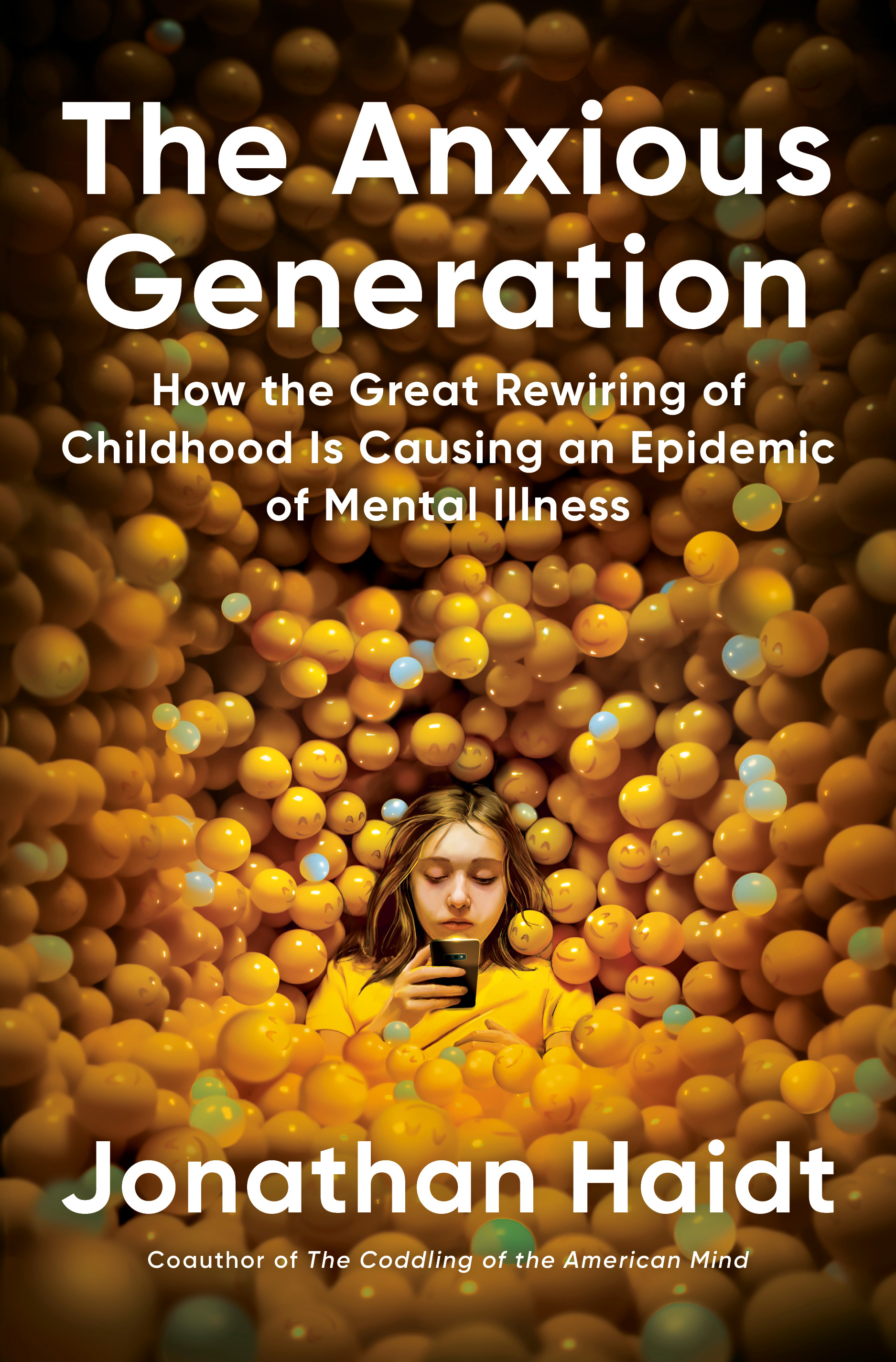
The Anxious Generation: How the Great Rewiring of Childhood is Causing an Epidemic of Mental Illness – Jonathan Haidt

After more than a decade of stability or improvement, the mental health of adolescents plunged in the early 2010s. Rates of depression, anxiety, self-harm, and suicide rose sharply, more than doubling on many measures. Why?

In The Anxious Generation, social psychologist Jonathan Haidt lays out the facts about the epidemic of teen mental illness that hit many countries at the same time. He then investigates the nature of childhood, including why children need play and independent exploration to mature into competent, thriving adults. Haidt shows how the “play-based childhood” began to decline in the 1980s, and how it was finally wiped out by the arrival of the “phone-based childhood” in the early 2010s. He presents more than a dozen mechanisms by which this “great rewiring of childhood” has interfered with children’s social and neurological development, covering everything from sleep deprivation to attention fragmentation, addiction, loneliness, social contagion, social comparison, and perfectionism. He explains why social media damages girls more than boys and why boys have been withdrawing from the real world into the virtual world, with disastrous consequences for themselves, their families, and their societies.

Most important, Haidt issues a clear call to action. He diagnoses the “collective action problems” that trap us, and then proposes four simple rules that might set us free. He describes steps that parents, teachers, schools, tech companies, and governments can take to end the epidemic of mental illness and restore a more humane childhood.

Haidt has spent his career speaking truth backed by data in the most difficult landscapes—communities polarized by politics and religion, campuses battling culture wars, and now the public health emergency faced by Gen Z. We cannot afford to ignore his findings about protecting our children—and ourselves—from the psychological damage of a phone-based life.

In My Hands Today…

Optimal: How to Sustain Personal and Organizational Excellence Every Day – Daniel Goleman, Cary Cherniss

In his groundbreaking #1 bestseller Emotional Intelligence , Daniel Goleman revolutionized how we think about intelligence. Now, he reveals practical methods for using these inner resources to more readily enter an optimal state of high performance and satisfaction while avoiding burnout.

There are moments when we achieve peak An athlete plays a perfect game; a business has a quarter with once-in-a-lifetime profits. But these moments are often elusive, and for every amazing day, we may have a hundred ordinary and even unsatisfying days.

Fulfillment doesn’t come from isolated peak experiences, but rather from many consistent good days. So how do we sustain performance, while avoiding burnout and maintaining balance?

In Optimal , Daniel Goleman and Cary Cherniss reveal how emotional intelligence can help us have a great day, any day. They explain how to set a realistic, attainable goal of feeling satisfied that you’ve had a productive day — to consistently work at your ‘optimal’ level.

Based on research of how hundreds of people build the inner architecture of having a good day, they sketch what an optimal state feels like, and show how emotional intelligence holds the key to our best performance. Optimal is the culmination of decades of scientific discoveries bearing on emotional intelligence. Enhanced emotional intelligence pays off in improved engagement, productivity, and more satisfying days.

In this book, you’ll find the keys to competence in emotional intelligence, and practical methods for applying this skill set more readily. It will equip you to become a highly effective leader and enable you to build an organizational culture that empowers workers to sustain high performance.

In My Hands Today…

The Memory Palace – Mira Bartok

People have abandoned their loved ones for much less than you’ve been through,” Mira Bartók is told at her mother’s memorial service.

It is a poignant observation about the relationship between Mira, her sister, and their mentally ill mother. Before she was struck with schizophrenia at the age of nineteen, beautiful piano protégé Norma Herr had been the most vibrant personality in the room. She loved her daughters and did her best to raise them well, but as her mental state deteriorated, Norma spoke less about Chopin and more about Nazis and her fear that her daughters would be kidnapped, murdered, or raped.

When the girls left for college, the harassment escalated–Norma called them obsessively, appeared at their apartments or jobs, threatened to kill herself if they did not return home. After a traumatic encounter, Mira and her sister were left with no choice but to change their names and sever all contact with Norma in order to stay safe. But while Mira pursued her career as an artist–exploring the ancient romance of Florence, the eerie mysticism of northern Norway, and the raw desert of Israel–the haunting memories of her mother were never far away.

Then one day, Mira’s life changed forever after a debilitating car accident. As she struggled to recover from a traumatic brain injury, she was confronted with a need to recontextualize her life–she had to relearn how to paint, read, and interact with the outside world. In her search for a way back to her lost self, Mira reached out to the homeless shelter where she believed her mother was living and discovered that Norma was dying.

Mira and her sister traveled to Cleveland, where they shared an extraordinary reconciliation with their mother that none of them had thought possible. At the hospital, Mira discovered a set of keys that opened a storage unit Norma had been keeping for seventeen years. Filled with family photos, childhood toys, and ephemera from Norma’s life, the storage unit brought back a flood of previous memories that Mira had thought were lost to her forever.

In My Hands Today…

The Power of Regret: How Looking Backward Moves Us Forward – Daniel H. Pink

Everybody has regrets, Daniel H. Pink explains in The Power of Regret. They’re a universal and healthy part of being human. And understanding how regret works can help us make smarter decisions, perform better at work and school, and bring greater meaning to our lives.

Drawing on research in social psychology, neuroscience, and biology, Pink debunks the myth of the “no regrets” philosophy of life. And using the largest sampling of American attitudes about regret ever conducted as well as his own World Regret Survey–which has collected regrets from more than 15,000 people in 105 countries–he lays out the four core regrets that each of us has. These deep regrets offer compelling insights into how we live and how we can find a better path forward.

As he did in his bestsellers Drive, When, and A Whole New Mind, Pink lays out a dynamic new way of thinking about regret and frames his ideas in ways that are clear, accessible, and pragmatic. Packed with true stories of people’s regrets as well as practical takeaways for reimagining regret as a positive force, The Power of Regret shows how we can live richer, more engaged lives.