
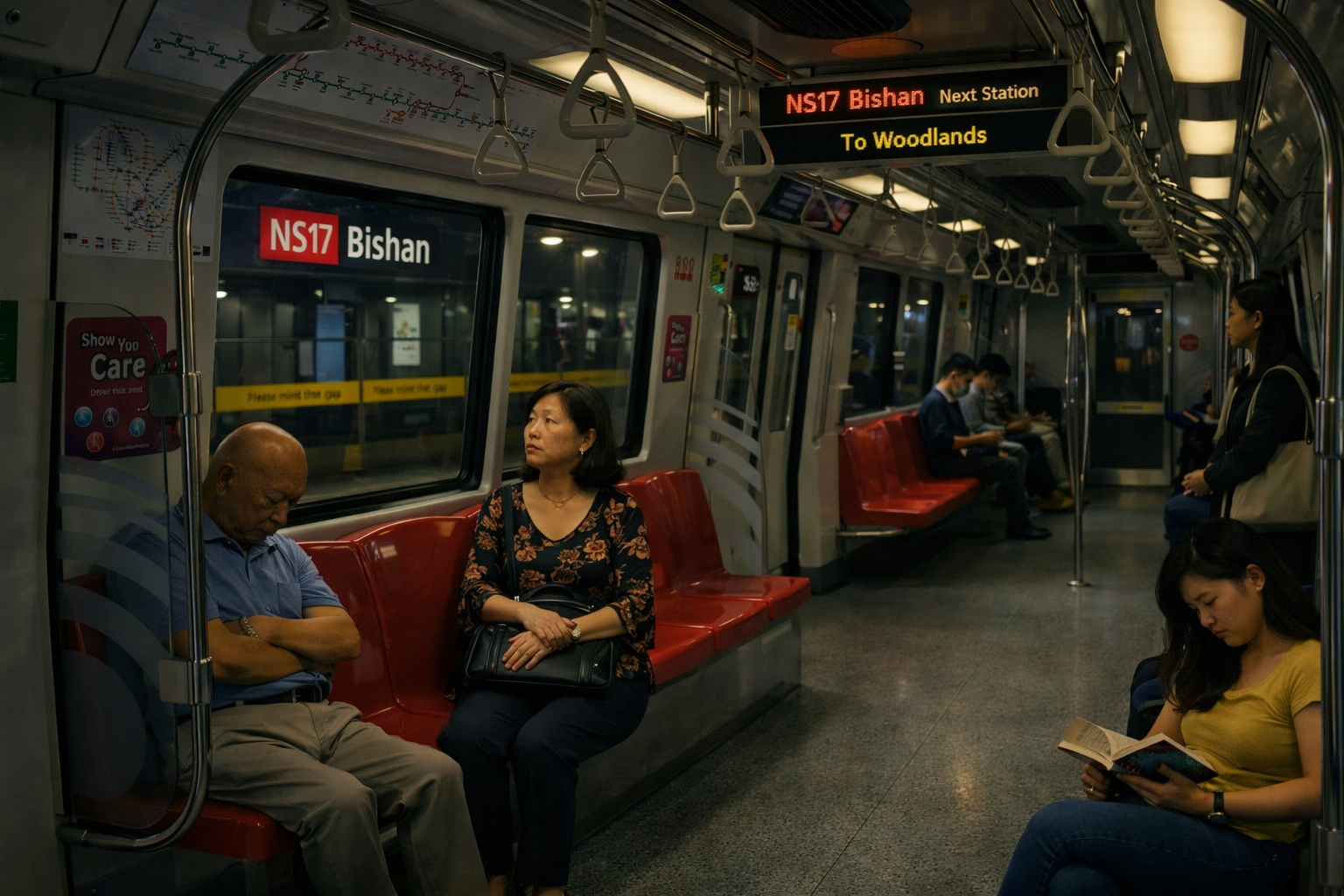
Just before midnight, Singapore becomes a city of people going home. The office towers in Raffles Place dim one floor at a time. Restaurants along Orchard Road stack their chairs and wash down the pavement in quick bursts of water. The last shoppers leave the malls carrying small bags and tired expressions, drifting toward bus stops and train stations. But underground, the trains are still running.
Mei Lin always catches the last MRT from City Hall. By the time her shift ends, the mall where she works has grown quiet. The bright shop windows are dark now, and the music that plays all day through the corridors has finally stopped. Only the low hum of the air-conditioning remains. She moves slowly through the empty space with her cleaning cart, wiping fingerprints from railings and smoothing a damp cloth across marble floors that will shine again in the morning.
Cleaning teaches you to notice things. You notice the small evidence people leave behind: half-finished bubble tea cups, lipstick marks on paper napkins, shopping bags abandoned beside benches when someone decides they no longer want what they bought.
You notice the way teenagers gather in small circles on the floor, even when there are empty chairs nearby. And sometimes you notice the way people stand in front of the restroom mirrors longer than necessary, staring at themselves as if trying to recognise the person looking back.
At eleven forty-five, Mei Lin takes the escalator down into City Hall Station. The platform feels different at that hour. The daytime rush has dissolved, leaving only scattered commuters waiting quietly. Their footsteps echo softly against the tiled floor.
“Last train towards Jurong East arriving in two minutes.” Mei Lin boards the same carriage she boards every night and sits near the middle. From there, she can see almost everyone. Not that anyone notices her. A cleaner is easy to overlook.
Across from her sits a nurse in pale blue scrubs, her head tilted back against the window, drifting in and out of sleep. Two construction workers stand near the door speaking in Tamil, their laughter low and tired. A pair of students whispers in Mandarin, their faces illuminated by the glow of their phones.
The train pulls away from the station. Outside the window, the tunnel slides past in long dark streaks. Mei Lin watches the reflection of the carriage in the glass. Rows of passengers floating faintly against the darkness.
Public transport is a strange intimacy. Strangers sitting inches apart. Sharing the same air, the same journey, the same tiredness. Yet somehow still alone.
At the next station, two young men step into the carriage and sit opposite her. They look like office workers, white shirts slightly creased, ties loosened, but something in the way they sit suggests the day has not gone well. “I still haven’t told my mother,” one of them says quietly. “About what?” the other asks. A pause. “That I quit the bank.” The train rattles softly through the tunnel. “You quit?” his friend says. “Two months ago.” “Does she know?” The young man shakes his head. “No. She wouldn’t understand.”
Mei Lin lowers her gaze to her hands. The conversation continues in soft voices. The young man talks about expectations. About how everyone assumes your life is stable once you have the right job title. About the quiet exhaustion of waking up every morning to a life that feels slightly borrowed. “I sat at that desk every day pretending to be someone else,” he says finally. His friend studies him for a moment. Then he says quietly, “Maybe everyone is pretending.” At Toa Payoh, the train slows, and the two men step onto the platform. The doors close. The train moves again.
For the rest of the journey, Mei Lin keeps thinking about that sentence. Pretending. She has done that herself. When relatives ask what she does for work, she tells them she works in “facilities.” It sounds more respectable that way. She does not say she empties bins and wipes fingerprints from mirrors. She does not say she has watched office workers cry quietly in bathroom stalls. She does not say she has overheard countless phone calls: apologies, arguments, and quiet confessions whispered into phones late at night. There are many things people do when they think no one is watching. And she has watched them all.
At Bishan, a woman in a beige blouse sits beside her and begins speaking softly on the phone. “I think I’m going to disappear for a while,” she says. Her voice is calm. Too calm. Mei Lin glances sideways without turning her head. The woman listens for a moment. “No, nothing dramatic,” she says quietly. “I just need to step away from everything.” A pause. “Yes,” she says finally. “I’m tired of pretending.” When the call ends, she stares silently at the dark window. The reflection of the carriage floats across the glass: tired faces drifting through the tunnel like ghosts. So many people moving quietly through the night.
The next evening, Mei Lin boards the last train again. Same carriage, same seat. Across from her sit two young office workers talking loudly. “I swear,” one of them says, scrolling through his phone, “some people just give up in life.” His friend laughs. “Yeah. That’s how they end up cleaning floors or something.” Mei Lin looks down at her hands. The skin is rough from years of detergent and disinfectant. For a moment, the familiar flicker of embarrassment rises. Then she remembers something. Every night, she sees things these men will probably never notice.
The nurse falling asleep after a twelve-hour shift, the migrant workers sharing food from the same plastic container, the teenagers whispering dreams they have not yet told their parents, and the quiet kindness of someone offering a seat to a stranger. She sees the city not as it pretends to be: efficient, successful, and endlessly moving forward, but as it truly is. A thousand private lives brushing past each other in silence. At the next station, the doors open again.
Across the carriage sits the woman from the phone call the night before. This time, she is drinking bubble tea and scrolling through her phone. Alive. Ordinary. Just another passenger on the last train. Their eyes meet briefly. For a moment, Mei Lin hesitates. In twelve years, she has never spoken to anyone on the train. She has only listened. Only observed. But tonight something shifts. Perhaps it was the young man who left the bank. Perhaps it was the quiet confession on the phone. Or perhaps it is simply the realisation that the city is full of people pretending to be fine.
She leans slightly toward the woman and says gently, “Long day?” The woman looks up, surprised. Then she smiles. “Yes,” she says.
The train hums softly through the dark tunnel. For a while, they sit in companionable silence as the carriage rocks gently along the tracks. Outside the window, their reflections drift together in the glass. Just before midnight, Singapore becomes a city of people going home. And sometimes, somewhere between one station and the next, two strangers remember that even in a crowded city, loneliness does not always have to travel alone.

