Sringeri Saradha Peetham

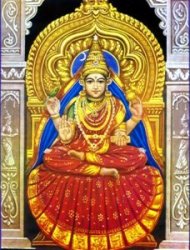
sharadamba

Sharadamba, the reigning deity in Sringeri

Since today is Vijaya Dashami or Dushera, I thought it was appropriate to post this long overdue post today.

My family (both paternal and maternal) have long been followers of the Sharadha Peetham which is based in Sringeri, in the southern state of Karnataka.

1200px-vidyashankara_temple_at_shringeri

The main Sharada temple in Sringeri

Before I say more about this Peetham, let me backtrack about its existence. This Peetham was established by the founder of what we know as Hinduism or what we call the Santana Dharma (or a code of ethics, a way of living through which one may achieve moksha which is enlightenment or liberation) Jagadguru Sri Adi Shankara Bhagavatpada. The Sringeri Peetham is the first of the four Amnaya Peethams established at Sringeri more than twelve centuries ago, around 800 AD to foster the sacred tradition of Sanatana Dharma. The other peethams are located in Dwaraka (Gujarat), Govardhana (Odisha) and Jyotirmath (Uttarakhand).

Tradition has it that after the Acharya had dispersed all the non-Vedic creeds prevailing in the country, He was on the look-out for a convenient and holy place where he could establish an institution to spread the truths of Advaita Vedanta. When the Acharya came to Sringeri, he saw an unusual sight on the banks of the Tunga. A cobra was seen spreading out its hood over a frog in labour pains, to give it a shadow from the scorching mid-day sun. Struck with the sanctity of the place, which could infuse love between natural adversaries, the Acharya chose this very location to establish His first Math.

guruparampara_wallpaper

The unbroken guru parampara with the current and next Shankaracharyas

The Acharya came across many virtuous people at Sringeri and taught them the doctrine of Advaita. He then invoked the Divinity of Knowledge, Goddess Sharada and consecrated an icon of the Goddess. Thus the Peetham He founded at Sringeri in South India for fostering the Vedas and the sacred tradition of Sanatana Dharma came to be known as the Dakshinamnaya Sri Sharada Peetham.

The Acharya appointed his prime disciple, Sri Sureshwaracharya as the first Acharya of the Peetham. Since then, the Peetham has been blessed with an unbroken Guru Parampara, a garland of spiritual masters and Jivanmuktas representing Sri Adi Shankaracharya. The succeeding Acharyas have led a life of such austere penance that it has led disciples to adore in them the radiance of Sri Adi Shankara Himself.

Besides being a centre of spiritual power, Sringeri also came to be known as a great place of traditional learning owing to the presence of Goddess Sharada and the erudition of the Acharyas of the Peetham. The Acharyas were instrumental in bringing forth commentaries on the Vedas and in further expounding the Bhashyas of Sri Adi Shankaracharya. The Acharyas also wrote a number of independent works related to Advaita besides producing a number of hymns underlining their ardent devotion to the non-dual Supreme worshipped in multifarious forms. The Peetham thus came to be regarded as the Vyakhyana Simhasana, The Throne of Transcendental Wisdom. Many regard Goddess Sharada Herself to be moving in the form of the presiding Acharya of the Peetham.

In the 14th century, royal patronage to the Peetham began with the founding of the famous Vijayanagar empire under the divine guidance of the 12th Acharya, Jagadguru Sri Vidyaranya. The austerity of the Acharya influenced the rulers to such an extent that they began ruling in the name of the Acharya and granted the Peetham the rights over the secular administration of the land. At the rulers’ request, the Acharya began conducting a Durbar during the Navaratri festival – an occasion deemed by the rulers to honour their Guru. This durbar is conducted even today and many members of my extended maternal family still visit Sringeri to take part in the Durbar.
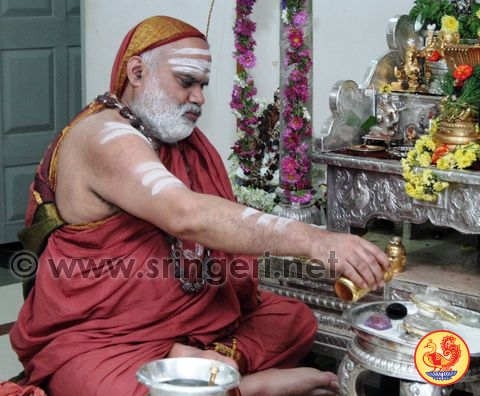
chandramouleeswara-pooja

The current pontiff Jagadguru Sri Sri Bharati Tirtha Mahaswamiji worshipping Lord Chandramoulishwara

Subsequently, the Acharya came to be known as the Karnataka Simhasana Prathisthapanacharya and the Peetham became a mighty institution – a Samsthanam and is known to this day as the Jagadguru Shankaracharya Mahasamsthanam, Dakshinamnaya Sri Sharada Peetham at Sringeri. Over the succeeding centuries, a number of empires and rulers including the Mysore Maharajahs Hyder Ali and Tipu Sultan, the Nizam of Hyderabad, the Peshwas and the Keladi rulers and Travancore Rajas were drawn towards the Peetham and respected the Acharya as their Guru.

In the recent past, the Sharada Peetham has shone through the lives of the Acharyas – Jagadguru Sri Sacchidananda Shivabhinava Nrisimha Bharati Mahaswamigal, the re-discoverer of Sri Adi Shankara’s birthplace at Kalady and the founder of the famous Pathashala at Sringeri; followed by the renowned Jivanmukta, Jagadguru Sri Chandrasekhara Bharati Mahaswamigal; succeeded by the crest jewel of Yogis, Jagadguru Sri Abhinava Vidyatirtha Mahaswamigal. They have all left indelible impressions in the hearts of the disciples.

With such a rich history associated with Sri Adi Shankaracharya’s first and foremost Peetham, many wonder at the aptness of the Acharya’s choice of locating the Peetham at Sringeri, a spot replete with a hoary past, and bountiful with natural splendour and serenity.

Today, the Sringeri Sharada Peetham bedecked with an unbroken chain of Acharyas continues to uphold the principles of Sanatana Dharma with the 36th Acharya Jagadguru Shankaracharya Sri Sri Bharati Tirtha Mahaswamiji acting as a treasure of spiritual wisdom and peace for all seekers.
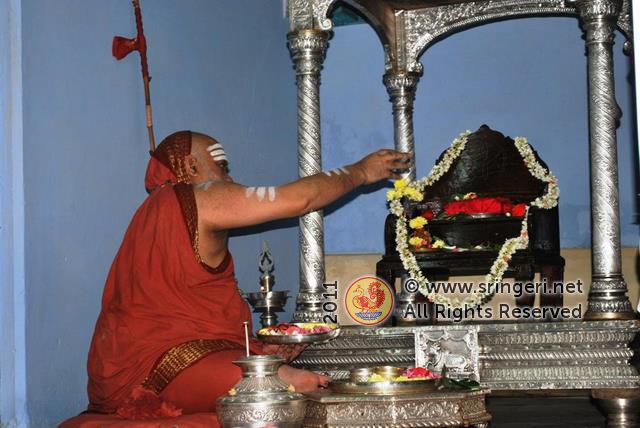
03-jagadgurus-sharada-prathishta-puja-on-the-commencement-of-navaratri

The current pontiff Jagadguru Sri Sri Bharati Tirtha Mahaswamiji worshipping 

The Sringeri Sharada Peetham site includes two major temples, one dedicated to Shiva (Vidyashankara Linga, tenth Shankara memorial) and the other to Saraswati (Sharada Amba). The Vidyashankara temple was built during the Vijayanagara Empire era (1338 CE) on a square plan set inside circles in the Tuluvas and Hoysala apsidal style. It includes shrines and relief carving in reverence of major Hindu gods and goddesses such as Brahma, Vishnu (all Dasavatara, with Buddha), Shiva, Saraswati, Parvati, Lakshmi, Ganesha, Shanmukha (Kartikeya, Murugan), Durga, Kali and others. The stone reliefs also include a large variety of Hindu legends from the epics and the Puranas.

The Sringeri Peetham is one of the major Hindu monastic institutions that has historically coordinated Smarta tradition and monastic activities through satellite institutions in South India, preserved Sanskrit literature and pursued Advaita studies. The Sringeri Peetham has been a library and a source of historic Sanskrit manuscripts. Along with other Hindu monasteries such as the Kanchi Kamakoti Peetham, the contemporary Sringeri matha has been active in preserving the Vedas, sponsoring students and recitals, Sanskrit scholarship, and celebrating annual Adishankaracharya Jayanti (gurupurnima).

sringeri

The sacred fish in the banks of the Tunga river at Sringeri

I have been to Sringeri twice so far, once for a cousin’s sacred thread ceremony and the second time in 2000, with my parents and grandfather just before he passed away. I want to make a trip there once more, this time with S, BB & GG as well as my parents so that before they get too old to make the trip, we can do this as a family trip together. Sringeri is a beautiful place and unfortunately, I don’t have the photos I took during my last trip there (pre-digital camera days).

If you ever get a chance to make a trip there, please do go there and enjoy the sereneness that is Sringeri along with getting immersed into the essence and core of the Sanathana Dharma.

The Power of Prayers

I usually start the morning with prayers to the Lord and am trying to inculcate the same with BB & GG too!

As you probably know from my posts, I am a Hindu and am also bringing up BB & GG in the same way. I am weird in the sense, though I have rock solid belief in God, I am not a very big beliver in going to temples. I firmly believe that if you believe in God and don’t go out of your way to harm someone, then even a heartfelt two minute prayer in your heart to God will give you the same results as going to the temple. You do not need the outward manifestation of your belief to God. I posted about religion some time back, but this post is more about the power of prayers.

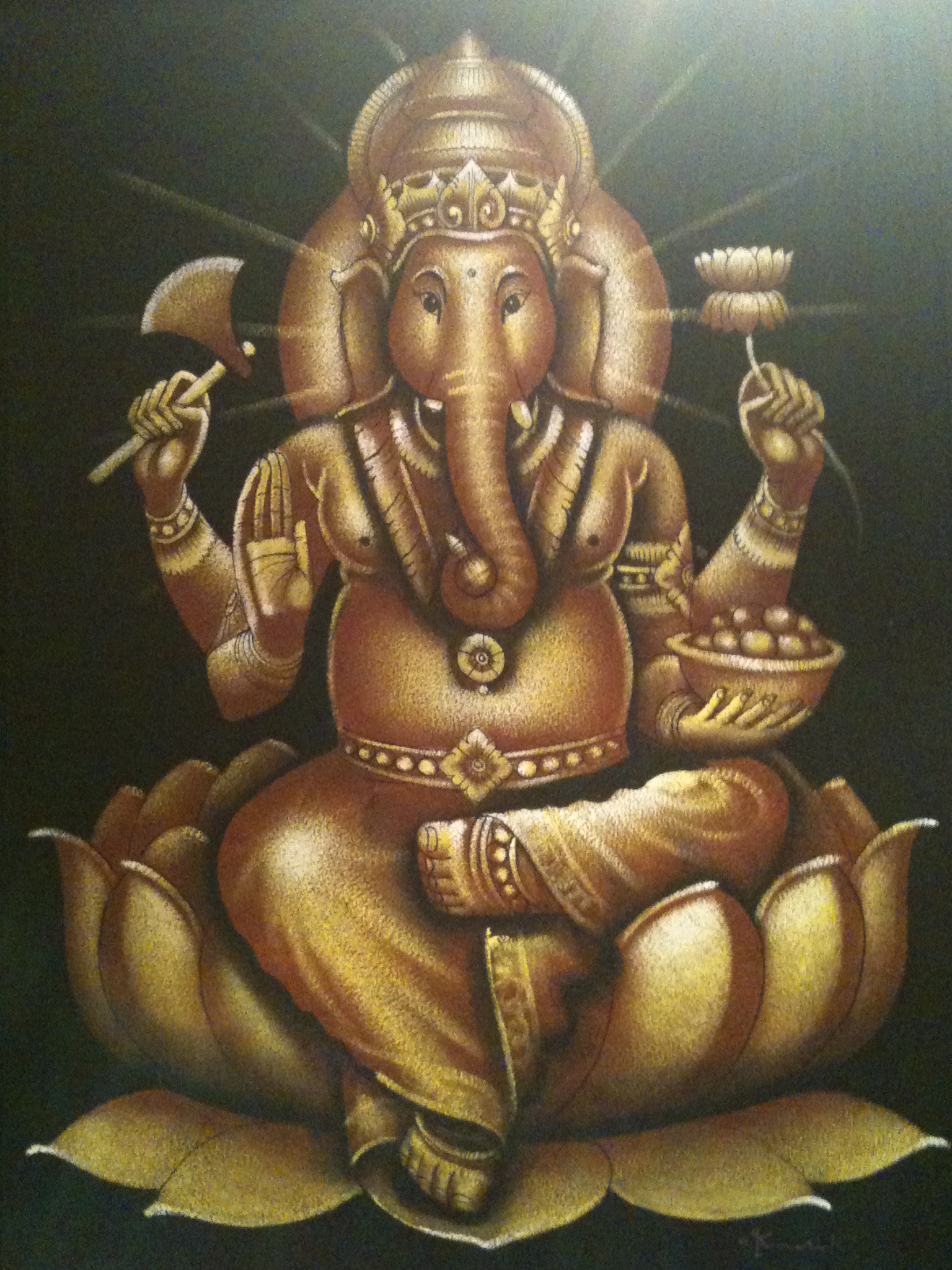
GaneshaLike I’ve said before, I have a very personal relationship with God and my personal God is the Lord Ganesh.

My daily routine is do a string of prayers in front of my altar at home. Hindus usually light the lamp in front of God twice a day and I do this in the morning after bath and in the evening after I am home. Once I light the lamp, I say my prayers. After this, I try to meditate for a couple of minutes and then have my conversation with him. The evening prayer is a much shorter one with a quick prayer after lighting the lamp. But I do have my conversation in the evening too, especially if the day has gone well for me, or I see his hand in something that happened during the say!

So does praying to God worth your while? My answer is an equivocal YES! Prayer is the vehicle with which you reach out to God or the higher divinity. It allows you to focus on the divine and helps a human being to become one with that one Universal Divine Being who can be called by various religions as their Gods!

Prayers also allow you to push your stress and desires on to your preferred God. This releases a lot of tensions in your lives when you move your stress to God! I remember there are days when my mind is full of things and I can’t sleep. Those days when I say a short prayer to Ganpati Bappa (Lord Ganesh) and tell him now it’s his responsibility to ensure that my problems are solved; I am able to sleep quite fast!

Do you believe in the divine and pray?

Random Musings

For a while now, I have been drawn to this shloka from the Mahabharat. What it means is that “You have the right to perform your actions, but you are not entitled to the fruits of the actions. Do not let the fruit be the purpose of your actions, and therefore you won’t be attached to not doing your duty”. So basically what it says is that a person should do what is it that they are supposed to be doing, but with no expectations from their deeds.

I am so drawn to this that I actually printed it out, along with the meaning in English and pasted it in my workspace – so that I am reminded of this every single minute and just do the work I am supposed to be doing, with no expectations. So no expecatations = no disappointments right?

Who am I? A question of Identity

I am all of the following – a daughter, grand-daughter, wife, daughter-in-law, mother and the myriad other relationships that we acquire as we move along in life. But at the core of all this is one identity that is uniquely me, which is ME! The ME who is a person in her own right, with an identity of her own.

This is so not Me

There are women who have no issues with going through their entire life as someone’s wife, daughter or mother. I know some women who have known each other for the last 30 plus years and still call each other as the other woman’s daughter’s mother. For me, this is something I can’t imagine. Imagine knowing someone and then not knowing or worse not acknowledging their own names – is that what life is all about? I for one refuse to call any of BB or GG’s friends moms by the names of their children. If I don’t know their names, I’ll make it a point to know it and then use that. Yes, we’re all happy and proud mom’s, but that’s not the end of our identity.

In India, most of the laws of Hindusim is governed by what is called Manusmirti or The Laws of Manu.  According to this, before marriage a woman is a subject of her father, at marriage her father passes her responsibility to her husband and if her husband dies before her, her responsibility then passes on to her son. Yet, the same Hindusim gives a woman equal rights as a man where a married man cannot undertake any religious ceremony without his wife sitting next to him and taking part in the ceremony.

Coming back to the topic, at marriage, a woman is supposed to be reborn and to ‘celebrate’ this, a new name is given to her. Some families force the new bride to taken on, formally a new name. So the name she was born with and grew up with is gone forever, and is will now be known as this new person. Her old name, harking back to carefree days is only a memory, which is taken out when she visits her maternal home. I have many friends on Facebook with multiple identities (that is have two first and two last names – pre and post marriage) who are living examples to this custom even today. This irritates me no end. Thank God I didn’t have to go through this – although knowing me, I wonder if I would have done it and whether I would have made a big fuss there and then?

This is one of the reasons I didn’t change my name when I got married (the other, more convenient reason being that I had to leave Mumbai immediately and so flew here on my maiden name and since then all official documentation has been in that name. This is the story I’m going to stick to!)

Saraswati Puja

Today is the last day of the Navaratri festival with the Saraswati Puja and Dusshera tomorrow. Then it’s the anticipation of Diwali!


Saraswati Puja is celebrated all over India and across the world today with the day being dedicated to Goddess Saraswathi. In Hinduism, Saraswathi is the goddess of knowledge, wisdom, studies, science and technology, music, arts etc. She is also said to be the consort of Lord Brahma, who is said to be the creator of the world in Hindy mythology. Goddess Saraswati is depicted as a beautiful woman wearing a spotless white saree symbolising the purity of knowledge with four hands embodying mind, intellect, ego and alertness. She is usually seated on a white lotus or a white swan which is also her vehicle of transport, with a peacock close to her. She also holds the following in her four hands – a book, which is usually the vedas representing universal, eternal and true knowledge as well as her power over knowledge and the sciences; a rudrashka or rosary representing the power of spirituality, a veena, which is a musical intrument representingin her perfection in all arts and sciences and a pot of gangajal or sacred water which represent creative adn purification powers. Unlike most Goddesses in Hindu mythology, she is usually dressed very simply and not adorned with loads of jewellery showing that she prefers the intellectual and the artistic over the material.

Saraswati is also the main goodess of the Sringeri Sarada Peetham, which is what my family has been following for generations and the Jagadguru Shankaracharya at the Sarada Peetham is whom we consider our guru. I’ll post more about this later, just is just a teaser.

In South India and our brahmin community, we worship the Goddess on the ninth day of Navaratri. On that day, after bath, we keep books and some new clothes at her feet and worship her. I made a payasam today as the prasad. On this day, children also do not look at their books since she is supposed to be sitting on them and to use them is to disrespect her. The next day, we have to read a couple of pages from each book that was kept at the pooja so that she blesses us with good intellect and the most important thing for children – marks!

I’ve kept BB & GG’s books at the altar and asked them to pray to Saraswati Ummachi (God) so that she can bless them. They both prayed “Ummachi, please bless us so that that we can study well and get good marks in our exams“.

One of the first shlokas that I learnt from my ammama and have taught GG & BB is the one about Goddess Saraswati. It goes like this:

Saraswati namasthubiyam, varade kamarupini
Vidyarambham karishyaami, siddhir bhavatume sadaa

O Goddess Saraswati, salutations to you, the giver of boons, the one who fulfills all desires. I begin my studies. May there always be accomplishments for me.

The picture in this post is the picture of Goddess Saraswati in my pooja.