In My Hands Today…

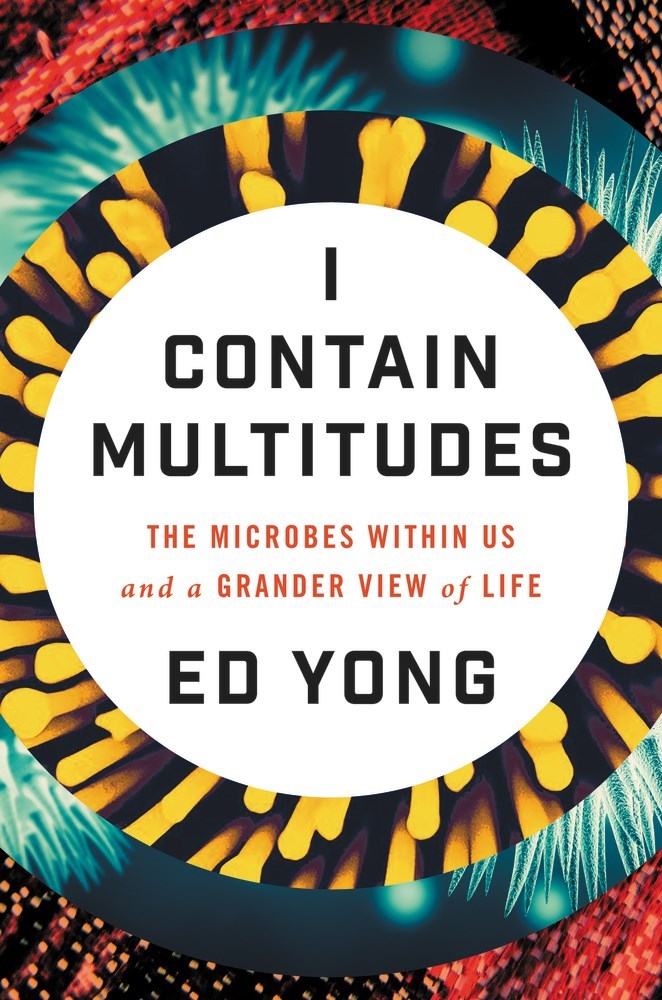
I Contain Multitudes: The Microbes Within Us and a Grander View of Life – Ed Yong

Every animal, whether human, squid, or wasp, is home to millions of bacteria and other microbes. Many people think of microbes as germs to be eradicated, but those that live with us—the microbiome—build our bodies, protect our health, shape our identities, and grant us incredible abilities. In this astonishing book, Ed Yong takes us on a grand tour through our microbial partners, and introduces us to the scientists on the front lines of discovery.

Yong, whose humor is as evident as his erudition, prompts us to look at ourselves and our animal companions in a new light—less as individuals and more as the interconnected, interdependent multitudes we assuredly are. The microbes in our bodies are part of our immune systems and protect us from disease. Those in cows and termites digest the plants they eat. In the deep oceans, mysterious creatures without mouths or guts depend on microbes for all their energy. Bacteria provide squids with invisibility cloaks, help beetles to bring down forests, and allow worms to cause diseases that afflict millions of people.

I Contain Multitudes is the story of these extraordinary partnerships, between the creatures we are familiar with and those we are not. It reveals how we humans are disrupting these partnerships and how we might manipulate them for our own good. It will change both our view of nature and our sense of where we belong in it.

In My Hands Today…

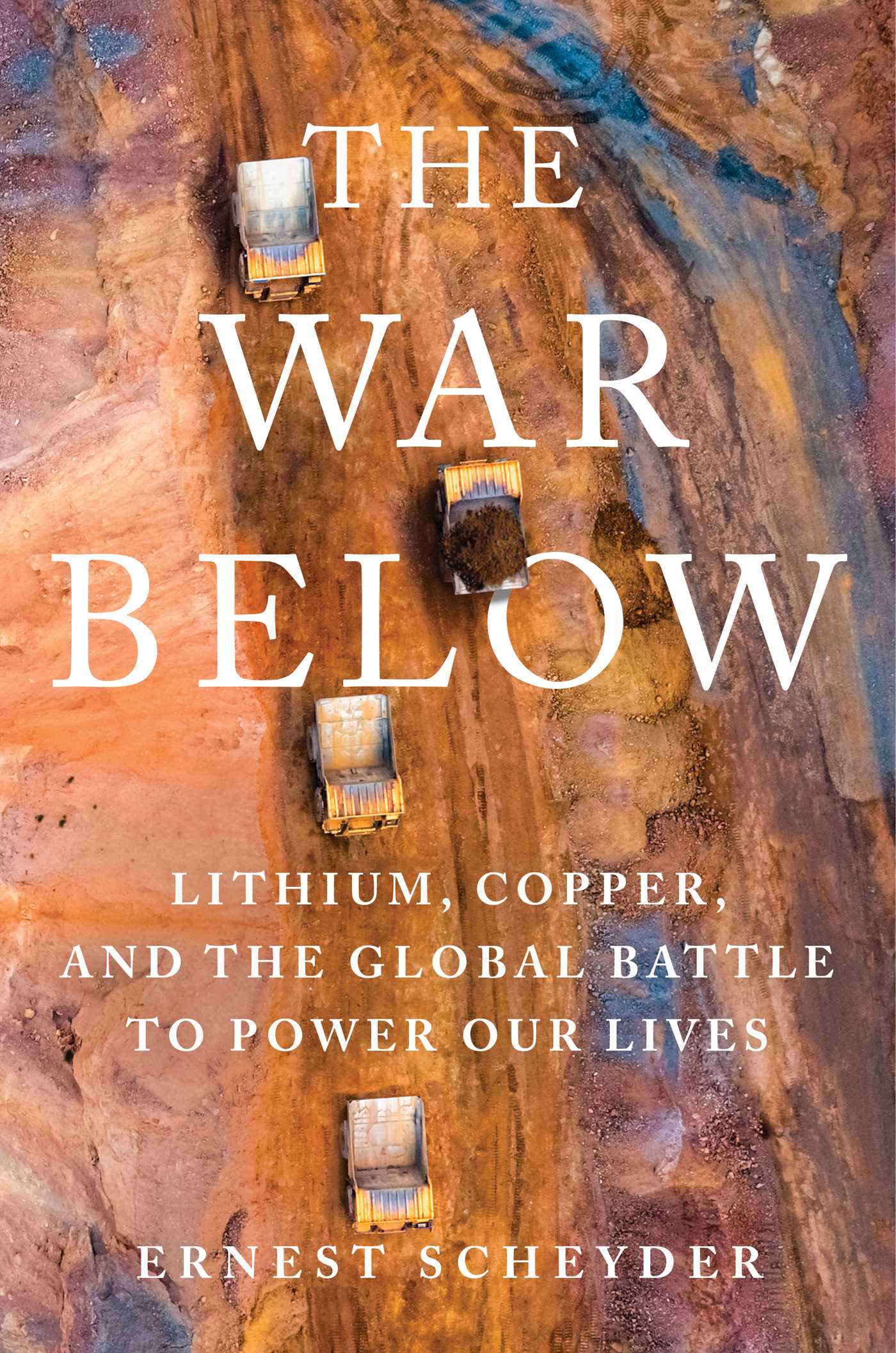
The War Below: Lithium, Copper, and the Global Battle to Power Our Lives – Ernest Scheyder

Tough choices loom if the world wants to go green. The United States and other countries must decide where and how to procure the materials that make our renewable energy economy possible. To build electric vehicles, solar panels, cell phones, and millions of other devices means the world must dig more mines to extract lithium, copper, cobalt, rare earths, and nickel. But mines are deeply unpopular, even as they have a role to play in fighting climate change. These tensions have sparked a worldwide reckoning over the sourcing of these critical minerals, and no one understands the complexities of these issues better than Ernest Scheyder, whose exclusive access has allowed him to report from the front lines on the key players in this global battle to power our future.

This is not a story of tree-hugging activists, but rather of industry titans, scientists, and policymakers jostling over how best to save the planet. Scheyder explores how a proposed lithium mine in Nevada would help global automakers slash their dependance on fossil fuels, but developing that mine could cause the extinction of a flower found nowhere else on the planet. A hedge fund manager’s attempt to resuscitate rare earths mining in California relies on Chinese expertise, exposing the paradox in Washington’s quest for minerals independence. The fight to end child labor in Africa’s mining sector is a key reason, supporters contend, to dig out a vast reserve of cobalt and nickel under Minnesota’s vulnerable wetlands. An international mining conglomerate’s plan to extract copper for electric vehicles deep beneath Arizona’s desert would destroy a Native American holy site, fueling tough questions about what matters more.

In The War Below , Scheyder crafts a business story that matters to everyone. If China continues to dominate production of these critical minerals, it will have a profound impact on the geopolitical order. Beyond China, countries such as Bolivia, Indonesia, and the Democratic Republic of the Congo aim to wield their vast reserves of key minerals. There are no easy answers when it comes to energy. Scheyder paints a powerfully honest and nuanced picture of what is needed to fight climate change and secure energy independence, revealing how America and the rest of the world’s hunt for the “new oil” directly affects us all.

In My Hands Today…

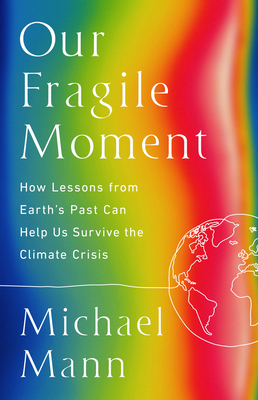
Our Fragile Moment: How Lessons from Earth’s Past Can Help Us Survive the Climate Crisis – Michael E. Mann

For the vast majority of its 4.54 billion years, Earth has proven it can manage just fine without human beings. Then came the first proto-humans, who emerged just a little more than 2 million years ago—a fleeting moment in geological time. What is it that made this benevolent moment of ours possible? Ironically, it’s the very same thing that now threatens us—climate change. The drying of the tropics during the Pleistocene period created a niche for early hominids, who could hunt prey as forests gave way to savannahs in the African tropics. The sudden cooling episode known as the “Younger Dryas” 13,000 years ago, which occurred just as Earth was thawing out of the last Ice Age, spurred the development of agriculture in the fertile crescent. The “Little Ice Age” cooling of the 16th-19th centuries led to famines and pestilence for much of Europe, yet it was a boon for the Dutch, who were able to take advantage of stronger winds to shorten their ocean voyages.

The conditions that allowed humans to live on this earth are fragile, incredibly so. Climate variability has at times created new niches that humans or their ancestors could potentially exploit, and challenges that at times have spurred innovation. But there’s a relatively narrow envelope of climate variability within which human civilization remains viable. And our survival depends on conditions remaining within that range.

In this book, renowned climate scientist Michael Mann will arm readers with the knowledge necessary to appreciate the gravity of the unfolding climate crisis, while emboldening them—and others–to act before it truly does become too late.

In My Hands Today…

Everything Is Predictable: How Bayesian Statistics Explain Our World – Tom Chivers

At its simplest, Bayes’s theorem describes the probability of an event, based on prior knowledge of conditions that might be related to the event. But in Everything Is Predictable, Tom Chivers lays out how it affects every aspect of our lives. He explains why highly accurate screening tests can lead to false positives and how a failure to account for it in court has put innocent people in jail. A cornerstone of rational thought, many argue that Bayes’s theorem is a description of almost everything.

But who was the man who lent his name to this theorem? How did an 18th-century Presbyterian minister and amateur mathematician uncover a theorem that would affect fields as diverse as medicine, law, and artificial intelligence?

Fusing biography, razor-sharp science writing, and intellectual history, Everything Is Predictable is an entertaining tour of Bayes’s theorem and its impact on modern life, showing how a single compelling idea can have far reaching consequences.

In My Hands Today…

Dinosaurs at the Dinner Party: How an Eccentric Group of Victorians Discovered Prehistoric Creatures and Accidentally Upended the World – Edward Dolnick

In the early 1800s the world was a safe and cozy place. But then a twelve-year-old farm boy in Massachusetts stumbled upon a row of fossilized three-toed footprints the size of dinner plates—the first dinosaur tracks ever found. Soon, in England, Victorians unearthed enormous bones—bones that reached as high as a man’s head.

Outside of myths and fairy tales, no one had imagined that creatures like three-toed giants once lumbered across the land. And if anyone conjured up such a scene, they would never imagine that all those animals could have vanished hundreds of millions years ago. The thought of sudden, arbitrary disappearance from life was unnerving and forced the Victorians to rethink everything they knew about the world. Celebrated storyteller and historian Edward Dolnick leads readers through a compelling true adventure as the paleontologists of the first half of the 19th century puzzled their way through the fossil record to create the story of dinosaurs we know today.