

Shaped like a teardrop, south of India, the nation previously called Serendip and Ceylon and now called Sri Lanka has been on my travel bucket list for some time now. But every time we decide to make a trip there, something happens and the trip gets postponed. But I am not going to give up hope and will get there one of these days.
Sri Lanka has been intrinsically intertwined with the mythological and historical records of India. A major portion of the mythological epic the Ramayana takes place in Sri Lanka and most, if not all Indians would have heard of this country by the time they were in their teens.
Growing up, the Tamil Tiger situation in Sri Lanka dominated the news cycle and it was pretty unanimous that this country was not very safe to travel to. Then, there was a time when Indians were not welcome there, probably because of the Indian peacekeeping forces in the island.

Sri Lanka’s documented history spans 3,000 years, with evidence of prehistoric human settlements dating back to at least 125,000 years. It has a rich cultural heritage and the first known Buddhist writings of Sri Lanka, the Pāli Canon, date back to the Fourth Buddhist council in 29 BC. Its geographic location and deep harbours made it of great strategic importance from the time of the ancient Silk Road through to the modern Maritime Silk Road.
One of the first written references to the island is found in the Indian epic Ramayana, which provides details of a kingdom named Lanka that was created by the divine sculptor Vishwakarma for Kubera, the Lord of Wealth. It is said that Kubera was overthrown by his demon stepbrother Ravana, the powerful emperor who built a mythical flying machine named Dandu Monara. The modern city of Wariyapola is described as Ravana’s airport.
Now that we have some of the history of the country taken care of, lets go on to the more interesting part, which are the places I would love to visit in Sri Lanka. My ideal trip to this beautiful and lush country would be about ten days to a week so that I can take in as much as I can of the varied landscapes of the country. So here goes my favourite Sri Lanka destinations and spots to visit:

Sigiriya: Located near the town of Dambulla in central Sri Lanka, this ancient rock fortress is a site of historical and archaeological significance that is dominated by a massive column of rock nearly 200 metres (660 ft) high. According to the ancient Sri Lankan chronicle the Culavamsa, this site was selected by King Kasyapa (477 – 495 CE) for his new capital. He built his palace on the top of this rock and decorated its sides with colourful frescoes. On a small plateau about halfway up the side of this rock he built a gateway in the form of an enormous lion. The name of this place is derived from this structure —Sīhāgiri, the Lion Rock. The capital and the royal palace was abandoned after the king’s death. It was used as a Buddhist monastery until the 14th century and today is a UNESCO listed World Heritage Site.
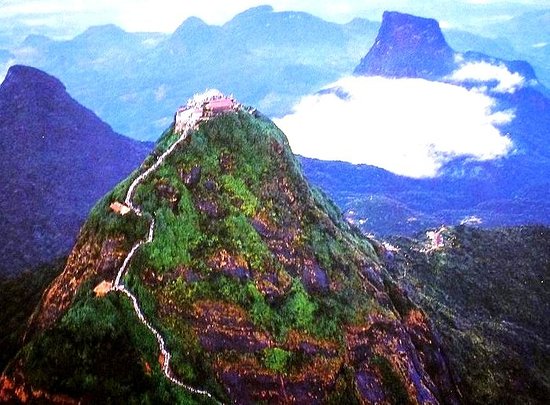
Adam’s Peak: Located in a diverse biological site, Adam’s Peak is a tall, pointed mountain in central Sri Lanka. This peak is a 2,243 m (7,359 ft) tall conical mountain, well known for the Sri Pada, i.e., “sacred footprint”, a 1.8 m (5 ft 11 in) rock formation near the summit, which in Buddhist tradition is held to be the footprint of the Buddha, in Hindu tradition that of Shiva and in Islamic and Christian tradition that of Adam, or that of St. Thomas and is a common pilgrimage route. Walking to the top in the early hours of the day will get you to see an unforgettable sunrise.

Galle: Located around 120 km from the capital Colombo, Galle is a well preserved colonial city with a well preserved fortified fort built by the Portuguese and extensively fortified by the Dutch in the 17th century. The fort is a world heritage site and is the largest remaining fortress in Asia built by European occupiers. The town is full of charming Dutch-era villas and delightful seaside views. Other good places to visit in Galle include the natural harbour, St. Mary’s Cathedral, the National Maritime Museum, St. Mary’s Cathedral founded by Jesuit priests, one of the main Shiva temples on the island, and Amangalla, the historic luxury hotel and Galle International Stadium, which is widely regarded as the most picturesque cricket ground. Important natural geographical features in Galle include Rumassala in Unawatuna, a large mound-like hill that forms the eastern protective barrier to Galle Harbour. Local tradition associates this hill with some events of Ramayana, one of the great Hindu epics.

Yala National Park: Yala National Park is the place to go to see big cats in Sri Lanka. The park is home to the highest concentration of leopards in the world, and it is also an important sanctuary for Sri Lankan elephants and aquatic birds. Monkeys, crocodiles, and other critters run around the park’s grassy plains and forest areas. The park is located on the southeast coast of the island, bordering the Indian Ocean. The area around Yala has hosted several ancient civilizations. Two important pilgrim sites, Sithulpahuwa and Magul Vihara, are situated within the park.

Polonnaruwa: Another UNESCO World Heritage Site, Polonnaruwa has very fine examples of ancient Sinhalese art and architecture. Numerous well-preserved ruins of tombs, temples, statues and other archaeological sites are located in the town. Hundreds of years ago, Polonnaruwa was a capital of the island as well as a busy commercial and religious hub. Don’t miss the historical treasures this World Heritage Site has to offer.

Kandy: Home of one of the most sacred places of worship for the Buddhists, the Temple of the Tooth holding a very sacred relic – Buddha’s tooth, Kandy was the last capital of the ancient kings’ era of Sri Lanka. Surrounded by the central highland mountains, this large city which is a World Heritage Site is the place to go to get a taste of Sinhalese culture, especially if you can visit during the Esala Perahera festival in the summer.

Nuwara Eliya: Another plateau town surrounded by mountains is Nuwara Eliya, also known as Little England for its old British colonial buildings like the Queen’s Cottage and the General’s House. The area holds many natural beauties, like waterfalls, hills, tea plantations, and the towering Pidurutalagala, the tallest mountain in Sri Lanka. Nuwara Eliya is one of many tea plantation areas in Sri Lanka, but it is regarded as the most important spot for tea production in the country.

Pinnawala Elephant Orphanage: Gaze at the adorable faces of baby elephants bathing in the river at Pinnawala Elephant Orphanage. The orphanage was founded in 1975 to feed and nurse wild orphaned elephants found abandoned in the forests of Sri Lanka. An elephant breeding program was launched at the facility in 1982, and as of 2012, there were 78 elephants living at the site.

Dambulla: This large town has the largest and best-preserved cave temple complex in all of Sri Lanka, holding five cave temples containing a huge collection of Sri Lankan Buddhist artwork, including statues, shrines, and murals. The paintings and statues tell stories from Buddha’s life—there are a whopping 153 Buddha statues created over 2,000 years ago and very well preserved till date throughout the complex. Other statue subjects include Sri Lankan kings, gods, and goddesses. The amazingly crafted murals cover a total area of 2,100 square meters. Various kings have contributed to this magnificence over the centuries, and King Nissanka Malla had the cave interiors gilded – thus earning the temple earned its name, Rangiri Dambulu (Golden Temple of Dambulla), now a UNESCO World Heritage site.

Anuradhapura: The city of Anuradhapura was the first ancient capital of Sri Lanka, and it is still a sacred Buddhist religious centre. It lies around 200 kilometres (124 miles) north of Colombo, the current capital. Buddhist worshippers and pilgrims visit the well-preserved ruins of the temples and religious centres along the bank of the river Malwathu Oya year-round. The city is also home to one of the largest and most sacred Bodhi trees in Sri Lanka, believed to be a descendant of the Bodhi tree where Buddha was illuminated. Anuradhapura became a UNESCO World Heritage Site in 1982.
While researching for this post, I’ve now realised that any trip to Sri Lanka can’t and should not be lesser than a minimum of two weeks so that we can soak up everything this beautiful country has to offer. I am now really yearning to visit this country, what about you?
 The Buckwater family live side-by-side with their Ceylonese staff in a house nestled in the lush hillside tea estates of ’30s Ceylon. Premawathi is their cook and housekeeper. She has two beautiful daughters and a son, Chandi, who even at four-years-old is bright, inventive and more mischievous than his young harried mother can sometimes cope with.
 Anil’s Ghost transports us to Sri Lanka, a country steeped in centuries of tradition, now forced into the late twentieth century by the ravages of civil war. Into this maelstrom steps Anil Tissera, a young woman born in Sri Lanka, educated in England and America, who returns to her homeland as a forensic anthropologist sent by an international human rights group to discover the source of the organised campaigns of murder engulfing the island. What follows is a story about love, about family, about identity, about the unknown enemy, about the quest to unlock the hidden past–a story propelled by a riveting mystery. Unfolding against the deeply evocative background of Sri Lanka’s landscape and ancient civilisation, Anil’s Ghost is a literary spellbinder–Michael Ondaatje’s most powerful novel yet.
 The epic tale of victory and defeat… The story of the Ramayana had been told innumerable times. The enthralling story of Rama, the incarnation of God, who slew Ravana, the evil demon of darkness, is known to every Indian. And in the pages of history, as always, it is the version told by the victors that lives on. The voice of the vanquished remains lost in silence.
 On December 26, 2004, Rob, Paul, Matty, and Rosie Forkan, ages 8-17, lost their parents in the tsunami that devastated Sri Lanka. They faced a 124 mile trek to get home to safety. The ingenuity, and resilience they displayed was the result of their unusual upbringing.
 Memories and Such
