
I just finished reading Colin Thubron’s ‘To a Mountain in Tibet’ and the book reignited one of my life bucket lists. The book is an account of his travel from Kathmandu to the foothills of the sacred and mystic mount Kailash, which is revered by Hindus , Buddhists, Jains and the followers of the Bon religion. Hindus believe that Kailash is the earthly incarnation of the mystical mount Meru, which is the supposed to be the centre of the universe in Hindu mythology. Buddhists and Jains also believe in the sanctity of mount Meru and therefore Mount Kailash and so for members of all three religions, circumambulating or doing a parikrama of the mountain will wash off all sins. Hindus also believe that Lord Shiva, the Destroyer, one of the three Gods who form the trinity of the Hindu pantheon, also resides at the top of Mount Kailash.
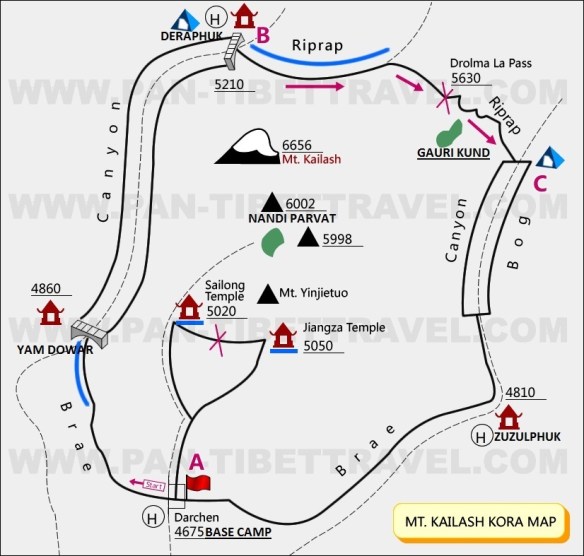
Mount Kailash Parikrama Map. Source
This post is neither about the book nor about Hindu mythology. What it is instead is about Mount Kailash and Manasarovar Lake. Ever since I’ve heard of these two places, I want to go there. Both are in Tibet, which is now in China. But most importantly, both are at very high altitudes, around 15,000 feet above sea level. For someone born, brought up and living in areas which are at sea level, I need to be extremely fit to attempt climbing this high, for my lungs to be able to cope. I still want to do this, preferably before I am too old, but one can only hope.
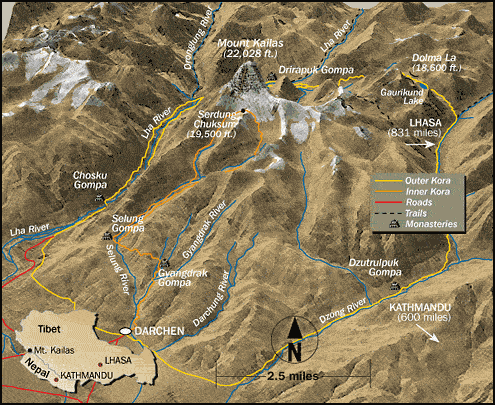
Mount Kailash is extremely ancient, even predating the Himalayas according to the book. The mountain is probably an island in the ancient Sea of Tethys which was what the whole Tibetan plateau was before the Indian subcontinent (India was a continent then) collided with what is now the rest of Asia, the tectonic shift that was caused gave birth to the Himalayas. It is said, even today, fossils of marine animals can be found in Tibet. The four faces of the mountain also correspond to the four cardinal points and four of India’s rivers, Ganges, Sutlej, Brahmaputra and Indus also originate close to the base of the mountain.
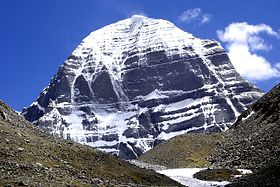
North face of Mount Kailash Source
The Indian government has a lottery where certain people get selected for the Kailash Manasarovar Yatra which is a pilgrimage officially sanctioned by the government and which enters Tibet through India. This trip is a longish one, through Himachal Pradesh and so pilgrims have a chance to slowly acclimatise themselves for the high altitudes. But I’ve heard that it’s quite difficult to get into this pilgrimage and also many people drop out during the process. You can also do this via private operators, most who are based in Nepal. I understand they fly you directly to Tibet from Kathmandu (huge amounts of elevations in altitudes in a matter of hours) and then you use vehicles to get as far as you can, and the balance is done by foot.
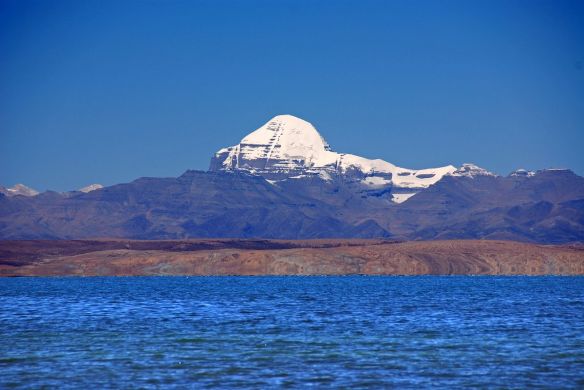
Manasarovar Lake with Mount Kailash in the background. Source
Manasarovar Lake and Rakshas Tal are two lakes found in the base of the Kailash Mountains. They lie around 15,000 feet above sea level. Manasarovar is a fresh water lake, probably one of the largest at that elevation. Rakshas Tal, which lies next to it is, however, a salt-water lake and there’s a natural channel which connects the two of them. Hindu mythology has this lake as a manifestation of Lord Brahma’s mind and so is quite sacred. It is said, anyone drinking the water of this lake will be cleansed from sin over a hundred lifetimes.

Yam Dwar or Lord Yama’s Door. Source
The first step or the start of the parikrama is a small door called Yama Dwar or Lord Yama’s door. Lord Yama is the Lord of Death (like the Grim Reaper in western thought) and the reasoning is that by going through this door, you get reborn. Another reason is that all of us have sinned at some point in time in life and it’s only a newborn who is pure of heart. So when you are reborn, you become pure and can complete the circuit without much difficulty.
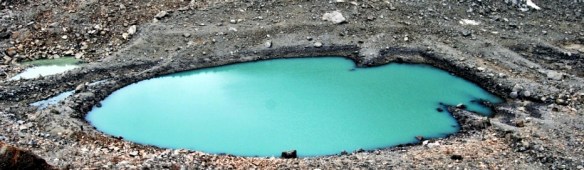
Gouri Kund Source
Then you start the parikrama. It is said a very fit person can complete it in 15-16 hours, but realistically speaking, for a normal person, not used to the high altitude and thin air, it should take at least two to three days to complete it, taking into account frequent rest stops on the way plus a camp at night. The average altitude for the parikrama is around 16,500 feet. You also see the Gouri Kund along the parikrama. This freshwater lake can be found during your descent from the Dolma Pass and is said to be a sacred place where Goddess Parvati seduced her husband and also the place where the Sky Dancers or Dakhinis in Tibetan mythology play and take bath in.
I loved writing this post and this has really allowed me to live through a virtual pilgrimage. I hope that in the near future before I am too old, I can actually do this physically as opposed to living it virtually!

 Troubled Pilgrimage: A Passage to Pakistan is about a journey by the author, a retired Canadian diplomat, who is visiting his ancestral land of Sindh and Punjab in Pakistan, the first visit since he was five. Bhaneja’s Hindu family had to leave their homeland following the Partition of the Indian subcontinent in August 1947.
 India’s Westernized elite, cut off from local traditions, ‘want to write a full stop in a land where there are no full stops’. From that striking insight Mark Tully has woven a superb series of ‘stories’ which explore Calcutta, from the Kumbh Mela in Allahabad (probably the biggest religious festival in the world) to the televising of a Hindu epic. Throughout, he combines analysis of major issues with a feel for the fine texture and human realities of Indian life. The result is a revelation. ‘The ten essays, written with clarity, warmth of feeling and critical balance and understanding, provide as lively a view as one can hope for of the panorama of India.
 Twenty-one-year-old Christina Lamb left suburban England for Peshawar on the frontier of the Afghan war. Captivated, she spent two years tracking the final stages of the mujaheddin victory over the Soviets, as Afghan friends smuggled her in and out of their country in a variety of guises.
 Memories and Such