A VUCA World and how it impacts us

The past few years have shown us in no uncertain words how volatile our world is. Every week brings new changes and most of us are unable to make any plans because we don’t know what next week will bring us.

This is encapsulated very well in the acronym VUCA which stands for Volatile, Uncertain, Complex and Ambiguous which stands for what our world is today. First used in 1987, the acronym draws on the leadership theories of Warren Bennis and Burt Nanus, to describe or to reflect on the volatility, uncertainty, complexity and ambiguity of general conditions and situations. The U.S. Army War College introduced the concept of VUCA to describe the more volatile, uncertain, complex and ambiguous multilateral world perceived as resulting from the end of the Cold War and more frequent use and discussion of the term VUCA began from 2002. It has subsequently taken root in emerging ideas in strategic leadership that apply in a wide range of organizations, from for-profit corporations to education.

The deeper meaning of each element of VUCA serves to enhance the strategic significance of the VUCA foresight and insight as well as the behaviour of groups and individuals in organisations. It discusses systemic failures and behavioural failures, which are characteristic of organisational failure.

V stands for Volatility which is the nature and dynamics of change, and the nature and speed of change forces and change catalysts. It refers to the speed of change in an industry, market or the world in general. It is associated with fluctuations in demand, turbulence and short time to markets and it is well-documented in the literature on industry dynamism. The more volatile the world is, the more and faster things change.

U is Uncertainty or the lack of predictability, the prospects for surprise, and the sense of awareness and understanding of issues and events. Uncertainty refers to the extent to which we can confidently predict the future. Part of the uncertainty is perceived and associated with people’s inability to understand what is going on. Uncertainty, though, is also a more objective characteristic of an environment. Truly uncertain environments are those that don’t allow any prediction, also not on a statistical basis. The more uncertain the world is, the harder it is to predict.

C means Complexity which is the multiplex of forces, the confounding of issues, no cause-and-effect chain and confusion that surrounds organisations. It refers to the number of factors that we need to take into account, their variety and the relationships between them. The more factors, the greater their variety and the more they are interconnected, the more complex an environment is. Under high complexity, it is impossible to fully analyse the environment and come to rational conclusions. The more complex the world is, the harder it is to analyse.

And lastly, A stands for Ambiguity which encompasses the haziness of reality, the potential for misreads, and the mixed meanings of conditions and the cause-and-effect confusion. These elements present the context in which organizations view their current and future state, present boundaries for planning and policy management and come together in ways that either confound decisions or sharpen the capacity to look, plan and move ahead. It points to a lack of clarity about how to interpret something. A situation is ambiguous, for example, when information is incomplete, contradicting or too inaccurate to draw clear conclusions. More generally it refers to fuzziness and vagueness in ideas and terminology. The more ambiguous the world is, the harder it is to interpret.
The particular meaning and relevance of VUCA often relate to how people view the conditions under which they make decisions, plan forward, manage risks, foster change and solve problems. In general, the premises of VUCA tend to shape an organisation’s capacity to anticipate the issues that shape, understand the consequences of issues and actions, appreciate the interdependence of variables, prepare for alternative realities and challenges and interpret and address relevant opportunities. For most organisations, VUCA is a practical code for awareness and readiness.

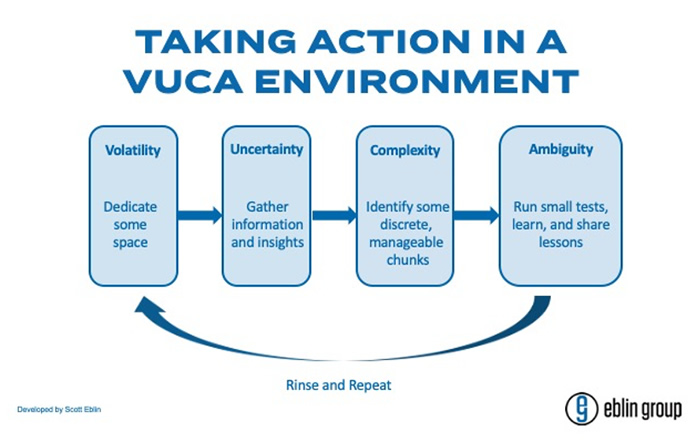
So how can we try and navigate a VUCA World? Though it may seem inescapable in certain situations and industries, one can use it to advantage. The key to managing is to break VUCA down into its parts and to identify volatile, uncertain, complex, or ambiguous situations. Each type of situation has its causes and resolutions, so one should aim to deal with one at a time.

  • Counter volatility with vision. Accept and embrace change as a constant and don’t resist it.
  • Create a strong, compelling statement of objectives and values, and develop a clear, shared vision of the future. Have flexible goals which can be amended quickly.
  • Meet uncertainty with understanding which can help understand and develop new ways of thinking and acting in response to VUCA’s elements.
  • Make investing in, analysing and interpreting business and competitive intelligence a priority, so that one doesn’t fall behind. Stay up to date with industry news, and listen carefully to find out what others want.
  • Review and evaluate performance. Consider what one did well, what came as a surprise, and what one could do differently next time.
  • Simulate and experiment with situations, so that one can explore how they might play out, and how one might react to them in the future. Aim to anticipate possible future threats and devise likely responses. Gaming, scenario planning, crisis planning and role-playing are useful tools for generating foresight and preparing responses.
  • Communicate clearly because in complex situations, clearly expressed communication help to understand direction.
  • Develop and promote collaboration. VUCA situations are often too complicated for one person to handle, so strong teams that can work effectively in a fast-paced, unpredictable environment is essential.
  • Fight ambiguity with agility by promoting flexibility, adaptability and agility. Plan, but build in contingency time and be prepared to alter plans as events unfold.
  • Hire, develop and promote people who thrive in VUCA environments as these people are likely to be collaborative, comfortable with ambiguity and change, and have complex thinking skills.
  • Encourage people to think and work outside of their usual functional areas, to increase their knowledge and experience. Job rotation and cross-training can be excellent ways to improve agility.
  • Lead teams, but don’t dictate to or control them, instead develop collaborative environments and work hard to build a consensus. Encourage debate, dissent and participation from everyone.
  • Embrace an ideas culture. Reward team members who demonstrate vision, understanding, clarity, and agility.

When one is affected by VUCA, one has a choice. Either one allows VUCA to manage, overload and overwhelm them, or they accept and manage it so that they can mitigate its effects. When one decides to accept VUCA, they choose to make themselves and others less vulnerable and empower everyone to deal with uncontrollable, unpredictable forces.

World Wetlands Day

Today is the World Wetlands Day. Dating back to 1971, World Wetlands Day is an environmentally-related celebration that reaffirms the protection and love for wetlands, which are the small environments of plant life and organisms found within water bodies that bring about ecological health in abundance to not only water bodies but environments as a whole. First celebrated in 1997, World Wetlands Day serves to recognise the influence and positive production that Wetlands have had on the world and in terms brings communities together for the benefit of Mother Nature. This day also raises global awareness because wetlands play a significant role in people and on the planet. The day was formally acknowledged by the United Nations on 30 August 2021as World Wetlands Day. 2 February each year is World Wetlands Day to raise global awareness about the vital role of wetlands for people and our planet. This day also marks the date of the adoption of the Convention on Wetlands on 2 February 1971, in the Iranian city of Ramsar on the shores of the Caspian Sea.

A patch of land that develops pools of water after a rainstorm would not necessarily be considered a wetland, even though the land is wet. Wetlands have unique characteristics: they are generally distinguished from other water bodies or landforms based on their water level and on the types of plants that live within them. Specifically, wetlands are characterised as having a water table that stands at or near the land surface for a long enough period each year to support aquatic plants. A wetland is a distinct ecosystem that is flooded by water, either permanently or seasonally. Flooding results in oxygen-free or anoxic processes prevailing, especially in the soils. Wetlands are considered among the most biologically diverse of all ecosystems, serving as home to a wide range of unique plant and animal species and occur naturally on every continent, except for Antarctica. The water in wetlands is either freshwater, brackish or salt water and the main wetland types are classified based on the dominant plants and/or the source of the water. Wetlands contribute several functions that benefit people and are called ecosystem services and include water purification, groundwater replenishment, stabilization of shorelines and storm protection, water storage and flood control, processing of carbon including carbon fixation, decomposition and sequestration, other nutrients and pollutants, and support of plants and animals. Wetlands also place a role in climate change mitigation and adaptation. The world’s largest wetlands include the Amazon River basin, the West Siberian Plain, the Pantanal in South America, and the Sundarbans in the Ganges-Brahmaputra delta. According to the UN Millennium Ecosystem Assessment, wetlands are more affected by environmental degradation than any other ecosystem on Earth.

Over time, human construction has led to various ecological problems affecting wetlands. Overpopulation and construction have led to a decrease in environmental conservation and total has brought issues to these lands. Many wetlands are being lost and ecologists claim that humans should recognise this dilemma before the loss of a natural filter and conserver of the world.

The theme for the 2022 World Wetlands Day is Wetlands Action for People & Nature and today the Convention on Wetlands and its Contracting Parties will launch the next World Wetlands Day campaign to scale wetlands conservation actions for people and planetary health.

Mumbai Memories

Source

A couple of days back, I was struggling to write something when I chanced upon some writing prompts. One of them stood out for me which said to write about a time when the community came together and displayed solidarity. And since I am in Mumbai right now, this prompt seemed apt to showcase the Mumbai spirit that I have witnessed.

The first experience was during the bomb blasts that shook the city in 1993. This was the first time something like this had happened. On March 12, 1993, a series of bomb blasts brought Mumbai, then known as Bombay, to a wailing stop. Twelve bombs went off within two hours and ten minutes that rocked several parts of the city, killing over 250 people. The explosions were the first large-scale coordinated terror attack to be carried out in the world and were the first terror attack where RDX was used as an explosive. The first bomb exploded in the basement of the Bombay Stock Exchange (BSE), followed by blasts in the Fisherman’s Colony in Mahim causeway, the Air India Building, Zaveri Bazaar, Hotel Juhu Centaur, Plaza Cinema, Hotel Sea Rock, Century Bazaar, Katha Bazaar, Worli and the Passport Office, over the next few hours.

My sister and I were in college then with my sister’s classmates coming from different parts of the city as it was a specialised college. There was chaos in the city and public transportation was shut down and if I remember correctly the city came under curfew. Because of the blasts, telephone exchanges were disabled or rather restricted. We could make calls to only numbers from the same exchange or possibly the next one. Educational institutions and offices all shut down and everyone was asked to go home and stay home. My sister called home in a fix because two of her classmates stayed in different parts of the city, and not at a walkable distance, so they were worried they could not get home. So we asked them to come home and my mum prepared extra food for the girls. They stayed in our home for the next two or three days until their families could pick them up. So how did the community come into the picture? Since we could not call their homes to let them know they were fine in our home, we started a phone chain. We called as many numbers as we could dial and in turn, asked them to try the girls’ numbers or if they could not get through, try to call as many people as they could and ask them, in turn, to try and call the girls homes. Everybody we called and they in turn called did this phone chain and by the end of the day, the parents of the girls knew about their whereabouts. This was the first time I saw what everyone always talks about the spirit of the city. Years later when I was working at my first job, I learnt from the old-time staff there that a bomb had blasted just meters away and they told me how they found burnt and charred pieces of flesh just outside the office complex. Everyone ran outside when heard the blast and tried to help as much as possible, both in terms of getting medical aid to those who needed it as well as food and water.

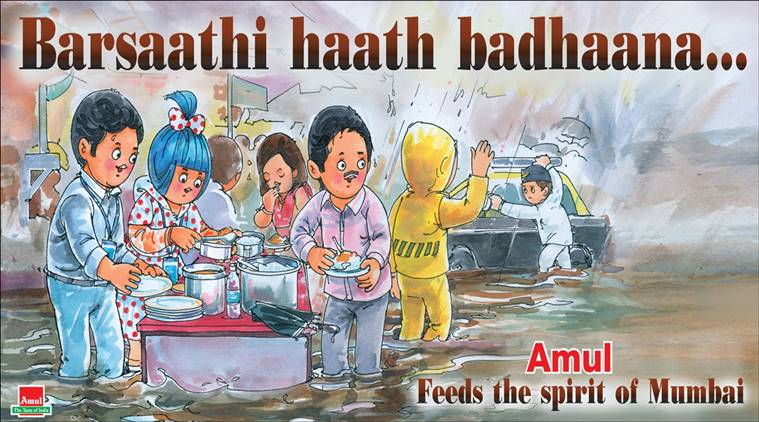
The next episode is a compilation of how people helped each other during the monsoon floodings that affect Mumbai every year. Since Mumbai is more or less reclaimed low lying land with an antiquated sewage system, inherited from the British during their rule, flooding during the monsoon season is par on course. The first one was in one of my first years of working. It had been raining for the whole day and by the time it was time to go home, the situation had become dire. I got on the bus and for some reason, fell asleep. When I woke up about 30 minutes later, I found that we were barely 10 minutes into a 30-minute journey and the bus had completely stopped. After waiting for another 10 minutes, I decided to just get off the bus and start walking. After walking for a while on a bridge, we realised that the bottom of the bridge was flooded and to add insult to the injury, there were open potholes. But then as we reached the bottom of the bridge, we found people from the nearby buildings helping those walking and walked them through the potholes, holding the hands of the elderly and those who had difficulty in walking. There were also women from the area with pots of hot tea and biscuits passing them around to the people. This was the pur Bombay spirit in action.

Another time was yet again when the rains played havoc in the city. This was either in 1999 or 2000 and I was working out of a small office of our company in south Mumbai. As before, it had started raining and the others in the office wanted to go back home. As the seniormost person in the office, I had to call the head office to get permission to leave around 2 pm. They gave us that permission after an hour after checking the situation. My sister who was also working close by suggested we take a taxi to get home and so we did. But because many areas of the city were waterlogged, we could only get as far as Dadar West, near Plaza to those who know the place. The taxi refused to move further because of the flooding and so we had to get out and walk. I remember at Khodadad Circle, the water was as high as my waist and I am not a very short person. Walking or rather wading in waist-deep water is pretty hard and by the time we got out of that area, we were exhausted. But there were so many people looking out for others during that hour-long walk that it didn’t feel so bad. A cousin who was doing an internship was stuck in Dadar station because the trains stopped running. After waiting for hours for the trains to restart, she finally called my mother and came to our home because there was no way she would make it to her house in one of the northern suburbs. Another friend who also lived in a far-flung suburb tried to get a lift from a colleague to get to a point from where she could go home was stuck in traffic for almost 7 hours with the car not moving an inch. Some people in the buildings nearby then came down and asked women and children to come up to their homes to spend the night because it would not be safe and that’s how she spent the night.

Source

I could go on and on about stories about how Mumbai’s people are super resilient and always come together, especially when there is a tragedy, but I think these stories showcase this wonderful city with a heart of gold. Mumbai is my hometown and even though I no longer live here, it will always be home and have a very special place in my heart.

Pet Peeves: Small irritations that can really annoy

You are in a restaurant or café and suddenly the person at the table next to you starts eating their food with loud noises. You instantly get triggered and irritated. That’s a pet peeve!

So what is a pet peeve? A pet peeve, pet aversion, or pet hate is a minor annoyance that an individual finds particularly irritating to them, to a greater degree than would be expected based on the experience of others. Pet peeves aren’t things that are so inappropriate and rude that they necessarily warrant taking action, but they’re generally bothersome in a way that will make one roll their eyes in frustration. While pet peeves are essentially trivial, hence the name, they are an evolutionary remnant of human beings’ survival skills. The feeling one gets when they are peeved was the body’s way of alerting a person to danger in the past, that something is wrong, triggering a flight response. They’re not as life-threatening anymore in modern society, but the discomfort remains.

The noun peeve, meaning an annoyance, is believed to have originated in the United States early in the twentieth century, derived by back-formation from the adjective peevish, meaning “ornery or ill-tempered”, which dates from the late 14th century. The term pet peeve was introduced to a wide readership in the single-panel comic strip The Little Pet Peeve in the Chicago Tribune during the period 1916–1920 and was created by the cartoonist Frank King, who also created the long-running Gasoline Alley strip. King’s “little pet peeves” were humorous critiques of generally thoughtless behaviours and nuisance frustrations.

In their book Annoying: The Science of What Bugs Us, Joe Palca and Florence Lichtman explore the history of research behind pet peeves. According to the authors, the three U’s are how we identify annoyances. The three Us are Unpleasant, which is the annoying stimulus is something we don’t like, Unpredictable because we have no way of determining when the annoying stimulus will happen and Uncertain Duration because it is repetitive and will continue for an indefinite amount of time.

The three types of annoyances are social annoyances which are caused by the violation of social norms, environmental annoyances which come from the sounds and smells of our environment and interpersonal annoyances that are caused by individuals around us, especially those with interact with frequently.

But why do we become annoyed in the first place? The truth is science hasn’t quite figured it out. According to some scientists, it could be a remnant of the evolutionary response where our brains are shocked into a focus mode when we become annoyed and we become more aware of our surroundings and pay greater attention to the stimulus that is annoying us which is nature’s way of protecting us, something that ancient man needed more than today’s humans.

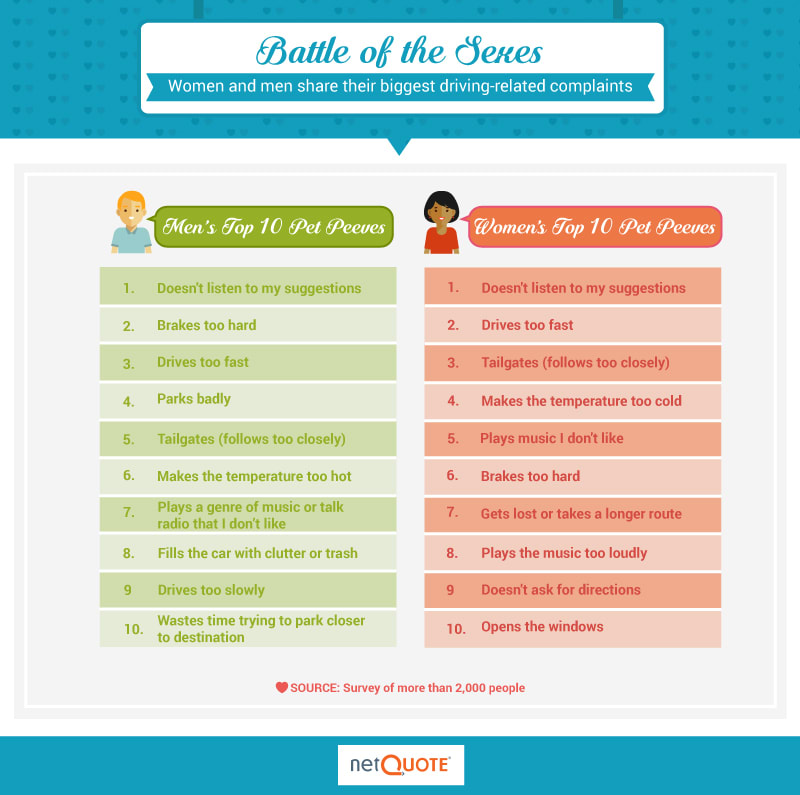
Everyone has some pet peeve or the other and here is a compilation of some of the most irritating habits that trigger most people and includes some of my pet peeves.

  • Loud chewing, people chewing with their mouths open or generally making any noises while eating.
  • Chronic lateness. As someone who is always on time, this tells me that my time is not as important as theirs. Of course, sometimes things happen, but if they don’t let me know they are late, it is even more irritating.
  • People who shuffle their feet while walking
  • The screeching of fingernails on a blackboard.
  • People who block the entrance to the train or bus and do not allow others to board or alight.
  • Those who cough or sneeze without covering their mouths.
  • People that clip their nails at work, while sitting at their desks.
  • People who walk slowly or stop suddenly in the middle of the sidewalk.
  • People who cut queues. This is not an issue in Singapore, but when I am in India, this makes me want to grit my teeth in frustration.
  • People who take ages to get through airport security and don’t know the rules even today.
  • People who stand on the left side of an escalator. Right is for standing! Left for walking!
  • Misspelling my name when it’s right there in the email staring you in the face.
  • Online stores that charge for shipping.
  • People who talk over you when you’re still in the middle of the sentence.
  • Passive-aggressive behaviour. If you have something you want to say, just say it.
  • People on public transport who will not use their headphones and instead choose to let the whole bus or train carriage their choice of music or personal conversations.
  • When people repeatedly hit the elevator button, as if that’ll make the elevator arrive sooner.
  • The reply-all that asks to be taken off of an email thread.
  • Receiving emails from a colleague with the boss copied.
  • People who abbreviate things that don’t need to be shortened.
  • Excessive public displays of affection.
  • Micro-Management at work
  • Staring at someone’s Phone
  • Standing too close to another person.
  • Talking to someone who has headphones on
  • Cracking knuckles.
  • Pushy salespeople and especially those salespeople who accost you while one is walking.
  • Being constantly pessimistic.
  • Looking at the phone during a conversation.
  • Leaving the toilet seat up.

In a perfect world, everyone would be mindful of their actions and habits not to be annoying. Sadly, some people don’t care about others and continue with their irritating ways. Instead of perpetually complaining, there are measures you can do to keep pet peeves from affecting your mood and disposition. The first thing you can do is admit what is bothersome. Being in denial and dismissive about what’s wrong will only delay the inevitable anger and frustration. It’s better to take the bull by the horns and be honest, even if it’s with yourself. Next, you can address the source of the pet peeve and open the lines of communication. This is important if the person who annoys you is someone you live or work closely with. Remember to be kind and polite when telling them. Sometimes, people are unaware of their quirks and are willing to accommodate your request. Lastly, you can choose to accept the situation that you can’t control everything. Take deep breaths when it happens or remove yourself from the area. Don’t let a simple pet peeve ruin your day.

So what are your pet peeves? Did they make my list?

The Tiara Syndrome: Something that will never happen unless you ask for it

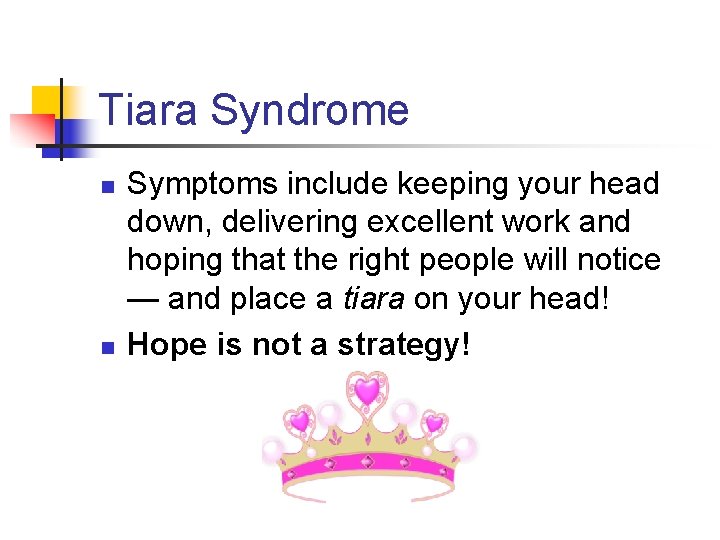
A term coined by Carol Frohlinger and Deborah Kolb, the founders of Negotiating Women, Inc, the Tiara Syndrome or the Tiara Effect is used to describe how many women approach salary and raise negotiations.

As Carol Frohlinger says, “Women expect that if they keep doing their job well someone will notice them and place a tiara on their head. That never happens.”

The fact is, most women don’t negotiate. That tiara is the recognition in the form of increased salary or pay. Women believe that they will be recognised for their value and automatically be paid what they are worth but the reality is, you have to ask for what you want. And if you don’t ask, the answer is always no.

In her bestselling book, Lean-In, Sheryl Sandberg says, “Women are also more reluctant to apply for promotions even when deserved, often believing that good job performance will naturally lead to rewards.”

Many women feel that working hard and doing a good job will be enough and the reality is that women are often extremely conscientious at delivering against their objectives. Just as at school where girls’ conscientiousness often leads to higher academic results than achieved by boys, many women believe that this same strategy will lead to success at work. However, sometimes this very diligence gets in the way of fast-tracking their careers. Many women are so so focused on doing the operational aspects of their job well that they don’t have time to step back and focus on strategic priorities and they often feel they do not have space in their busy working weeks to fit in networking which is seen as an unnecessary, and often uncomfortable, use of their precious time. In the same vein, they do not seek mentors to guide them or get the support of sponsors to give them the invaluable exposure and opportunities needed to step up to senior leadership positions.

Academic psychologist Cordelia Fine says such behaviour stems from socialisation, not innate differences between the sexes. And, of course, some men are sufferers, just as many women aren’t. But how do those who have been schooled not to boast learn to champion their cause and get over tiara syndrome?

A 2003 study of thirty-eight business students conducted University of California at Irvine discovered that 85% of the men believed that it was up to them to make sure their company paid them what they were worth. Only 17% of the women in the study believed this to be the case. The remaining 15% of the men and 83% of women assumed their worth would be determined by what their company paid them. The Tiara Syndrome only adds to the pay disparity between men and women. If we don’t ask for more pay based on our contributions, the answer is always no.

As women, we don’t negotiate. Most of us don’t negotiate our first job offer, which has been calculated to equal $500,000 over the length of her career. And all because we don’t speak up for ourselves and our worth.

So why do we women avoid negotiating? This is to a large extent because of the social conditioning females are brought up in where we are always told to be polite and quiet. Asking for money seems, greedy and rude and it is also uncomfortable. Frohlinger advises women to keep a work journal by month detailing the projects and accomplishments achieved, client kudos, amounts in new business created, or savings generated. This compelling evidence of their value to the company can be persuasively presented during a salary negotiation. Even if one gets an automatic raise annually, this substantiation of the corporate value could pay off in a larger increase. If you are stepping into a new role or moving to a new organization, don’t settle for the first offer.

Tory Johnson, the CEO of Women for Hire and Good Morning America’s career expert recommends the following for negotiating that initial offer. Start positive and get the whole compensation package in writing if it has been verbal so far. Be firm. If you have been offered a package lower than your expectations, then let them know politely with an emphasis on the skills and experience you bring to the role and ask them how much wriggle room is available. Every organisation will have a wriggle room, especially for someone they deem the best fit. Follow up especially if the hiring manager is firm on their offer. Work towards reaching an agreement, on paper, for a salary negotiation or review within a pre-determined period. Also try and negotiate on non-money aspects like vacation time, flexible working arrangements, medical benefits, etc.

What are the blocks that don’t allow extremely able women from progressing? These include insufficient impact and presence and lack of a strong personal brand, a lowered productivity and overwhelm through being pulled in too many directions at once as well as poor work-life balance, a belief that doing a good job will be enough and not seeking sponsors, discomfort with networking both internally and externally, being insufficiently strategic and too stuck in the detail, a lack of strategic career planning and reduced confidence and lack of self-belief as a leader.

If you suffer from this syndrome, here’s what you can do to overcome it:

Own your career, acknowledge that you suffer from the syndrome and come up with an action plan. If you don’t like talking about it, use technology instead. Copy your boss into relevant emails and share them on your professional social media accounts. Keep a career journal to keep a record of your accomplishments. This is great for building evidence required for negotiations, it can be confidence boosting and be useful for CVs, appraisals, and other career development opportunities. Stop comparing yourself to others and plan for and maximise the formal opportunities for negotiation, whether for a pay rise or a promotion. Build your brand and internal network. Your brand also includes managing your energetic presence, personal image and communication, including body language. Harness Your Potential which includes identifying and capitalising on strengths as well as being clear about which weaker areas are mission-critical and maximising time and energy. Creating a balance between work and other aspects of life is also vital for sustainable career success. Cultivate supportive relationships within your current work setting as well as the wider professional network, including sponsors and mentors. It is important to be able to initiate these relationships, enhance your influence and also handle difficult relationships. Focus on strategy and volunteer for strategic or extra credit projects so that you can develop an idea of the big picture. Thinking like a leader is necessary to develop a leadership mindset and this includes handling the little voice of doubt that we all have in our heads and also learning to let go of some of what we have excelled at to take on even higher level leadership tasks.

It’s naive to think that delivering excellent results is all that it takes to succeed in the workplace. The playing field is not yet equal for women; the fact is that women have to negotiate for things their male colleagues can often take for granted. In addition to the obvious issue regarding compensation, women should negotiate for high visibility assignments, the resources they need to get the job done, support from those senior in the organization and buy-in from colleagues. They should also negotiate in their personal lives for the things that will enable them to be successful in the workplace. Effective negotiation is a prerequisite to “leaning in”. As Sheryl Sandberg says, “Do not wait for power to be offered. Like that tiara, it might never materialise.” So to all the women reading this post, if you have the Tiara Syndrome, shrug it off and know that you too are worth it!