2016 Week 50 Update

Another week in Mumbai and we are now counting down to the days before we return back to Singapore and our usual, humdrum life. We leave at the end of next week. 

I will do a detailed post on the poonal, but this will have to wait till I am back in Singapore to gather my thoughts together and put it down coherently. Though I am on holiday, here I realised that I don’t even get 30 minutes to myself. The past week has been a whirl of activities – shopping for things, catching up with my aunts and grandmother and visiting Temples. I also started meeting up old friends and so time has been literally slipping from my hands!

I’ve realised one thing though this trip which never bothered me before – Mumbai is incredibly noisy! My parents’ home is right next to two schools which run on two shifts – the first from 7:30 am to 12:30 pm and the next from 1 to 6 pm. So we have to contend with not only children talking and shouting (as children are vaunt to do) but also listen to them rote learning their lessons. And during both the starts and dismissals, you have children eager to get out of school. Now this is not as bad as the noise generated by horns. I realise now that Mumbaikars love their vehicle horns. Even when there’s no one in the street they are driving on, it’s a compulsion to use the horn a couple of times. And if you are caught in a traffic jam, unless you have incredibly strong eardrums, your ears will be subjected to the incessant noises that horns generate. I’m typing a draft version of this post while waiting for some friends at a mall and there’s a free open air concert by a Bollywood singer going on. The singer is not here yet, but my eardrums are going to pay for this for sure later. I knew there was a good reason I don’t like discotheques and loud pubs….

The meeting with old school classmates was good. We spent a couple of hours talking and catching up on each other’s lives.

As an early anniversary meal, the four of us plus my parents went for lunch at a mall. The place we ate, Barbeque Nation overlooks the descent of planes into Mumbai airport and BB and S had a good time planespotting. Both specifically requested to go to this particular outlet to have the lunch as we had gone here last year too and they had a ball looking at all the planes landing and trying to figure out the airline from their tail regalia and the type of planes. 

This marked week 2.5 of ours in Mumbai. I’m meeting another friend later today and also some more friends during the week. So am looking forward to those gossip and catching up sessions too!

In My Hands Today…

Ajaya: Roll of the Dice (Epic of the Kaurava Clan #1) – Anand Neelakantan

18684615The Mahabharata endures as the great epic of India. But while Jaya is the story of the Pandavas, told from the perspective of the victors of Kurukshetra; Ajaya is the narrative of the ‘unconquerable’ Kauravas, who were decimated to the last man.
At the heart of India’s most powerful empire, a revolution is brewing. Bhishma, the noble patriarch of Hastinapura, is struggling to maintain the unity of his empire. On the throne sits Dhritarashtra, the blind King, and his foreign-born Queen – Gandhari. In the shadow of the throne stands Kunti, the Dowager-Queen, burning with ambition to see her firstborn become the ruler, acknowledged by all.

And in the wings:

  • Parashurama, the enigmatic Guru of the powerful Southern Confederate, bides his time to take over and impose his will from mountains to ocean.
  • Ekalavya, a young Nishada, yearns to break free of caste restrictions and become a warrior.
  • Karna, son of a humble charioteer, travels to the South to study under the foremost Guru of the day and become the greatest archer in the land.
  • Balarama, the charismatic leader of the Yadavas, dreams of building the perfect city by the sea and seeing his people prosperous and proud once more.
  • Takshaka, guerilla leader of the Nagas, foments a revolution by the downtrodden as he lies in wait in the jungles of India, where survival is the only dharma.

Jara, the beggar, and his blind dog Dharma, walk the dusty streets of India, witness to people and events far greater than they, as the Pandavas and the Kauravas confront their searing destinies.

Amidst the chaos, Prince Suyodhana, heir of Hastinapura, stands tall, determined to claim his birthright and act according to his conscience. He is the maker of his own destiny – or so he believes. While in the corridors of the Hastinapura palace, a foreign Prince plots to destroy India. And the dice falls…

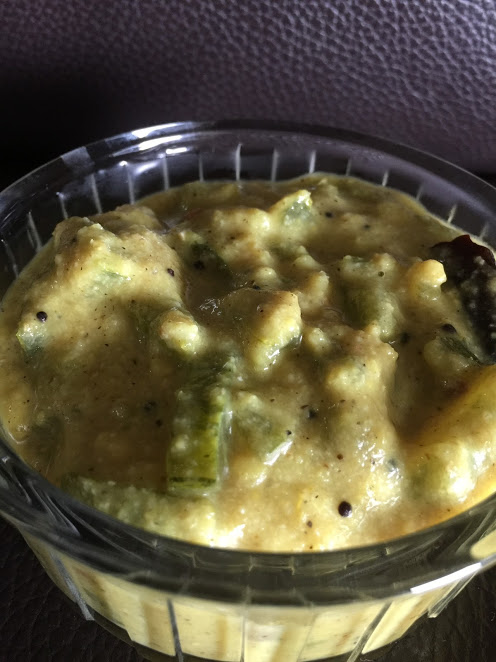
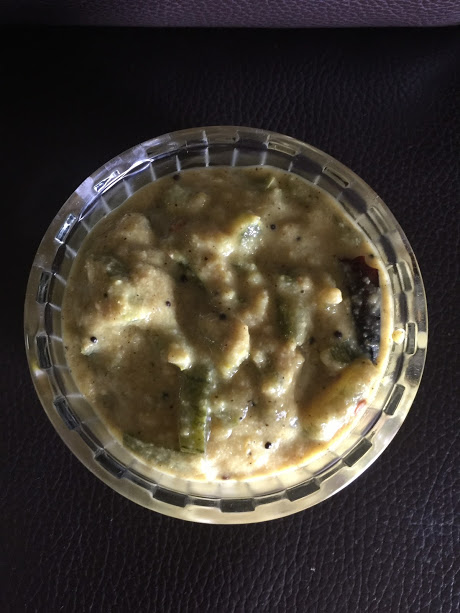
Recipe: Pudalangai Kootu aka Snake Gourd Stew

img_6189

This is a typical tambram recipe which is made in perhaps every household at some point or the other. But surprisingly I had never made it before and so when I had to make it for the Sumangali pooja, I had to rely on my tambram cooking bible – Cook and See by Meenakshi Ammal. I am reproducing the recipe as it is published. Even though I was cooking it for the first time, it was yummy and I realised, I actually liked it a lot.

This recipe is pretty standard for a kootu, in that it has the vegetable, some dal and a coconut spice blend. What was different was that instead of chillies, the coconut was blended with black peppercorn, which made the difference in taste.

img_6192

Pudalangai Kootu or Snakegourd Stew

Ingredients:

  • 2 snake gourds
  • 1 cup moong dal, washed and cooked with a pinch of turmeric powder till it is mushy
  • 4-5 tbsps grated coconut
  • 1.5 tsps peppercorns
  • 1 tsp cumin seeds
  • 1/4 tsp turmeric powder
  • 1 tsp oil
  • 1 tsp mustard seeds
  • 1 tsp split urad dal
  • 2-3 dried red chillies
  • 4-5 curry leaves
  • salt to taste

Method:

  • To chop the snake gourd, slit it lengthwise first and remove all the seeds and fibre from inside. Then cut it in half lengthwise and then into thin slices horizontally.
  • In a pan cook the snake gourd with minimum water, 1/4 tsp turmeric powder and some salt.
  • While the snake gourd is cooking, in a blender, blend the coconut, peppercorns and cumin seeds to a fine paste and keep aside.
  • When the snake gourd is cooked, but still keeping its shape, add the cooked dal to it and mix gently. Now add the coconut paste and add a bit of water if needed. Kootus are generally thick, but you can adjust the thickness of the dish as you like.
  • Check for salt and when it comes to a rolling boil, let it boil for five minutes and switch off the gas.
  • In a smaller pan, heat the oil and when it becomes warm, add the mustard seeds. When the seeds crackle, add the urad dal, asafoetida, curry leaves and dried red chillies and let the dal brown and the curry leaves become crisp. Pour this seasoning into the kootu and serve hot as an accompaniment to rice.

img_6190

img_6191

In My Hands Today…

All the Light We Cannot See – Anthony Doerr 

18143977Marie-Laure lives with her father in Paris near the Museum of Natural History, where he works as the master of its thousands of locks. When she is six, Marie-Laure goes blind and her father builds a perfect miniature of their neighborhood so she can memorize it by touch and navigate her way home. When she is twelve, the Nazis occupy Paris and father and daughter flee to the walled citadel of Saint-Malo, where Marie-Laure’s reclusive great-uncle lives in a tall house by the sea. With them they carry what might be the museum’s most valuable and dangerous jewel.
In a mining town in Germany, the orphan Werner grows up with his younger sister, enchanted by a crude radio they find. Werner becomes an expert at building and fixing these crucial new instruments, a talent that wins him a place at a brutal academy for Hitler Youth, then a special assignment to track the resistance. More and more aware of the human cost of his intelligence, Werner travels through the heart of the war and, finally, into Saint-Malo, where his story and Marie-Laure’s converge.

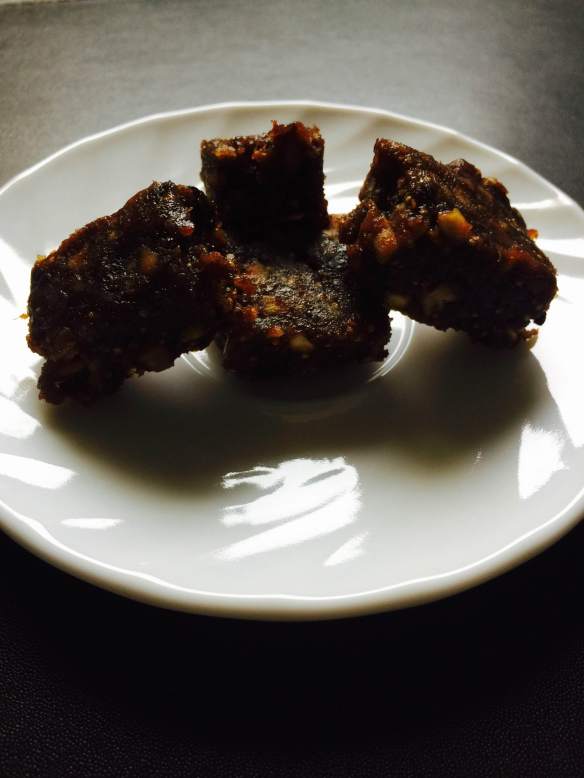
Recipe: Gulkand Dry Fruit Barfi

img_6184

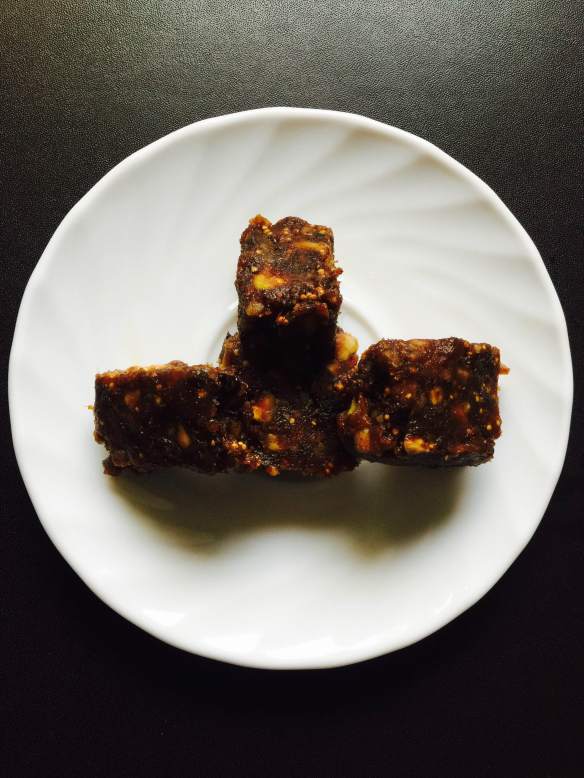
Around six months back, I brought a tub of Gulkand which is a kind of rose jam. To be honest, I was intrigued by its smell and texture and so decided to buy it. It was lying in my fridge all this time and I was wondering if I could do something with it for Diwali when I chanced upon this recipe from Archana’s Kitchen.

I made this recipe almost as it is mentioned on the page and it turned out more like a fudge rather than a barfi.It does not have any added sugars to it, with all the sugars coming from the dry fruit and the gulkand.

img_6188

Gulkand Dry Fruit Barfi

Ingredients:

  • 2 cups dry figs (anjeer), chopped
  • 2 cups dates, chopped
  • 1/2 cup almonds
  • 1/2 cups cashew nuts
  • 1/2 cups walnuts
  • 1/4 cup pistachios
  • 1/2 cup raisins
  • 2-3 tbsps gulkand
  • 1/4 tsp nutmeg powder
  • 1 tbsp ghee

Method:

  • Soak the chopped figs, dates and raisins separately in bowls of water and let them soak for around 30 minutes.
  • Strain the water from the dates, figs and raisins and grind them to a smooth paste. I added some water as my mixer was not a very strong one, but if you can do this without adding water, that is better.
  • In a food chopper, chop the cashew nuts, almonds, walnuts and pistachios into small pieces and keep aside.
  • Grease a tray with some ghee or butter and keep aside.
  • In a non-stick pan, heat the ghee and when the ghee gets warm, add the fig, dates and raisins paste and mix well and saute it for a while.
  • Now add the chopped nuts, gulkand and nutmeg powder and combine well.
  • Stir well for a couple of minutes until the mixture starts to leave the sides of the pan.
  • Once this happens, pour the mixture into the greased tray and level it well.
  • Cover the tray and when the mixture is cool, keep it in the fridge for around 30-45 minutes to firm up.
  • Cut it into smaller pieces and serve.

img_6182

img_6185

img_6183